
Can You Replace a Vacuum Power Cord? Safety Guide

Quick Answer
Yes, you can replace a vacuum power cord on many corded vacuum cleaners. The replacement must match the vacuum’s electrical requirements and original safety design. Some models require manufacturer-authorized service. If the cord has exposed wires, cracked insulation, melting, or sparking, unplug the vacuum and stop using it until it is properly repaired.
A damaged vacuum cord does not always mean you need a new vacuum cleaner. On many models, the cord is a replaceable component, although reaching its connections may require opening the housing.
The real question is whether your particular vacuum supports a safe replacement. A cord that looks like a simple cable may include molded connectors, a strain-relief system, or a retractable reel that requires special handling.
Before spending money on parts or opening the machine, you can check a few important details to decide whether replacement is practical.
When Can a Vacuum Power Cord Be Replaced?
A vacuum power cord can generally be replaced when a suitable replacement is available and the manufacturer permits the repair to be performed using an approved service procedure.
Many traditional upright and canister vacuums have cords connected inside the handle, switch compartment, or main housing. Some manufacturers provide replacement parts and service instructions for these connections.
However, cord replacement is not automatically a suitable do-it-yourself job.
- Fixed external cord: Replacement may be relatively straightforward for a qualified technician when the correct service part is available.
- Retractable cord: Replacement may involve a spring-loaded reel and internal electrical contacts, making the repair more complicated.
- Detachable power cord: Some equipment uses a removable, manufacturer-specified cord assembly that can be exchanged without opening the appliance.
- Sealed or specialized vacuum: The manufacturer may require professional service or replacement of an entire assembly.
The vacuum’s model number matters more than its appearance. Two machines from the same brand can use different cord assemblies, connectors, and internal layouts.
Find the model identification label, usually underneath or behind the vacuum, and check the owner’s manual or official support information before choosing a repair method.
How Do You Know the Power Cord Needs Replacing?
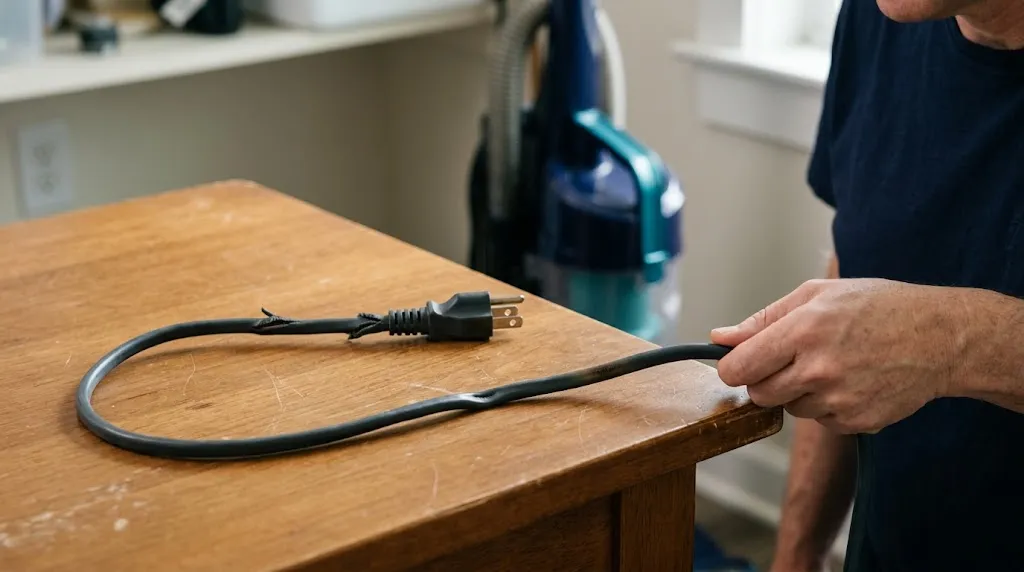
A power cord needs repair or replacement when its insulation, conductors, plug, or electrical connections are damaged. The vacuum may still operate even when the cord is unsafe.
Look for these warning signs while the machine is unplugged:
- Cracks or splits exposing inner insulation or conductors.
- Fraying where the cable enters the plug or vacuum housing.
- Flattened, crushed, or severely kinked sections.
- Scorch marks, melting, or discoloration around the plug.
- A loose plug or damaged prongs.
- Power that cuts in and out when the cord moves.
- Sparking, buzzing, or an electrical burning smell.
These symptoms deserve attention even when the vacuum’s suction remains normal.
A small surface scuff is not necessarily the same as damaged insulation. However, if you cannot confidently determine whether the outer jacket is intact, stop using the machine until the cord has been assessed.
Our guide explaining why vacuum power cords become damaged covers common wear patterns and how bending, pulling, and abrasion affect cables.
Warning
Do not wrap a split or frayed vacuum cord with electrical tape and continue using it. Tape does not reliably restore damaged conductors, the original cable construction, or strain protection. A damaged cord must be assessed and properly repaired or replaced before further use.
What Type of Replacement Cord Does Your Vacuum Need?
The correct replacement cord must be compatible with the vacuum’s electrical rating, construction, and connection system.
A similar-looking cable is not necessarily an acceptable substitute. The conductor size, insulation, grounding arrangement, and cord-entry protection all matter.
Match the electrical specifications
Check the original part number and manufacturer documentation. Relevant specifications may include:
- Voltage rating: The cord must be suitable for the appliance and supply voltage.
- Current capacity: The replacement must safely accommodate the vacuum’s electrical load.
- Conductor size: The wire gauge or cross-sectional area must meet the specified requirements.
- Number of conductors: A grounded appliance must retain its required protective grounding connection.
- Insulation and flexibility: The cable must be suitable for the intended movement, temperature, and operating environment.
- Connector and strain relief: The assembly must fit and protect the connections as originally designed.
Do not replace a grounded three-conductor cord with a two-conductor cable or remove the grounding pin to make a plug fit.
Should the new cord be longer?
Not unless the manufacturer explicitly approves the alternative length and configuration.
Installing a longer cable can affect storage, mechanical strain, and the conditions under which the appliance was evaluated for electrical safety. Workplace equipment may also be subject to additional approval requirements.
The safest purchasing approach is to use the manufacturer’s specified replacement assembly rather than selecting a generic cable based on length alone.
How Is a Vacuum Power Cord Replaced?
For a vacuum with a permanently attached cord, replacement generally involves opening the designated service compartment, removing the damaged assembly, installing the specified new assembly, and checking electrical safety before use.
The exact procedure varies by model. The following sequence explains what a proper repair involves, rather than providing universal wiring instructions.
- Disconnect the power completely. Switch off and unplug the vacuum. Never inspect or repair internal mains connections while the machine is connected to electricity.
- Confirm the correct replacement part. Match the part number and electrical specifications against the model’s service information.
- Review the manufacturer procedure. Identify whether the housing is serviceable and whether the repair is restricted to qualified personnel.
- Access the cord connection. A qualified repairer removes the appropriate covers without damaging clips, seals, or nearby components.
- Remove the damaged assembly. The original connections, protective grounding if present, cable routing, and strain-relief arrangement must be documented and handled correctly.
- Install the compatible replacement. The new cord is connected and secured according to the model-specific service instructions, without altering the original safety design.
- Reassemble and inspect. The housing must close correctly without pinching wires or leaving cable sections exposed.
- Perform electrical safety checks. Before energizing the appliance, a qualified person should verify the relevant connections, protective features, and insulation integrity using appropriate test methods.
Do not assume that matching wire colors is enough to establish correct connections. Wiring conventions and internal arrangements vary by product and region.
A useful example of the model-specific nature of the job appears in iFixit’s vacuum power cable replacement guide, which documents an involved cord-reel repair. It should not be treated as a universal procedure for every vacuum.
If you lack experience with mains electrical repairs, have the work completed and tested by a qualified appliance repair technician.
Is a Retractable Vacuum Cord Harder to Replace?
Yes. A retractable cord can be more difficult to replace because the cable is integrated with a winding reel, spring mechanism, and electrical connection system.
Unlike a basic fixed cord, a retractable assembly must allow the cable to extend and retract while maintaining its required electrical connections.
Potential complications include spring tension, worn contact components, cable routing, and limited access inside the housing.
If the cable will not retract, the fault may involve the reel mechanism rather than the cord itself. A cable that fails to supply power may have a different problem.
A qualified technician may determine that replacing the complete reel assembly is more appropriate than changing only the cable.
Do not open a spring-loaded reel without the correct service information and experience. Its stored mechanical energy can cause injury or damage.
Can You Replace Just the Plug Instead of the Whole Cord?
Sometimes. A damaged plug can potentially be replaced without replacing the entire cable, provided the remaining cord is sound and the repair restores the appliance to its approved condition.
The Occupational Safety and Health Administration’s vacuum cord interpretation explains circumstances in which a suitable replacement plug is permitted for workplace equipment.
That interpretation does not mean every consumer vacuum can accept any replacement plug. Manufacturer restrictions, approved parts, grounding, strain relief, and local requirements still apply.
A full replacement is preferable when the cable has damage along its length, internal conductor failure, or deterioration near the vacuum housing.
Do not splice household wiring into a damaged cord, make an improvised detachable joint, or attach a new plug merely to bypass damaged insulation.
Should You Repair the Cord or Replace the Vacuum?
Repair is often worth considering when the vacuum otherwise operates well, the damage is limited to the cord, and a compatible replacement is available.
Replacing the entire machine becomes more reasonable when the cord is only one of several significant defects or when safe servicing is impractical.
| Situation | Practical decision |
|---|---|
| Cord damaged; vacuum otherwise works well | Consider proper cord replacement. |
| Original replacement part is available | Request a compatible repair estimate. |
| Cord reel and other components are damaged | Compare full repair cost with replacement. |
| Internal melting or electrical damage is suspected | Stop use and request professional evaluation. |
| Manufacturer does not support safe repair | Consider replacing the appliance. |
When comparing options, account for the replacement part, labor, electrical testing, and the vacuum’s remaining useful condition.
If the machine also has repeated shutdowns, unusual motor noise, or poor suction, determine whether those problems are separate from the cord. Our guide on why vacuums shut off unexpectedly explains other possible causes.
How Can You Prevent Damage to a Replacement Cord?
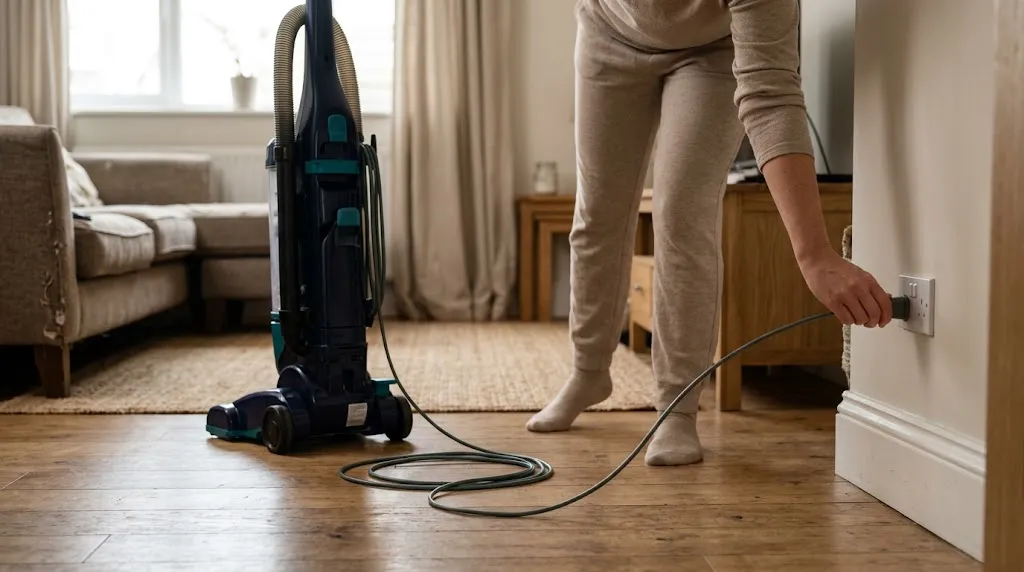
A correctly installed cord can still wear prematurely if it is repeatedly pulled, crushed, or bent sharply.
Protecting the cable during normal cleaning and storage is the best way to reduce avoidable damage.
- Unplug by holding the plug body rather than pulling the cable.
- Keep the cord away from powered brush rolls and rotating floor heads.
- Avoid trapping it beneath furniture or closing doors on it.
- Do not wrap it tightly around sharp corners or small hooks.
- Inspect the plug, cord entry, and flexible sections periodically.
- Use retractable cords according to the manufacturer’s instructions.
If the plug or vacuum housing becomes abnormally hot during use, stop operating the machine. A heating problem may involve electrical connections or other components, not necessarily the cord alone.
For related troubleshooting, see our explanation of why a vacuum may overheat.
Tip
Before ordering a cord, photograph your vacuum’s model label and contact the manufacturer’s parts or service department. Ask for the approved cord assembly and whether replacement requires an authorized technician. This helps avoid purchasing an incompatible cable.
Frequently Asked Questions
Can you replace the cord on an older vacuum cleaner?
Yes, if a compatible cord and a safe repair procedure are available. Older machines can be harder to service when original parts are discontinued or their insulation and internal components have deteriorated.
Can a vacuum power cord fail without visible damage?
Yes. A conductor or connection can fail internally while the outer insulation appears intact. Intermittent power or complete loss of power may indicate a hidden problem that requires proper diagnosis.
Will replacing the power cord fix a vacuum that will not turn on?
Only if the cord or its connections caused the failure. A faulty switch, motor, thermal protector, outlet, or internal circuit can produce similar symptoms. The actual fault should be identified before parts are replaced.
Does replacing a vacuum cord affect the warranty?
It may. Warranty coverage depends on the manufacturer’s terms, the applicable consumer law, and how the repair is performed. Check the warranty documents before opening the housing or using third-party parts.
Can you shorten a vacuum power cord instead of replacing it?
Do not shorten the cord as an improvised repair. Altering its length or plug arrangement may compromise the approved configuration. Use a manufacturer-approved repair method instead.
Can an extension cord replace a damaged vacuum cord?
No. An extension cord does not repair damaged insulation, conductors, or connections on the vacuum itself. The defective appliance cord must be properly repaired or replaced before the vacuum is used.
Conclusion
Replacing a vacuum power cord is possible on many corded vacuum cleaners, and it can make sense when the machine is otherwise in good condition. The key is finding the correct replacement assembly and following the manufacturer’s servicing requirements.
Not every damaged cord needs the same repair. A faulty plug, damaged cable, retractable reel, or internal connection may require a different solution.
If your vacuum has electrical damage, leave it unplugged until the problem has been properly assessed. A qualified repair technician can confirm whether cord replacement is safe and worthwhile. Repairing a serviceable vacuum is useful, but restoring its electrical safety must come first.
