
Can a Full Dustbin Reduce Vacuum Performance? Causes and Fixes

Quick Answer
Yes, a full dustbin can reduce vacuum performance. When accumulated dirt obstructs the airflow path or interferes with dust separation, the vacuum may lose cleaning effectiveness even though its motor still runs. Empty the dustbin at the manufacturer’s fill line, remove trapped debris, and check the filters if suction remains weak.
A vacuum that picked up crumbs easily last week may suddenly leave dirt behind. Before assuming something expensive has failed, look at the dustbin.
An overfilled collection chamber is a common and easily corrected cause of poor pickup. However, the amount of performance loss depends on the vacuum’s design, the material collected, and whether dirt is obstructing its airflow system.
Understanding that difference helps you fix the actual problem without replacing parts unnecessarily.
Why Does a Full Dustbin Reduce Vacuum Performance?
A full dustbin can weaken cleaning performance because a vacuum needs moving air to transport dirt from the floor into its collection chamber.
The motor and fan create a pressure difference that draws air through the floorhead, hose or internal passages, collection system, and filters.
When debris interferes with that pathway, the volume of air moving through the machine may decrease. The motor can continue running while the cleaning head struggles to collect dirt.
1. Accumulated debris can restrict airflow
Dust, hair, lint, and carpet fibers can collect near the dustbin inlet or other narrow passages.
Once these materials form a dense obstruction, incoming air has less room to move. Lightweight debris may remain on the floor, and larger particles may become trapped at the nozzle.
A bin does not necessarily cause immediate suction loss simply because it contains dirt. The problem becomes more significant when the debris reaches a point where it obstructs the machine’s intended airflow path.
2. Excess debris can interfere with cyclonic separation
Many bagless vacuums use cyclonic separation to move collected particles away from the main airflow.
Air spins inside a separation chamber, helping heavier material move toward the dust container while air continues through the filtration system.
When the collection area becomes overcrowded, accumulated material can interfere with this process. Depending on the design, more debris may remain near the separator or contribute to blocked internal openings.
This is why the manufacturer’s maximum fill line matters. It identifies the intended collection limit rather than simply the physical amount of dirt the container can hold.
3. Fine dust can clog filters before the bin looks full
A nearly empty-looking dustbin does not guarantee unrestricted airflow.
Fine particles from ordinary household dust can accumulate on filter surfaces. Once the filter becomes heavily loaded, air has more difficulty passing through it.
That means poor performance may continue even after the bin has been emptied.
For a closer explanation, see our guide to what happens when a vacuum filter becomes clogged.
How Can You Tell If the Dustbin Is Affecting Suction?
The strongest clue is a noticeable improvement after emptying the dustbin and clearing debris from its inlet.
Other symptoms may suggest restricted airflow, although none proves the bin is responsible on its own.
- Weak pickup: Crumbs, dust, and hair remain on the floor after normal passes.
- Repeated cleaning: Areas that previously needed one pass now require several.
- Debris trapped at the inlet: Hair or lint forms a compact clump near the dustbin opening.
- Changed motor sound: The machine sounds different as airflow resistance changes.
- Unusual warmth: The vacuum becomes hotter than normal during operation.
- Automatic shutdown: Some models stop when protective systems detect overheating or another fault.
These symptoms overlap with dirty filters, blocked hoses, and faulty attachments. Treat them as reasons to inspect the vacuum, not as a definite diagnosis.
For example, if pickup becomes weak halfway through cleaning a carpeted room, inspect the bin before continuing. If a compacted ball of hair is blocking the inlet, removing it may restore normal airflow immediately.
How to Restore Vacuum Performance After the Dustbin Fills
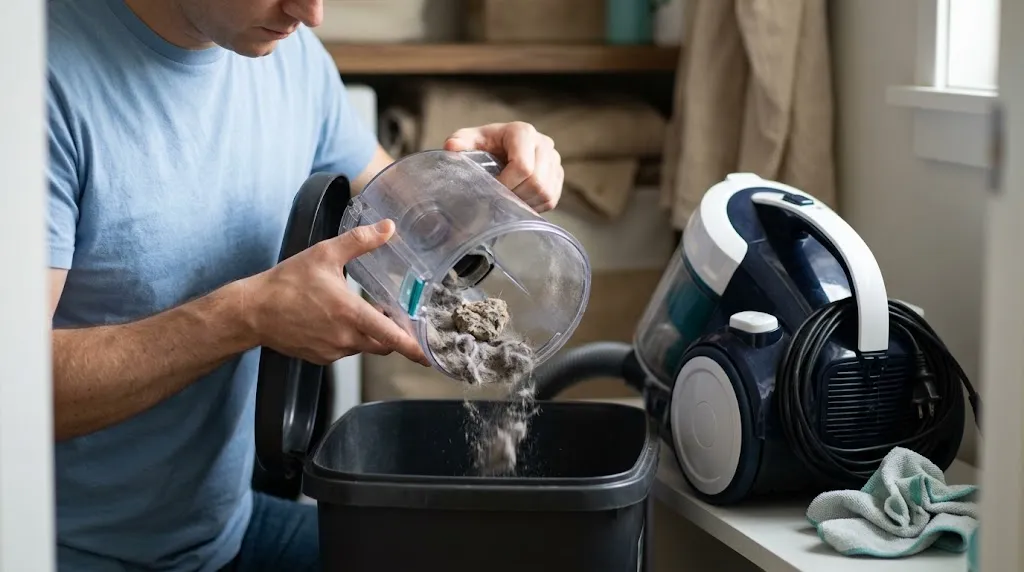
Start with the simplest maintenance checks. This sequence helps identify whether the dustbin is responsible before you investigate other parts.
- Switch the vacuum off. Unplug a corded machine or disconnect its removable battery when the manual instructs you to do so.
- Remove the dustbin. Follow the manufacturer’s release procedure without forcing the container or latch.
- Empty the contents. Hold the bin close to a trash container and release the debris. Emptying it outdoors can help limit indoor dust exposure.
- Inspect the inlet. Look for compacted hair, lint, or other material caught near the entrance or separator. Remove accessible debris gently.
- Check the dustbin seal. Make sure the door closes fully and that no dirt is trapped along the gasket or sealing edge.
- Inspect the filters. Remove loose dust and clean or replace filters only as the owner’s manual permits.
- Reinstall everything correctly. Confirm that the bin, filters, and covers are completely dry where applicable, correctly seated, and securely latched.
- Test the vacuum. Try collecting a small amount of ordinary dry household debris from an appropriate floor surface.
If pickup returns to normal, the problem likely involved the collection system, a temporary obstruction, or another issue corrected during cleaning.
If performance does not improve, avoid repeatedly running the vacuum while it appears blocked. Continue with the other airflow checks below.
Warning
Do not operate a household vacuum without its required filters or with damp components unless the manufacturer specifically allows that configuration. Never reach into moving brush mechanisms, and disconnect power before removing obstructions.
For detailed dustbin maintenance, our guide explains how to clean a vacuum dustbin safely, including which parts may be washed.
How Full Is Too Full for a Vacuum Dustbin?
The dustbin is too full when its contents reach the manufacturer’s maximum fill indicator, interfere with the airflow path, or begin reducing normal pickup.
Do not assume the entire physical capacity of a transparent container is usable. Some vacuums need a particular amount of clear space around their cyclone or inlet components.
Other designs can maintain relatively consistent pickup until debris approaches the specified collection limit.
There is no universal percentage at which every vacuum suddenly loses performance.
Should you empty the bin before it reaches the maximum line?
Yes, you can empty it earlier, particularly after collecting substantial hair, lint, or fine dust.
Early emptying is a practical maintenance habit, not proof that every vacuum begins losing suction when its bin is half full.
Shark’s official upright vacuum maintenance guidance recommends emptying the dust cup after each use and checking the filters and airflow passages when suction is weak.
Your own model’s instructions should take priority because collection capacity and recommended maintenance intervals vary.
Why Emptying the Dustbin Doesn’t Always Restore Suction
Emptying the bin cannot fix an obstruction located elsewhere in the vacuum.
Use the following comparisons to narrow down the problem without immediately assuming that the motor has failed.
| What you notice | Possible cause | Next check |
|---|---|---|
| Suction remains weak after emptying | Loaded filter | Inspect and maintain filters according to the manual |
| Debris stops inside the hose | Hose or wand blockage | Inspect removable airflow passages |
| Poor carpet pickup with otherwise normal airflow | Tangled or inactive brush roll | Check brush movement and settings |
| Suction worsens after reinstalling the bin | Incorrect seating or air leak | Inspect seals and latches |
| Vacuum repeatedly overheats or shuts down | Severe restriction or another fault | Stop use and follow model-specific troubleshooting |
The key distinction is between weak airflow and poor surface agitation. A brush roll tangled with hair can leave dirt behind even when the motor is generating adequate suction.
Likewise, a leaking gasket may allow air to enter the vacuum through the wrong opening, weakening pickup at the floorhead.
If the filter is the likely problem, follow our instructions for cleaning a blocked vacuum filter safely.
For a broader diagnosis, see our guide to common causes of vacuum suction loss.
Does a Full Dustbin Affect Every Vacuum the Same Way?
No. The effects depend partly on how the vacuum collects dirt and separates it from the airflow.
Bagless upright and stick vacuums
These machines commonly use removable containers and cyclonic separation. The most relevant problems are packed debris, blocked collection openings, and dust-loaded filters.
A transparent bin makes collection levels easy to monitor, but it does not reveal every internal airflow restriction.
Bagged vacuum cleaners
Bagged models behave somewhat differently because air must pass through porous bag material.
As fine dust accumulates, the bag’s filtering material can become increasingly resistant to airflow. Consequently, a bag may affect performance before it appears physically stuffed.
The distinction between bagged and bagless systems is explained in RTINGS’ bagged-versus-bagless vacuum comparison.
Robot vacuums
Robot vacuums generally have compact onboard collection bins, making regular emptying particularly relevant.
Some use an auto-empty station. This reduces manual emptying, but debris can still collect in the robot’s internal pathway, station inlet, or collection bag.
If a robot begins leaving crumbs behind, inspect its onboard bin and brush assembly rather than assuming the docking station has cleared every obstruction.
Can an Overfilled Dustbin Damage the Vacuum?
Persistently operating a vacuum with severely restricted airflow can contribute to overheating or other problems, but a full bin does not automatically mean the motor has been damaged.
The risk depends on the design, the severity of the restriction, and how long the machine operates under those conditions.
Some vacuums rely on moving air to help cool internal components. Reduced airflow may increase operating temperatures, while protective systems in certain models can shut the machine down.
If a vacuum smells unusually hot, repeatedly switches itself off, or makes an abnormal noise, stop using it. Allow it to cool and follow the manufacturer’s troubleshooting instructions before restarting.
Do not continue operating the machine simply to see whether the problem disappears.
A single episode of overfilling does not establish permanent damage. If normal function returns after maintenance and no warning symptoms remain, the issue may have been temporary.
How to Keep the Dustbin From Reducing Performance Again
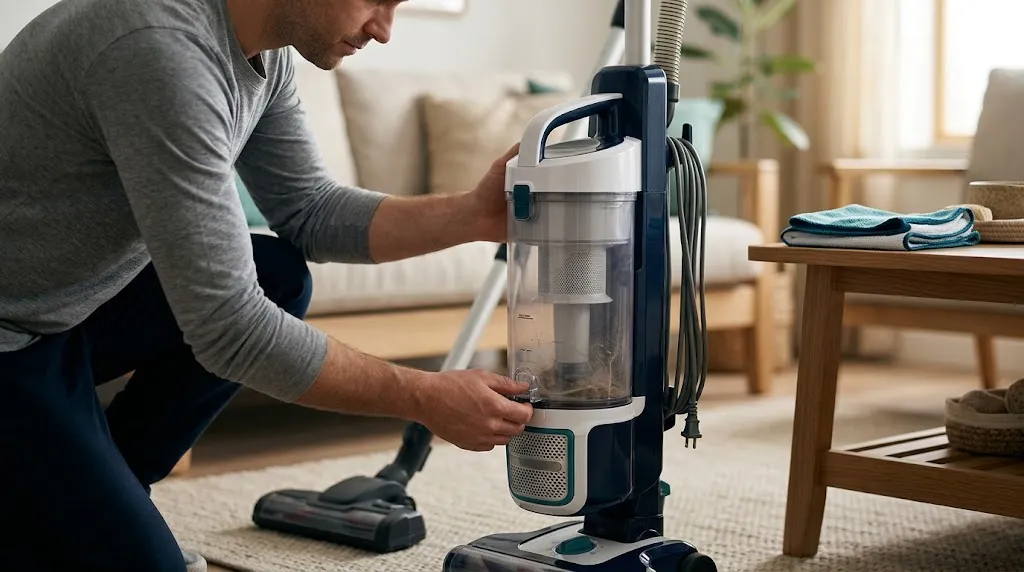
Consistent suction depends on keeping the collection system and other airflow passages reasonably clear.
- Watch the fill indicator. Empty the bin at the specified limit rather than packing in additional debris.
- Check after heavy cleaning. Pet hair, lint, and bulky debris can occupy collection space quickly.
- Inspect the inlet. Remove accessible compacted material before it becomes a stubborn blockage.
- Maintain filters separately. An empty dustbin does not replace normal filter cleaning or replacement.
- Keep seals clean. Dirt trapped along a dustbin door can interfere with proper closure.
- Use the correct vacuum for the material. Avoid collecting liquids, ash, construction dust, or other restricted materials with an ordinary household vacuum unless the manufacturer explicitly permits it.
Frequency matters less than responding to the actual dust load. A small vacuum used around shedding pets may need emptying much sooner than a large-capacity unit cleaning a lightly dusty floor.
Practical Tip
Use the empty-bin test when pickup suddenly weakens: power off, empty the container, clear visible obstructions, reassemble it properly, and compare performance on the same type of surface. If there is no improvement, investigate filters and other airflow restrictions next.
This approach avoids unnecessary part replacement and helps distinguish an ordinary maintenance issue from a fault that deserves further attention.
Frequently Asked Questions
Can a vacuum lose suction before its dustbin is completely full?
Yes. Compacted hair, lint, or fine dust can obstruct an inlet or load a filter before the collection chamber reaches its maximum capacity. The fill level alone does not tell you whether airflow is restricted.
Will emptying a vacuum dustbin make it more powerful?
Emptying the bin may restore normal cleaning performance if accumulated debris was restricting airflow. It does not increase the motor’s original rated power or repair an unrelated mechanical problem.
Why does my vacuum lose suction when collecting pet hair?
Pet hair can form bulky clumps that occupy bin space or become trapped around an inlet. It can also tangle around the brush roll. Check both the collection system and brush assembly when pickup declines.
Can fine dust cause weak suction even with an almost empty bin?
Yes. Fine particles can load the vacuum’s filter and restrict airflow even when the dustbin contains relatively little visible debris. Inspect the filter according to the manufacturer’s instructions.
Is it safe to compress dirt to fit more into the dustbin?
No. Packing debris beyond the manufacturer’s capacity limit can interfere with airflow and make the container harder to empty. Remove the collected material instead of compressing it into the chamber.
Should I replace my vacuum if suction stays weak after emptying the dustbin?
Not immediately. Check the filters, hose, floorhead, brush roll, seals, and settings first. If the machine still performs poorly after the recommended troubleshooting steps, seek model-specific service advice before deciding whether replacement is necessary.
Conclusion
A full dustbin can reduce vacuum performance, especially when collected debris obstructs airflow, interferes with separation, or contributes to clogged filters. However, the effect is not identical across every vacuum, and a partially filled bin does not automatically cause weak suction.
The simplest response is to empty the container at the manufacturer’s recommended limit and check for trapped material. If cleaning performance remains poor, inspect the filters, hose, seals, and floorhead before assuming the motor has failed.
Regular collection-bin maintenance takes little effort and can help preserve reliable cleaning performance while making more serious problems easier to identify.
