
When Should You Replace a Vacuum Instead of Repairing It?

Quick Answer
You should consider replacing a vacuum instead of repairing it when the total repair cost approaches or exceeds 50% of the price of a comparable new vacuum, especially if the machine is older or keeps breaking down. Replacement also makes sense when essential parts are unavailable, major damage is extensive, or safe operation cannot be restored economically. For simple clogs, filters, belts, and replaceable batteries, repairing is often the better option.
A vacuum that stops working does not always need to be replaced. Sometimes a clogged hose, dirty filter, or worn belt is all that stands between you and a working machine.
But spending money on an aging vacuum can also become a poor investment. A costly repair might solve today’s problem while leaving other worn components ready to fail.
The useful question is not simply whether the vacuum can be repaired. It is whether repairing it will provide enough reliable cleaning time to justify the expense.
When Is Replacing a Vacuum Better Than Repairing It?
Replacing a vacuum is usually the more practical choice when repairing it costs too much relative to its remaining value, or when several problems make future reliability uncertain.
These situations deserve particular attention:
- Expensive repair: The complete repair estimate is close to half the price of a suitable new vacuum or higher.
- Repeated breakdowns: The machine has needed several repairs within a relatively short period.
- Major motor damage: Replacing a failed motor would be expensive compared with replacing the entire appliance.
- Unavailable components: Essential parts have been discontinued or cannot be sourced reliably.
- Serious structural damage: Cracks or damaged mounting points affect the machine’s safe operation.
- Persistent poor cleaning: Correct maintenance and reasonable repairs no longer restore satisfactory performance.
No single symptom settles every case. A five-year-old premium vacuum with one failed switch may still be worth repairing. A much newer budget vacuum with extensive electrical damage might not be.
If you are still identifying the problem, HomeHygia’s guide on how to know when a vacuum needs replacing explains the main warning signs in more detail.
Use the 50% Repair-Cost Rule Before Deciding

A useful starting point is the 50% rule: consider replacement when the cost of repairing your vacuum reaches approximately half the price of a comparable new machine.
This is a budgeting guideline, not a technical standard or an automatic replacement requirement.
How to calculate whether a repair is worth it
First, obtain an estimate that includes parts, labor, diagnostic charges, and applicable taxes. Then compare it with the current price of a new vacuum that offers similar cleaning capabilities.
Use this formula:
Repair percentage = (Total repair cost ÷ Comparable new vacuum price) × 100
For example, suppose a technician quotes $140 to repair a vacuum and a comparable replacement costs $250.
The repair would cost 56% of the replacement price. That makes buying a new machine worth serious consideration.
Now imagine a $60 repair on an otherwise reliable vacuum that would cost $400 to replace. The repair represents only 15% of the replacement price and may be excellent value.
These are hypothetical examples, not quoted market prices.
| Repair as % of Replacement | Suggested Approach |
|---|---|
| Under 30% | Repair is often attractive if the vacuum is otherwise sound. |
| 30%–50% | Check age, repair history, and expected remaining usefulness. |
| 50%–70% | Give replacement serious consideration, particularly for older models. |
| Over 70% | Replacement is often more economical unless there is a compelling reason to repair. |
These ranges are practical decision bands, not guaranteed outcomes. A repair that costs 55% of replacement can still make sense if a high-quality vacuum has many serviceable years left.
Also compare against an equivalent replacement, not the cheapest vacuum on the shelf. Otherwise, the calculation may favor a new machine that performs worse than the one you own.
Which Vacuum Problems Are Usually Worth Repairing?
Small, isolated faults are often worth fixing when the vacuum’s main components still work properly.
Before paying a technician, look for problems that can be solved through routine maintenance or an approved replacement component.
- Clogged filters: Clean washable filters or install the specified replacement filters according to the manual.
- Blocked hoses: Remove accessible debris without damaging the hose or internal passages.
- Worn drive belt: Replace the belt on models that use a serviceable belt.
- Tangled brush roll: Remove wrapped hair and thread after disconnecting power.
- Cracked removable hose: Replace the hose if a correctly fitting part is available.
- Weak cordless battery: Consider an approved replacement battery when the rest of the machine remains dependable.
A belt failure, for example, may stop a vacuum from cleaning carpet effectively even though the suction motor works normally. Our vacuum belt replacement guide explains how to check and replace a serviceable belt.
Cordless owners should also distinguish battery deterioration from a failed motor. A suitable battery replacement can extend the useful life of an otherwise healthy machine.
For the correct precautions, see how to replace a vacuum battery safely.
When Does Motor Damage Make Replacement More Sensible?
Major motor damage can make replacement more attractive, particularly in lower-cost vacuums where the motor assembly and professional labor account for a large portion of the appliance’s value.
Possible warning signs include abnormal grinding noises, recurring shutdowns, persistent electrical odors, and operation that remains unreliable after ordinary maintenance.
However, these symptoms do not prove the motor itself has failed.
For example, an obstructed airflow path can cause overheating and automatic shutdown. Some motors also use replaceable components, while others are sealed assemblies that are less economical to service.
A qualified diagnosis should establish whether the problem involves the motor, a switch, a control board, a battery, or something else.
Our guide on whether a vacuum motor can be repaired explains which kinds of motor damage may be serviceable.
Warning
Stop using the vacuum if you notice smoke, sparks, melting plastic, a strong electrical burning smell, exposed wiring, or an unusually hot or swollen battery. Disconnect power only when it is safe to do so. Do not repeatedly restart the machine to test it; seek qualified service or a safe replacement decision.
Does the Age of Your Vacuum Change the Decision?
Yes. Age affects the repair decision because an older vacuum may have several components approaching the end of their useful life.
But there is no universal age at which every vacuum must be replaced.
A well-maintained, repairable canister vacuum may remain useful long after a heavily used budget stick vacuum begins developing problems.
Consider these factors together:
- Repair history: Has the vacuum been dependable, or does something fail every few months?
- Usage: Does it clean a small apartment occasionally or handle heavy daily cleaning?
- Build quality: Can major components be serviced or replaced individually?
- Maintenance: Have filters, bags, seals, and brush rolls received proper attention?
- Parts support: Are compatible replacement components still obtainable?
Age matters most when combined with expensive repairs and declining reliability.
A six-year-old vacuum needing a minor service may be a better repair candidate than a two-year-old model with extensive liquid damage.
What Should You Check Before Buying a New Vacuum?
Complete a short maintenance check before assuming the machine is beyond repair. This can prevent an unnecessary purchase.
- Disconnect the power. Unplug corded models or switch off cordless models, following the manufacturer’s instructions before touching accessible moving components.
- Empty the bin or replace the bag. A full collection container can interfere with normal airflow.
- Inspect the filters. Clean only filters identified as washable, or replace disposable filters as directed.
- Check the airflow path. Inspect the hose, wand, cleaner head, and accessible openings for trapped debris.
- Inspect the brush roll. Remove tangles and check for obvious damage or resistance.
- Allow adequate cooling. If the vacuum shut down from heat, follow the model-specific cooling instructions before testing again.
- Reassemble and evaluate. Once everything is correctly installed and dry, check whether normal performance has returned.
Manufacturer instructions should take priority over any general troubleshooting sequence.
Shark’s official vacuum maintenance guidance identifies clogs, brush-roll jams, and overheating protection as common troubleshooting areas.
If your vacuum continues shutting off after maintenance, HomeHygia’s guide to why a vacuum overheats provides more focused checks.
How Do You Decide When Repair Costs Are Borderline?
When the estimate falls close to half the cost of a replacement, examine what you will receive for the money.
Ask the repair provider whether the estimate includes a complete diagnosis, original or approved parts, labor, and any service warranty.
Then consider whether one repair is likely to restore dependable cleaning or whether other major components already show signs of deterioration.
Here are two hypothetical situations:
Situation A: A premium canister vacuum needs a $160 repair. An equivalent replacement costs $700, and the machine has otherwise been reliable. Repairing may offer better value.
Situation B: A budget upright needs a $110 motor repair. A comparable replacement costs $150, and the brush-roll assembly is also worn. Replacement is likely the more practical choice.
These examples show why the original purchase price alone is not enough. What matters is today’s replacement cost and the expected benefit of the repair.
Key Insight
A cheap repair is not automatically good value, and an expensive repair is not automatically wasteful. The better choice depends on the cost of equivalent replacement, the condition of the remaining components, and the reliability you can reasonably expect afterward.
Should You Replace a Vacuum That Keeps Breaking Down?
Frequent breakdowns are a strong reason to consider replacement, even if each individual repair seems affordable.
A vacuum that repeatedly needs switches, hoses, brush-roll assemblies, batteries, or other components may be creating an ongoing maintenance expense.
Review what you have spent during the past year and compare that with the price of a suitable replacement. Include the inconvenience of arranging service and being without a working vacuum.
Repeatedly replacing a consumable part is not always evidence of failure. Regular bag changes and scheduled filter replacements are normal maintenance.
What matters is whether unexpected faults are becoming common and whether each repair restores dependable use.
Can Repairing an Old Vacuum Be Better for the Environment?
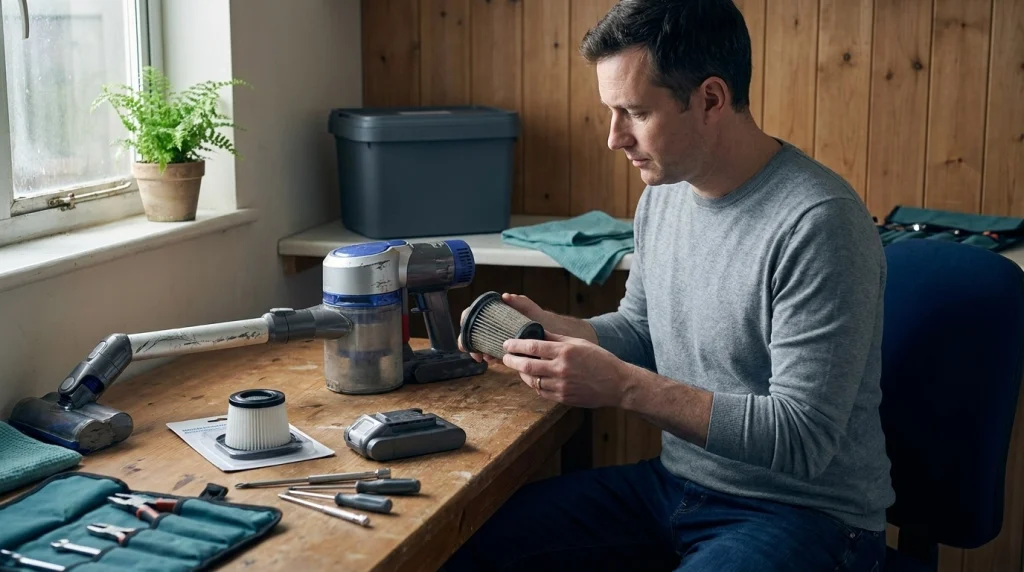
Yes. Repairing a safe, useful vacuum can avoid discarding components that still work and reduce the need to manufacture an entire replacement.
Environmental considerations strengthen the case for inexpensive repairs, especially when a machine has a sound motor, housing, and electrical system.
However, repair is not always practical. Severe damage, unavailable parts, or recurring unsafe failures can make replacement necessary.
When disposing of a cordless vacuum, pay particular attention to its battery. The US Environmental Protection Agency’s lithium-ion battery guidance explains why these batteries should not enter ordinary household trash or curbside recycling.
Use an appropriate electronics recycler, battery collection facility, or local take-back program for the battery and appliance.
Frequently Asked Questions
Is it worth repairing a cheap vacuum cleaner?
Yes, if the fault is inexpensive and easy to resolve. Cleaning a clogged filter or replacing a serviceable belt may be worthwhile. Expensive motor or electronic repairs are harder to justify when a comparable new vacuum costs only slightly more.
Should I replace my vacuum if it has lost suction?
Not immediately. Empty the collection container and inspect the filters, hose, and cleaner head. Weak suction often results from restricted airflow. Consider professional diagnosis if performance remains poor after appropriate maintenance.
Can a vacuum last more than 10 years?
Yes. Some vacuums remain useful for more than 10 years, especially when maintained properly and supported by available replacement parts. Age alone does not determine whether repair is worthwhile.
Should I repair a vacuum that is still under warranty?
Check the warranty terms before paying for independent service. An eligible fault may qualify for a manufacturer-approved repair or replacement. Unauthorized repairs can also affect warranty coverage, depending on the applicable terms and laws.
Does a bad vacuum battery mean I need a new vacuum?
No. If the battery is designed to be replaced and a compatible manufacturer-approved replacement is available, changing the battery may be more economical than replacing the entire vacuum. Do not use damaged or swollen battery packs.
What if a replacement part is no longer available?
Contact the manufacturer or an authorized repair provider to confirm availability. If a necessary safety-critical component cannot be obtained, replacing the vacuum may be more sensible than attempting an unapproved modification.
Final Verdict: Repair or Replace Your Vacuum?
Repair your vacuum when the problem is isolated, the parts are available, and the cost is reasonable compared with an equivalent replacement.
Consider replacing it when expensive repairs, repeated failures, unavailable components, or significant damage make reliable operation difficult to restore.
Before buying anything, complete the basic maintenance checks, confirm the fault, and compare the full repair estimate with a suitable replacement. That gives you a much stronger basis for deciding where your money is best spent.
