What MERV Rating Should I Use for My Home? (MERV 8 vs 11 vs 13)

Quick answer
For most homes, a MERV 8 pleated filter is the right balance of cleaner air and easy airflow. Choose MERV 11 if you have pets or seasonal allergies, and MERV 13 if someone has asthma or you deal with wildfire smoke, as long as your HVAC system can push air through it. The U.S. EPA suggests MERV 13 or the highest rating your system fan and filter slot can handle. Ratings above 13 are usually meant for hospitals and commercial systems, not home furnaces.
The filter in your furnace or air handler is the one air cleaner every room in the house shares. Picking the wrong one either lets fine dust circulate or chokes the system. This guide explains what the MERV number means, which rating fits your home, and how to tell whether your HVAC can handle a higher one.
What does MERV mean?
MERV stands for Minimum Efficiency Reporting Value. It comes from the ASHRAE 52.2 test standard and runs from 1 to 16. The test measures how much of three particle size bands a filter captures, from 0.3 to 10 microns (EPA: What is a MERV rating?):
- 3 to 10 microns: pollen, dust mite debris, lint, carpet fibers.
- 1 to 3 microns: mold spores, pet dander, fine dust.
- 0.3 to 1 micron: smoke, bacteria, vehicle exhaust, the particles that reach deepest into the lungs.
A higher MERV number means the filter traps a larger share of the smaller particles. It does not remove gases or odors; that needs activated carbon (see charcoal vs HEPA filters).
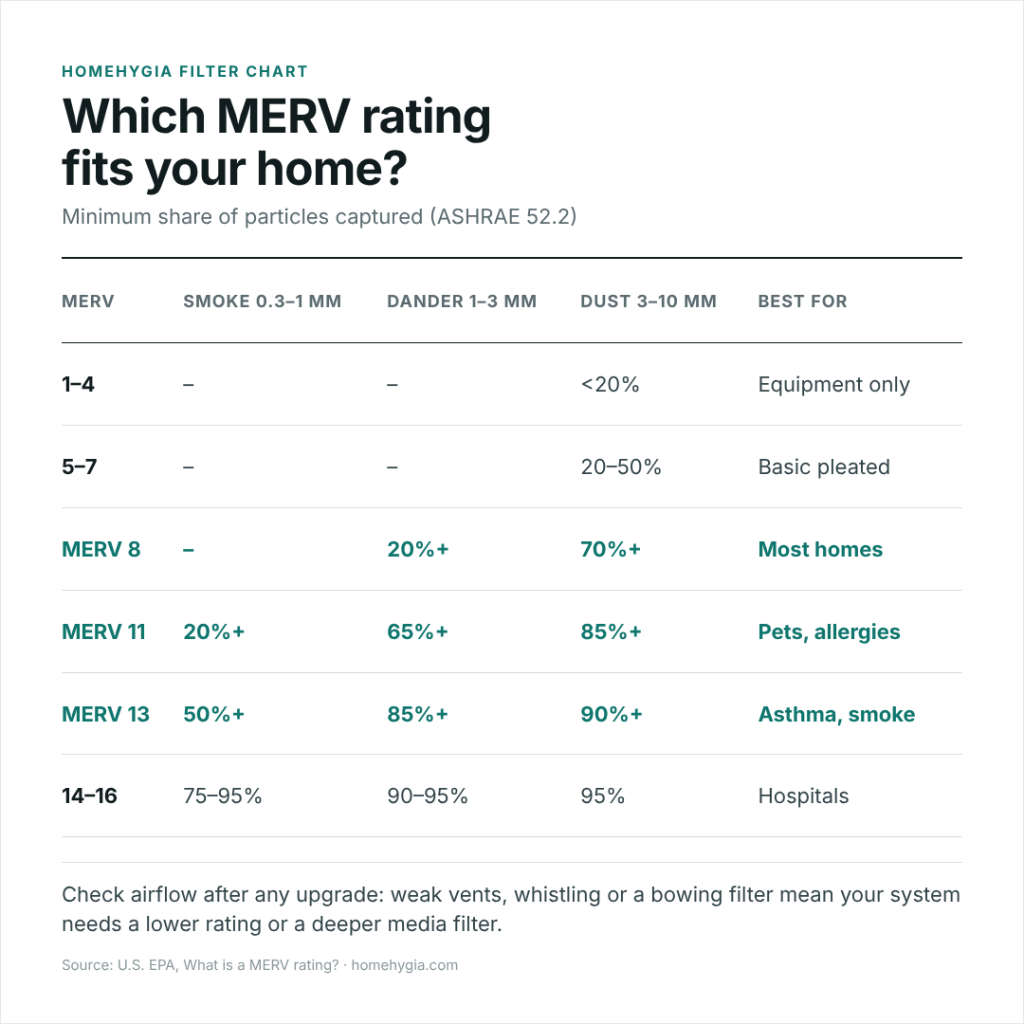
MERV rating chart for home filters
| MERV | 0.3–1 µm (smoke, bacteria) | 1–3 µm (dander, spores) | 3–10 µm (pollen, dust) | Typical home use |
|---|---|---|---|---|
| 1–4 | — | — | under 20% | Cheap fiberglass; protects the equipment only |
| 5–7 | — | — | 20–50% | Basic pleated filters |
| 8 | — | 20% or more | 70% or more | Standard choice for most homes |
| 11 | 20% or more | 65% or more | 85% or more | Pets, allergies |
| 13 | 50% or more | 85% or more | 90% or more | Asthma, wildfire smoke, city pollution |
| 14–16 | 75–95% | 90–95% | 95% | Hospitals and commercial systems |
Which MERV rating should you use?
MERV 8: most homes
A MERV 8 pleated filter catches most visible dust, lint and pollen and keeps the blower and coil clean. It is cheap, widely sold in every size, and almost every residential system can run it without airflow problems. If nobody in your home has allergies or breathing issues, start here.
MERV 11: pets and allergies
MERV 11 adds meaningful capture of pet dander, mold spores and fine dust in the 1 to 3 micron range. It is the usual step up for homes with cats or dogs or with hay fever in spring and fall. Most modern systems handle a 1-inch MERV 11 without trouble, but check airflow after the switch (see below). For room-level help with pets, a portable unit works alongside it; read whether air purifiers help with pet dander.
MERV 13: asthma, smoke and high pollution
MERV 13 is the first level that traps at least half of the smallest band, which includes smoke particles. The EPA recommends at least MERV 13, or as high as your system fan and filter slot can accommodate, when you want the HVAC to clean the air (EPA Guide to Air Cleaners in the Home). It is the best choice during wildfire season or near busy roads. The catch is airflow: a thin 1-inch MERV 13 can restrict older or smaller systems. A 4- or 5-inch media cabinet solves this because the larger surface area lowers resistance.
MERV 14 to 16: rarely needed at home
These filters are designed for hospitals, labs and commercial air handlers with stronger fans. In a typical home furnace they add resistance with little extra benefit over MERV 13. If you need near-HEPA cleaning, a whole-house system designed for it or a portable HEPA purifier is the better route. Our whole house air purifier guide covers those options.
Can a higher MERV filter hurt your HVAC?
It can if the system was not designed for it. Denser filter media creates more resistance (pressure drop). When the blower can’t overcome it, airflow falls, which can mean longer run times, higher energy use, a frozen AC coil in summer or an overheating heat exchanger in winter. Watch for these signs after you upgrade:
- Weaker airflow from the vents, or rooms that heat or cool unevenly.
- Whistling at the return grille or filter slot.
- The filter bowing or getting sucked out of its frame.
- Ice on the refrigerant lines or indoor coil in cooling mode.
If you see any of these, drop back one level or ask an HVAC technician to measure static pressure. A technician can also tell you whether a deeper media filter cabinet fits your return. If you are thinking about adding air cleaning to the ductwork, read can you add an air purifier to your HVAC system and our central air purifier installation guide.

MERV vs MPR vs FPR
Some brands print their own scales instead of, or next to, MERV. 3M uses MPR (Microparticle Performance Rating) and The Home Depot uses FPR (Filter Performance Rating). They are not official standards, so compare by the MERV number when the package lists it. As a rough guide, MPR 1000 or FPR 7 filters are usually close to MERV 11, and MPR 1500 to 1900 or FPR 10 filters are close to MERV 12 to 13. Check the box or the maker’s chart to be sure.
Tips for getting the most from your filter
- Use the exact size. The nominal size (for example 16x25x1) is printed on the old filter frame. Gaps around a filter let air bypass it entirely.
- Point the arrow toward the blower. The airflow arrow on the frame faces away from the return and toward the furnace.
- Change it on schedule. 1-inch filters typically last 1 to 3 months; 4- to 5-inch media filters 6 to 12 months. Homes with pets, smokers or construction dust need the short end.
- Run the fan. The filter only cleans air while the blower runs. Setting the thermostat fan to “on” or “circulate” for part of the day increases filtration, at the cost of some electricity.
- Add a portable purifier where it matters. A HEPA purifier in the bedroom cleans one room far more than the central filter can. Keep it working with our guide on how to clean air purifier filters.
Frequently asked questions
Is MERV 8 or MERV 11 better?
MERV 11 captures more fine particles such as pet dander and mold spores, so it is better for allergies and pets. MERV 8 is enough for homes without those needs and puts less load on the system.
Is MERV 13 too high for a home furnace?
Not for most modern systems, especially with a 2-inch or deeper filter. Older systems and 1-inch slots can struggle. Check for weak airflow or whistling after switching, or ask a technician to measure static pressure.
Does a higher MERV filter use more electricity?
It can, slightly, because the blower works against more resistance. Deeper media filters keep the increase small, and a clogged low-MERV filter can cost more than a clean MERV 13.
Is a MERV 13 filter the same as HEPA?
No. HEPA filters capture at least 99.97% of 0.3-micron particles, while MERV 13 captures at least 50% of particles between 0.3 and 1 micron (EPA: What is a HEPA filter?). Most home HVAC systems cannot run true HEPA filters.
Do MERV filters remove odors?
No. MERV ratings only measure particles. For smells and VOCs you need a filter with activated carbon. See activated carbon filtration for smoke.
Sources
- U.S. EPA: What is a MERV rating?
- U.S. EPA: Guide to Air Cleaners in the Home
- U.S. EPA: What is a HEPA filter?