
How Often Should You Change Your HVAC Filter? (By Filter Type and Home)

Quick answer
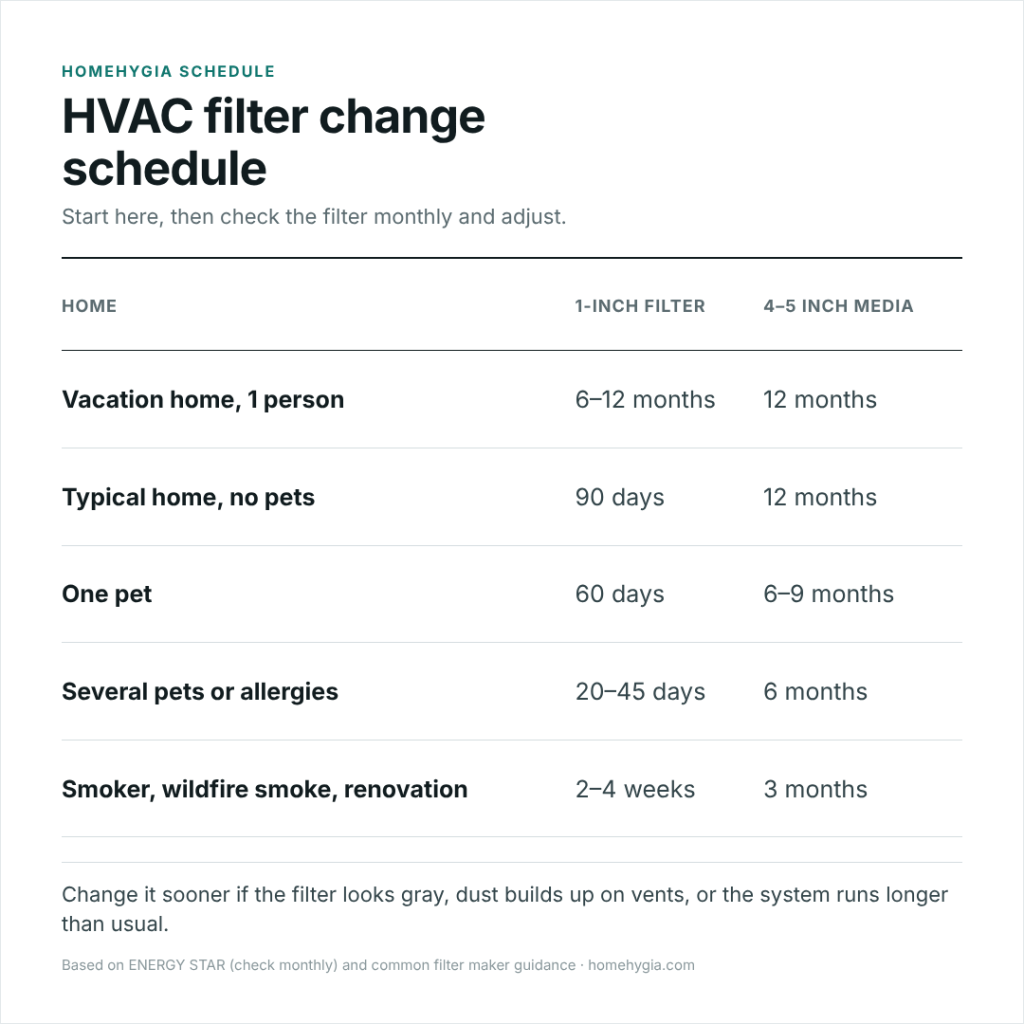
Change a standard 1-inch HVAC filter every 1 to 3 months and a 4- to 5-inch media filter every 6 to 12 months. Homes with pets, allergies, smokers or wildfire smoke should use the short end, around every 30 to 60 days for 1-inch filters. ENERGY STAR recommends checking the filter once a month and replacing it when it looks dirty, no matter what the calendar says.
A clogged filter is one of the most common reasons a furnace or air conditioner runs longer, costs more and breaks down early. It also stops cleaning your air. The right schedule depends on the filter’s thickness and on what your household puts into the air, so here is a simple way to work it out.
How often to change your HVAC filter: the short version
- 1-inch pleated filter (most common): every 60 to 90 days in a typical home.
- 2-inch filter: every 3 to 6 months.
- 4- to 5-inch media filter: every 6 to 12 months.
- Cheap fiberglass filter: every 30 days. These clog fast and catch little.
- Washable or electrostatic filter: clean every 1 to 3 months as the maker directs.
What changes the schedule
Pets
Pet hair and dander load a filter quickly. With one cat or dog, plan on every 60 days for a 1-inch filter; with several pets, every 20 to 45 days. Shedding season in spring and fall may need an extra change.
Allergies or asthma
A fresh filter keeps catching pollen, dust and dander at its rated efficiency. If someone in the home has allergies or asthma, change 1-inch filters every 30 to 45 days and consider a higher rating. Our guide to what MERV rating to use explains the options.
Smoke, renovation and wildfire season
Smoking indoors, sanding drywall, or smoke drifting in from wildfires can clog a filter in a couple of weeks. Check it every week during these periods and replace it as soon as it turns gray.
How much the system runs
The filter only collects dust while the blower runs. A system that runs nonstop in a hot summer or cold winter needs changes sooner than one that runs a few hours a day. A vacation home that sits empty can go 6 to 12 months.
Filter thickness
Thicker filters have far more pleated media, so they hold more dust before airflow drops. That is why a 4-inch media filter lasts several times longer than a 1-inch one of the same rating.
Signs your filter needs changing now
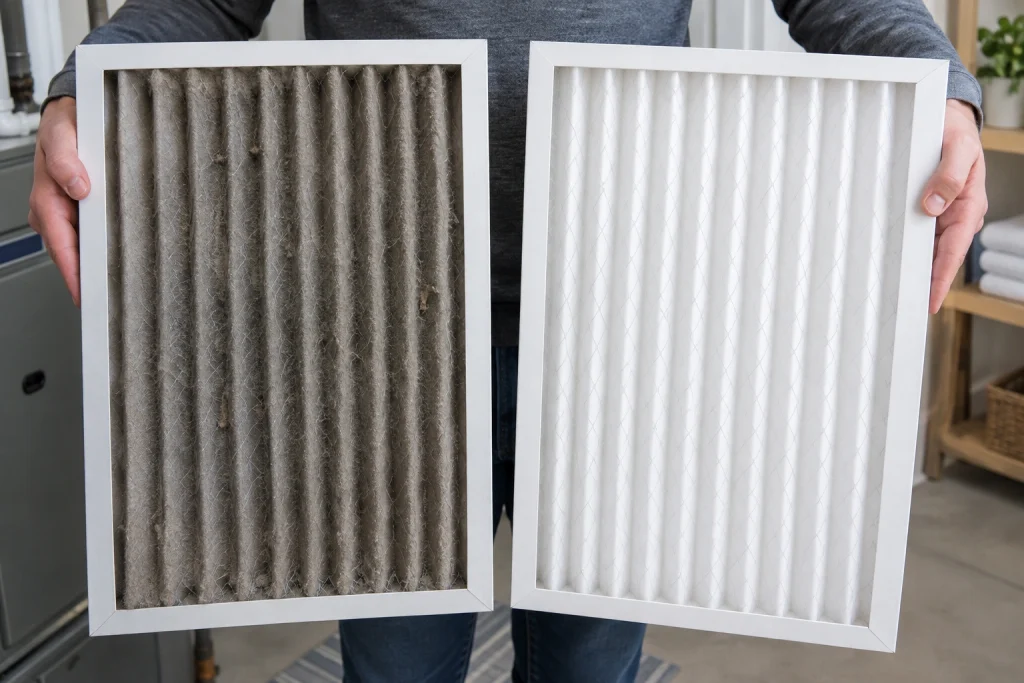
- The filter surface looks gray or brown, or you can’t see light through it when you hold it up.
- More dust settles on furniture, or the supply vents have dusty streaks.
- Weaker airflow from the vents, or some rooms feel warmer or cooler than usual.
- The system runs longer to reach the thermostat setting, or your energy bill rises.
- A whistling sound from the filter slot or return grille.
- Allergy symptoms get worse indoors.
The same rule applies to portable units: see how often to change an air purifier filter and how a clogged filter affects performance.
What happens if you don’t change it
As the filter fills, the blower has to pull harder to move air through it. ENERGY STAR notes that a dirty filter can increase energy costs and damage your equipment, leading to early failure (ENERGY STAR maintenance checklist). In cooling mode, low airflow can freeze the indoor coil; in heating mode, it can make the furnace overheat and shut off on its safety limit. Dust that gets past an overloaded filter also coats the blower and coil, which is a much bigger cleaning job than a filter swap.
How to change an HVAC filter in 5 steps
- Turn the system off at the thermostat so it doesn’t pull dust in while the slot is open.
- Find the filter. It is in a slot on the furnace or air handler, or behind a return air grille on a wall or ceiling.
- Note the size printed on the frame (for example 16x25x1) and the airflow arrow direction.
- Slide in the new filter with the arrow pointing toward the furnace or blower, away from the return duct.
- Write the date on the frame or set a phone reminder for your next check.
Buying filters in a multipack lowers the cost and means you always have a spare. If your home needs more cleaning than a central filter can give, read about adding an air purifier to your HVAC system or the central air purifier installation guide.
Frequently asked questions
Is it OK to change an HVAC filter every 6 months?
For a 4- or 5-inch media filter, yes. For a 1-inch filter, 6 months is usually too long unless the home is empty most of the time. Check it monthly to be sure.
Should I change my filter more often in summer and winter?
Yes. The system runs the most during peak heating and cooling, so the filter collects dust faster. Many homeowners change 1-inch filters at the start of each season and again mid-season.
Does a higher MERV filter need changing more often?
It can, because it catches more fine particles and loads up faster. Thicker media filters offset this. Check a new higher-rated filter after 30 days to see how quickly it fills.
Can I vacuum and reuse a disposable filter?
No. Vacuuming removes surface dust but not the particles trapped in the media, and it can damage the fibers. Replace disposable filters; only clean filters labeled washable.
Can a dirty filter make you sick?
A dirty filter doesn’t create germs, but it stops capturing dust, pollen and dander, so they circulate through the house. That can make allergy and asthma symptoms worse.