MERV vs HEPA: What’s the Difference and Which Filter Do You Need?

Quick answer
HEPA is a strict standard: a true HEPA filter captures at least 99.97% of particles 0.3 microns in size. MERV is a 1 to 16 scale for HVAC filters; even a MERV 13 only has to capture 50% of particles between 0.3 and 1 micron. HEPA cleans better, but it is too dense for most home furnaces. For most homes the best setup is a MERV 11 to 13 filter in the HVAC plus a portable HEPA air purifier in the bedroom or main living area.
Shopping for filters means running into two different rating systems that seem to measure the same thing. They don’t. MERV is how HVAC filters are graded; HEPA is a pass-or-fail standard mostly used in air purifiers and vacuums. Here is how they compare and which one fits your home.
What is MERV?
MERV (Minimum Efficiency Reporting Value) comes from the ASHRAE 52.2 test. Filters are scored from 1 to 16 based on how much of three particle size bands they catch: 0.3–1, 1–3 and 3–10 microns. A MERV 8 is the standard pleated furnace filter; MERV 13 is the level the EPA suggests when you want your HVAC to clean the air (EPA: What is a MERV rating?). For a full breakdown, read what MERV rating should I use.
What is HEPA?
HEPA (High Efficiency Particulate Air) is a type of pleated mechanical filter that must remove at least 99.97% of particles 0.3 microns in diameter. That size is the hardest to catch; larger and smaller particles are captured at even higher rates (EPA: What is a HEPA filter?). Watch for labels like “HEPA-type” or “HEPA-like”: these are not held to the 99.97% standard. Our guide to air purifier filter efficiency percentages explains how to read the claims.
MERV vs HEPA: key differences
1. Filtration efficiency
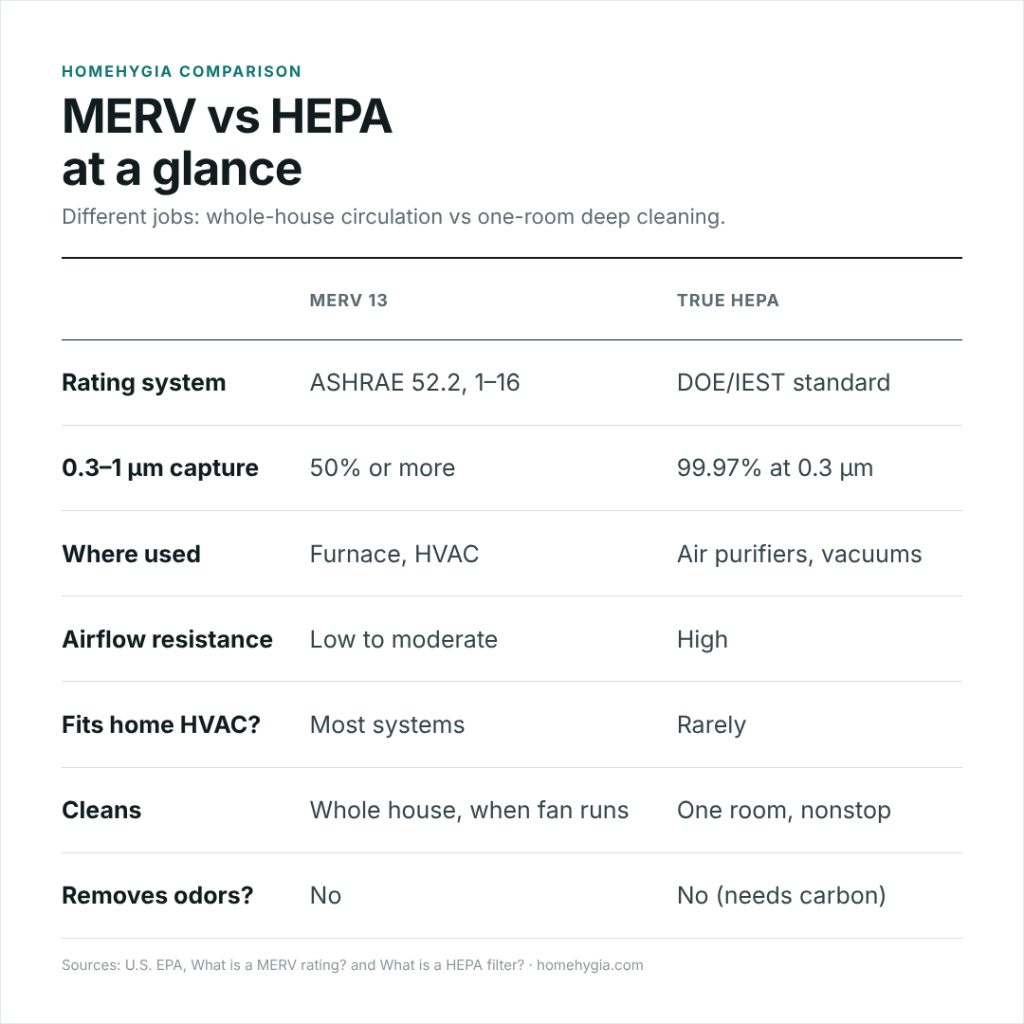
A true HEPA filter outperforms every MERV level on the smallest, most harmful particles. MERV 16, the top of the scale, captures 95% or more of 0.3–1 micron particles; HEPA captures 99.97% at 0.3 microns. For smoke, fine dust and airborne bacteria, HEPA is the stronger filter.
2. Airflow resistance
HEPA media is very dense. Pushing air through it takes a powerful, purpose-built fan. That is why air purifiers are designed around their filter. A typical home furnace or air handler is not, and forcing a HEPA filter into its slot would choke the airflow.
3. Where each is used
MERV filters go in furnaces, air handlers and HVAC returns, where they clean all the air the system moves through the house. HEPA filters go in portable air purifiers, vacuums, and dedicated whole-house HEPA systems that bypass part of the airflow through their own blower.
4. Coverage
The HVAC filter treats air from every room, but only while the blower runs. A portable HEPA purifier runs nonstop, but only in one room. They solve different parts of the problem, so many homes use both.
5. Cost
MERV 8 to 13 filters are inexpensive and sold in every standard size. HEPA replacement filters for purifiers cost more per filter, and a whole-house HEPA system requires professional installation.
Can you put a HEPA filter in your furnace?
Usually not. Standard residential HVAC systems are not designed for the pressure drop of a true HEPA filter. Restricted airflow can freeze the AC coil, overheat the furnace and shorten the blower’s life. If you want HEPA-level cleaning for the whole house, an HVAC contractor can install a bypass HEPA unit with its own fan. Otherwise, upgrade to the highest MERV your system handles (often MERV 13 in a 4-inch media cabinet) and add portable HEPA purifiers. See can you add an air purifier to your HVAC system and whole house air purifiers for the options.

Which one do you need?
- Healthy household, no special needs: a MERV 8 to 11 HVAC filter is enough.
- Pets or seasonal allergies: MERV 11 to 13 in the HVAC, plus a HEPA purifier in the bedroom.
- Asthma, wildfire smoke or city pollution: MERV 13 in the HVAC and a correctly sized HEPA purifier in each room where people spend the most time.
- No central HVAC (radiators, mini-splits): portable HEPA purifiers are your main filtration.
- Odors and VOCs: neither filter removes gases. You need activated carbon; see charcoal vs HEPA filters.
Frequently asked questions
Is MERV 13 as good as HEPA?
No. MERV 13 captures at least 50% of 0.3–1 micron particles; HEPA captures 99.97% at 0.3 microns. MERV 13 is still a big upgrade over standard filters and is the practical choice for most furnaces.
What MERV rating is equal to HEPA?
None. HEPA is above the MERV scale. MERV 16 is the closest, at 95% or more for the smallest band.
Is a HEPA air purifier worth it if I have a good HVAC filter?
Yes, for bedrooms and anyone with allergies or asthma. The purifier runs continuously in one room and filters the air many times an hour, which a central system can’t match for that room.
Do HEPA filters have a MERV rating?
Some manufacturers list one, but HEPA filters are normally tested to their own standard. When comparing, look for “true HEPA” and the 99.97% figure.
Sources
- U.S. EPA: What is a MERV rating?
- U.S. EPA: What is a HEPA filter?
- U.S. EPA: Guide to Air Cleaners in the Home