Dyson Air Purifier Comparison Chart: Every Range Side by Side

Quick answer
Every current Dyson air purifier uses the same basic idea: a sealed HEPA filter for particles plus activated carbon for odors and gases, with sensors and an app. What separates the ranges is the extra job each one does. Pick Purifier Cool if you want a purifier and a fan, Hot+Cool if you also want a heater, Humidify+Cool for dry winter air, Big+Quiet for large open spaces, and the HushJet Compact for a small, quiet bedroom purifier. Choose a Formaldehyde version only if you have new furniture, flooring or a recent renovation.
Dyson sells several purifier ranges with similar names, which makes the lineup hard to compare. This chart groups them by function so you can see what you’re paying extra for, then explains how to match a model to your room.
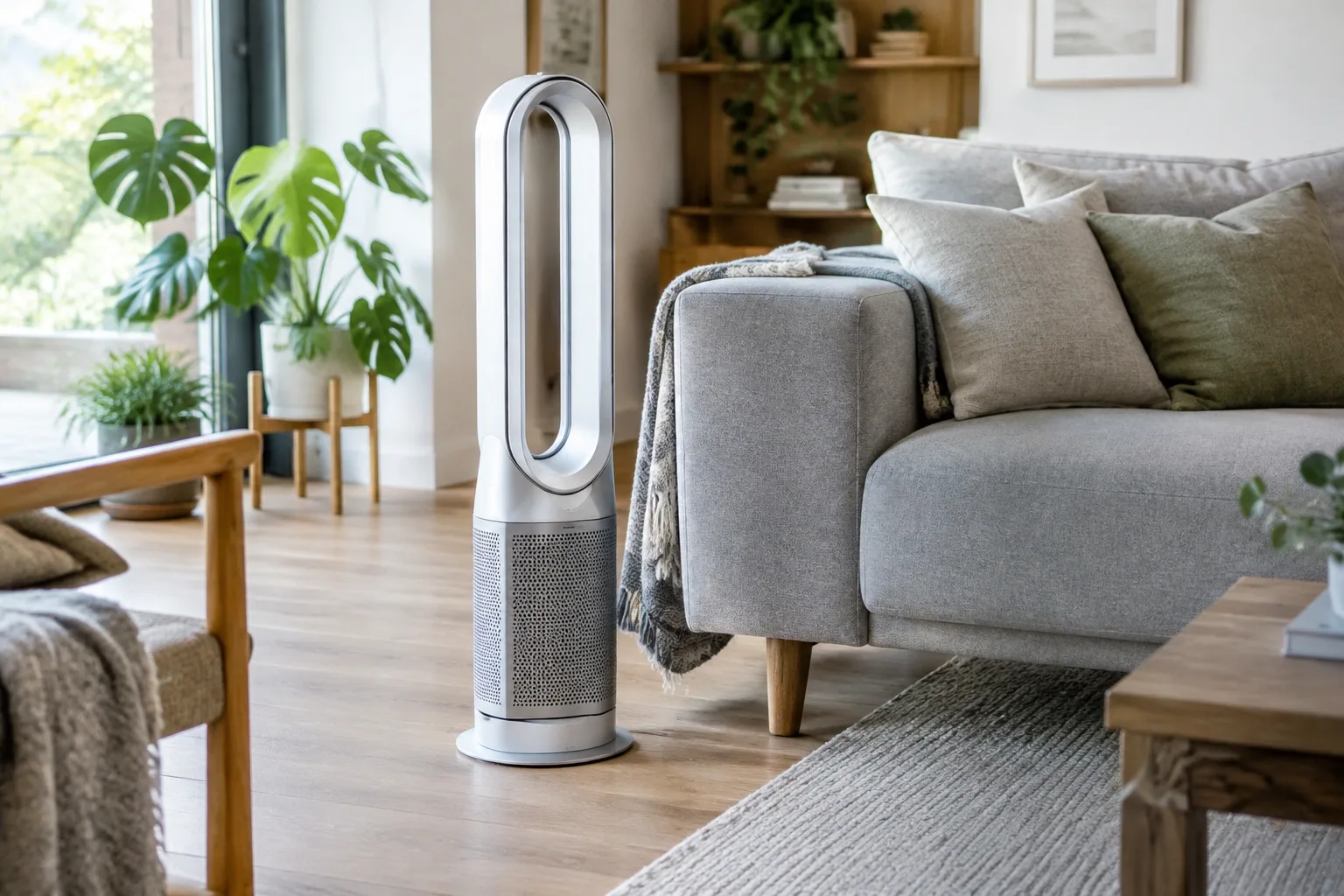
Dyson air purifier comparison chart
| Range (model codes) | Purify | Cooling fan | Heat | Humidify | Formaldehyde version | Best for |
|---|---|---|---|---|---|---|
| Purifier Cool (TP07) / Cool Formaldehyde (TP09) | Yes | Yes | No | No | TP09 | Bedrooms, living rooms, summer |
| Purifier Hot+Cool (HP07) / Hot+Cool Formaldehyde (HP09) | Yes | Yes | Yes | No | HP09 | Year-round use in one room |
| Purifier Humidify+Cool (PH03) / Humidify+Cool Formaldehyde (PH04) | Yes | Yes | No | Yes | PH04 | Dry winter air, bedrooms |
| Purifier Big+Quiet Formaldehyde (BP04) | Yes | No (purifying airflow) | No | No | Yes | Large open-plan spaces |
| HushJet Purifier Compact (HJ10) | Yes | No | No | No | No | Small bedrooms, home offices |
Model codes vary slightly by country (for example TP7A or HP7A in some markets), and Dyson regularly releases new versions. Before buying, check the current product page for the recommended room size, filter type and price in your region.
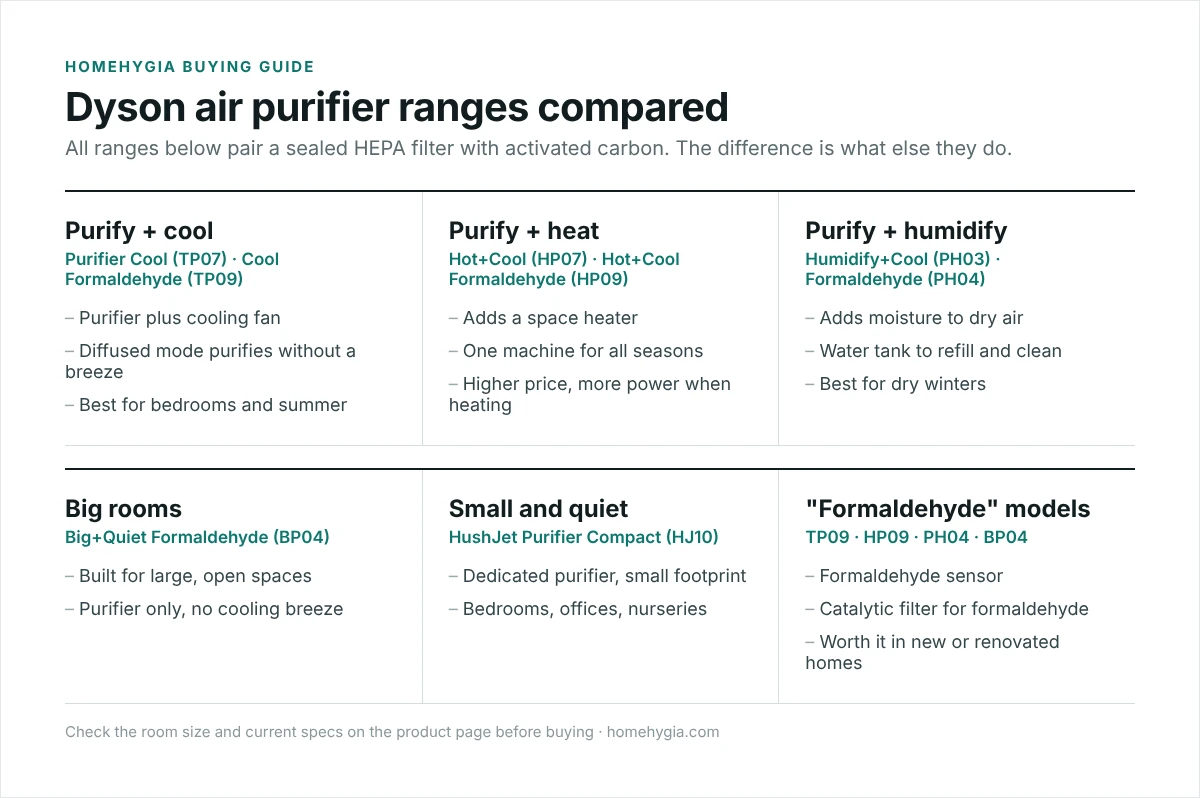
What all Dyson purifiers have in common
- HEPA plus carbon filtration. The HEPA layer captures particles such as dust, pollen and pet dander; the activated carbon layer targets odors and gases. The EPA notes that most filters target either particles or gases, so a purifier needs both types to handle both (EPA: Guide to Air Cleaners in the Home).
- Sensors and auto mode. The machines read particles and VOCs and can adjust speed automatically. Results show on the display and in the MyDyson app.
- Sealed design. Dyson emphasizes that its machines are sealed so air can’t leak around the filter, which matters because a filter only works on air that passes through it.
The differences that matter
Cool vs Hot+Cool
Both purify and both work as a fan. Hot+Cool adds a heater, so one machine can run all year. If you already have heating and only want cleaner air plus a summer breeze, the Cool range costs less. Heating mode uses much more electricity than purifying alone.
Humidify+Cool
The Humidify+Cool range adds a water tank and humidifier. It helps in dry winter air, but the tank needs refilling and regular cleaning. Aim to keep indoor humidity in a comfortable middle range rather than as high as possible, since constantly damp air can encourage mold and dust mites. If smoke or odors are your main concern instead, see the best air purifiers for smoke.
Formaldehyde models
Formaldehyde is a common indoor gas released by some pressed-wood products, glues, paints and new furnishings (EPA: Facts About Formaldehyde). Dyson’s Formaldehyde models add a dedicated formaldehyde sensor and a catalytic filter designed to break it down. They’re worth the premium mainly in new builds, after a renovation, or with lots of new flat-pack furniture. For everyday dust and pollen, a standard model does the same job.
Big+Quiet and HushJet
These are dedicated purifiers rather than fans. Big+Quiet is designed to project clean air across large rooms; the HushJet Compact is a smaller, quieter unit for one bedroom or office.
How to choose the right size
For particles, the EPA advises choosing an air cleaner with a clean air delivery rate (CADR) large enough for the room. Its rule-of-thumb table works out to roughly two-thirds of the floor area: about 130 cfm for a 200 sq ft room and 195 cfm for 300 sq ft, assuming an 8-foot ceiling. For higher ceilings or open-plan spaces, size up (EPA).
Many brands publish an AHAM-verified CADR, which makes comparisons easy. Dyson tends to quote its own room-coverage figures instead, so compare those carefully with any rival purifier’s CADR rather than assuming they’re measured the same way. You can look up certified models in the AHAM Verifide directory.
Which Dyson purifier should you buy?
- Allergies in a bedroom: Purifier Cool or HushJet Compact; run it on auto and keep the door closed.
- One machine all year: Purifier Hot+Cool.
- Dry winters or dry skin and throat: Humidify+Cool.
- New furniture or renovation: any Formaldehyde version.
- Large open-plan living area: Big+Quiet, or two smaller units.
- Tight budget: a non-Dyson HEPA purifier with a published CADR will often clean the same room for less. See what is the best Dyson air purifier and air purifiers for VOCs.
Filters and running costs
The machine tracks filter life and alerts you on the display and in the app when the filter needs changing; Dyson’s guidance is roughly once a year with typical daily use. Buy the replacement filter that matches your model code, since filters aren’t interchangeable across all ranges. Humidify+Cool models also need periodic tank and evaporator cleaning. Running the purifier with windows open reduces its effect; see air purifiers with windows open.
Frequently asked questions
What is the difference between Dyson air purifiers?
They all purify with HEPA and carbon filters. The ranges differ in what they add: a cooling fan (Cool), a heater (Hot+Cool), a humidifier (Humidify+Cool), large-room airflow (Big+Quiet), or a compact quiet design (HushJet). Formaldehyde versions add formaldehyde sensing and a catalytic filter.
Is the Dyson Formaldehyde model worth it?
Mainly if you have new furniture, new flooring or a recent renovation. For dust, pollen and pet dander, a standard model performs the same particle filtration.
Should you leave a Dyson air purifier on auto?
Yes, for most homes. Auto mode raises the fan speed when the sensors detect pollution and lowers it when the air is clean, which balances air quality, noise and filter life.
Does a Dyson air purifier remove dust?
It removes airborne dust that passes through the HEPA filter. It won’t remove dust that has settled on surfaces, so keep vacuuming and dusting.
Dyson vs Coway or Philips: which is better?
Dyson adds fan, heat or humidify functions and design; Coway and Philips often offer a higher published CADR for the money. If clean air is the only goal, compare CADR and filter cost first.
Sources
- EPA: Guide to Air Cleaners in the Home
- EPA: What is a HEPA filter?
- EPA: Facts About Formaldehyde
- AHAM Verifide
Related guides
- Air Purifier Comparison Chart: Essential Guide
- Dyson Air Purifier Model Comparison: Essential Guide
- Air Purifier Molekule vs Dyson: Essential Comparison
- Molekule vs Dyson Air Purifier: Essential Comparison