
How Long Should You Run a Bathroom Exhaust Fan After a Shower?

Quick answer
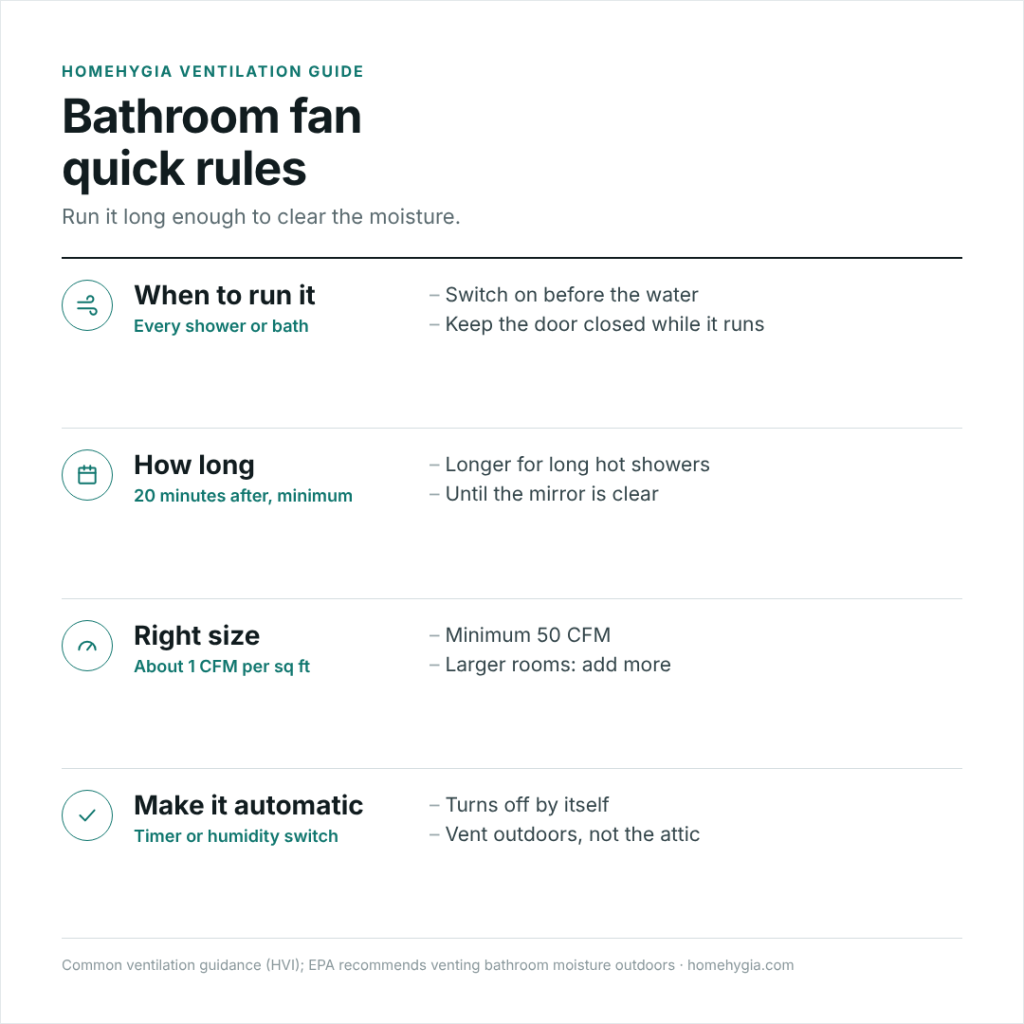
Turn the bathroom exhaust fan on when you start your shower and leave it running for at least 20 minutes after you finish. Run it longer after long, hot showers or baths, or until the mirror is clear. A timer switch or humidity-sensing fan makes this automatic. The fan should be sized at about 1 CFM per square foot of floor area (at least 50 CFM) and must vent outdoors.
Most people switch the bathroom fan off as they walk out, or don’t use it at all. But the steam from a shower doesn’t disappear when the water stops. It settles into towels, grout, ceiling paint and the walls, which is exactly what bathroom mold needs.
Why 20 minutes?
A typical shower releases a lot of water vapor into a small room. A correctly sized fan replaces the room’s air roughly eight times an hour, so about 20 minutes clears most of the humid air and gives wet surfaces a chance to start drying. Home ventilation guidance, including from the Home Ventilating Institute, commonly recommends running the fan for about 20 minutes after bathing. Moisture control is the key to preventing mold, as the EPA explains (EPA: A Brief Guide to Mold, Moisture and Your Home).
When to run it longer
- Long or very hot showers, or a bath.
- Several people showering one after another.
- A small bathroom with no window.
- Cold weather, when moisture condenses on windows and outside walls (see how to stop window condensation).
- A fan that is undersized or old and weak.
Simple test: if the mirror is still fogged or the walls are still wet, keep the fan running.
Is your fan the right size?
Fans are rated in cubic feet per minute (CFM). The common rule for bathrooms up to 100 square feet is 1 CFM per square foot, with a minimum of 50 CFM. An 8 x 10 ft bathroom (80 sq ft) needs an 80 CFM fan. Larger bathrooms, or those with a separate toilet room, jetted tub or high ceiling, need more. Check the label inside the fan housing, or compare models in the ENERGY STAR ventilation fan list, which certifies quieter, more efficient fans.
Quick airflow test: hold a single square of toilet paper near the grille with the fan on. If it isn’t pulled firmly against the grille, the fan, duct or damper may be clogged or undersized.
Make it automatic
- Timer switch: a countdown switch (for example 10, 20, 30 or 60 minutes) replaces the standard switch. Press it when you leave and it turns off on its own.
- Humidity-sensing fan or switch: turns on when humidity rises and off when it falls. Good for families and forgetful users.
- Continuous low-speed fans: some fans run quietly all the time and boost when you shower, which also ventilates the home.
Common bathroom fan mistakes
- Venting into the attic. The fan must vent to the outside through a duct with a damper. Venting into the attic moves the moisture problem there and can cause mold on the roof deck.
- Leaving the door open. With the door wide open, the fan pulls air from the hallway instead of clearing the bathroom. Close it, leaving the gap under the door for air to enter.
- Never cleaning it. Dust on the grille and blades cuts airflow. Turn off the power, remove the cover and vacuum it every few months.
- Switching it off when you leave. The moisture is still there.
Is it OK to leave a bathroom fan on all night?
Modern fans are designed for long run times, and ENERGY STAR models use little electricity. Running one for an hour or two is fine. If you want to leave one on overnight, make sure it is in good condition, not overheating or noisy, and consider a timer instead. Replace any fan that hums, rattles or smells hot.
Related guides
If mold has already appeared, see how to get rid of mold in the bathroom. For overall humidity targets, read the ideal indoor humidity level, and to compare with other options, air purifier vs exhaust fan.
Frequently asked questions
Should the bathroom fan be on during a shower?
Yes. Turn it on before or as you start, so it removes steam as it forms.
Can I use a bathroom fan instead of opening a window?
Yes, and in cold or humid weather the fan is usually better, because it steadily removes moist air.
How long should I run the fan after using the toilet?
About 5 to 10 minutes usually clears odors.
Why is my bathroom still humid with the fan on?
The fan may be too small, clogged, or venting through a long or crushed duct. Clean it, test the airflow, and consider a larger or better-ducted fan.