
Do Air Purifier Use a Lot of Energy? Essential Guide

Yes, air purifiers use energy, but the amount varies significantly based on model, features, and usage. Understanding these factors helps you choose an energy-efficient unit and minimize your electricity bill while breathing cleaner air.
Air purifiers have become indispensable in many homes, offering a solution to common indoor air quality concerns like allergens, pollutants, and odors. However, a frequently asked question that arises is: do air purifiers use a lot of energy? This concern is understandable, as adding another appliance to your home can impact your electricity bill. I’m here to demystify the energy consumption of air purifiers, helping you make informed decisions. We’ll explore the factors influencing their power usage and provide practical tips for choosing and using them efficiently.
Understanding Air Purifier Energy Consumption
Air purifiers consume energy, but modern units are often surprisingly efficient, with most using less electricity than a standard light bulb. The actual amount depends on the device’s size, fan speed, filter type, and additional features like UV-C lights or ionizers.
Most air purifiers operate on a relatively low wattage, comparable to small household appliances. A typical air purifier might consume between 15 to 100 watts, depending on its settings and size. This is significantly less than many other common household appliances like refrigerators or televisions. For instance, a small to medium-sized air purifier running on a low setting might use around 20-50 watts. Higher settings or larger, more powerful units will naturally consume more energy.
What Factors Influence an Air Purifier’s Energy Use?
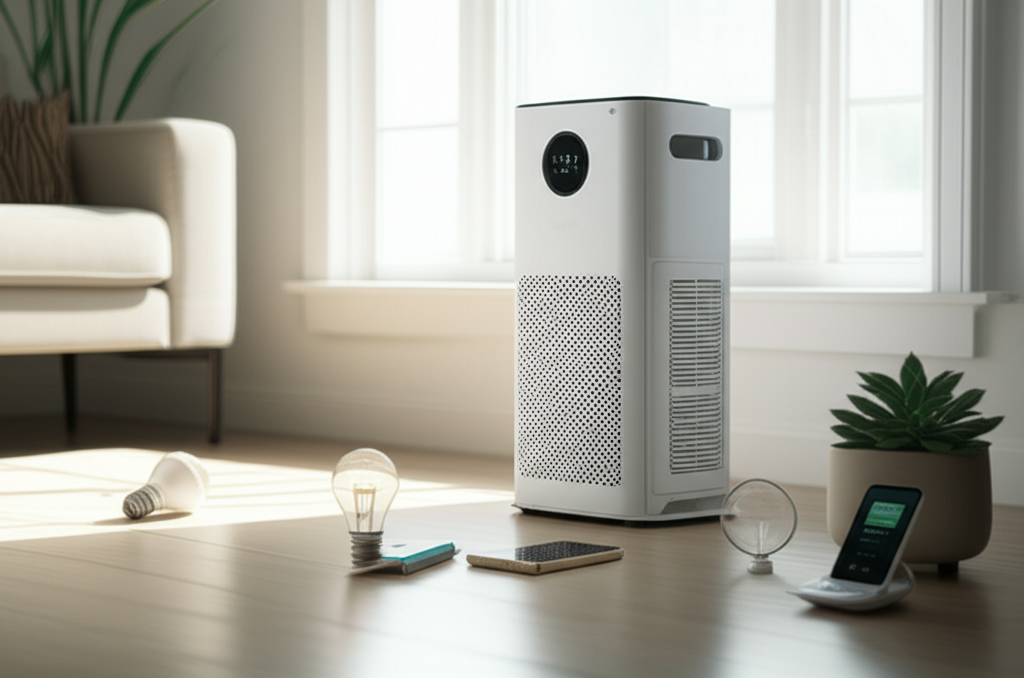
Several key elements contribute to how much electricity an air purifier draws. Understanding these will help you gauge potential energy costs and make informed purchasing decisions.
Fan Speed: The most significant factor influencing energy consumption is the fan speed. Higher speeds move more air, thus requiring more power. Running your air purifier on its lowest effective setting is the most energy-efficient approach.
Unit Size and CADR: Larger units designed for bigger rooms or those with higher Clean Air Delivery Rates (CADR) generally require more powerful motors and thus consume more energy. CADR measures how quickly an air purifier filters specific pollutants like smoke, dust, and pollen.
Filter Type: While filters don’t directly consume electricity, the type of filtration system can indirectly affect energy use. For example, some advanced filtration systems might require more powerful fans to push air through denser materials.
Additional Features: Features like UV-C germicidal lights, ionizers, or built-in humidifiers/dehumidifiers can add to the overall energy consumption of the unit. These components require their own power source.
Age and Efficiency Rating: Older models may be less energy-efficient than newer ones. Look for Energy Star certified models, which are designed to meet strict energy efficiency guidelines set by the U.S. Environmental Protection Agency.
The Role of Fan Speed in Energy Usage
The fan is the heart of an air purifier, circulating air through the filtration system. Its speed directly correlates with power draw, making it the primary variable in energy consumption.
When an air purifier is set to its highest fan speed, it will draw the most power. Conversely, the lowest fan speed will result in the lowest energy consumption. For continuous operation, especially overnight, using the lowest setting that effectively cleans your air is crucial for saving energy. Many users find that a medium or low setting is sufficient for maintaining good air quality in a typical room.
Understanding Wattage and Kilowatt-Hours (kWh)
To truly understand energy use, it’s important to know about wattage and kilowatt-hours. Wattage is the rate at which an appliance uses energy, while kilowatt-hours measure the total energy consumed over time.
Wattage (W): This is the power consumption rating you’ll find on the appliance’s label. For example, an air purifier might be rated at 50W.
Kilowatt-hour (kWh): This is the unit used by utility companies to bill you for electricity. One kWh is equal to using 1000 watts for one hour. To calculate daily energy use, you can use the formula: (Wattage / 1000) Hours of Use = kWh.
For example, a 50W air purifier running for 24 hours a day would consume (50 / 1000) 24 = 1.2 kWh per day.
Comparing Air Purifier Energy Use to Other Appliances
Placing the energy consumption of air purifiers into context with other household appliances can be very reassuring. Most air purifiers are remarkably energy-efficient when compared to many other common electronics.
Here’s a general comparison:
| Appliance | Typical Wattage Range |
| :—————– | :——————– |
| Air Purifier | 15 – 100 W |
| LED Light Bulb | 5 – 15 W |
| Smartphone Charger | 5 – 20 W |
| Laptop | 30 – 70 W |
| Television (LED) | 50 – 150 W |
| Refrigerator | 100 – 200 W |
| Microwave Oven | 600 – 1200 W |
As you can see, even a powerful air purifier typically uses less energy than a refrigerator and is comparable to or less than a television. This comparison helps to alleviate concerns about significantly increased electricity bills.
Energy Star Certification: A Mark of Efficiency
The Energy Star label is a voluntary program developed by the U.S. Environmental Protection Agency (EPA) and the U.S. Department of Energy. It identifies products that meet strict energy efficiency guidelines.
Choosing an Energy Star certified air purifier means you are selecting a model that has been independently tested and verified to use less energy than standard models without sacrificing performance. These units are designed to be more efficient in their motor, fan, and overall operation. This certification is a strong indicator that the air purifier will not use a lot of energy.
How Energy Star Models Save Power
Energy Star certified air purifiers achieve their efficiency through various design improvements. These can include more efficient motors, optimized fan blades, and improved airflow dynamics.
They often use advanced sensors to adjust fan speed automatically based on detected air quality, ensuring they only use the energy needed. This intelligent operation prevents the unit from running at full power unnecessarily, leading to substantial energy savings over time.
Factors Beyond Wattage: Understanding True Cost
While wattage is the primary indicator, other factors contribute to the overall cost and energy impact of an air purifier. These include the cost of replacement filters and how often you run the unit.
The cost of replacement filters can add up over the lifespan of an air purifier. While not directly related to energy consumption, it’s an important part of the total ownership cost to consider. Some HEPA filters may need replacement every 6-12 months, depending on usage and air quality.
The Impact of Running Time
The total energy consumed is a product of wattage and the duration the appliance is in use. An air purifier with a higher wattage but used for only a few hours a day might consume less energy overall than a lower-wattage unit that runs continuously.
For optimal air quality and energy efficiency, consider running your air purifier on an automatic or low setting for extended periods rather than on high for short bursts. This provides consistent air cleaning with minimal energy impact. Many modern air purifiers have smart timers and sensors to manage this effectively.
Filter Replacement and Energy Efficiency
While filters themselves don’t consume electricity, clogged or old filters can force the fan to work harder, thus increasing energy consumption. Regular filter maintenance is crucial for both performance and efficiency.
A dirty pre-filter can restrict airflow, making the fan struggle to pull air through. Similarly, a saturated HEPA filter will impede the passage of air. Replacing filters according to the manufacturer’s recommendations ensures optimal airflow and keeps energy usage at its intended level.
When Do Air Purifiers Use More Energy?
Certain situations and settings will naturally lead to higher energy consumption from your air purifier. Recognizing these scenarios can help you manage usage and expectations.
High Fan Speeds: As previously discussed, running the fan on its highest setting for extended periods will significantly increase energy usage. This is often done to quickly clear a room of pollutants after an event like cooking or when dealing with strong odors.
Larger Room Coverage: Air purifiers designed for larger spaces typically have more powerful motors to circulate air effectively across a wider area. These units will inherently consume more energy than smaller models.
Continuous Operation on High: Leaving an air purifier on its highest setting 24/7 is the most energy-intensive way to operate it. This is rarely necessary for maintaining good air quality.
Dealing with High Pollution Events
During periods of unusually high indoor air pollution, such as during wildfire smoke events or when significant dust is stirred up, you might need to run your air purifier on a higher setting. This is when it will use more energy to quickly improve air quality.
Many air purifiers are equipped with air quality sensors that automatically increase fan speed when pollution levels rise. This ensures rapid cleaning while still attempting to optimize energy use by returning to lower settings once the air is clean.
The Trade-off: Performance vs. Energy Savings
There’s often a direct trade-off between the speed at which an air purifier cleans the air and its energy consumption. A higher CADR unit or a higher fan speed will clean the air faster but use more electricity.
For most daily use, a balance is key. You want a unit that effectively cleans your air without running your energy bills sky-high. For example, a unit rated for a 500 sq ft room might only need to run on a medium setting to maintain air quality in a 250 sq ft bedroom.
Smart Air Purifiers and Energy Management
The advent of smart technology has introduced air purifiers with enhanced energy management capabilities. These devices offer greater control and automation, leading to more efficient operation.
Smart air purifiers often connect to Wi-Fi and can be controlled via a smartphone app. This allows for remote monitoring, scheduling, and even integration with smart home ecosystems. This level of control can lead to significant energy savings by ensuring the purifier only runs when and how it’s needed.
App Control and Scheduling
Many smart air purifiers allow you to set schedules for operation. You can program them to run on lower, energy-saving settings overnight or when you’re typically away from home.
This scheduling feature ensures that your air is being purified consistently without you having to manually adjust settings. It also prevents the unit from running unnecessarily when you don’t need it, directly reducing energy consumption.
Automatic Mode and Air Quality Sensors
A key feature of many smart air purifiers is their automatic mode, powered by built-in air quality sensors. These sensors detect the presence of pollutants like PM2.5, VOCs, or odors and adjust the fan speed accordingly.
When air quality is good, the fan speed is reduced to save energy. When pollution is detected, the fan speed automatically increases to clean the air more effectively. This responsive operation is highly efficient and ensures optimal air quality with minimal manual intervention.
Choosing an Energy-Efficient Air Purifier: What to Look For
When shopping for an air purifier, several factors can help you identify models that are kind to your electricity bill. Prioritizing these features will lead to a more cost-effective and energy-efficient purchase.
Energy Star Certification: Always look for the Energy Star label. This is the most reliable indicator of energy efficiency.
Low Wattage Rating: Check the product specifications for the wattage. Compare models, especially those designed for similar room sizes.
Variable Fan Speeds: Ensure the unit has multiple fan speed settings, including a quiet, low-power option for continuous use.
CADR to Wattage Ratio: While not always explicitly stated, a higher CADR rating for a given wattage suggests better efficiency. This means it’s cleaning more air per watt of energy consumed.
Reading Product Specifications
Don’t hesitate to delve into the product specifications. Manufacturers are required to provide detailed information about power consumption.
Look for details like “Power Consumption” or “Rated Power” in watts. You might also find information on the noise level at different fan speeds, which often correlates with energy use (quieter usually means lower power).
Considering Room Size Appropriateness
Choosing an air purifier that is appropriately sized for your room is crucial. An undersized unit will struggle to clean the air effectively and may run constantly on high, using more energy. An oversized unit might be more powerful than necessary and consume more energy than required for the space.
Match the air purifier’s recommended room coverage area to the size of the space you intend to use it in. This ensures it operates efficiently without overexerting itself.
Tips for Minimizing Air Purifier Energy Use
Once you have your air purifier, there are several practical steps you can take to ensure it operates as energy-efficiently as possible. These habits can make a noticeable difference in your energy bills.
Use the Lowest Effective Fan Speed: For continuous operation, always opt for the lowest fan speed that maintains your desired air quality. This is the single most effective way to save energy.
Utilize Timers and Smart Features: If your air purifier has a timer or smart capabilities, use them to schedule operation during off-peak hours or when you’re not home.
Regularly Clean or Replace Filters: Dirty filters impede airflow, forcing the fan to work harder and consume more energy. Follow the manufacturer’s maintenance schedule.
Keep Doors and Windows Closed: Air purifiers work best in a sealed environment. Opening doors and windows allows polluted outdoor air to enter, making the purifier work harder.
Strategic Placement: Place your air purifier in a location where it can effectively circulate air. Avoid blocking air intakes or outlets.
The Importance of Regular Maintenance
Maintaining your air purifier is not just about performance; it’s also about efficiency. Neglecting maintenance can indirectly increase energy consumption.
Regularly cleaning washable pre-filters and replacing HEPA and activated carbon filters as recommended by the manufacturer ensures optimal airflow. This allows the fan to operate at its intended efficiency, preventing unnecessary energy waste.
Strategic Placement for Optimal Airflow
The placement of your air purifier can significantly impact its effectiveness and, consequently, its energy usage. Proper placement ensures efficient air circulation and filtration.
Avoid placing the unit in corners or behind furniture that could obstruct airflow. Allowing at least a foot of clearance around the unit ensures that air can be drawn in and expelled freely, maximizing its performance without requiring higher fan speeds.
Are Air Purifiers Worth the Energy Cost?
Considering the energy consumption, the question remains: are air purifiers worth the investment and ongoing energy cost? For many, the benefits to health and well-being far outweigh the energy expenditure.
Air purifiers can significantly reduce allergens, dust, pet dander, mold spores, and volatile organic compounds (VOCs) from your indoor air. This can lead to relief from allergy symptoms, asthma, and other respiratory issues. They also help to remove odors, creating a more pleasant living environment.
Health Benefits vs. Energy Consumption
The health benefits derived from cleaner indoor air can lead to tangible improvements in quality of life and potentially reduced healthcare costs. For individuals with respiratory sensitivities, an air purifier is often not a luxury but a necessity.
The energy cost of a typical air purifier is relatively low, especially when compared to other appliances. When weighed against the potential health improvements and comfort, most users find the energy expenditure to be a worthwhile investment.
Cost-Benefit Analysis: Energy vs. Health
To conduct a simple cost-benefit analysis, consider the average energy cost of running an air purifier and compare it to the potential benefits. For example, a 50W air purifier running 24/7 might cost around $30-$60 per year in electricity, depending on your local rates. This is often a small price to pay for improved respiratory health and a fresher home environment.
Many reputable sources, like the U.S. Environmental Protection Agency, provide further information on indoor air quality and the role of air cleaners.
Frequently Asked Questions About Air Purifier Energy Use
How much electricity does a typical air purifier use per day?
A typical air purifier uses between 0.36 kWh (24 hours 15W) and 2.4 kWh (24 hours * 100W) per day. Most fall within the lower to middle range, making their daily energy consumption quite modest.
Will an air purifier significantly increase my electricity bill?
For most users, an air purifier will not significantly increase their electricity bill. When used efficiently and choosing an Energy Star model, the added cost is often minimal, comparable to running a few light bulbs.
Can I leave my air purifier on all the time?
Yes, you can leave your air purifier on all the time, especially if you use a lower fan speed or an automatic mode. Continuous operation at lower settings is often more energy-efficient than frequent on-and-off cycles and ensures consistent air purification.
Do HEPA filters use more energy?
HEPA filters themselves do not use energy. However, their dense structure can sometimes require a more powerful fan to push air through, potentially increasing energy consumption compared to less efficient filter types.
What is the most energy-efficient way to use an air purifier?
The most energy-efficient way is to use the lowest effective fan speed, utilize timers or smart scheduling, ensure filters are clean, and choose an Energy Star certified model appropriate for your room size.
Conclusion: Energy Efficiency is Achievable
In conclusion, the answer to “do air purifiers use a lot of energy?” is that they use energy, but it is generally manageable and often surprisingly low. By understanding the factors that influence consumption, choosing Energy Star certified models, and employing smart usage habits, you can enjoy the benefits of cleaner indoor air without a dramatic increase in your electricity bill. Prioritizing efficiency ensures your air purifier is a valuable investment in your health and home comfort, not a drain on your resources.
