
Is It Worth Repairing an Old Vacuum Cleaner? Fix or Replace

Quick Answer
Yes, repairing an old vacuum cleaner is often worth it when the problem is minor, replacement parts are available, and the total repair cost is much lower than buying a comparable new vacuum. Fixing a belt, filter, hose, or removable battery can make financial sense. However, expensive motor damage, repeated breakdowns, or repair costs approaching half the price of a suitable replacement may make buying a new vacuum the better choice.
An old vacuum that stops picking up dirt does not necessarily belong in the trash. Sometimes the problem is a blocked hose or worn belt. Other times, the motor is failing and the repair could cost more than the machine is worth.
The difficult part is deciding how much money to spend on equipment that may already have years of wear.
Before paying for repairs, compare the vacuum’s condition, the likely fault, the complete repair estimate, and the price of a suitable replacement. A few simple checks can make that decision much easier.
When Is an Old Vacuum Cleaner Worth Repairing?
An old vacuum is generally worth repairing when one identifiable fault is stopping an otherwise reliable machine from working properly.
Age matters, but it should not be the only deciding factor. A well-maintained premium vacuum may still be useful after many years, while an inexpensive vacuum with several failing components may not justify a repair bill.
Repairing is more attractive when:
- The problem is minor: A clogged hose, dirty filter, worn belt, or damaged attachment may be inexpensive to fix.
- Cleaning performance was previously good: The vacuum handled your floors effectively before the recent problem.
- Replacement parts are available: Correct parts can be purchased without excessive shipping costs or complicated modifications.
- The machine has a good repair history: This is its first meaningful failure rather than another in a series of breakdowns.
- The repair is reasonably priced: Parts and labor cost substantially less than replacing the vacuum with a comparable machine.
A useful starting point is to compare the estimate with the price of a new vacuum that meets the same cleaning needs.
In its vacuum repair guidance, Consumer Reports describes the half-of-replacement-cost rule as a practical limit for many older machines. That guidance is a rule of thumb, not a guarantee that a repair will be worthwhile.
If an older vacuum requires a repair costing more than half the price of a comparable new one, replacement deserves serious consideration.
How Much Should You Spend Repairing an Old Vacuum?

The amount worth spending depends on the vacuum’s replacement value, overall condition, and likely remaining useful life.
Do not compare a repair estimate with the original purchase price alone. Compare it with what you would actually need to spend today to buy a machine offering similar cleaning performance and useful features.
For example, imagine your vacuum needs a $60 repair and a suitable new model costs $240. The repair represents 25% of the replacement cost. If the rest of the vacuum is in good condition, repairing it could be reasonable.
Now imagine the repair costs $170. That represents approximately 71% of the same replacement price. Spending that much on an aging machine with an uncertain future is harder to justify.
The following ranges are practical decision guidelines, not measured probabilities or universal repair standards.
| Repair Cost vs. Replacement | Suggested Decision |
|---|---|
| Under 25% | Repair is often attractive if the fault is clear. |
| 25%–50% | Consider age, condition, and future reliability. |
| Over 50% | Replacement deserves stronger consideration. |
| Near replacement cost | Usually replace unless the machine has special value. |
These percentages work best as an initial screen. A repairable, expensive canister vacuum and an inexpensive stick vacuum may deserve different decisions even when the repair percentages match.
Ask for an itemized estimate covering diagnosis, parts, labor, taxes, and any applicable service fees. Check whether the estimate includes a repair warranty.
Which Vacuum Cleaner Problems Are Usually Worth Fixing?
Problems involving ordinary maintenance or replaceable components are generally the most promising repair candidates.
1. Weak Suction From Clogs or Dirty Filters
Weak suction often comes from restricted airflow rather than a failed motor.
A full dustbin, blocked wand, dirty filter, or packed hose can prevent the vacuum from picking up debris properly.
Before arranging a repair, disconnect the machine from power and inspect its accessible airflow path. Our guide to what happens when a vacuum filter is clogged explains how restricted airflow affects cleaning performance.
Clean only washable filters identified as washable in the manufacturer’s instructions. Replace damaged or non-washable filters as directed.
2. Broken Belts and Tangled Brush Rolls
A vacuum may run normally but struggle to clean carpets when its rotating brush stops turning.
Hair, thread, string, and other debris can jam the brush roll. Some vacuum designs also use a replaceable drive belt that stretches, slips, or breaks.
Removing tangles or fitting the correct replacement belt can restore normal brushing action without requiring a new vacuum.
However, a brush roll with damaged bearings or a faulty electrical drive may require a more substantial repair.
3. Damaged Vacuum Hoses
Small leaks in a detachable, non-electrified vacuum hose may be repairable. Severely torn or crushed hoses are often better replaced.
The location of the damage matters. A split near a removable cuff may offer different repair options from a long tear through the hose body.
For suitable hose designs, our vacuum hose leak repair guide explains which damage may be fixable and when hose replacement is more sensible.
Do not attempt improvised repairs on hoses containing electrical conductors.
4. Worn Cordless Vacuum Batteries
A cordless vacuum with much shorter runtime may need a replacement battery rather than an entirely new machine.
Battery replacement is especially appealing when the manufacturer offers a compatible removable pack and the remaining components function correctly.
Check our guide on how to replace a vacuum battery before ordering a part. Battery design, voltage, connectors, and service requirements differ between models.
Do not open or rebuild a lithium-ion battery pack as a casual home repair.
When Is Replacing the Vacuum Cleaner the Better Choice?
Replacement becomes more reasonable when repairing one problem will not address the machine’s larger condition or reliability issues.
Consider replacing the vacuum when:
- The motor has major damage: A replacement motor and professional labor may cost too much relative to the machine.
- Several components are failing: Multiple repairs increase the total expense and the chance of further problems.
- Parts are discontinued: The required component cannot be sourced reliably.
- Breakdowns keep returning: Previous repairs have not restored dependable operation.
- The vacuum no longer suits your home: It struggles with your current floors, cleaning needs, or accessibility requirements even when functioning normally.
A failing motor deserves particular care because unusual noises, reduced performance, and shutdowns do not always prove that the motor itself is defective.
Our article on whether a vacuum motor can be repaired explains why some motor-related faults are serviceable while others require replacement.
Warning
Stop using a vacuum that produces smoke, sparks, melting plastic, an electrical burning smell, or abnormal heat from a damaged battery. Disconnect power if safe to do so. Do not repeatedly restart the machine or open electrical components to investigate. Seek qualified service or replace the vacuum.
Does the Age of Your Vacuum Cleaner Matter?
Yes, but there is no single age at which every vacuum should be discarded.
Age is useful because internal components experience wear, plastic parts may become brittle, and replacement parts can become harder to obtain.
However, years of ownership do not reveal how many hours a vacuum has operated or how well it has been maintained.
Two seven-year-old machines can have very different conditions. One might have received regular filter changes and occasional use. Another may have cleaned a large home daily while repeatedly overheating.
Judge age alongside:
- Frequency and intensity of use
- Maintenance history
- Availability of compatible parts
- Previous repair costs
- Current cleaning performance
- Condition of the motor, housing, cord, and attachments
A decade-old vacuum with a minor belt problem may be worth saving. A relatively new machine with extensive water damage or serious electrical faults may not be.
What Should You Check Before Paying for Vacuum Repairs?
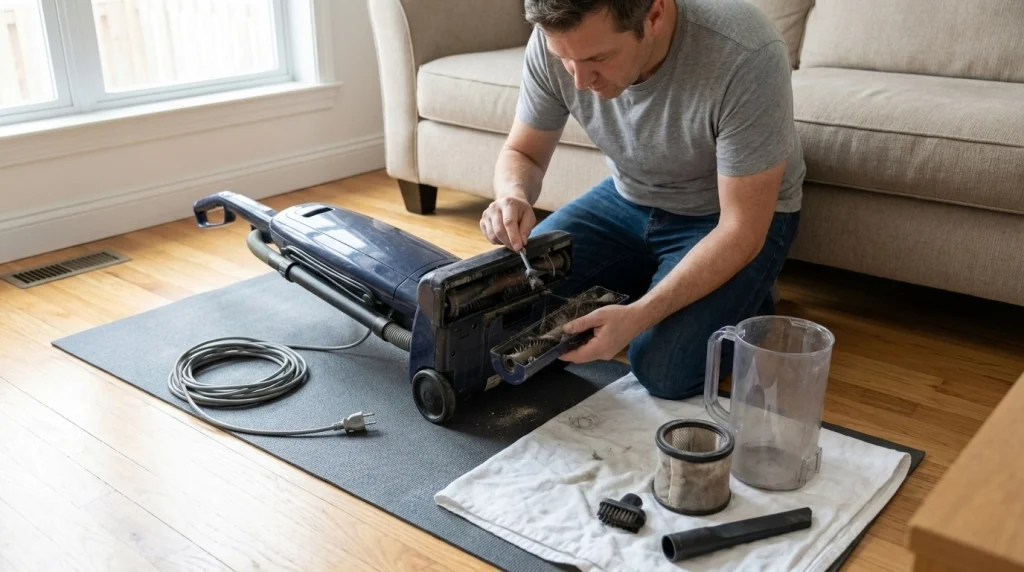
Start with simple, non-electrical checks before assuming an expensive component has failed.
- Disconnect power: Unplug a corded vacuum or remove its user-removable battery according to the manual.
- Check the dustbin or bag: Empty or replace it if full.
- Inspect accessible hoses and wands: Remove visible blockages without damaging internal surfaces or wiring.
- Check the filters: Clean or replace them using the manufacturer’s instructions.
- Examine the brush roll: Remove hair and debris from accessible components after confirming the machine cannot start accidentally.
- Inspect external damage: Look for cracked housings, damaged cords, or signs of battery deterioration.
- Reassemble and test safely: Restart only if there are no electrical warning signs and all components are correctly installed.
These checks can help distinguish ordinary maintenance from a likely mechanical or electrical fault.
The iFixit vacuum repair guide collection also provides model-specific resources for some common replacement tasks.
If the vacuum keeps overheating after its airflow path has been cleared, stop testing and investigate the cause. Our guide to why a vacuum overheats covers common causes and warning signs.
How to Make the Final Repair-or-Replace Decision
The strongest decision considers not only what a repair costs today, but what you can reasonably expect afterward.
Use this simple process:
- Identify the actual fault: Avoid paying for a motor replacement when the problem is only a blocked filter.
- Get the complete repair price: Include parts, labor, diagnosis, and transport when applicable.
- Find a comparable replacement: Choose a machine that suits the same floors and cleaning tasks.
- Evaluate remaining condition: Check whether other components show signs of approaching failure.
- Consider repair guarantees: A written warranty on the work reduces some financial uncertainty.
- Compare likely future usefulness: Choose the option providing dependable cleaning at a reasonable total cost.
Key Insight
A cheap repair is not automatically a good repair. It makes sense when it restores a machine you can reasonably expect to keep using. Likewise, replacing an old vacuum is not automatically better simply because newer models exist.
For example, imagine a six-year-old canister vacuum that still cleans effectively but needs a $45 hose replacement. Repairing it may provide excellent value.
Now consider an aging budget vacuum needing a motor, brush assembly, and damaged power cord replaced. Even if each fault is technically repairable, the combined cost and uncertainty may favor replacement.
Repairing also reduces the immediate need to discard an appliance. However, environmental benefits depend on factors such as the replacement part, the machine’s remaining life, and how the old equipment is handled.
Frequently Asked Questions
Can a 10-year-old vacuum cleaner still be worth repairing?
Yes. A 10-year-old vacuum may be worth repairing if it is well maintained, compatible parts are available, and the fault is inexpensive. The overall condition matters more than age alone.
Is it worth repairing a cheap vacuum cleaner?
It can be worth repairing a cheap vacuum when the fix involves cleaning, unclogging, or replacing an inexpensive part. Professional labor for major mechanical or electrical repairs may exceed its practical replacement value.
Can a vacuum cleaner work like new after repairs?
Sometimes. Replacing the component responsible for poor performance may restore normal operation. However, repairing one fault does not reverse wear in unrelated components or guarantee the vacuum’s original performance.
Should I repair a vacuum that keeps shutting off?
First check for a full dustbin, clogged filter, or blocked airflow path after disconnecting power. If shutdowns continue, professional diagnosis may be necessary. Do not keep restarting a machine showing overheating or electrical warning signs.
Are replacement parts available for discontinued vacuums?
Sometimes. Manufacturers, authorized parts suppliers, and specialist repair shops may carry compatible components for discontinued models. Always confirm the exact model and part number before purchasing.
Is it better to repair or replace a robot vacuum?
It depends on the fault. Replacing a compatible brush, wheel, or user-serviceable battery may be reasonable. Expensive navigation electronics, charging faults, or multiple component failures can make replacement more attractive.
Final Verdict: Should You Fix Your Old Vacuum?
Repairing an old vacuum cleaner is worth considering when the fault is minor, the machine remains dependable, and the cost is comfortably below that of a suitable replacement.
Start with safe maintenance checks, confirm the problem, and compare complete costs before deciding.
If the motor has serious damage, repairs keep recurring, or the estimate approaches the cost of a new vacuum, replacement may provide better long-term value.
The goal is not to keep every vacuum running forever. It is to get dependable cleaning without spending more than necessary.
