
Can You Repair a Vacuum Motor? Fix or Replace

Quick Answer
Yes, you can repair some vacuum motors, but it depends on the damage and motor design. Replaceable carbon brushes, certain bearings, and loose connections may be repairable by a qualified technician. Burned windings, severe internal damage, or sealed motor assemblies often make replacement more practical. Before assuming the motor has failed, check for clogged filters, blocked hoses, overheating, and power problems.
A vacuum that suddenly stops working can make you think its motor has burned out. But a silent machine, weak suction, or an unusual noise does not automatically mean the motor needs replacing.
The practical challenge is finding out whether the problem is inside the motor, somewhere in the vacuum’s airflow system, or in another electrical component.
Some problems are simple maintenance jobs. Others require a replacement motor assembly or professional electrical repair. Knowing the difference helps you avoid unnecessary expense and unsafe repair attempts.
Which Vacuum Motor Problems Can Actually Be Repaired?
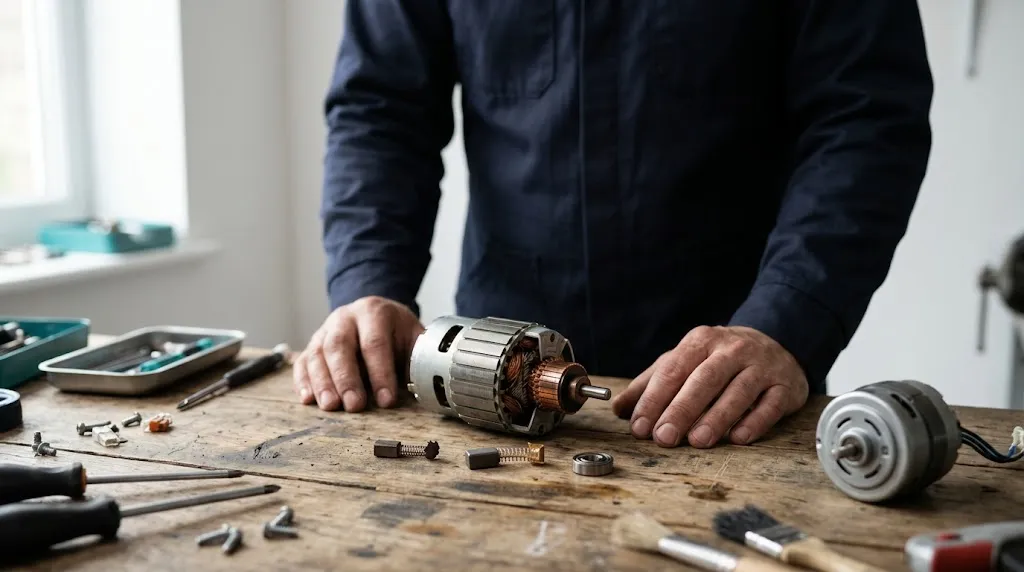
Some motor faults involve replaceable components. Others damage the core of the motor so badly that installing a replacement assembly is the more sensible option.
The motor type matters. Older vacuum cleaners may use serviceable brushed motors, while many newer cordless models use compact brushless motors with integrated electronic controls. Not every manufacturer supplies individual internal parts.
Worn Carbon Brushes
Some brushed vacuum motors use carbon brushes to carry electricity to the rotating commutator. These brushes wear down during operation.
When they become too short or lose proper contact, the motor may start intermittently, run unevenly, or stop altogether.
If the manufacturer supplies suitable replacement brushes and the commutator remains in usable condition, a technician may be able to restore the motor without replacing the whole unit.
However, brush replacement will not fix a burned armature or severely damaged commutator. Brushless motors do not have carbon brushes to replace.
Worn or Damaged Bearings
Motor bearings support the rotating shaft. As they wear, they may develop excessive noise, vibration, friction, or resistance.
Some motors have replaceable bearings. Others use sealed or difficult-to-disassemble assemblies, making a complete motor replacement more realistic.
A grinding sound is worth investigating, but it does not prove the bearings are bad. Debris touching an impeller, damaged fan components, and loose parts can produce similar noises.
Loose Connections or Faulty Electrical Controls
A defective switch, connector, wire, or motor-control circuit can prevent an otherwise functional motor from starting.
Repairing the actual failed part may restore operation. The important distinction is that an electrical supply problem is not necessarily a motor defect.
These faults require appropriate electrical testing. Internal wiring should not be disturbed by someone unfamiliar with appliance electrical safety.
Burned Windings or Severe Internal Damage
Motor windings contain insulated electrical conductors. If that insulation breaks down, the motor can develop short circuits, overheating, or complete failure.
Specialist motor rebuilding is technically possible for some designs, but it is generally impractical for many household vacuum motors.
Severe winding damage, melted components, heavily damaged commutators, and certain integrated electronic failures commonly favor replacement over component-level repair.
How Can You Tell Whether Your Vacuum Motor Is Bad?
No single symptom proves that a vacuum motor has failed. Start by identifying what the machine actually does.
| Symptom | Possible Explanation | First Action |
|---|---|---|
| Vacuum will not start | Power, battery, switch, protection system, or motor fault | Check external power and cooling requirements |
| Stops after running | Overheating, airflow restriction, battery, or electrical fault | Disconnect power, cool, inspect airflow |
| Motor runs but suction is weak | Clog, dirty filter, leak, or fan damage | Inspect dust collection and airflow path |
| Grinding or rattling | Debris, loose fan part, bearing, or floorhead issue | Stop and inspect accessible components |
| Smoke or electrical burning smell | Potential electrical or motor damage | Disconnect power and arrange qualified assessment |
These symptoms narrow the possibilities but cannot confirm which internal part has failed. A technician may need to inspect the motor, power circuit, or electronics before recommending repair.
What Should You Check Before Repairing the Motor?
Begin with basic checks that do not require opening the motor housing. They can reveal an inexpensive problem that only looks like motor failure.
- Disconnect power. Unplug a corded vacuum. For a cordless model, switch it off and remove the battery only when the manufacturer permits removal.
- Check the power supply. Verify that the outlet works using another suitable appliance. Inspect the vacuum’s cord and plug visually without touching exposed conductors. For cordless models, check charging indicators and approved battery connections.
- Empty the dust container. Replace a full bag or empty the bin. Packed debris can restrict airflow and contribute to overheating.
- Inspect the hose and wand. Detach accessible sections as directed by the manual. Look for hair, paper, lint, or larger objects blocking airflow.
- Check the filters. Clean washable filters only as instructed. Replace nonwashable or damaged filters and let washed filters dry completely before reinstalling them.
- Examine the floorhead. Remove accessible hair and string around the brush roll. On belt-driven models, inspect the belt if the manual permits.
- Allow the vacuum to cool. If it shut down during operation, follow the manufacturer’s thermal-reset instructions before one cautious restart.
If the vacuum works normally after clearing a blockage or cleaning a filter, an internal motor repair may not be necessary.
For detailed filter care, see our guide on how to clean a blocked vacuum filter safely.
Warning
Do not repeatedly restart a smoking, sparking, or electrically damaged vacuum. Never bypass thermal protection or operate the motor outside its housing. Some appliances contain electrical components that can retain a hazardous charge after disconnection.
Can an Overheated Vacuum Motor Work Again?
Yes. If a vacuum stopped because its thermal protection activated, it may work again after cooling and correcting the cause.
Many vacuum cleaners rely on airflow for cooling. A blocked hose, dirty filter, or full container can restrict the airflow needed for normal operation.
For example, Electrolux advises checking filters and blockages, then allowing an overheated vacuum to cool for at least 30 minutes. The exact cooling time depends on the model.
Our article on how a clogged vacuum filter can cause overheating explains this relationship in greater detail.
If the machine resumes normal operation and stays cool after maintenance, the shutdown may have been protective rather than evidence of permanent motor damage.
However, frequent shutdowns despite clear airflow and correct maintenance need professional investigation. Cooling a damaged motor does not repair the underlying defect.
Can You Repair a Vacuum Motor Yourself?
Basic vacuum maintenance is often suitable for home users, but repairing the internal motor is a different level of work.
Most owners can safely perform manufacturer-approved tasks such as emptying the bin, cleaning accessible filters, clearing hoses, and removing brush-roll tangles.
Internal motor work may involve electrical testing, soldering, precise mechanical assembly, insulation checks, and confirming that the repaired appliance remains electrically safe.
A motor that appears easy to remove is not necessarily safe to dismantle. Some assemblies include capacitors, high-speed rotating components, sealed bearings, or electronic controllers.
For these reasons, internal brush replacement, bearing replacement, winding repairs, and electrical diagnostics are better left to qualified repair personnel unless the manufacturer expressly provides a user-serviceable procedure.
Bosch recognizes professional motor repair as a service option and directs customers toward trained technicians and suitable replacement parts through its vacuum cleaner motor repair guidance.
Is It Better to Repair or Replace a Vacuum Motor?
Repair makes sense when the defect is identifiable, the parts are available, and the completed repair costs substantially less than a suitable replacement.
Motor replacement is often preferable when damage affects several internal components or when the motor is supplied only as a sealed assembly.
Consider these points before approving work:
- Parts availability: Can the manufacturer or repair provider supply the correct component?
- Motor design: Is it intended to be serviced, or replaced as one assembly?
- Repair cost: How does the complete estimate compare with a replacement vacuum?
- Machine condition: Are the battery, housing, floorhead, seals, and other components still in good shape?
- Warranty: Would an authorized repair be covered, and could an unauthorized repair affect coverage?
- Repair reliability: Can the technician verify safe operation after the work?
For example, replacing accessible carbon brushes in an otherwise sound vacuum may be economical. Rebuilding a severely burned motor in an inexpensive cleaner may cost more than the practical benefit justifies.
A relatively new, high-quality machine with available replacement parts may justify a motor replacement even when the original motor cannot be rebuilt.
Key Insight
Repairing a motor and replacing a motor are different solutions. An individual motor component may be unrepairable, but the vacuum itself may still be worth saving with a compatible replacement motor assembly.
What If the Brush Motor Stops but the Suction Motor Still Works?
A stopped floor brush does not necessarily mean the main suction motor is broken.
Some vacuum cleaners have a separate motor inside the powered cleaning head. Other models use a drive belt or mechanical connection to turn the brush roll.
If the vacuum still produces suction but the brush no longer turns, start with the floorhead rather than assuming the main motor needs repair.
Look for wrapped hair, a jammed roller, an incorrect floor setting, or an accessible damaged belt. Our vacuum brush-roll repair guide covers these checks in more detail.
If a powered floorhead remains unresponsive after normal troubleshooting, its wiring, connection, controller, or separate motor may need professional assessment.
How Can You Prevent Future Vacuum Motor Problems?
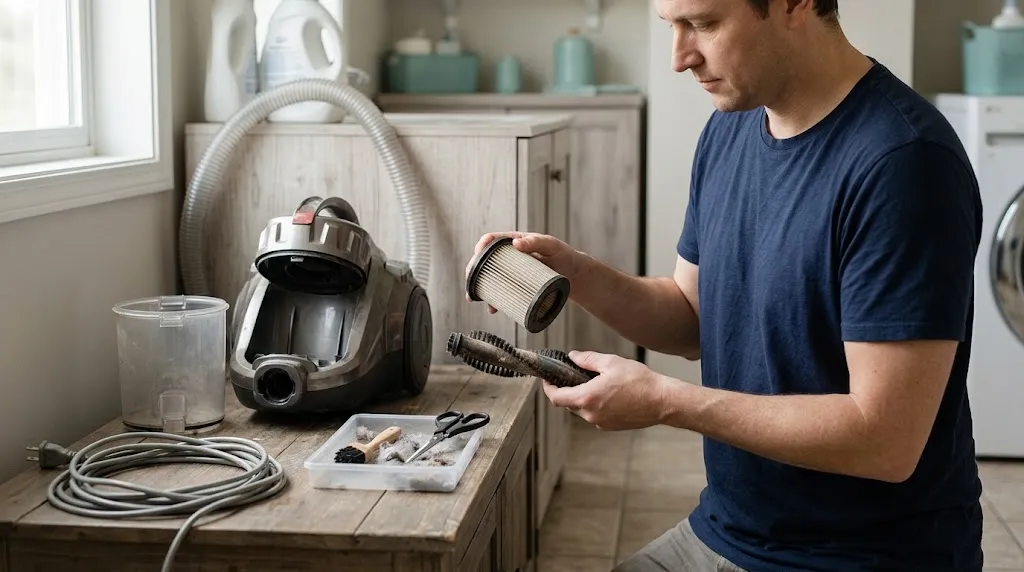
Good maintenance cannot prevent every motor failure, but it can reduce avoidable airflow restrictions, heat buildup, and mechanical strain.
- Empty the dust container before debris exceeds its recommended fill level.
- Clean or replace filters according to the specific model’s instructions.
- Remove hair and string from accessible brush-roll components.
- Inspect hoses and wands when suction drops or the motor sound changes.
- Use the correct attachments and floor settings.
- Keep moisture out of motors and electrical controls.
- Stop using the vacuum if it develops unusual electrical odors, sparks, or abnormal heat.
There is no universal filter-maintenance interval that suits every vacuum. Usage, construction, dust conditions, and manufacturer instructions all affect how frequently maintenance is needed.
For persistent burning odors, use our vacuum burning-smell troubleshooting guide to distinguish common airflow and belt issues from warning signs that warrant professional inspection.
Frequently Asked Questions
Can a burned-out vacuum motor be repaired?
Sometimes, but serious internal electrical damage often makes motor replacement more practical. A technician must determine whether the damage is limited to a replaceable component or affects the windings, armature, or other major parts.
Can you replace the carbon brushes in a vacuum motor?
Yes, on some brushed motors designed to accept replacement brushes. The replacement must match the motor, and the commutator must still be serviceable. Brushless vacuum motors do not use replaceable carbon brushes.
Can vacuum motor bearings be replaced?
Some can. Bearing replacement depends on the motor construction, suitable parts, and the ability to dismantle and reassemble it safely. Sealed motor assemblies are often replaced completely.
Does a humming vacuum mean the motor is broken?
Not necessarily. Humming may come from mechanical resistance, a jam, an electrical problem, or a damaged motor. Switch the vacuum off rather than repeatedly trying to start it, and have unresolved faults assessed.
Can water damage a vacuum motor permanently?
Yes. Water entering electrical components can damage insulation, bearings, or control electronics. Unless the vacuum is specifically designed for wet pickup, do not use it to collect liquid. Disconnect a wet or water-damaged machine and seek qualified assessment before reuse.
Can I use a different vacuum motor as a replacement?
Only when compatibility is confirmed. Motor dimensions, mounting, voltage, electrical requirements, airflow design, cooling, and safety features must all match. A motor that physically fits is not automatically a safe replacement.
Final Thoughts
Vacuum motors can sometimes be repaired, especially when the problem involves a serviceable component rather than severe internal damage. But a vacuum that refuses to start, overheats, or loses suction may not need motor repair at all.
Check accessible filters, hoses, dust collection, power supply, and brush-roll components first. If those checks do not resolve the problem, a qualified technician can determine whether component repair, motor replacement, or replacing the vacuum is the safest and most economical choice.
