
How Do I Fix a Vacuum Brush Roll? A Step-by-Step Repair Guide

Quick Answer
To fix a vacuum brush roll, disconnect the vacuum from power, remove wrapped hair and debris, check whether the roller turns freely, inspect the drive belt if your model uses one, and reinstall the roller correctly. If the brush still will not spin after these basic fixes, stop before opening electrical components and check your manual or professional repair options through resources such as Consumer Reports.
Quick repair steps
- 1. Disconnect power: Unplug a corded vacuum or remove the battery when the design allows it.
- 2. Remove tangles: Cut away hair, thread, string, and carpet fibers without damaging the bristles.
- 3. Check rotation: Look for debris packed around the roller ends or other accessible moving points.
- 4. Inspect the belt: On belt-driven models, replace a broken, stretched, damaged, or incorrectly seated belt with the correct part.
- 5. Reassemble carefully: Seat the brush roll, belt, end caps, and bottom plate exactly as your manual specifies.
- 6. Stop if needed: Burning smells, melted parts, damaged wiring, sparks, or repeated electrical faults need professional attention.
A vacuum brush roll that stops spinning can turn a good cleaner into a machine that pushes hair and crumbs around the floor. I usually start with the roller itself because hair, thread, debris, and belt problems are common and easy to inspect.
This guide covers the practical fixes you can safely try at home in 2026. It also explains when a brush-roll problem has moved beyond routine vacuum-cleaner maintenance and into professional repair territory.
In This Guide
- What is a vacuum brush roll, and what does fixing it mean?
- Why is my vacuum brush roll not spinning?
- How do I fix a vacuum brush roll step by step?
- How do I fix the belt, end caps, or roller bearings?
- How does the repair change between brush-roll designs?
- When should I replace the brush roll or call a professional?
- Frequently asked questions
What is a vacuum brush roll, and what does fixing it mean?
A vacuum brush roll is the rotating cylinder inside a floorhead that uses bristles, fins, or similar agitators to loosen debris from a floor surface. You may also see it called a roller brush, beater bar, agitator, or floorhead roller.
Not every vacuum uses the same system. Some rollers are turned by replaceable belts, while motorized floorheads may use a dedicated electric motor.
Air-driven turbine tools are different again. They use moving airflow to spin a small turbine connected to the brush.
First identify what is actually wrong
A brush roll can fail in several ways, and the correct repair depends on the symptom. Don’t buy a replacement roller before checking the simple causes.
- Roller will not move: Hair, thread, or debris may be locking the roller.
- Roller turns weakly: A belt may be slipping, or resistance may be building around the roller ends.
- Roller turns but cleans poorly: The bristles may be badly worn, or the floorhead height may be wrong for the surface.
- Brush works intermittently: The floorhead may have a switch, sensor, connection, or motor-related problem.
- Brush stops on rugs: Thick pile, rug fringe, or excessive resistance may be overloading the system.
Also separate a brush-roll problem from a suction problem. A clogged hose, loaded bag, blocked filter, or restricted intake can reduce pickup even when the brush is spinning normally.
For homes where dust and allergens matter, keep the vacuum’s filtration system maintained according to its manual. The U.S. Environmental Protection Agency provides broader guidance on filtration and indoor air quality.
Why is my vacuum brush roll not spinning?
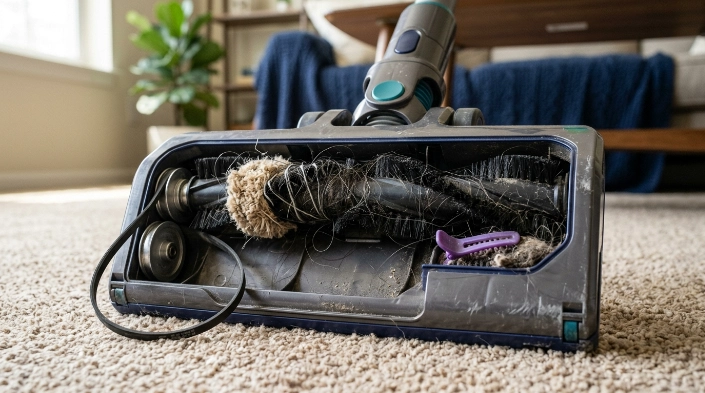
The most common causes are mechanical rather than electrical. Wrapped hair, jammed debris, a damaged belt, or resistance at the roller ends should usually be checked first.
Hair and thread are wrapped around the roller
Long hair can wind around the brush until the roller becomes difficult to rotate. Thread, dental floss, rug fibers, and string can create the same problem.
I pay particular attention to both ends of the roller. A brush may look clean through the middle while a tight ring of hair remains hidden beside an end cap.
The drive belt is damaged or displaced
Many upright vacuums use a rubber belt to transfer movement from the drive system to the brush roll. If that belt breaks or slips off, the roller stops even though the vacuum motor may still run.
A stretched belt can also allow the roller to turn weakly. Use only the belt type specified for your exact model.
A small object is blocking the floorhead
Coins, hair clips, toy pieces, paper, stones, rug fringe, and other debris can jam a roller suddenly. Stop the vacuum immediately if you hear a sharp change in sound.
Continuing to run a jammed system may create heat or damage another component. Remove the obstruction before testing again.
The roller ends are binding
Debris can accumulate around removable end caps, bushings, or bearing areas. That extra resistance may make a healthy belt appear weak.
Do not pour household oil into these areas unless your manufacturer specifically instructs you to lubricate them. Some sealed components are not designed for added lubricant.
The brush setting is turned off
Some vacuums let you disable brush rotation for hard flooring. Others stop the brush automatically when the handle is upright or when a floorhead protection system detects excessive resistance.
Check the floor mode, brush switch, handle position, and any warning lights before disassembling the cleaner.
How do I fix a vacuum brush roll step by step?
Start with cleaning and inspection before replacing parts. This approach solves common mechanical problems without taking apart sections that do not need to be opened.
- Disconnect the vacuum from power. Unplug a corded model. For a cordless vacuum, switch it off and remove the battery if your manufacturer’s instructions allow battery removal during servicing.
- Place the floorhead where you can see the roller. Protect the floor with a towel if needed. Avoid balancing a heavy upright where it can fall.
- Remove the soleplate if required. Some plates use screws, quarter-turn fasteners, clips, or tool-free locks. Follow the markings or owner’s manual.
- Cut wrapped fibers carefully. Use small scissors or a seam ripper where there is enough clearance. Keep the blade away from rubber belts, soft fins, wiring, and the roller surface.
- Pull debris away in sections. Remove hair and fibers from the center, between bristles, and around accessible roller ends.
- Inspect the intake opening. Look for solid objects or compacted debris immediately behind the roller.
- Check the roller’s movement. If the manual permits manual rotation while disconnected from power, confirm that it is not obviously binding.
- Inspect the drive system. If your model has an accessible belt, look for breakage, cracking, excessive stretching, twisting, or incorrect seating.
- Reinstall every part correctly. Make sure end caps sit in their proper slots and the belt follows the correct path.
- Test the vacuum briefly. Reconnect power only after covers and guards are secured. Stop immediately if you hear grinding or smell something burning.
Should you wash the vacuum brush roll?
Only wash a brush roll when the manufacturer says that specific part is washable. Motorized rollers and floorheads can contain bearings, electrical contacts, motors, or materials that should not get wet.
A removable washable roller must be fully dry before reinstallation. Never rinse the complete powered floorhead unless its instructions explicitly allow it.
What if cleaning does not restore movement?
If the roller is still stiff after visible debris is removed, inspect the accessible roller ends. Resistance there can indicate hidden hair, a damaged end cap, a seized component, or physical roller damage.
Do not force a roller that remains locked. Forcing it can make diagnosis harder and may damage the drive mechanism.
Section Takeaway: Start with debris removal, roller movement, and the belt before assuming the vacuum has a motor problem. Reassemble all guards before reconnecting power.
How do I fix the belt, end caps, or roller bearings?
A clean brush roll can still fail when its drive components are worn or obstructed. Belt-driven vacuums are often simpler to inspect than powered direct-drive floorheads.
How do you replace a vacuum brush-roll belt?
First confirm your vacuum actually uses a user-replaceable belt. The model number matters because belts can differ in length, width, shape, and elasticity.
- Disconnect power and open the floorhead only as the manual describes.
- Photograph the existing belt routing before removing anything if the path is not obvious.
- Remove the brush roll and old belt according to the manufacturer’s procedure.
- Clear hair or debris from the belt path and accessible roller ends.
- Install the exact compatible replacement belt.
- Seat the roller squarely in its mounting points.
- Rotate the mechanism by hand only if the manufacturer permits it.
- Reinstall the baseplate before testing.
If a new belt immediately slips, burns, or breaks, don’t keep fitting new belts. Something else may be creating excessive resistance.
What should you do about dirty end caps?
If your roller has removable end caps, check underneath them only when they are designed for user removal. Hair often winds tightly around the shaft area.
Clean away accessible debris without prying apart sealed bearings. Reinstall each cap on the correct side because some rollers use different left and right fittings.
Can you repair a seized bearing yourself?
A removable bearing assembly may be serviceable on some designs, while others use sealed parts or an integrated roller. Your model’s parts diagram or service instructions should decide what you attempt.
Expert Alert: Stop DIY work when repair requires opening a powered motor assembly, repairing wiring, bypassing a safety switch, or working on damaged electrical contacts. Use a qualified appliance repair technician instead.
General household electrical-safety information is also available from the Centers for Disease Control and Prevention and other public safety authorities, but your vacuum manufacturer’s service instructions should control model-specific repairs.
How does the repair change between brush-roll designs?
There is no single brush-roll repair procedure for every vacuum. Identifying the drive design helps you avoid taking apart the wrong component.
| Brush-roll system | How it spins | Common checks | DIY repair level |
|---|---|---|---|
| Belt-driven roller | A belt transfers movement to the brush roll. | Tangles, belt condition, belt seating, roller ends. | Often suitable for routine DIY maintenance when the manual permits it. |
| Motorized or direct-drive head | A dedicated electric drive powers the roller. | Tangles, removable roller, contacts, connections, warning indicators. | Cleaning may be DIY; internal electrical repair usually is not. |
| Air-driven turbine tool | Airflow turns a turbine connected to the brush. | Hair, intake blockage, turbine obstruction, airflow restriction. | External cleaning is often practical; internal disassembly depends on the model. |
| Soft roller or dual-roller head | One or more powered rollers collect fine debris and larger particles. | Roller removal, hair at ends, obstructions, correct roller placement. | Routine cleaning may be simple, but the drive assembly may require service. |
Never assume a cordless motorized head has the same repair procedure as an older upright. What looks like a simple brush housing can contain a motor, wiring, sensors, and electrical contacts.
What if the roller spins but the vacuum still leaves dirt behind?
Look beyond the brush. Check the dust container or bag, hose, filters, floorhead opening, and seals according to the owner’s manual.
If allergies are a concern, organizations such as the Asthma and Allergy Foundation of America publish broader household guidance on reducing dust and allergen exposure. A working brush roll is only one part of the vacuum’s cleaning system.
When should I replace the brush roll or call a professional?
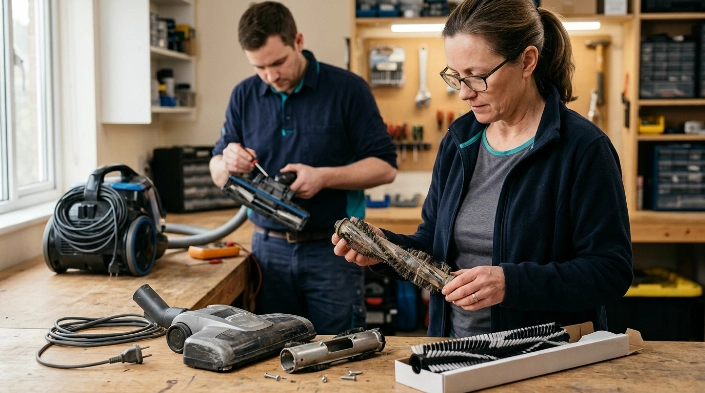
Replace the roller when cleaning cannot correct physical wear or damage. Professional service is the safer choice when the fault involves electrical parts or repeated overheating.
Signs the brush roll itself may need replacement
- Broken bristles or fins: Large damaged sections can reduce normal floor agitation.
- Cracked roller body: Structural damage can cause vibration or poor alignment.
- Warping: A distorted roller may rub against the housing.
- Persistent binding: The roller remains difficult to move after accessible debris is removed.
- Damaged mounting ends: Worn or broken end fittings may prevent correct seating.
- Repeated abnormal noise: Grinding or rattling returns despite correct cleaning and assembly.
When should you stop using the vacuum?
Stop immediately if you see smoke, sparks, melted plastic, exposed wires, or severe cord damage. A strong electrical or burning smell also deserves attention before further use.
If an appliance repeatedly causes an electrical fault, treat that as more than a brush-cleaning problem. Don’t bypass switches, thermal protection, or other safety devices.
Expert Alert: Electrical repairs inside a powered floorhead or vacuum body should be handled by a qualified technician unless the manufacturer specifically provides a user-service procedure for that component.
How can you prevent another brush-roll jam?
I find quick visual checks more useful than waiting for the roller to stop completely. A few strands are easier to remove than a tightly compressed layer around both ends.
- Check the roller regularly for long hair, pet fur, string, and thread.
- Pick up cords, shoelaces, small toys, and loose fabric before vacuuming.
- Avoid running the floorhead over rug fringe unless the vacuum is designed for it.
- Empty the bin or maintain the bag before airflow becomes heavily restricted.
- Clean or replace filters only at the intervals and by the methods your manual specifies.
- Use the correct floor setting for carpet, rugs, and hard flooring.
- Investigate new noises instead of continuing to vacuum until something fails.
Keeping the rest of the machine maintained matters too. For general health information related to dust, allergens, and household environments, the National Institutes of Health is another useful authority resource.
Frequently asked questions
Why is my vacuum brush not spinning even after I removed the hair?
The problem may be a broken or slipping belt, debris around the roller ends, incorrect assembly, a brush switch setting, or a fault in a motorized floorhead. Check the owner’s manual before opening any powered components.
Can I use WD-40 or oil on a vacuum brush roll?
Don’t add lubricant unless the vacuum manufacturer specifically recommends it for that component. Many rollers use sealed bearings, bushings, plastics, or drive parts that aren’t designed for general-purpose household lubricants.
Can I cut hair off a vacuum brush roll with scissors?
Yes, if you have disconnected the vacuum from power and have enough clearance to cut safely. Use small scissors carefully and keep the blades away from the belt, wiring, rubber fins, and roller surface.
How do I know if my vacuum brush-roll belt is broken?
On a belt-driven vacuum, the roller may stop while the main vacuum motor continues running. Disconnect power and inspect the belt according to the manufacturer’s instructions rather than reaching into the floorhead while it operates.
Why does my vacuum brush roll keep stopping on carpet?
The carpet may be too thick for the current floor setting, or hair and debris may be creating extra resistance. Rug fringe can also jam a roller, while some vacuums automatically stop the brush when resistance becomes excessive.
Should a vacuum brush roll spin freely by hand?
There is no universal amount of resistance because brush-roll designs differ. With the vacuum disconnected, follow the manual’s inspection procedure and look for obvious binding rather than assuming every roller should free-spin identically.
Is it worth replacing a vacuum brush roll?
It often makes sense when the roller is the confirmed problem and a correct replacement part is available. Compare the part cost, vacuum age, condition of the rest of the machine, and whether additional motor or electrical repairs are needed.
Final takeaway: Most vacuum brush-roll problems start with tangles, obstructions, worn belts, or debris around the roller ends. Begin with those simple checks, follow your model’s manual, and stop before turning a routine cleaning job into an electrical repair.
If the roller is clean, correctly installed, and still refuses to work, identify the exact vacuum model before buying parts. That one step can save you from replacing a perfectly good brush roll when the real fault is somewhere else.
“`
