
Is Air Duct Cleaning Worth It? When You Need It (and When You Don’t)

Quick answer
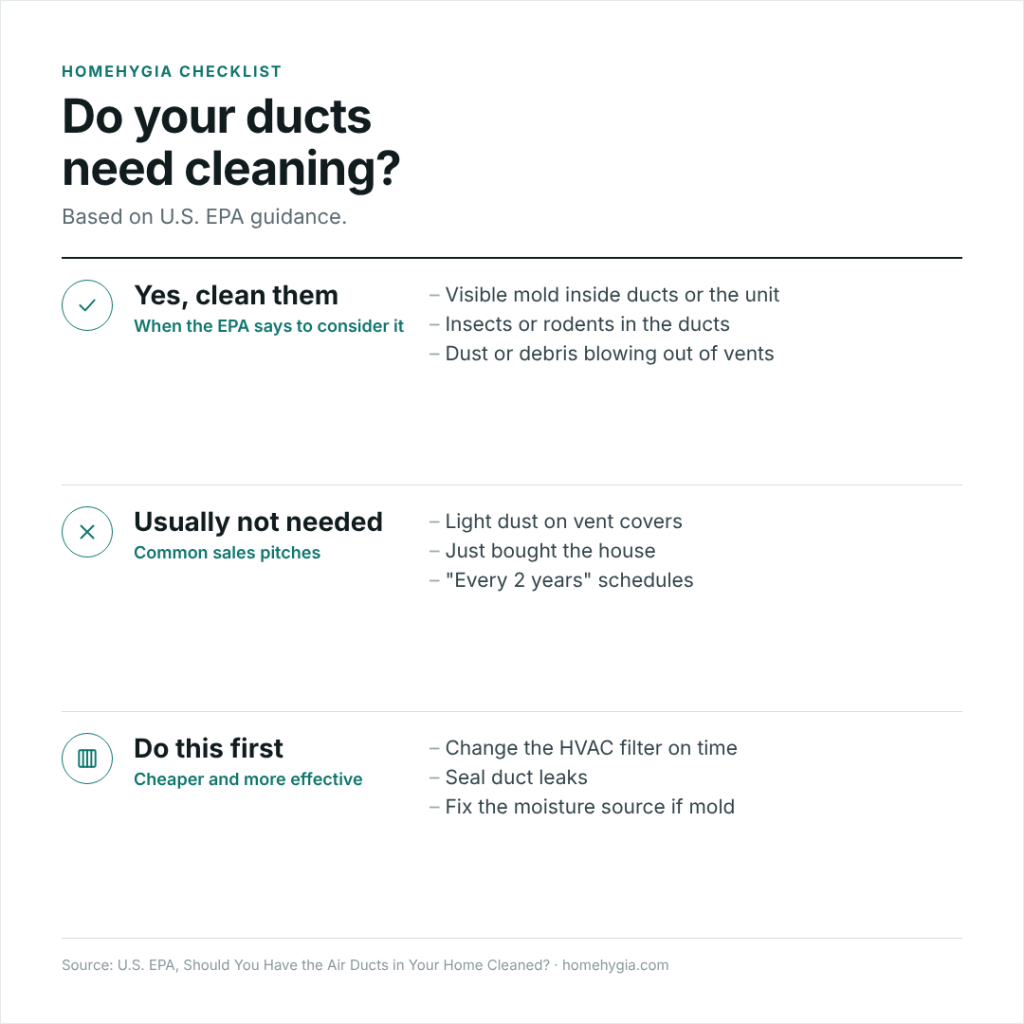
Usually not as a routine service. The U.S. EPA says duct cleaning has never been shown to prevent health problems, and that a light amount of household dust in ducts poses no known risk. It is worth it when there is visible mold inside the ducts or HVAC unit, insects or rodents in the ductwork, or so much dust and debris that it blows out of the vents. For everyday dust, a good filter changed on time does more.
Air duct cleaning ads often promise fresher air, lower bills and fewer allergies. Some of that is true in specific cases, but for most homes the money is better spent elsewhere. Here is what the evidence says and how to decide.
What the EPA says about air duct cleaning
The EPA’s guidance is that duct cleaning should be considered on an as-needed basis, not on a fixed schedule. It notes that research has not shown duct cleaning prevents health problems, that much of the dust in ducts sticks to the duct surfaces and doesn’t reach the living space, and that a light amount of dust poses no known risk (EPA: Should You Have the Air Ducts in Your Home Cleaned?). Dirty ducts are just one of many possible sources of particles in a home.
When air duct cleaning is worth it
The EPA suggests you consider cleaning if:
- There is substantial visible mold inside hard sheet-metal ducts or on other parts of the heating and cooling system. Ask the contractor to show you; only lab testing confirms mold. And fix the moisture problem first, or it will come back.
- Ducts are infested with insects or rodents.
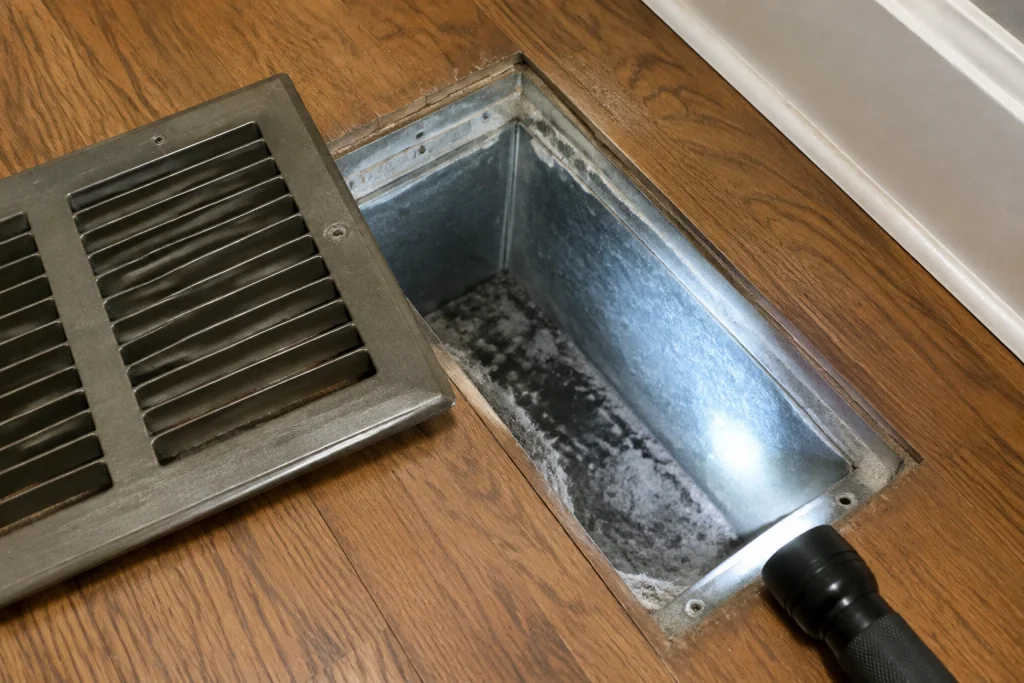
- Ducts are clogged with excessive dust and debris, or particles actually blow out of the supply registers.
Other reasonable times to consider it: after a major renovation that produced a lot of drywall dust, or after smoke damage from a fire.
When you probably don’t need it
- You see a little dust on the vent covers. Wipe or vacuum the covers.
- You just moved in and there are no signs of mold, pests or debris.
- A company recommends cleaning “every two to three years” by default.
- A coupon offers whole-house cleaning for a very low price. These deals are often bait for upselling sanitizers or “mold” removal.
What to do first (it costs less)
- Change the filter on schedule. A clean, properly fitting filter keeps dust out of the ducts in the first place. See how often to change your HVAC filter.
- Use a better filter. Upgrading to MERV 11 or 13 captures far more fine dust. Read what MERV rating to use.
- Check the filter fits. Gaps around the edge let dirty air into the ducts. See how to find your air filter size.
- Seal duct leaks in attics, crawlspaces and basements, which pull in dust and insulation fibers.
- Control humidity to prevent mold in the system: keep it at 30–50% (see the ideal indoor humidity level).
- Clean the registers yourself with a vacuum brush attachment.
If you hire a duct cleaner
- Get several quotes and check references.
- Make sure they clean the whole system, including the blower, coil, drain pan and grilles, not just the ducts. The EPA notes that cleaning only the ducts while leaving other parts dirty can recontaminate the system.
- They should use a high-powered vacuum that exhausts outdoors or through HEPA filtration, and protect carpet and furniture.
- Be cautious about chemical biocides or sealants sprayed inside ducts. The EPA advises understanding the pros and cons before agreeing to them.
- Avoid anyone who claims duct cleaning will cure health problems.
If what you really want is cleaner air, consider adding filtration instead: see adding an air purifier to your HVAC system or whole house air purifiers.
Frequently asked questions
How often should air ducts be cleaned?
There is no set schedule. Clean them only when there is mold, pests or heavy debris.
Does duct cleaning help with allergies?
There is little evidence that it does. A better HVAC filter, regular vacuuming with a HEPA vacuum and a bedroom air purifier usually help more.
Does duct cleaning lower energy bills?
Cleaning a dirty blower and coil can improve efficiency. Cleaning ducts alone has little proven effect. Sealing duct leaks saves more.
Can I clean air ducts myself?
You can remove and wash vent covers and vacuum as far as you can reach. Deep cleaning needs professional equipment.
Sources
- U.S. EPA: Should You Have the Air Ducts in Your Home Cleaned?
- U.S. EPA: A Brief Guide to Mold, Moisture and Your Home