
Ultrasonic vs Evaporative Humidifier: Which Is Better?

Quick answer
Ultrasonic humidifiers are nearly silent and use little electricity, which makes them great for bedrooms, but with tap water they spray minerals into the air as white dust, so you should use distilled water. Evaporative humidifiers have a fan that makes some noise and a wick that needs replacing, but they leave minerals in the wick, produce little or no white dust, and naturally can’t over-humidify a room. If you have hard water or don’t want to buy distilled water, choose evaporative.
Both are “cool mist” humidifiers and both add moisture to dry winter air. They work very differently, though, and that affects noise, cleaning, cost and what ends up in your air. Here is how to choose.
How an ultrasonic humidifier works
A small metal disc (a transducer) vibrates at an ultrasonic frequency, breaking water into a fine, visible mist that a small fan pushes out. Because the water itself is turned into droplets, anything dissolved in it goes into the air too. The EPA notes that ultrasonic and impeller humidifiers are very efficient at dispersing minerals in tap water, which many people notice as white dust (EPA: Use and Care of Home Humidifiers).
How an evaporative humidifier works
A fan blows dry room air through a wet wick or filter that soaks up water from the tank. Water evaporates from the wick as invisible vapor. Minerals stay behind in the wick. Because evaporation slows as the air gets more humid, these units are largely self-regulating.
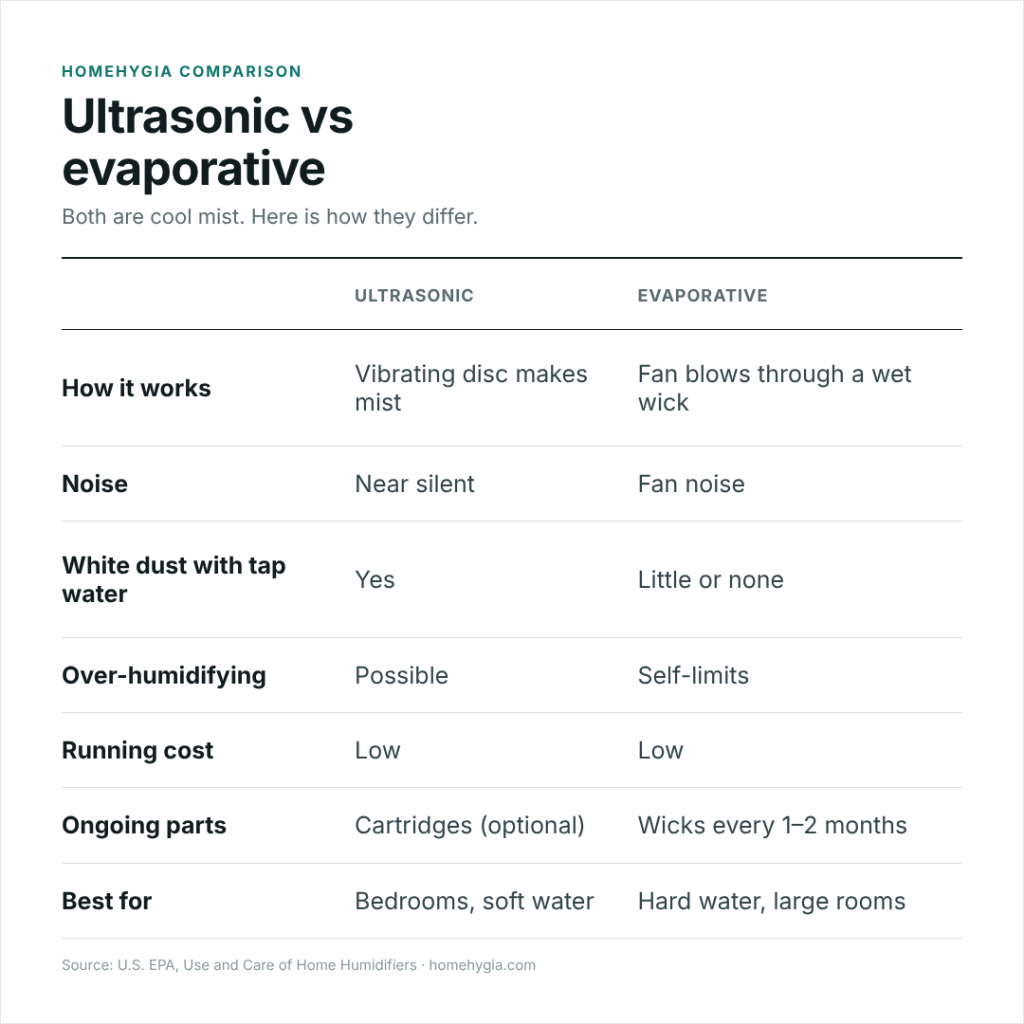
Ultrasonic vs evaporative: head to head
Noise
Ultrasonic wins. Many are almost silent, apart from a faint hum or gurgle. Evaporative models have a fan you’ll hear, similar to a quiet desk fan on low; some people like it as white noise.
White dust and air quality
Evaporative wins. With tap water, ultrasonic units release mineral particles that settle as white dust and can raise particle readings on an air quality monitor. Distilled water or a demineralization cartridge fixes this. See humidifier white dust.
Over-humidifying
Evaporative wins. An ultrasonic unit keeps adding mist regardless of room humidity unless it has a humidistat, which can lead to condensation and damp. Keep humidity in the 30–50% range either way; see the ideal indoor humidity level.
Maintenance and running costs
Both are cheap to run. Ultrasonic units need regular descaling of the disc and, if you use them, distilled water or cartridges. Evaporative units need a new wick every one to two months in heavy use, and the wick itself can grow mold if neglected.
Hygiene
Both must be cleaned. Any standing water can grow microbes, and the EPA recommends emptying and drying daily and cleaning every third day. Ultrasonic units can spray microbes from a dirty tank into the air; a dirty wick in an evaporative unit can smell. See how to clean a humidifier.
Output and room size
Both come in small and large sizes. Large evaporative console models are popular for whole floors; ultrasonic models dominate small tabletop units.
What about warm mist humidifiers?
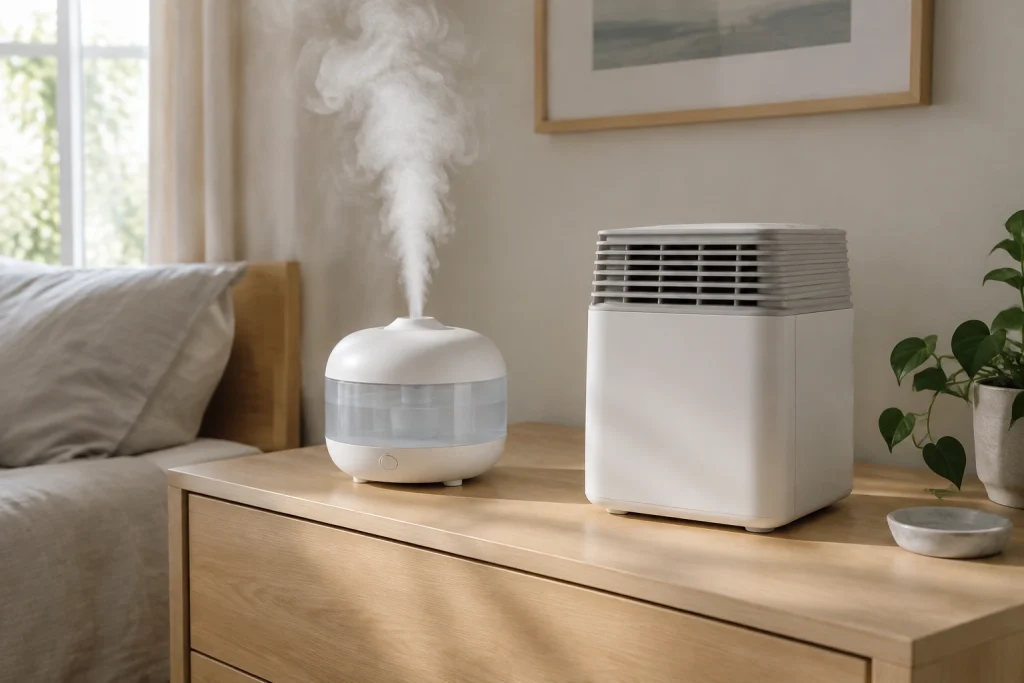
Warm mist (steam) humidifiers boil water, so minerals stay behind and the vapor is free of microbes. But they use much more electricity and the hot water is a burn hazard, so the EPA advises keeping steam vaporizers out of children’s reach.
Which should you buy?
- Bedroom, light sleeper, soft water or happy to use distilled water: ultrasonic with a humidistat.
- Hard water, large room, or don’t want to buy distilled water: evaporative.
- Kids or pets in the room: any cool mist type; avoid warm mist.
- Allergies or asthma: evaporative, or ultrasonic only with distilled water, and keep either one very clean.
Not sure if you need a humidifier at all? Compare devices in air purifier vs dehumidifier vs humidifier and the difference between a humidifier and an air purifier.
Frequently asked questions
Is ultrasonic or evaporative better for health?
Evaporative is the safer default because it doesn’t spray minerals or microbes into the air. An ultrasonic unit kept clean and filled with distilled water is also fine.
Do ultrasonic humidifiers need distilled water?
They work with tap water, but distilled water prevents white dust and slows scale. The EPA recommends low-mineral water for these models.
Why don’t I see mist from my evaporative humidifier?
That’s normal. It releases invisible water vapor, not droplets. Check a hygrometer to see it working.
Which humidifier is cheaper to run?
Both use little power. Factor in distilled water for ultrasonic models and replacement wicks for evaporative models.