Is Lab Charge a Good Air Purifier? An Honest Look at Ionic Purifiers

Quick answer
Lab Charge sells small, plug-in ionic air purifiers that are cheap, quiet and need no filter changes, but they are not a substitute for a HEPA purifier. Ionizers make particles stick to nearby surfaces instead of trapping them, they publish no verified CADR, and Lab Charge’s own website says its purifiers are not CARB-certified for ozone emissions and cannot be shipped to California. For allergies, asthma, smoke or pets, a True HEPA purifier with a verified CADR is the better choice.
Lab Charge purifiers are widely advertised online, usually in multi-packs of small wall-plug units that promise to cover around 250 sq ft each with “filterless” ion technology. That sounds convenient, but it’s worth understanding how ionizers work and what the company itself says about them before you buy.
What Lab Charge air purifiers are
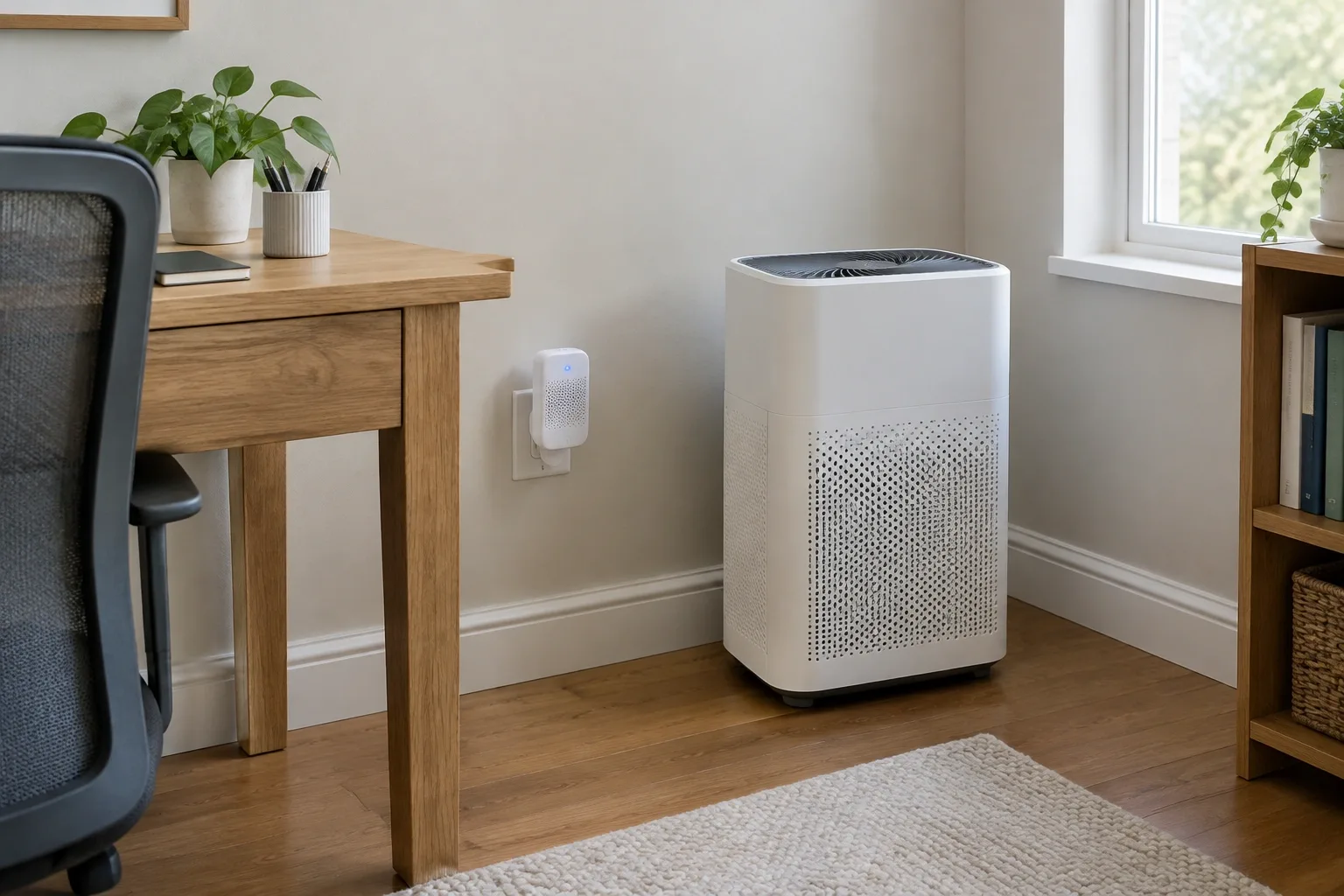
According to Lab Charge’s website, its main product is an ionic air purifier with a filterless design, advertised as covering up to 250 sq ft and suited to bedrooms, home offices and small rooms. The same site carries a notice that its air purifiers “are not CARB-certified and do not meet California’s electrical safety and ozone emission requirements,” and that sales to California are prohibited.
How ionic purifiers work, and their limits
An ionizer releases charged particles (ions) into the air. These attach to dust, pollen and smoke, which then cling to walls, furniture and floors, or to each other, and drop out of the air. That has some real drawbacks:
- Particles aren’t removed from the room. They settle on surfaces near the unit and can be stirred back up by walking or vacuuming. Many owners notice dark dust marks on walls near ionizers.
- Possible ozone. Ionizers can produce ozone as a by-product. The EPA warns that ozone is a lung irritant (EPA). California’s Air Resources Board (CARB) certifies air cleaners that meet an ozone emission limit; Lab Charge says its units are not certified.
- No odor or gas removal. Without an activated carbon filter, ionizers don’t remove cooking smells or VOCs well.
- No verified performance figure. Unlike many filter purifiers, these units don’t list an AHAM-verified CADR, so you can’t check how much clean air they actually deliver.
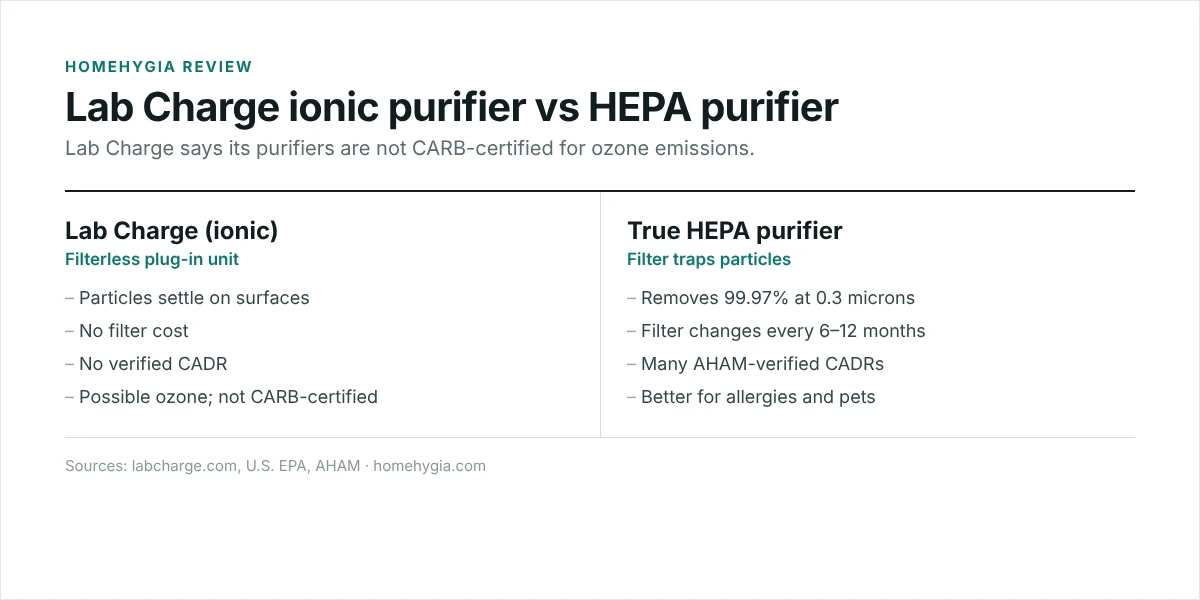
Lab Charge vs a HEPA air purifier
| Lab Charge ionic | HEPA purifier | |
|---|---|---|
| How it cleans | Ions make particles settle on surfaces | Filter traps particles inside the unit |
| Filter costs | None | Replacement filters, often every 6–12 months |
| Verified CADR | Not published | Many models AHAM-verified |
| Ozone | Possible; not CARB-certified (per Lab Charge) | Most HEPA-only models produce none |
| Odors / VOCs | Little effect | Yes, with a carbon filter |
| Price | Low | Low to high |
| Best for | Light freshening where nothing else fits | Allergies, asthma, pets, smoke |
Who might still choose one?
If you only want light freshening in a small space where a floor unit won’t fit, and nobody in the home has asthma or ozone sensitivity, a plug-in ionizer is inexpensive and silent. Keep it away from walls and fabrics you don’t want marked, and clean nearby surfaces regularly.
For everyone else, a compact True HEPA purifier gives better, measurable results for a similar long-term cost. See our picks of air purifiers for small rooms, the best filter for a small room, and how budget brands compare in are IKEA air purifiers any good.
How to judge any air purifier
- True HEPA filtration (99.97% at 0.3 microns), not “HEPA-type” or “HEPA-like”.
- A CADR that matches your room: at least two-thirds of the floor area in square feet (AHAM Verifide).
- No ozone, or CARB certification if it has an ionizer.
- Carbon filter if you need odor control.
- Clear filter costs and availability.
Frequently asked questions
Is Lab Charge a legitimate company?
Lab Charge LLC sells its products through its own website and online marketplaces. Customer reviews are mixed, and some mention slow responses to warranty claims, so keep your order details.
Do Lab Charge purifiers produce ozone?
Ionizers can produce ozone. Lab Charge states its purifiers are not CARB-certified for ozone emissions, so if you are sensitive to ozone or have asthma, choose a filter-based purifier instead.
Do ionic air purifiers really work?
They reduce some airborne particles by making them settle, but they don’t remove them from the room the way a HEPA filter does.
Why are there black marks on the wall near my ionizer?
Charged particles stick to nearby surfaces. Move the unit away from walls and clean the area regularly.
Can I use Lab Charge for allergies?
It isn’t a good choice for allergies. A True HEPA purifier with a verified CADR is more effective.
Sources
- Lab Charge: official website (product claims and California notice)
- EPA: Ozone Generators that are Sold as Air Cleaners
- EPA: Air Cleaners and Air Filters in the Home
- AHAM Verifide: Room Air Cleaners
Related guides
- Air Purifier Tips: Genius & Essential Guide
- Do You Really Need an Air Purifier? Essential Guide
- Lab Charge Air Purifier Reviews: Essential, Proven Performance
- Are Lab Charge Air Purifiers Good? Essential Guide