
Can You Use a Vacuum Without a Filter?

Quick Answer
No, you generally should not use a household vacuum without its required filter. The filter helps keep dust out of the motor and prevents fine particles from escaping through the exhaust. The EPA also notes that a true HEPA vacuum must direct its airflow through the HEPA filter. Only run a vacuum filter-free when the manufacturer specifically says that operating mode is allowed.
What can happen without the filter?
- Motor contamination: Fine dust may reach components the pre-motor filter normally protects.
- Dusty exhaust: Particles may pass through the machine and return to the room.
- Possible damage: Some manufacturers warn that operating without the motor-protection filter can shorten appliance life.
- Poor filtration: A HEPA-equipped machine cannot provide its intended filtration when the HEPA stage is missing.
- Warranty concerns: Using a vacuum contrary to its owner’s manual may create warranty or service problems.
Safest choice
- If the filter is being washed or replaced, leave the vacuum unused until the correct clean, completely dry filter is installed.
I’ve removed plenty of vacuum filters for cleaning, and I treat one simple rule as non-negotiable: if the machine was designed to have a filter installed, I don’t switch it on without one.
That short wait can protect the vacuum and help keep collected household dust from returning to your room. There are a few exceptions, especially with certain wet/dry machines, so the owner’s manual always gets the final say.
In This Guide
Is It Safe to Use a Vacuum Without a Filter?
For a typical upright, canister, stick, robot, or household bagless vacuum, the safest answer is no. If the manufacturer designed the machine to use a filter, operate it only with the correct filter installed.
A vacuum filter is a porous component that allows airflow through the machine while trapping particles at a specific stage of the vacuum’s air path.
Many machines use more than one filtration stage. A pre-motor filter may protect internal components, while an exhaust or HEPA filter captures particles before air returns to the room.
- Pre-motor filter: Helps prevent fine debris from reaching the motor area.
- Exhaust filter: Filters air leaving the vacuum.
- HEPA filter: Provides high-efficiency particle filtration when used in a properly designed system.
- Dust bag: In many bagged machines, the bag itself provides an important filtration stage.
This is why removing one small-looking part can affect more than suction. You’re changing the airflow and filtration system the manufacturer designed.
Some manufacturers state this directly. Philips, for example, warns against using certain vacuum cleaners without the motor-protection filter because doing so can damage the motor and shorten appliance life.
What about using it for only one minute?
I wouldn’t recommend it. A quick cleanup still pulls dust-filled air through the same internal path.
The amount of damage or dust leakage from one short use can’t be predicted across every model. The safer option is simply to wait for the filter or install a correct replacement.
What Happens If You Vacuum Without a Filter?
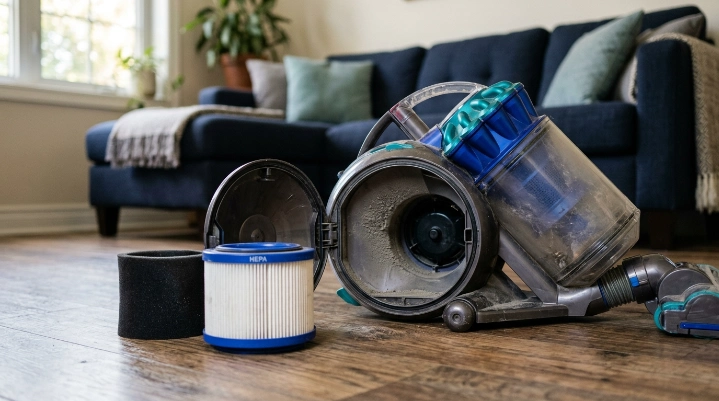
Using a vacuum without a required filter can affect both the machine and the dust coming from its exhaust. The exact result depends on where the missing filter sits.
1. Fine dust can reach the motor area
A pre-motor filter acts as a barrier between collected debris and sensitive internal parts. Remove that barrier, and finer material may travel farther through the vacuum.
This is especially important with bagless vacuums. Cyclonic separation can remove much of the larger debris, but the filters still handle particles that continue with the airflow.
2. More particles may escape through the exhaust
A vacuum doesn’t make the incoming air disappear. It pulls air inside, separates or captures debris, then exhausts that air back into the environment.
The EPA notes that vacuuming can release smaller particles back into indoor air and that high-efficiency systems can help reduce those emissions.
For households concerned about asthma or allergies, this matters. The Asthma and Allergy Foundation of America includes vacuum cleaners among products evaluated through its asthma & allergy friendly certification program.
3. You lose the benefit of HEPA filtration
HEPA stands for high-efficiency particulate air. Under the EPA definition used for HEPA vacuums, the filter can capture 99.97% of particles measuring 0.3 microns under the specified test criteria.
That number applies to the HEPA filter standard, not automatically to every vacuum carrying a HEPA-style component. The machine also needs an airflow design that prevents dirty air from bypassing the filtration stage.
4. You may shorten the vacuum’s working life
Manufacturers build motor-protection filters into machines for a reason. Operating without one may expose the motor to material the filter was intended to stop.
That doesn’t mean every filterless use causes instant failure. It means you’re creating an unnecessary risk that the owner’s manual may explicitly prohibit.
Section Takeaway: If your vacuum requires a filter, removing it can compromise both motor protection and particle control. A missing filter isn’t a shortcut worth taking.
Do All Vacuum Cleaners Need Filters?
Most household vacuums use some form of filtration, but they don’t all use the same filter design. That’s why a universal yes-or-no rule can become misleading.
Bagless vacuums
Bagless models usually combine cyclonic separation with one or more physical filters. You may find foam, felt, pleated, cartridge, or HEPA-style filters in the same machine.
Don’t assume the clear dirt bin replaces those filters. The cyclone and filters perform different jobs.
Bagged vacuums
A vacuum bag often acts as an important filtration stage while also storing debris. Many bagged machines add a separate motor-protection or exhaust filter.
Running one without its bag or required secondary filter can therefore bypass part of the designed filtration path.
Stick, cordless, and robot vacuums
These machines use compact airflow paths. Their small filters may look simple, but they’re still part of the system.
Never assume a cordless vacuum can run safely without a filter because its dust cup appears to contain the debris.
Wet/dry and shop vacuums
This is the main category where the answer can change. Some wet/dry vacuums specify different filter setups for dry debris and liquid pickup.
A model may require a cartridge filter for dry vacuuming but instruct you to remove or change that filter for certain wet-pickup operations. Follow the exact manual for your machine.
Expert Alert: Don’t use an ordinary household vacuum for lead, asbestos, hazardous renovation dust, or significant mold remediation. These materials may require specialized HEPA equipment, containment, and qualified professional handling.
Which Vacuum Filters Matter Most?
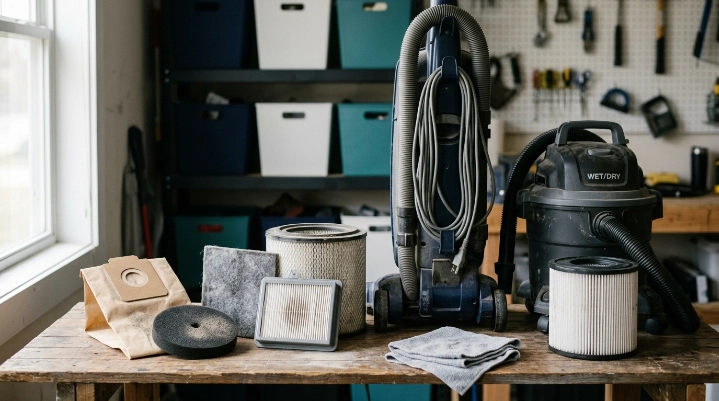
Each filtration stage has a different job. Removing any required stage can change how the vacuum performs.
| Filter or Stage | Main Purpose | Run Without It? | Key Point |
|---|---|---|---|
| Pre-motor foam/felt filter | Helps keep fine debris away from the motor | Usually no | Check whether it is washable or replaceable |
| Exhaust filter | Captures particles before exhaust air returns to the room | Usually no | Missing filtration may increase particle escape |
| HEPA filter | High-efficiency fine-particle filtration | No, when required | HEPA standard: 99.97% at 0.3 microns under specified criteria |
| Dust bag | Collects debris and often provides filtration | No, unless the model explicitly supports another mode | Use the bag type specified for the machine |
| Wet/dry cartridge or wet filter | Changes with dry or liquid pickup mode | Model-dependent | Follow the wet/dry configuration in the owner’s manual |
HEPA deserves special attention because the filter alone isn’t the whole story. EPA guidance says a HEPA vacuum should be designed so incoming air passes through the HEPA stage rather than leaking around it.
That’s why adding a HEPA-looking replacement to an incompatible machine doesn’t automatically turn it into a true HEPA vacuum.
Can You Vacuum While the Filter Is Drying?
No, not if that filter is required for operation. Leave the vacuum off until the washable filter is fully dry and correctly reinstalled.
This is one of the situations where I’m most tempted to rush. You clean the filter, notice crumbs on the floor, and think one quick pass probably won’t matter.
I keep a simple rule instead: a vacuum with its filter removed for washing is temporarily out of service.
Don’t put a wet filter back early
Filterless operation isn’t the solution, but neither is reinstalling a dripping or damp filter. Moisture where the manufacturer doesn’t expect it can create problems inside the appliance.
Use this process instead:
- Turn off and unplug the vacuum.
- Remove the filter carefully without shaking dust through the room.
- Clean it only if the manufacturer labels it washable.
- Allow it to air-dry completely for the period specified in the manual.
- Check that no damp areas remain.
- Reinstall it in the correct orientation before switching the vacuum on.
Some people buy a second compatible washable filter and rotate between the two. That can be useful if you vacuum often, provided the replacement is approved for your exact model.
How Should You Clean or Replace a Vacuum Filter?
Start with the owner’s manual because filter materials differ. A washable foam filter and a non-washable pleated filter shouldn’t be treated the same way.
For a washable filter
- Unplug first: Never perform filter maintenance with the vacuum powered.
- Remove loose debris carefully: Avoid creating a dust cloud indoors.
- Rinse only as directed: Follow the manufacturer’s water and detergent instructions.
- Don’t scrub delicate media: Aggressive cleaning can damage the material.
- Dry completely: Reinstall only when the filter is fully dry.
For a disposable filter
Replace it rather than washing it. Water can damage filter media that was designed for dry, single-life use.
Match the replacement by model or part number. A filter that merely fits inside the compartment may not seal or perform as intended.
Check the rest of the airflow path
A dirty filter isn’t the only reason a vacuum loses suction. Inspect the bin or bag, hose, wand, floor head, and brush roll as well.
- Empty the bin before it exceeds its fill line.
- Replace a full bag according to the manufacturer’s guidance.
- Clear hose and wand blockages safely.
- Remove hair wrapped around the brush roll.
- Inspect seals and filter covers for incorrect seating.
For broader household dust control, the EPA’s indoor air quality resources explain why managing indoor particles involves both source control and appropriate cleaning practices.
The CDC/NIOSH guidance for hazardous lead dust also illustrates why specialized HEPA vacuuming matters when the particles involved are more dangerous than ordinary household dirt.
Section Takeaway: Clean only filters designed to be cleaned, replace disposable filters, and never reinstall a washable filter until it’s completely dry. Your manual’s instructions override generic maintenance advice.
Frequently Asked Questions
Can a vacuum work without a filter?
The motor may switch on and create suction, but that doesn’t mean the vacuum should be operated that way. If its design requires a filter, running it without one can let debris travel where it shouldn’t and can reduce exhaust filtration.
Can I use my vacuum without the HEPA filter?
Don’t remove a required HEPA filter and continue vacuuming unless the manufacturer explicitly allows it. Without that stage, the machine cannot provide the filtration performance associated with its installed HEPA system.
Will using a vacuum without a filter damage the motor?
It can increase the risk on machines where a pre-motor filter protects internal components. Some manufacturers specifically warn that operating without the motor-protection filter may damage the motor or shorten appliance life.
Can I use a bagless vacuum without its foam filter?
Usually not. Foam filters commonly serve as pre-motor filtration in bagless vacuums. Check your manual before operation, because the transparent dust bin and cyclone don’t necessarily replace the foam filter’s function.
Can I run the vacuum for a few minutes while the filter dries?
The safer choice is no. If the manufacturer requires the filter, wait until it’s fully dry and reinstall it. A spare compatible filter can reduce downtime if you regularly wash your vacuum’s reusable filter.
Can a shop vacuum run without a filter?
It depends on the model and what you’re collecting. Some wet/dry vacuums specify different filter configurations for liquid and dry pickup, so follow the owner’s manual rather than applying household-vacuum rules to a shop vacuum.
What should I do if my vacuum filter is missing?
Stop using the vacuum and identify the correct replacement using the model number or owner’s manual. Don’t improvise with fabric, paper towels, generic foam, or an incorrectly sized filter because it may alter airflow or fail to seal properly.
The bottom line: You generally should not use a vacuum without its required filter. The filter is part of the machine’s airflow, motor-protection, and particle-control system.
If you’ve removed a washable filter, let it dry completely before reinstalling it. If the filter is lost or damaged, replace it with the correct part before your next cleaning session.
When you’re unsure, check the manual for your exact vacuum model. That one step is safer than guessing whether your particular machine can run filter-free.
