
Do Snake Plants Purify the Air? What the Science Actually Shows

Quick answer
A little, but not enough to matter in a real home. Snake plants can absorb small amounts of volatile organic compounds (VOCs) such as formaldehyde and benzene, as NASA’s 1989 study showed in small sealed chambers. A 2019 review of that research found you would need roughly 10 to 1,000 plants per square meter of floor to match the air cleaning that normal ventilation already provides. Keep snake plants because they are easy and attractive, and use ventilation, source control and a HEPA air purifier to actually clean the air.
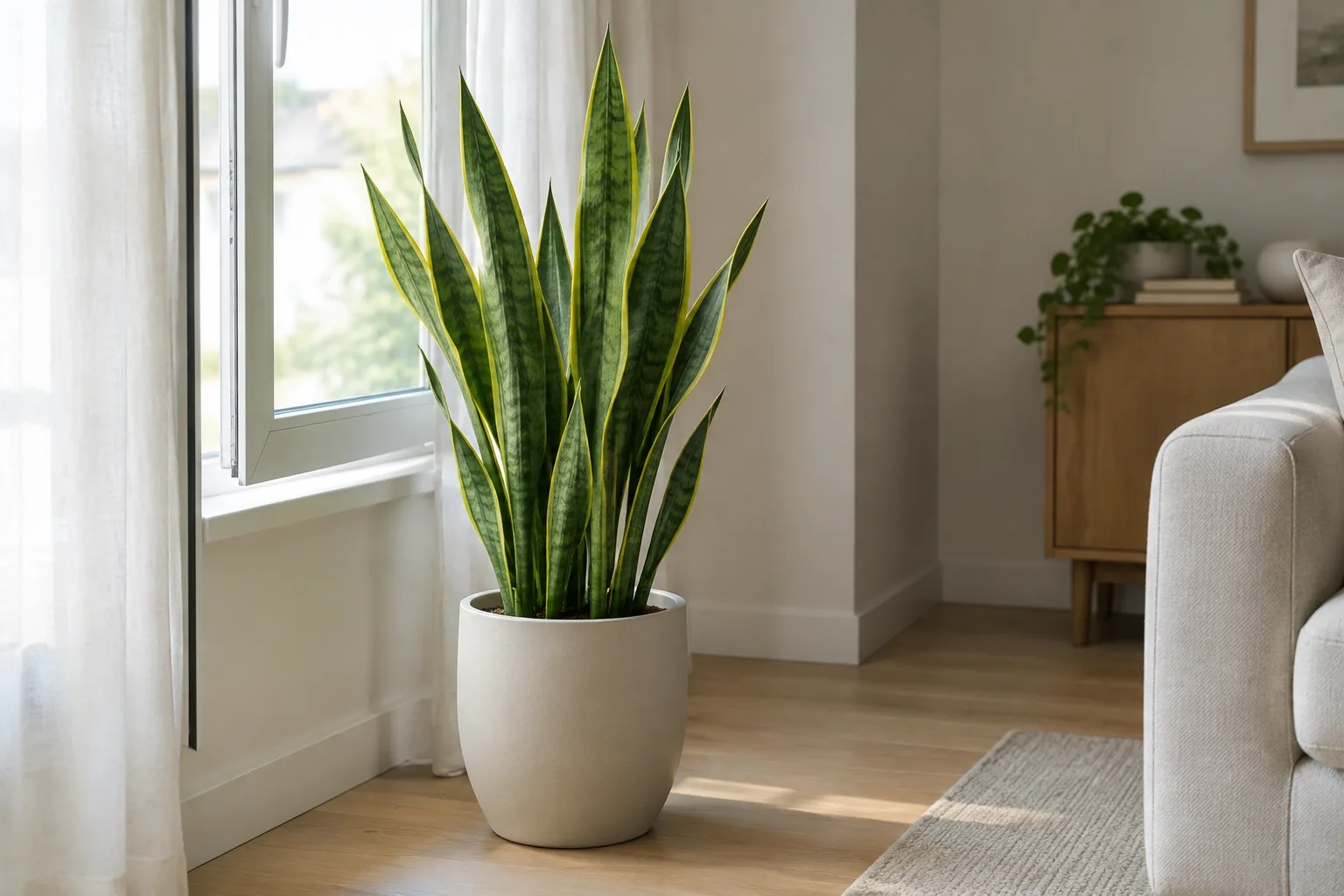
The snake plant (Dracaena trifasciata, formerly Sansevieria trifasciata) appears on almost every “air purifying plants” list. It is hardy, tolerates low light and needs little water, so it is a great houseplant. The air-purifying claim is a different matter. Here is what the research actually tested, why the results don’t carry over to a living room, and what does improve indoor air.
Where the claim comes from: the NASA Clean Air Study
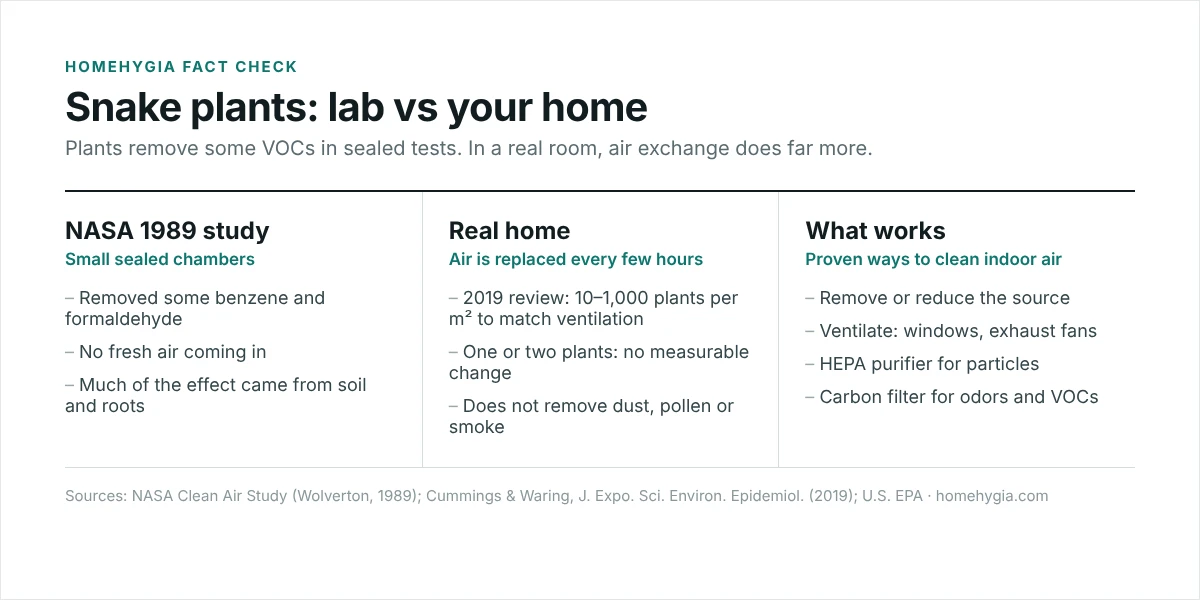
In 1989, NASA researcher B.C. Wolverton and colleagues tested common houseplants for removing benzene, formaldehyde and trichloroethylene inside small, sealed Plexiglas chambers (NASA Technical Reports Server). The goal was air quality in sealed space habitats. Snake plant was among the plants that lowered VOC levels in those chambers over 24 hours, and a good share of the removal was attributed to microbes in the potting soil and roots, not just the leaves.
The results were real, but the setting was nothing like a home: a sealed box of under one cubic meter, a single high dose of one chemical, and no fresh air coming in.
Why it doesn’t work the same way at home
Homes are not sealed. Outdoor air leaks in and indoor air leaks out all the time, typically replacing the air in a room every few hours. That air exchange removes VOCs far faster than a plant can.
In 2019, Bryan Cummings and Michael Waring of Drexel University reviewed a dozen chamber studies spanning 30 years and converted the results into a “clean air delivery rate” for plants (Journal of Exposure Science & Environmental Epidemiology). Their conclusion: to match the VOC removal of an ordinary building’s air exchange, you would need somewhere between 10 and 1,000 plants per square meter of floor space. A few snake plants in a 15 m² bedroom make no measurable difference.
What snake plants can and can’t do
| Claim | What the evidence says |
|---|---|
| Removes VOCs (formaldehyde, benzene) | Yes in sealed lab chambers; negligible in a ventilated room |
| Removes dust, pollen, pet dander or smoke particles | No. Plants don’t filter airborne particles in any useful amount |
| Releases oxygen at night | Yes. Snake plants use CAM photosynthesis and open their pores at night, but the oxygen added is tiny compared with room air |
| Raises humidity | Very slightly. Snake plants use little water, so the effect is minimal |
| Improves mood and makes a room feel fresher | Plausible. Many people enjoy living with plants, which is reason enough to keep one |
What actually cleans indoor air
The U.S. EPA lists three strategies, in this order: control the sources of pollution, ventilate, and then use air cleaning (EPA Guide to Air Cleaners in the Home).
- Reduce the source. Choose low-VOC paint and furniture, store solvents and cleaners outside the living space, and don’t smoke indoors.
- Ventilate. Open windows when outdoor air is clean and use kitchen and bathroom exhaust fans.
- Filter particles. A HEPA air purifier sized to the room removes dust, pollen, dander and smoke particles. See how plants compare with air purifiers.
- Add carbon for odors and VOCs. A purifier with a substantial activated carbon filter reduces gases that HEPA can’t catch.
How to grow a snake plant
- Light: bright indirect light is best; it tolerates low light but grows slowly.
- Water: let the soil dry out completely between waterings, roughly every 2–4 weeks. Overwatering and root rot are the most common way people kill it.
- Soil and pot: a fast-draining cactus or succulent mix in a pot with a drainage hole.
- Pets: the ASPCA lists snake plant as toxic to cats and dogs; chewing it can cause nausea, vomiting and diarrhea (ASPCA). Keep it out of reach.
If you want more greenery, compare the options in peace lily vs other air purifying plants and the best air purifying plants for your home, or read about the plants in NASA’s study. Just treat any plant as decoration, not as an air cleaner.
Frequently asked questions
How many snake plants do I need to purify a room?
Far more than anyone keeps. Based on the 2019 review, matching normal ventilation would take at least 10 plants per square meter, and possibly hundreds. Ventilation and a purifier are the practical options.
Is it good to keep a snake plant in the bedroom?
Yes, it is a fine bedroom plant because it needs little care and light. It releases some oxygen at night, but not enough to change the air you breathe.
Do snake plants filter toxins like formaldehyde?
They can absorb small amounts in sealed lab tests. In a normal home the effect is too small to measure.
Can a snake plant replace an air purifier?
No. Snake plants don’t remove airborne particles such as dust, pollen or smoke, and their VOC removal is negligible at home.
Are snake plants safe for cats and dogs?
No. The ASPCA lists them as toxic to cats and dogs, usually causing stomach upset if chewed.
Sources
- NASA: Interior Landscape Plants for Indoor Air Pollution Abatement (1989)
- Cummings & Waring (2019): Potted plants do not improve indoor air quality
- EPA: Guide to Air Cleaners in the Home
- ASPCA: Snake Plant
Related guides
- Does a Dehumidifier Purify the Air? Essential Guide
- Does an Air Conditioner Purify Air: The Essential Guide
- Top Plants That Purify the Air: Genius & Essential
- Best Plants for Bedroom to Purify Air: Proven Essentials