
How Do You Store a Vacuum Cleaner?

Quick Answer
Store a vacuum cleaner clean, dry, and in a stable position inside a dry indoor closet, cabinet, or utility area. Protect the hose from kinks, wrap the cord loosely, keep attachments together, and keep cordless batteries away from excessive heat. Choosing a dry location also follows EPA indoor air quality guidance about controlling indoor moisture.
Quick storage steps
- Empty it: Empty the dustbin or check the bag before putting the vacuum away.
- Remove debris: Clear hair, string, and dirt from the brush roll and intake area.
- Dry parts: Let every washed filter, bin, or attachment dry completely.
- Protect the cord: Use the cord hooks without pulling the cable tight.
- Protect the hose: Leave flexible hoses in a relaxed curve instead of folding them sharply.
- Choose a dry spot: Keep the machine away from leaks, damp walls, extreme heat, and heavy objects.
I like giving a vacuum a permanent storage spot instead of pushing it wherever there is space. It makes cleaning easier, protects the appliance, and keeps accessories from disappearing around the house.
Proper vacuum cleaner storage is also simple. You mainly need to control dirt, moisture, heat, cord strain, hose damage, and the risk of the machine falling over.
In This Guide
- What does proper vacuum cleaner storage mean?
- How do you prepare a vacuum cleaner for storage?
- Where is the best place to store a vacuum cleaner?
- How should storage change by vacuum type?
- What vacuum storage mistakes should you avoid?
- How should you store cords, hoses, accessories, and batteries?
- Frequently asked questions about vacuum storage
What Does Proper Vacuum Cleaner Storage Mean?
Proper vacuum cleaner storage means keeping the appliance clean, dry, stable, protected, and easy to access between uses. The goal isn’t simply getting the vacuum out of sight.
A good storage setup also protects its hose, electrical cord, attachments, filters, and battery.
A vacuum storage area is a dedicated indoor place where the machine can remain safely positioned without moisture, crushing pressure, excessive heat, or unnecessary strain on its parts.
I prefer a dedicated spot because it removes one small frustration from every cleaning session. I know where the vacuum is, and the crevice tool isn’t hiding in another closet.
What conditions does a vacuum need?
A household vacuum usually stores best under normal indoor conditions. Your specific owner’s manual should take priority whenever it gives storage limits or positioning instructions.
- Dry surroundings: Avoid leaks, standing water, condensation, and persistently damp walls.
- Stable positioning: Don’t leave a top-heavy machine where a small bump can knock it over.
- Reasonable temperature: Avoid heaters, hot vehicles, and locations with severe temperature swings.
- No crushing pressure: Keep boxes and other heavy objects off hoses, wands, and floor heads.
- Easy access: Store frequently used machines where you don’t have to unload a closet first.
As of 2026, I still consider a normal indoor utility closet or cleaning cabinet the safest default for most household vacuums. Garages and basements need more thought because moisture and temperature can change considerably.
How Do You Prepare a Vacuum Cleaner for Storage?
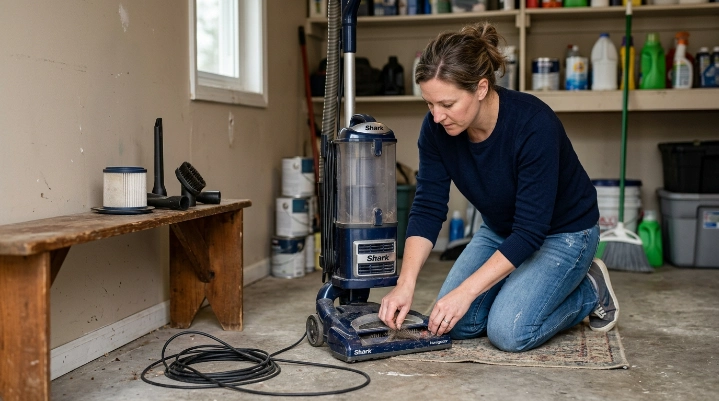
Prepare the vacuum by removing collected debris, checking the brush area, servicing filters as directed, and making sure washed components are completely dry. You don’t need a deep clean after every five-minute vacuuming job.
For routine storage, I use a short inspection before putting the machine away.
- Turn it off: Unplug a corded model before opening covers or touching the brush area.
- Check the bin or bag: Empty a bagless bin when needed and replace bags according to the machine’s instructions.
- Inspect the brush roll: Remove obvious hair, thread, or fibers before they become tightly wrapped.
- Check the airflow path: Look for larger objects around the intake, wand, and hose.
- Check washable parts: Never reinstall a washed filter while it is still damp.
- Put tools back: Return crevice tools, dusting brushes, and other attachments to their designated spots.
Consumer Reports’ vacuum maintenance guidance also stresses unplugging a vacuum before maintenance and paying attention to bins, bags, and filters.
Do you need to empty the vacuum every time?
There isn’t one rule for every model. Follow the maximum-fill marks, bag indicators, and maintenance instructions supplied with your vacuum.
I don’t like putting away an overloaded bagless vacuum. A nearly full bin gives me another chore before the next cleaning session and can leave debris sitting in the machine unnecessarily.
What if you washed the filter?
Check first that your filter is actually washable. HEPA means high-efficiency particulate air, but the HEPA label alone doesn’t tell you whether a particular vacuum filter can be washed.
Follow the manufacturer instructions and let washable parts dry fully before reinstalling them. Don’t guess a drying time if your manual specifies one.
Where Is the Best Place to Store a Vacuum Cleaner?
The best place is usually a dry indoor closet, utility room, laundry-area cabinet, or dedicated cleaning cupboard. The space should protect the machine without making it difficult to retrieve.
Moisture deserves special attention. EPA guidance on indoor moisture control recommends keeping indoor relative humidity below 60 percent and ideally around 30% to 50%.
| Storage place | Suitability | Main issue to check | My approach |
|---|---|---|---|
| Indoor closet | Excellent | Crowding | Leave room around hose and cord |
| Cleaning cabinet | Excellent | Correct dimensions | Measure before choosing shelves |
| Laundry room | Good | Humidity or leaks | Keep away from wet plumbing |
| Basement | Conditional | Dampness | Use only when consistently dry |
| Garage | Conditional | Heat, cold, moisture | Check manufacturer limits first |
| Outdoor shed | Usually poor | Weather and temperature swings | Prefer indoor storage |
A cabinet can work well when it has enough room for the complete vacuum rather than forcing hoses and handles into awkward positions. Don’t pack a damp machine tightly inside an enclosed cabinet.
Expert Alert: If your intended storage area has persistent leaks, widespread mold, damaged wiring, or unsafe electrical outlets, deal with that problem professionally before storing appliances there.
How Should Storage Change by Vacuum Type?
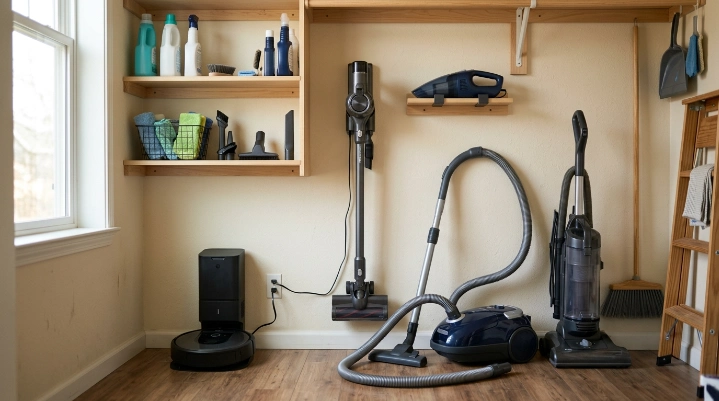
Every vacuum needs clean, dry storage, but the shape and power system change what you should protect. An upright vacuum doesn’t need the same setup as a cordless stick or robot vacuum.
| Vacuum type | Good storage method | Main concern |
|---|---|---|
| Upright | Standing in a stable indoor closet | Cord strain and tipping |
| Canister | Body on floor or shelf with hose relaxed | Crushed or kinked hose |
| Cordless stick | Approved dock or secure storage mount | Battery heat and insecure mounting |
| Robot vacuum | Manufacturer-recommended dock location | Blocked dock access |
| Handheld | Shelf, dock, or secure wall mount | Falling and charger loss |
How do you store an upright vacuum?
Stand an upright on a flat surface with the handle locked as designed. Keep the cord on its hooks without stretching it tightly.
How do you store a canister vacuum?
Give the canister enough floor or shelf space that nothing sits on its hose. I prefer a broad curve in the hose instead of wrapping it tightly around the body.
How do you store a cordless stick vacuum?
Use its docking or mounting system according to the manufacturer’s instructions. Don’t improvise a weak wall mount for a machine designed to hang vertically.
If you’re comparing designs, Consumer Reports’ vacuum guide shows how uprights, canisters, sticks, handhelds, and robot vacuums differ in construction and features.
What Vacuum Storage Mistakes Should You Avoid?
The biggest storage mistakes involve moisture, crushing, tight cord wrapping, unstable positioning, and ignoring battery conditions. Most are easy to prevent once the vacuum has a permanent home.
- Storing damp filters: Let every washable part dry fully before reassembly.
- Leaving the machine overloaded: Don’t repeatedly store a bagless vacuum beyond its maximum fill line.
- Crushing the hose: Never stack boxes, cleaning products, or tools on flexible vacuum hoses.
- Wrapping the cord tightly: Avoid sharp bends around the plug or where the cable enters the machine.
- Leaning a stick vacuum loosely: A tall lightweight vacuum can fall if it isn’t supported or docked securely.
- Using a damp basement corner: Convenience isn’t worth exposing an appliance to recurring moisture.
- Blocking a robot dock: Robot vacuums need the clearance specified by their manufacturer.
- Ignoring heat: Don’t store battery-powered machines next to heaters or inside unusually hot locations.
One mistake I avoid is using the vacuum itself as a storage rack. Hanging bags, cords, or other household objects from the handle can make the machine less stable.
I also avoid sealing a recently cleaned vacuum inside plastic. If any washable component still contains moisture, trapping it isn’t a good storage strategy.
How Should You Store Cords, Hoses, Accessories, and Batteries?
Small components deserve almost as much attention as the vacuum body. Poor accessory storage leads to missing tools, crushed hoses, and unnecessary strain on electrical cables.
Power cords
Use built-in cord hooks or an automatic rewind mechanism as intended. Leave enough slack that the cable isn’t pulled tightly at the plug or strain-relief point.
Stop using the vacuum if a cord becomes cut, scorched, badly cracked, or exposes wiring.
Expert Alert: Don’t open or repair damaged mains wiring unless you’re qualified to work on electrical appliances. A damaged power cord should be assessed or replaced correctly.
Flexible hoses
Store a detachable hose in a broad loop or relaxed curve. Avoid tight folds and don’t use the hose to support the machine’s weight.
Attachments
Keep commonly used tools together so they’re ready for the next cleaning session.
- Crevice tool
- Dusting brush
- Upholstery tool
- Pet-hair attachment
- Extension wand
- Approved spare filters or bags
- Charging adapter or dock accessories
A labeled basket works well when the vacuum doesn’t have onboard tool storage. I keep the basket beside the machine rather than in a different room.
Cordless batteries
Battery storage guidance varies between models, so don’t assume one charge percentage works for every cordless vacuum. Follow the manufacturer’s instructions for charging, temperature, and long periods of non-use.
Never store a battery that is swollen, leaking, cracked, or unusually hot.
Expert Alert: Don’t puncture, crush, open, or attempt an internal repair on a damaged lithium-ion battery. Follow appropriate professional or local disposal guidance.
Frequently Asked Questions About Vacuum Storage
Can you store a vacuum cleaner in a closet?
Yes. A dry indoor closet is one of the best vacuum storage locations when there is enough space for the machine, cord, hose, and attachments without crushing them.
Can you store a vacuum cleaner in a garage?
You can if the garage conditions stay within the manufacturer’s storage limits. Heat, freezing temperatures, humidity, and condensation can make a garage less suitable, especially for cordless models with lithium-ion batteries.
Can you store a vacuum cleaner in a basement?
A dry basement can work, but avoid areas with leaks, condensation, flooding risk, or persistent dampness. An indoor closet is usually the simpler choice when moisture control is uncertain.
Should you empty a vacuum before storing it?
For routine use, follow your vacuum’s fill line and bag guidance. Before long-term storage, I prefer starting with an empty bin or appropriately serviced bag so old debris isn’t left sitting inside for months.
Should a vacuum cleaner be stored upright?
Store an upright model in its normal locked position unless the manufacturer says otherwise. Canisters, handhelds, sticks, and robots have different storage designs, so use the position intended for your model.
Can you hang a cordless vacuum on the wall?
Yes, when the manufacturer supplies or approves a wall-mounted dock or bracket. Secure it to a suitable wall surface and follow the mounting instructions rather than improvising a weak hook.
How should you store a vacuum for several months?
Empty and clean it, clear debris, service filters as directed, dry washable parts completely, protect the hose and cord, and follow battery-storage instructions. Then place the vacuum in a clean, dry, temperature-appropriate indoor location.
Final Takeaway: The easiest way to store a vacuum cleaner is to give it a permanent dry indoor spot. Keep the machine clean, protect flexible and electrical parts, follow battery instructions, and avoid stuffing it into an overcrowded or damp space.
A few minutes of care when putting the vacuum away makes the next cleaning session easier. It also keeps the machine and all its tools organized and ready to use.