
How to Clean Upholstery with Baking Soda (Step by Step)

Quick answer
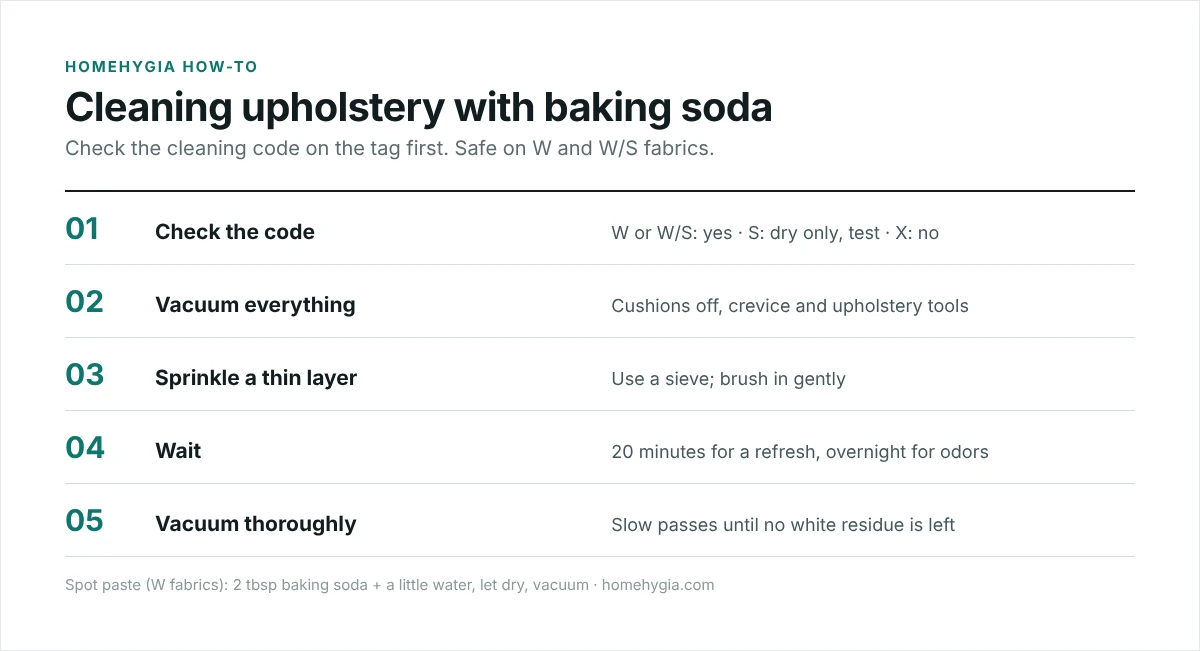
Baking soda is a safe, cheap way to deodorize most fabric sofas and chairs. Check the cleaning code first (on the tag under the cushions): it is fine for W and W/S fabrics. Sprinkle a thin, even layer, leave it 20 minutes to a few hours, then vacuum thoroughly with the upholstery tool. For spots, a paste of baking soda and a little water works on W fabrics. Skip it on S and X fabrics, velvet, silk and leather.
Baking soda doesn’t really “clean” fabric the way soap does. What it does well is absorb odors and loosen light surface grime, which makes it ideal for refreshing a couch that smells of pets, food or general use. Below is the right way to use it, how to check your fabric first, and what to do for stains it can’t handle.
Step 1: Check the upholstery cleaning code
Most upholstered furniture has a cleaning code on a tag under the seat cushions or on the frame (American Leather, Living Spaces):
| Code | Meaning | Baking soda? |
|---|---|---|
| W | Water-based cleaners are safe | Yes, dry or as a paste |
| W/S or SW | Water- or solvent-based cleaners | Yes, dry; test a paste first |
| S | Solvent cleaners only; water can leave rings | Dry sprinkle only, test first; no paste |
| X | Vacuum only (or professional cleaning) | No |
Step 2: Vacuum first
Remove the cushions and vacuum every surface, including the crevices, with the upholstery and crevice tools. Loose crumbs and pet hair stop the baking soda from reaching the fabric. See how to vacuum a couch.
Step 3: Deodorize with dry baking soda
- Test on a hidden area, such as the back or underside, especially on dark fabric.
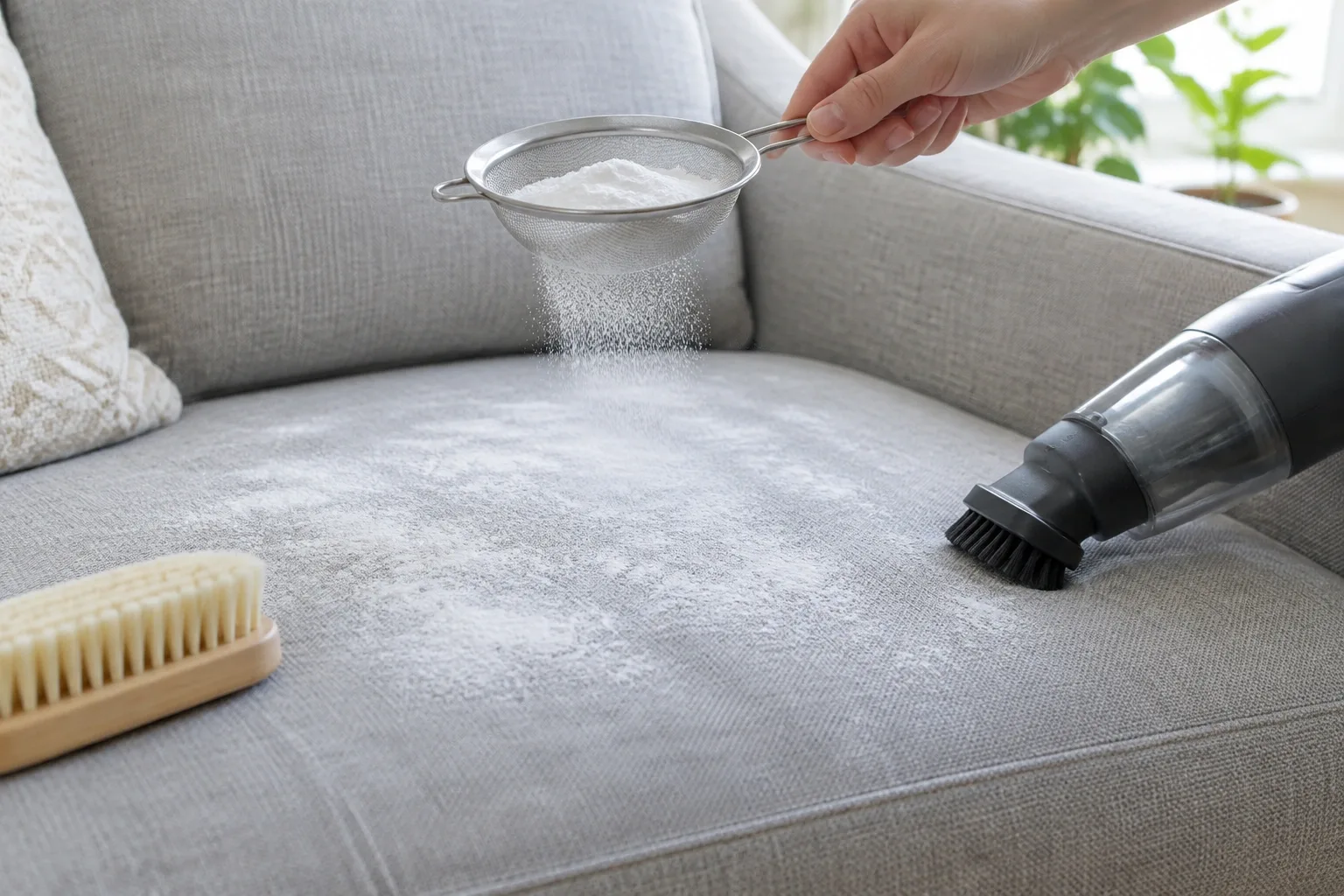
- Sprinkle a thin, even layer using a sieve or shaker. A heavy pile is harder to vacuum out.
- Gently work it in with a soft brush.
- Leave it for at least 20 minutes, or several hours (overnight for strong odors).
- Vacuum slowly and thoroughly with the upholstery tool until no white residue remains.
Step 4: Spot-clean with a paste (W fabrics only)
- Mix 2 tablespoons of baking soda with just enough water to make a soft paste.
- Dab it on the stain with a soft cloth. Don’t scrub hard.
- Let it dry completely.
- Brush off and vacuum, then blot any residue with a barely damp white cloth.
For greasy marks, sprinkle dry baking soda or cornstarch on the spot first to absorb the oil, leave it 15–20 minutes, then brush off before using the paste.
When baking soda isn’t enough
- Set-in or colored stains: use an upholstery cleaner made for your fabric code.
- Pet urine: clean with a mild soap solution and an enzyme cleaner first. Our homemade pet stain cleaner guide covers the method.
- A deep clean: a portable carpet and upholstery machine works on W fabrics. See can you use carpet cleaner on a sofa.
What not to do
- Don’t use baking soda on leather, suede, silk or velvet; it can dry or mark them.
- Don’t mix baking soda with vinegar on fabric. They neutralize each other and the fizz can push liquid deeper into the cushion.
- Don’t leave residue behind; it can feel gritty and attract dirt.
- Don’t soak S-code fabrics with a paste or wet cleaner.
Frequently asked questions
How long should baking soda sit on a couch?
At least 20 minutes for a light refresh, and several hours or overnight for strong odors.
Can baking soda damage upholstery?
Rarely, on W and W/S fabrics. It can leave a white haze on dark fabrics if not vacuumed out, and it isn’t suitable for X-code fabrics, leather or delicate materials.
Does baking soda remove stains?
It helps with light, fresh stains and grease, but not set-in or dye-based stains.
Can I use baking soda on a microfiber couch?
Yes, if the code is W or W/S. Microfiber marked S should be cleaned with a solvent cleaner instead.
Is baking soda safe around pets?
In small amounts on furniture, yes, but keep pets off until you have vacuumed it all up.
Sources
- American Leather: Explaining Fabric Cleaning Codes
- Living Spaces: Understanding Upholstery Cleaning Codes
Related guides
- Baking Soda Upholstery Cleaner: Genius Essential Guide
- Baking Soda In Mop Water: Genius & Essential Cleaning
- Baking Soda For Cleaning Carpet: Proven, Effortless Solution
- Baking Soda For Carpet Cleaning: Genius, Essential Fix