
Do Range Hoods Need to Vent Outside? Ducted vs Ductless Explained

Quick answer
Not every range hood has to vent outside: ductless (recirculating) hoods are allowed in most homes and apartments. But a ducted hood that vents outdoors is far better for indoor air. It removes smoke, fine particles, steam, heat and, on gas stoves, combustion gases such as nitrogen dioxide. A ductless hood only traps grease and some odors in its filters and blows the rest back into the kitchen. Local building codes and the stove maker’s instructions decide what’s required for your home.
Cooking is one of the biggest sources of indoor air pollution in most homes. Frying, searing and roasting release fine particles, and gas burners add nitrogen dioxide and carbon monoxide. How well your range hood deals with that depends mostly on where it sends the air.
Ducted vs ductless range hoods
Ducted (vented) hoods
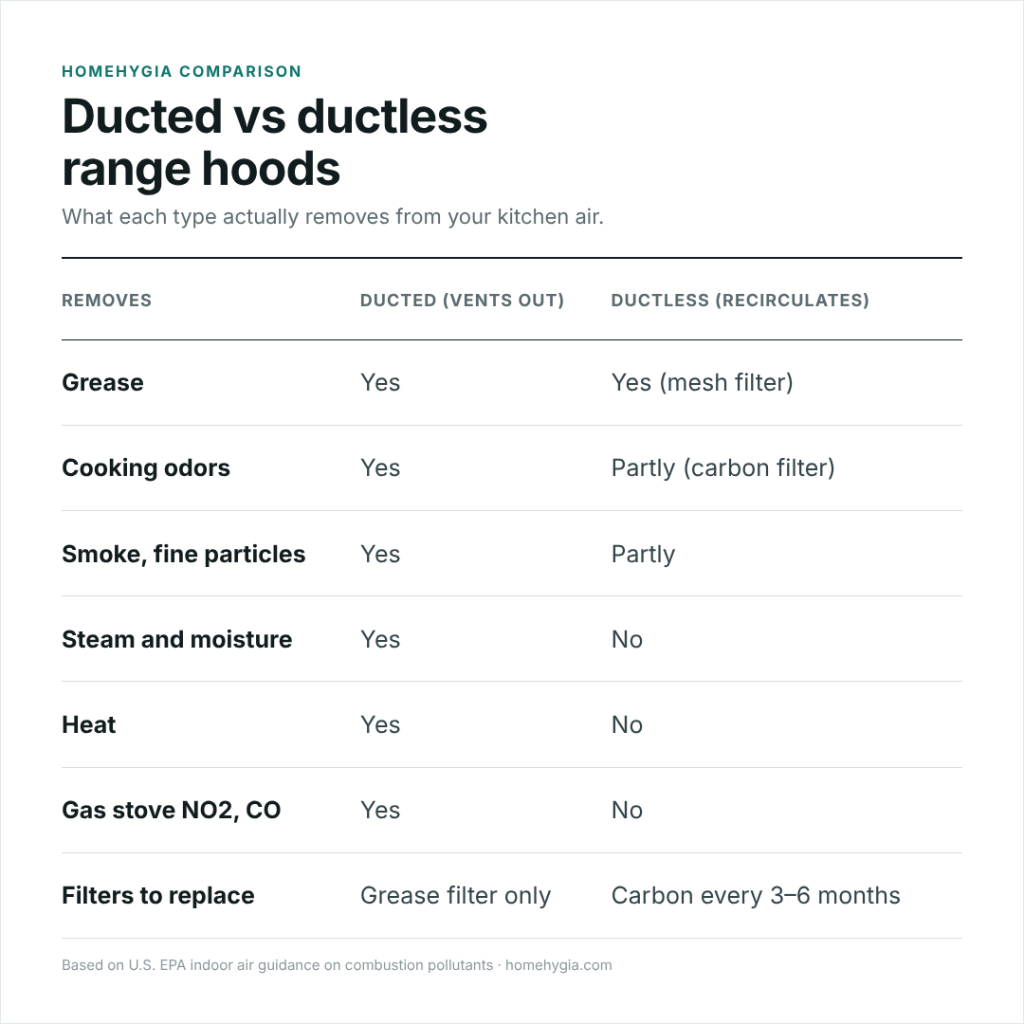
A ducted hood pulls cooking fumes through a grease filter and sends them through a duct to the outside. Everything leaves the house: smoke, grease vapor, odors, moisture and heat. This is the most effective option, and the one indoor air experts recommend whenever it’s possible to install.
Ductless (recirculating) hoods
A ductless hood pulls air through a metal mesh grease filter and an activated carbon filter, then blows it back into the room. It captures grease and reduces some odors, but it doesn’t remove moisture, heat or combustion gases, and fine particles are only partly captured. The carbon filter must be replaced every few months or it stops working.
Why venting outside matters
Gas stoves are one of the main indoor sources of nitrogen dioxide (NO2), which the EPA lists among unvented combustion appliances and which irritates the eyes, nose, throat and airways, with stronger effects in people with asthma (EPA: Nitrogen Dioxide’s Impact on Indoor Air Quality). A ductless hood cannot remove it. Steam from boiling and simmering also adds a lot of moisture, which a recirculating hood leaves in the kitchen to condense on windows and cabinets.
Even on electric stoves, high-heat cooking sends PM2.5 levels sharply up. If you own an air quality monitor, you’ll see it: compare readings with the hood on and off (see how to read an air quality monitor).
Is a range hood required by code?
Rules vary by country, state and city. Many residential codes don’t require a hood at all; others require one for certain stoves or set rules for powerful hoods, such as make-up air for hoods above a certain airflow. Gas range manufacturers often specify ventilation in their installation instructions. Check your local building department and your stove’s manual before buying or installing.
How to get the most out of any range hood
- Turn it on before you start cooking, and leave it running 10 to 15 minutes after you finish.
- Use the back burners; hoods capture fumes from the back far better than from the front.
- Use a higher speed for frying, searing and stir-frying.
- Clean the grease filter monthly; most metal filters can go in the dishwasher.
- Replace carbon filters in ductless hoods every 3 to 6 months, or as directed.
- Open a window slightly if you have a ductless hood or no hood, especially with a gas stove.
No vent possible? Other options
If you rent or can’t add a duct, combine a ductless hood with an open window and a portable air purifier with a HEPA and carbon filter near the kitchen. It won’t remove moisture or NO2, but it helps with particles and odors. See air purifiers for cooking odors and does an air purifier help with a gas stove. For moisture, the bathroom and kitchen work the same way: see how long to run an exhaust fan and how to improve indoor air quality without an air purifier.
Frequently asked questions
Are ductless range hoods worth it?
They’re better than nothing for grease and some odors, but they don’t remove moisture, heat or gas-stove pollutants. Choose ducted if you can.
Can a range hood vent into the attic?
No. Venting into an attic, wall cavity or soffit dumps grease and moisture inside the building and can cause mold and fire risk. Ducts must end outdoors.
How powerful should a range hood be?
Size it to your cooktop and kitchen; your stove maker’s guidance and local code apply. Larger, high-output gas ranges need more airflow, and very strong hoods may need make-up air.
Does a microwave hood count as a range hood?
Many over-the-range microwaves have a fan, but they capture fumes poorly. If yours can be ducted outdoors, set it up that way.