
How to Find Your Air Filter Size (Nominal vs Actual, and How to Measure)

Quick answer
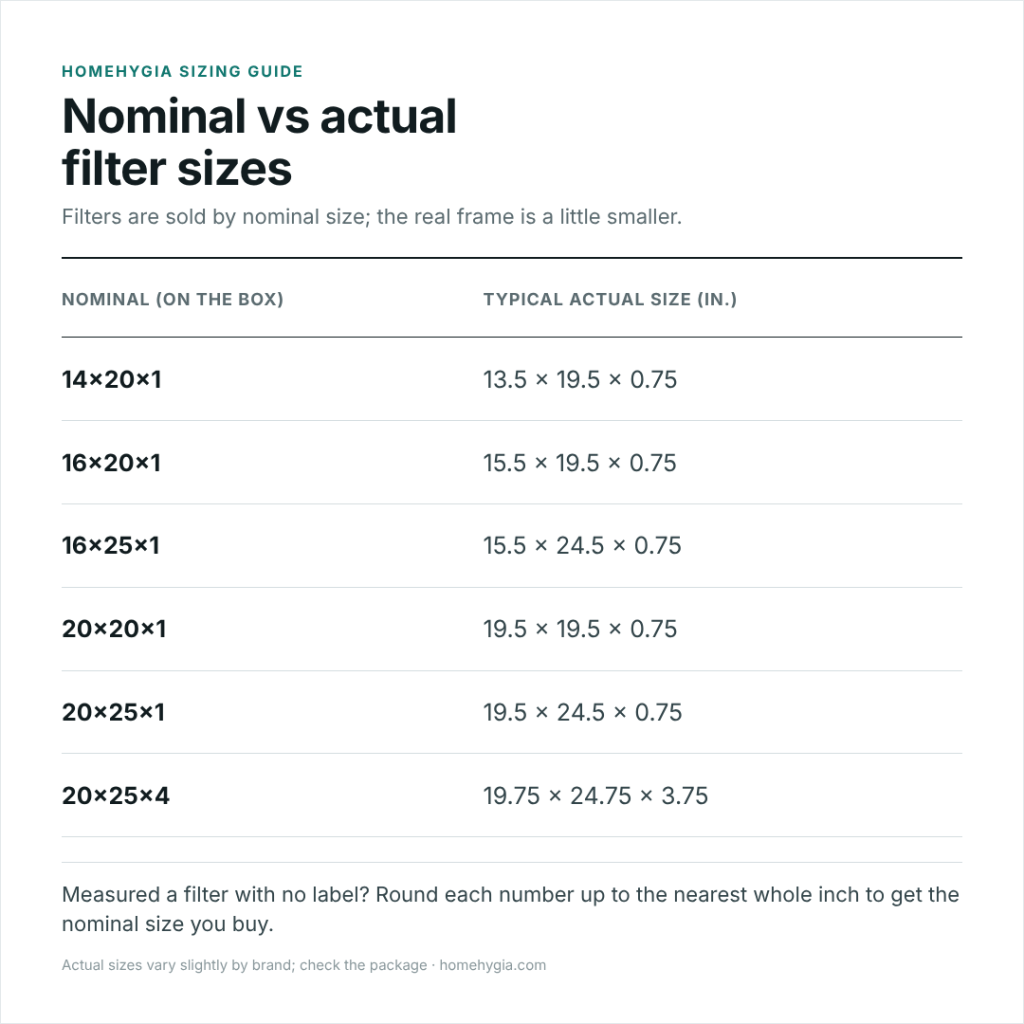
Your air filter size is printed on the edge of the cardboard frame as three numbers, for example 16x25x1: length x width x depth in inches. That is the nominal size you shop for. The real filter is slightly smaller, about 15.5 x 24.5 x 0.75 inches, so it slides into the slot. If there is no label, measure the old filter or the slot and round each number up to the nearest whole inch.
Buying the wrong filter size is one of the most common HVAC mistakes. A filter that is too small leaves gaps that let dusty air bypass it completely, and one that is too big won’t fit or gets bent into place. Here is how to find the right size in a couple of minutes.
Step 1: Find your current filter
Turn the system off at the thermostat, then look in these places:
- In the furnace or air handler cabinet: a slot or a removable door near where the return duct connects, usually beside or below the blower.
- Behind a return air grille: a large vent on a wall, ceiling or floor, often in a hallway. Flip the latches and the grille swings open.
- Several returns: some homes have a filter in each return grille. Check them all; they may be different sizes.
Step 2: Read the size on the frame
Slide the filter out and look along the cardboard edge. You’ll usually find two sets of numbers:
- Nominal size, in large print, such as 16x25x1. This is the size to buy.
- Actual size, in smaller print, such as 15.5 x 24.5 x 0.75. This is the real measurement.
The first two numbers are the face of the filter (the order doesn’t matter: 16×25 and 25×16 are the same filter). The third number is the depth, or thickness. Write it down or take a photo before you throw the old filter away.
Step 3: No label? Measure it
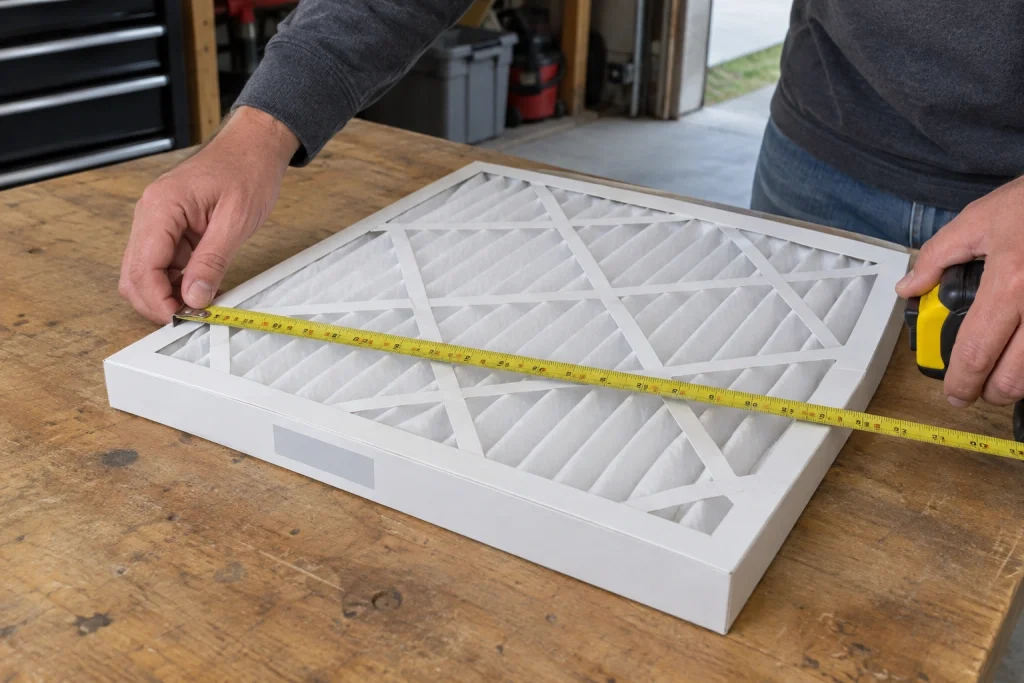
- Measure the length and width of the old filter with a tape measure, to the nearest eighth of an inch.
- Measure the depth (thickness) of the frame.
- Round each number up to the next whole inch. A filter that measures 19.5 x 24.5 x 0.75 is a 20x25x1.
- Exception for thick filters: media filters measuring around 3.75 to 4.5 inches deep are sold as 4-inch; those around 4.5 to 5 inches deep are sold as 5-inch. Check the cabinet brand if unsure.
If there is no filter at all, measure the inside of the slot or grille opening and subtract about a quarter to half an inch from length and width, then round up to find the nominal size.
Common HVAC filter sizes
The most common residential sizes are 16x20x1, 16x25x1, 20x20x1, 20x25x1 and 14x20x1, plus 16x25x4 and 20x25x4 for media cabinets. Standard sizes are cheaper and sold everywhere. Unusual sizes may need to be ordered custom.
Mistakes to avoid
- Buying by actual size. Shops sell by nominal size. Searching for “15.5×24.5” usually finds nothing.
- Forcing a thicker filter in. A 2-inch filter won’t seal in a 1-inch slot. To go thicker you need a media filter cabinet, which an HVAC technician can install.
- Ignoring gaps. If air can pass around the edges, the filter can’t do its job. A snug fit matters more than a high rating.
- Installing it backwards. The arrow on the frame points toward the furnace or blower, in the direction of airflow.
Once you know the size
Pick the right efficiency next: our guide to what MERV rating to use explains MERV 8, 11 and 13. Then set a reminder using how often to change your HVAC filter. Wondering about reusable filters? See washable vs disposable air filters. For more whole-home air cleaning, read the central air purifier installation guide.
Frequently asked questions
Does the order of filter dimensions matter?
No. 20x25x1 and 25x20x1 are the same filter. Just keep the depth as the last number.
Can I use a slightly smaller filter?
Only if it is within about a quarter inch. Anything smaller leaves gaps where unfiltered air slips past. Use the correct nominal size.
Why is the actual size smaller than the label?
Manufacturers make filters a little undersized so they slide easily into a slot built to the nominal size.
Where do I find the size if the filter is missing?
Check the furnace manual or the label inside the blower door, or measure the slot opening and round to the nearest standard size.