
How to Read an Air Quality Monitor: PM2.5, VOC, CO2 and Humidity Explained

Quick answer
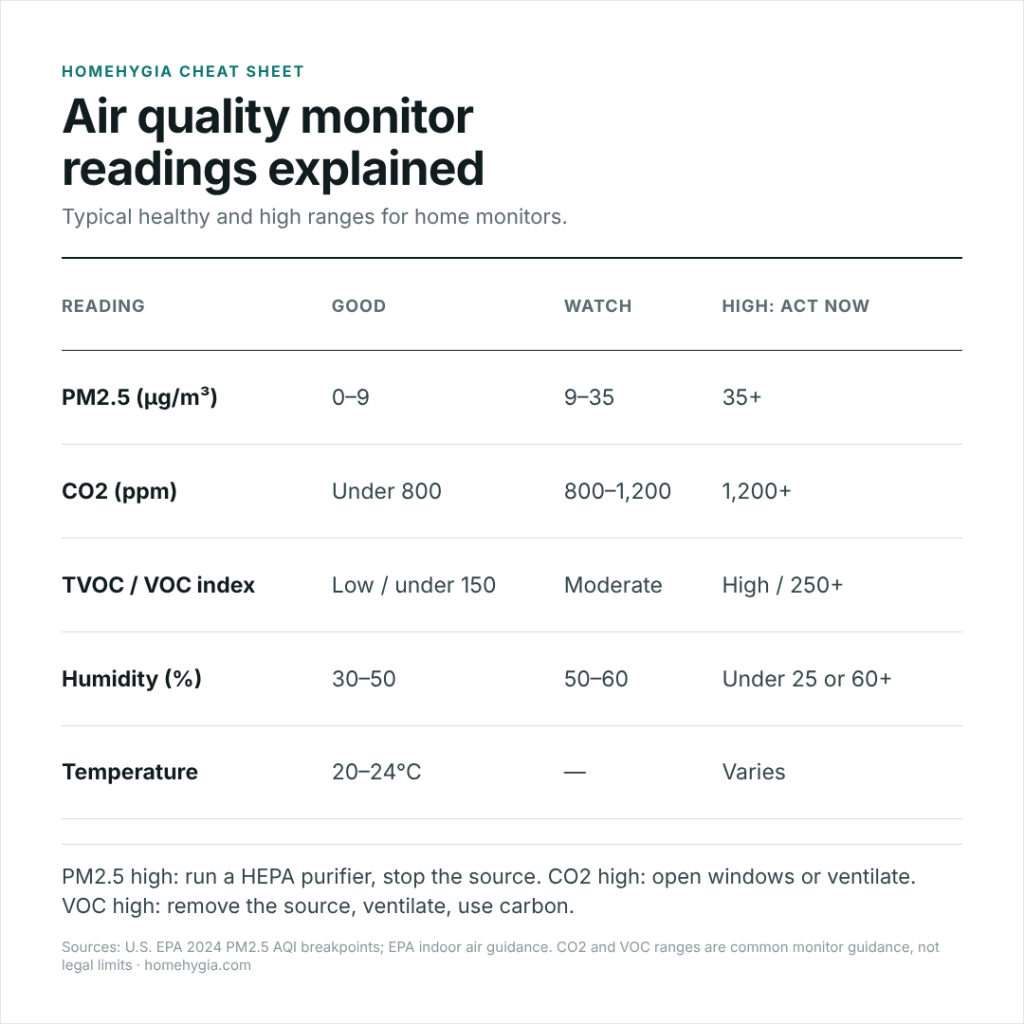
Healthy indoor air on a home monitor usually looks like this: PM2.5 at 9 µg/m³ or less (the EPA’s 2024 “Good” range), CO2 under about 800 ppm, a low VOC reading, and humidity between 30% and 50%. PM2.5 above 35 µg/m³ calls for a HEPA purifier and finding the source; CO2 above 1,000–1,200 ppm means the room needs fresh air; high VOCs mean a chemical source and poor ventilation.
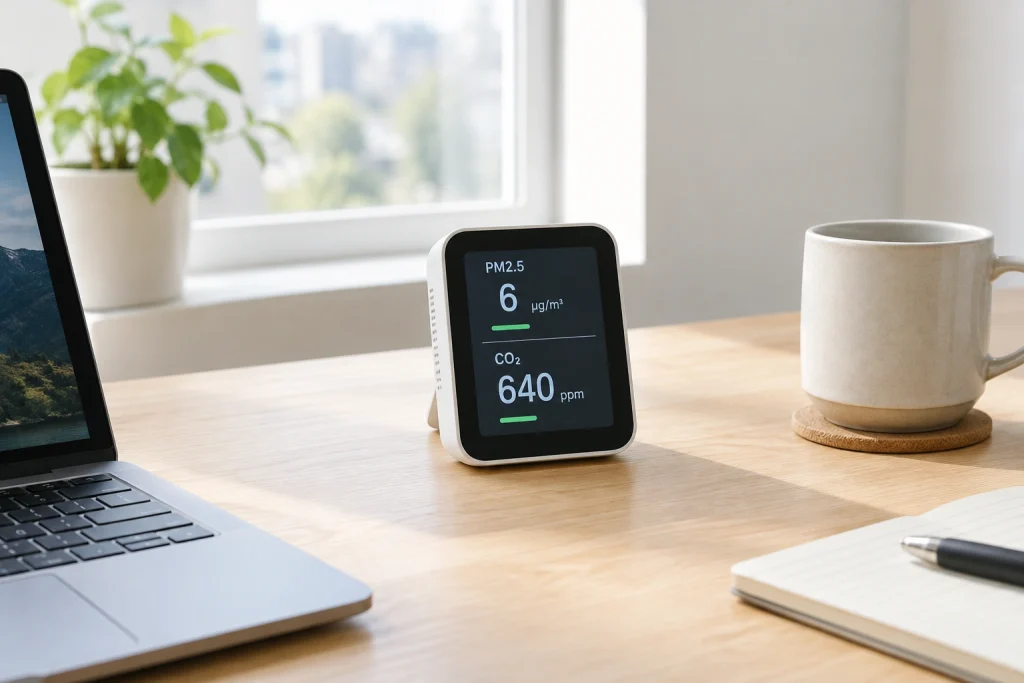
Indoor air quality monitors are cheap and popular, but their screens are full of acronyms and colored bars. Each number tells you something different, and each needs a different fix. This guide explains what the readings mean, which ranges are fine, and what to do when one goes red.
PM2.5: fine particles
PM2.5 is the mass of particles 2.5 microns or smaller in each cubic meter of air, shown in micrograms (µg/m³). These particles come from cooking, candles, smoking, wildfire smoke and outdoor pollution, and they are small enough to reach deep into the lungs (EPA: Particulate Matter Basics).
In 2024 the EPA tightened its Air Quality Index for PM2.5. Most monitors use these bands (24-hour average):
| PM2.5 (µg/m³) | AQI category |
|---|---|
| 0 – 9.0 | Good |
| 9.1 – 35.4 | Moderate |
| 35.5 – 55.4 | Unhealthy for sensitive groups |
| 55.5 – 125.4 | Unhealthy |
| 125.5 – 225.4 | Very unhealthy |
| 225.5 and above | Hazardous |
Short spikes while you cook or light a candle are normal. What matters is how high it goes and how fast it falls. Fix: run the range hood, ventilate, and use a correctly sized HEPA purifier. See choosing a PM2.5 air purifier. Some monitors also show PM10 (coarser dust and pollen) and PM1.0 (the very finest particles); read them the same way.
CO2: a ventilation gauge
Carbon dioxide (CO2), shown in parts per million (ppm), comes mainly from people breathing. Outdoor air is around 420 ppm. At typical indoor levels CO2 itself is not toxic; its value is as a sign of how much fresh air the room gets. Common monitor guidance:
- Under 800 ppm: well ventilated.
- 800–1,200 ppm: getting stuffy; open a window or turn on ventilation.
- Above 1,200 ppm: poorly ventilated; many people feel drowsy or get headaches.
Bedrooms with the door and window closed often climb past 1,500 ppm overnight. Fix: crack a window, leave the door open, or run a ventilation system. Air purifiers do not lower CO2; see does an air purifier remove CO2.
VOCs and TVOC
Volatile organic compounds are gases from paints, cleaning products, air fresheners, new furniture, cooking and cosmetics. The EPA notes that indoor levels of many VOCs are consistently higher than outdoors (EPA: VOCs’ Impact on Indoor Air Quality).
Home monitors use a cheap sensor that reacts to a mix of gases. It cannot tell a harmless one from a harmful one, so the reading is a trend, not a precise measurement. Brands report it differently: as TVOC in ppb or µg/m³, or as a VOC index where 100 is your home’s normal baseline and higher numbers mean more than usual. There is no official indoor VOC limit. Use your monitor’s own color bands and watch for big jumps.
Fix: remove or seal the source, ventilate, and use a purifier with a substantial activated carbon filter. See air purifiers with activated charcoal for VOCs.
Humidity and temperature
Most monitors also show relative humidity and temperature. Keep humidity between 30% and 50%: below 30% dries skin and sinuses, above 60% encourages mold and dust mites. Our guide to the ideal indoor humidity level explains the seasonal targets. A comfortable temperature for most homes is about 20–24°C (68–75°F).
Other readings you might see
- HCHO (formaldehyde): low-cost formaldehyde sensors are often inaccurate. Treat a high reading as a reason to ventilate and look for new furniture, flooring or pressed-wood products.
- AQI score: a single number combining sensors. Check which reading is driving it.
- Radon and carbon monoxide: most all-in-one monitors don’t measure these. Use a dedicated radon test and a CO alarm.
Tips for accurate readings
- Place the monitor at breathing height, about 1 to 1.5 m off the floor, in the room you use most.
- Keep it away from windows, vents, the humidifier and the stove, or it will show local spikes instead of room air.
- Give new monitors a day or two to calibrate, especially the CO2 and VOC sensors.
- Watch trends over days, not single readings.
Some purifiers have a built-in sensor; see air purifiers that show air quality.
Frequently asked questions
What is a good PM2.5 level indoors?
9 µg/m³ or less over the day matches the EPA’s “Good” category. Many homes with a HEPA purifier stay under 5 most of the time.
Why does my PM2.5 spike when I cook?
Frying, searing and toasting release large amounts of fine particles, especially on gas stoves. Use the range hood on high and ventilate until the reading falls.
Is 1,000 ppm CO2 bad?
It isn’t dangerous, but it shows the room needs more fresh air. Many people feel more alert when CO2 stays below 800 ppm.
Are cheap air quality monitors accurate?
PM2.5 laser sensors are reasonably good for trends. Look for a true NDIR CO2 sensor rather than an “eCO2” estimate. VOC and formaldehyde sensors are the least accurate.
Sources
- AirNow: AQI Basics
- U.S. EPA: Particulate Matter (PM) Basics
- U.S. EPA: Volatile Organic Compounds’ Impact on Indoor Air Quality