
Does a Salt Lamp Purify the Air? What It Can and Can’t Do

Quick answer
No, not in any meaningful way. A Himalayan salt lamp is a lump of rock salt with a bulb inside. It has no fan and no filter, so room air isn’t pulled through anything that could trap dust, pollen or smoke. There’s no good evidence that it releases enough negative ions to change air quality, and salt doesn’t absorb “electronic pollution” from phones or Wi-Fi. Enjoy one as a warm night light if you like the look, but use ventilation and a HEPA air purifier if you want cleaner air, and keep salt lamps away from pets.
Salt lamps are sold with a long list of claims: cleaner air, fewer allergies, better sleep, protection from electronics. They are pretty and give off a soft amber glow, which is part of their appeal. Here’s what the claims are based on, what the evidence actually shows, and a few safety points most listings leave out.
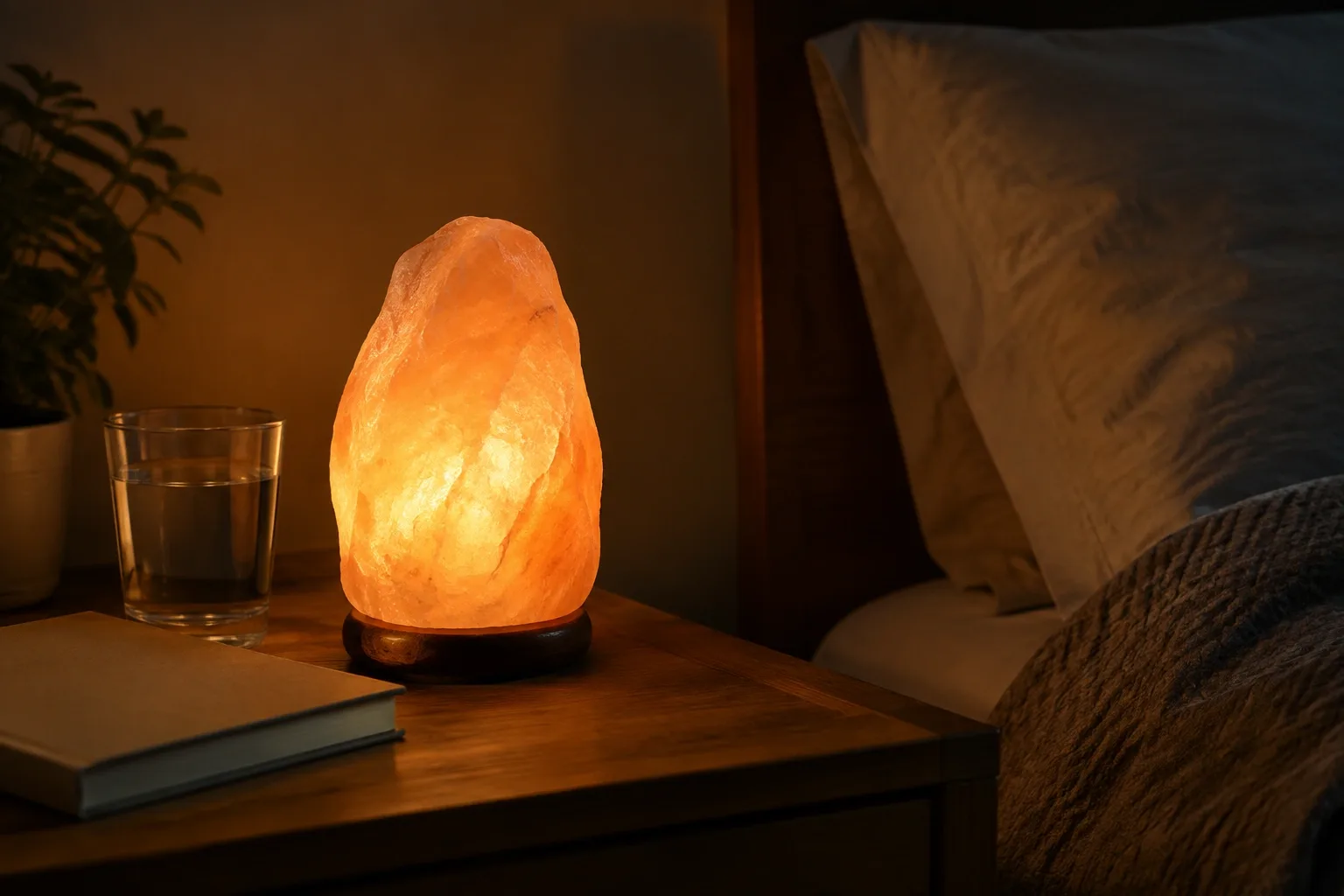
The claims, one by one
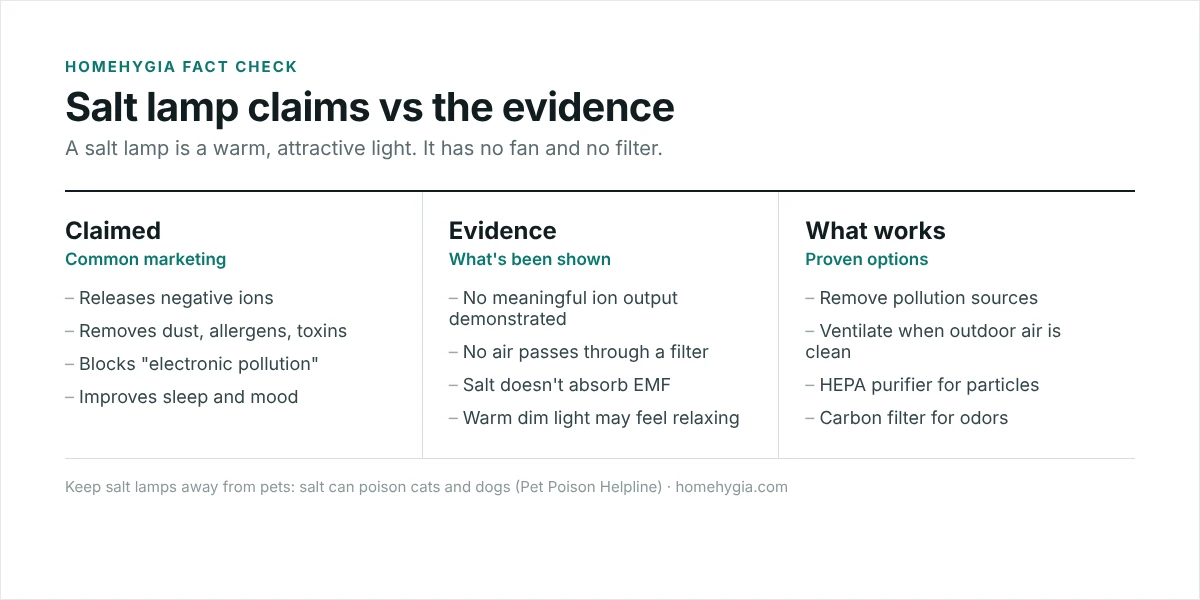
“Salt lamps release negative ions”
The idea is that warming salt releases negative ions, which then attach to airborne particles and make them fall out of the air. Negative ions are produced in meaningful amounts by things like waterfalls, lightning and electrical ionizers. A warm block of salt sitting on a table is not a known source. There is no good evidence that a salt lamp produces enough ions to measurably change the air in a room.
“They absorb moisture and trap pollutants”
Salt is hygroscopic: it attracts water vapor from the air, which is why salt lamps can look wet or “sweat” in humid rooms. The amount of moisture is tiny compared with a room’s air, and any particles that land on the surface are trivial. Without a fan moving air through a filter, the lamp can’t clean the room.
“They reduce electronic pollution”
This is the most common search about salt lamps, and the claim has no scientific basis. Electromagnetic fields from phones, computers and Wi-Fi are not “absorbed” or neutralized by salt crystals. If you’re concerned about devices, distance and turning them off are the only things that change exposure.
“They improve sleep, mood and allergies”
A dim, warm light in the evening is more sleep-friendly than bright blue-white screens, so a salt lamp can be a pleasant night light. That’s about the light, not the salt. There is no evidence it treats allergies or asthma.
Salt lamp vs air purifier
| Salt lamp | HEPA air purifier | |
|---|---|---|
| Moves air | No | Yes, with a fan |
| Removes dust, pollen, pet dander, smoke | No measurable effect | Yes; True HEPA captures 99.97% of 0.3-micron particles |
| Reduces odors and gases | No | With an activated carbon filter |
| Independently tested rating | None | CADR (clean air delivery rate) |
| Main benefit | Warm, decorative light | Cleaner air in a room |
The U.S. EPA’s advice for better indoor air is to reduce pollution sources and ventilate first, then use filtration such as a portable HEPA air cleaner or a MERV 13 HVAC filter (EPA Guide to Air Cleaners in the Home). A salt lamp doesn’t fit into any of those steps.
Also be wary of “ionic” purifiers and ozone devices marketed with similar claims. The EPA warns that ozone generators sold as air cleaners can irritate the lungs (EPA: Ozone Generators Sold as Air Cleaners).
Salt lamp safety
- Keep it away from pets. Cats and dogs may lick salt lamps. The Pet Poison Helpline warns that too much salt can cause vomiting, diarrhea, tremors, seizures and even death in pets (Pet Poison Helpline: salt). Put the lamp somewhere pets can’t reach.
- Check the cord and switch. In 2017 the U.S. Consumer Product Safety Commission announced a recall of about 80,000 Lumière salt lamps sold at Michaels because the dimmer switch or plug could overheat and ignite (CPSC recall). Buy lamps with a certified (UL or ETL listed) cord, and replace damaged ones.
- Watch for moisture. In humid rooms the salt can get damp and drip, which can damage wood furniture and corrode metal bases. Use a coaster and wipe it dry.
- Use the right bulb. Stick to the wattage on the lamp’s label.
What actually improves indoor air
- Reduce the sources: don’t smoke indoors, use the range hood, store chemicals outside living areas.
- Ventilate when outdoor air is clean. See air purifiers with windows open.
- Run a HEPA air purifier sized for the room, with a carbon filter for odors.
- Keep humidity between 30% and 50%.
Houseplants have a similar reputation; read do snake plants purify the air for what the research shows.
Frequently asked questions
Do salt lamps really clean the air?
No. They have no fan or filter, and there’s no good evidence they release enough negative ions to change air quality.
Do Himalayan salt lamps reduce EMF or electronic pollution?
No. Salt doesn’t absorb electromagnetic fields from phones, computers or Wi-Fi.
Are salt lamps safe for cats and dogs?
They can be dangerous if licked, because too much salt is toxic to pets. Keep them out of reach.
Why is my salt lamp wet?
Salt attracts moisture from humid air. Keep the lamp on, wipe it dry, and place it on a coaster.
Is there any benefit to a salt lamp?
It’s a warm, dim light that many people find relaxing in the evening. Treat it as decor, not as an air purifier.
Sources
- U.S. EPA: Guide to Air Cleaners in the Home
- U.S. EPA: Ozone Generators Sold as Air Cleaners
- Pet Poison Helpline: Salt
- CPSC: Michaels Recalls Rock Salt Lamps
Related guides
- Does a Dehumidifier Purify the Air? Essential Guide
- Does an Air Conditioner Purify Air: The Essential Guide
- Air Purifier vs Himalayan Salt Lamp: Essential Guide
- Air Purifier vs Salt Lamp: Essential Health Benefits