
Why Is My Vacuum Not Picking Up Pet Hair? 9 Causes and Fixes

Quick Answer
If your vacuum isn’t picking up pet hair, start by emptying the bin or bag, cleaning the filters, clearing the hose, and removing wrapped hair from the brush roll. Strong hose suction but poor carpet pickup usually points to the brush roll, belt, floor-head setting, or tool choice rather than the motor itself. For homes where pet dander and dust also matter, see the EPA’s indoor-air cleaning guidance.
Check these first
- Full bin or bag: Restricted airflow makes lightweight fur harder to lift.
- Dirty filter: A clogged filter can reduce airflow through the entire machine.
- Wrapped brush roll: Long pet hair and human hair can stop the bristles from reaching carpet fibers.
- Blocked airway: Dense fur clumps often lodge inside hoses, elbows, wands, and floor heads.
- Weak belt or drive: A brush roll that turns slowly may leave embedded hair behind.
- Wrong floor setup: An unsuitable height, suction setting, or attachment can push hair around instead of collecting it.
Fastest way to narrow it down
- Test suction at the hose first. If it’s strong there but weak at the floor head, concentrate on the brush roll, belt, head, and settings.
Few vacuum problems are more annoying than watching dog or cat hair stay on the carpet after several passes. I’ve run into this pattern with both powerful uprights and lightweight stick vacuums, and raw suction isn’t always the real problem.
Pet-hair pickup depends on airflow, agitation, floor contact, and a clear path into the dust container. This guide shows you how to identify which part is failing before you assume the vacuum needs replacing.
In This Guide
- Why does a vacuum stop picking up pet hair?
- How can I diagnose the problem quickly?
- Why does my vacuum have suction but leave pet hair behind?
- What settings and tools work best for pet hair?
- How do I stop pet hair from clogging my vacuum?
- When does poor pickup mean my vacuum needs repair?
- Frequently asked questions
Why Does a Vacuum Stop Picking Up Pet Hair?
A vacuum usually leaves pet hair behind for one of two reasons: airflow has weakened, or the floor head isn’t loosening hair from the surface. Pet fur makes both problems more noticeable because strands can cling tightly to carpet and upholstery.
Definition: A pet-hair pickup problem happens when a vacuum runs normally but fails to remove loose or embedded animal hair effectively from floors, carpets, furniture, or other surfaces.
A full dustbin or bag restricts airflow
Air must move through the floor head, airway, filters, and dust container. As the container fills, compacted hair and fine dust can interfere with that airflow.
Don’t judge a bagless vacuum only by whether the bin has reached its maximum line. A dense layer of fur around the cyclone or screen can cause trouble earlier.
Pet hair is wrapped around the brush roll
The brush roll agitates carpet fibers so the vacuum can lift debris into the airflow. When hair wraps around that roller, the bristles may lose effective contact with the carpet.
- Long dog hair can wind tightly around the roller.
- Fine cat hair can collect around bearings and end caps.
- Human hair and thread can combine with pet fur into dense tangles.
The filter is dirty
A heavily loaded filter makes it harder for air to pass through the vacuum. That can reduce pickup even when the motor still sounds normal.
Follow your manufacturer’s cleaning or replacement instructions. Don’t wash a filter unless its manual specifically identifies it as washable.
There’s a hidden clog
Pet fur forms soft clumps that can lodge inside places you can’t see from outside. The usual trouble spots are hose bends, wand connections, floor-head necks, and narrow internal airways.
Section Takeaway: Pet hair pickup depends on both airflow and mechanical agitation. Check the bin, filter, brush roll, and airway before blaming the motor.
How Can I Diagnose the Problem Quickly?
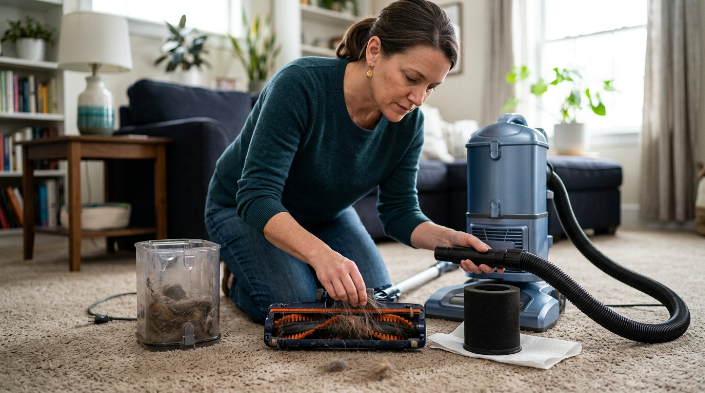
Start at the simplest point and work toward the more complicated parts. This avoids dismantling a floor head when the real problem is a full bin or clogged hose.
- Switch the vacuum off and unplug it if it uses a power cord.
- Empty the bin or replace the bag.
- Inspect the filter for heavy dust buildup.
- Disconnect the hose or wand and check for obstructions.
- Inspect the floor-head inlet for a compacted fur plug.
- Remove wrapped hair from the brush roll according to the manual.
- Check whether the brush roll turns normally during operation.
- Test the vacuum again on a small section of the same surface.
Compare hose suction with floor-head pickup
This is one of my favorite troubleshooting checks because it separates airflow problems from floor-head problems. If the hose pulls strongly but the vacuum still leaves hair on carpet, the floor head deserves your attention.
| What you notice | Most likely area | What to check next |
|---|---|---|
| Weak suction at hose and floor head | Airflow path | Bin or bag, filters, hose, seals, internal clog |
| Strong hose suction but poor carpet pickup | Floor head | Brush roll, belt, head height, floor setting |
| Good pickup on hard floors but poor pickup on carpet | Agitation or carpet setup | Brush roll operation, height adjustment, carpet mode |
| Good floor pickup but poor furniture pickup | Attachment | Mini motorized tool, upholstery tool, blocked attachment |
| Brush roll stops or sounds strained | Brush drive | Hair tangles, belt, bearings, automatic shutoff |
If performance returns after cleaning the airflow path, you probably don’t need a repair. Persistent weakness after basic maintenance deserves closer inspection.
Why Does My Vacuum Have Suction but Leave Pet Hair Behind?
Strong suction doesn’t guarantee strong carpet pickup. Hair can grip carpet fibers tightly enough that it needs agitation before airflow can carry it away.
The brush roll isn’t contacting the carpet correctly
A brush roll that’s set too high may skim across the surface. Set too low, some vacuums become difficult to push and airflow through the nozzle can suffer.
If your model has adjustable carpet height, start with the manufacturer’s recommended setting. Change one setting at a time so you can see what improves pickup.
The belt is slipping
On belt-driven vacuums, a stretched or damaged belt can let the brush roll turn without enough force. You may hear the vacuum running normally while embedded hair stays put.
- Check for an obviously broken belt.
- Look for a brush roll that turns inconsistently.
- Replace belts only with the correct part for your model.
The brush design doesn’t suit the surface
Traditional bristle rolls can work well on carpet, while rubber fins and hybrid rollers often reduce the amount of hair winding around the roller. Mini motorized tools can also outperform basic upholstery nozzles on fabric furniture.
| Tool or head type | Best use | Pet-hair consideration |
|---|---|---|
| Bristled brush roll | Carpet | Good agitation, but long hair may wrap around bristles |
| Rubber-fin or hybrid roller | Carpet and mixed flooring | Can reduce tangling depending on the design |
| Soft roller | Hard flooring | Useful for surface debris but not intended for deep carpet agitation |
| Mini motorized pet tool | Sofas, stairs, pet beds | Adds agitation where a plain suction nozzle may struggle |
This is why two vacuums with seemingly strong suction can behave differently on the same carpet. Floor-head design matters.
What Settings and Tools Work Best for Pet Hair?
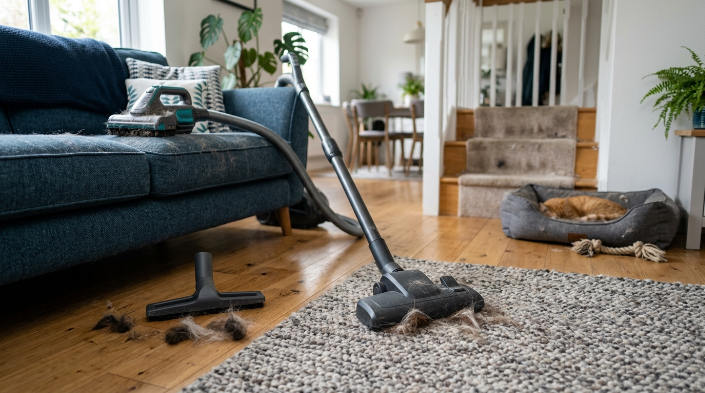
Match the vacuum setup to the surface rather than using one attachment everywhere. Pet hair behaves differently on carpet, smooth flooring, upholstery, stairs, and bedding.
For carpet
Use the powered brush roll or carpet mode when the manufacturer recommends it. Work slowly enough for the roller to loosen hair instead of making rapid passes.
- Vacuum in more than one direction when hair is embedded.
- Keep the brush roll free of heavy tangles.
- Use the correct carpet-height setting if your model offers one.
For hard floors
Hair usually sits on the surface instead of becoming embedded. A hard-floor head or appropriate roller can collect it without scattering lightweight strands ahead of the nozzle.
If the vacuum blows fur away, reduce unnecessary brush action or use the dedicated hard-floor setting if available.
For sofas, stairs, and pet beds
A small powered tool is useful when hair has worked into fabric. A plain upholstery attachment may work for loose fur but can struggle with strands woven into textured material.
Pet hair can also carry dander and other material from the animal’s environment. The National Institute of Environmental Health Sciences explains pet allergens and notes that fur can carry allergenic material from dander and saliva.
What does HEPA filtration change?
HEPA filtration concerns fine particles after they’re drawn into the vacuum; it doesn’t automatically make a floor head better at grabbing visible fur. The two features solve different problems.
The EPA defines a true HEPA filter as capable of capturing at least 99.97% of particles measuring 0.3 micrometers under the stated standard. A properly designed HEPA vacuum must also route its exhausted air through that final filtration stage.
Section Takeaway: Choose the floor head for visible hair pickup and filtration for the fine material traveling through the machine. Neither feature automatically replaces the other.
How Do I Stop Pet Hair From Clogging My Vacuum?
Frequent light maintenance works better than waiting until pickup suddenly collapses. Pet-owning homes can load a vacuum with bulky fur much faster than dust alone.
- Empty the bin regularly: Don’t let compressed fur block screens, cyclones, or air passages.
- Inspect the roller: Cut away wrapped hair using the method approved in the owner’s manual.
- Check narrow elbows: These are common places for soft fur plugs to form.
- Maintain filters: Clean or replace them at the intervals specified for your model.
- Clean attachments: Mini pet tools can clog just like the main floor head.
- Inspect seals: Make sure bins, hoses, filters, and covers are fully seated after maintenance.
Vacuum before fur becomes heavily embedded
Freshly shed hair is usually easier to collect than fur that’s been walked into carpet or pressed deep into upholstery. Short, regular cleaning sessions can therefore reduce the workload on the brush roll.
EPA guidance recommends regular carpet and furniture vacuuming as part of controlling household dust and allergens. Its asthma-trigger guidance also discusses HEPA-filtered vacuuming for homes where asthma or allergies are a concern.
Don’t confuse visible hair with pet allergens
Removing visible fur makes a room look cleaner, but pet allergy triggers aren’t limited to the hairs you can see. Proteins from dander, saliva, urine, and other sources can occur on much smaller particles.
That distinction matters when choosing a vacuum. Strong pet-hair pickup and effective filtration are both useful features, but they describe different parts of the cleaning process.
When Does Poor Pickup Mean My Vacuum Needs Repair?
If basic maintenance doesn’t restore pickup, a worn or failed component may be responsible. Don’t keep running a machine that smells hot, makes unusual grinding noises, or repeatedly shuts itself off.
Signs a repair may be needed
- The brush roll won’t turn after all visible tangles are removed.
- A new correct belt doesn’t restore brush movement.
- Suction remains weak after the bag, bin, filters, hose, and airway are cleared.
- The floor head repeatedly cuts out during normal use.
- The motor pitch changes sharply or the vacuum smells overheated.
- Cracked hoses or damaged seals create obvious air leaks.
A replaceable belt, hose, filter, or brush roll can make repair straightforward. Motor, control-board, battery, or powered-head failures require more consideration.
Expert Alert: If diagnosis requires opening motor housings, handling internal electrical wiring, or bypassing safety switches, stop and use a qualified appliance repair technician.
When replacing the vacuum makes more sense
Consider replacement when several expensive components are failing or suitable parts are no longer available. Age alone isn’t a good reason to discard a vacuum that still has a sound motor and affordable service parts.
If pet hair has always been difficult for the machine, the issue may also be design rather than failure. In that case, look for a vacuum with a powered floor head suited to your flooring, easy brush-roll maintenance, useful pet tools, and an airflow path that’s simple to clear.
Section Takeaway: Persistent poor pickup after complete maintenance can indicate a belt, brush drive, seal, motor, or floor-head failure. Repair simple service parts first, but leave internal electrical work to a professional.
Frequently Asked Questions
Why is my vacuum pushing pet hair around instead of picking it up?
The floor head may be scattering lightweight hair before suction reaches it. Check the floor setting, brush-roll mode, nozzle height, and airflow, then try slower passes with a head designed for that floor type.
Why does my vacuum pick up crumbs but not dog hair?
Crumbs are loose particles, while dog hair can cling to carpet fibers and upholstery. Your vacuum may have adequate airflow but insufficient brush-roll agitation, poor floor contact, or an attachment that isn’t suited to embedded hair.
Why does pet hair keep wrapping around my vacuum roller?
Long hair naturally winds around rotating brush rolls, especially traditional bristled designs. Remove tangles regularly and inspect the roller ends, because packed hair near bearings can eventually interfere with rotation.
Will a HEPA vacuum pick up pet hair better?
Not necessarily. HEPA describes filtration of fine particles passing through the vacuum, not the floor head’s ability to loosen visible fur. For pet-hair pickup, brush design, airflow, floor contact, and attachment choice are more directly relevant.
Can a dirty filter stop a vacuum from picking up pet hair?
Yes. A heavily clogged filter can restrict airflow and weaken pickup throughout the machine. Clean or replace filters only according to the manufacturer’s instructions, since not every vacuum filter is washable.
Why is my cordless vacuum suddenly bad at picking up pet hair?
Check the bin, filter, floor-head airway, and brush roll first. If those are clean, reduced battery output or a powered floor-head problem may also affect performance, especially if the brush roll slows or stops under load.
Should I vacuum pet hair every day?
There’s no single schedule that suits every household. Homes with heavy shedding may benefit from frequent quick passes, while lighter-shedding homes need less; the practical goal is to collect hair before it becomes deeply embedded or overloads the vacuum.
Final takeaway: When a vacuum stops picking up pet hair, don’t start by shopping for a new machine. Restore airflow, clean the brush roll, check the floor head and belt, then match the correct setting or attachment to the surface.
That simple troubleshooting order solves many pet-hair pickup problems and also tells you when a genuine repair is the next sensible step.
“`