
Why Is My Vacuum Filter Clogging So Quickly?

Quick Answer
Your vacuum filter usually clogs quickly because too much fine dust, hair, lint, or powder is reaching the filter at once. A full bin, blocked airflow path, wrong filter, or heavy fine-dust cleaning can make the problem worse; manufacturer fine-dust vacuuming guidance also recommends using the correct collection system when fine dust rapidly loads a filter.
Most Common Reasons
- Fine dust: Drywall dust, sanding dust, fireplace ash, and similar powders can load filter media quickly.
- Full bin: Packed debris can disrupt normal airflow and send more fine material toward the filter.
- Heavy pet debris: Hair, dander, fibers, and fine household dust can create a dense layer on pre-filters.
- Hidden blockage: A restricted hose, wand, or floorhead can reduce airflow through the whole machine.
- Wrong maintenance: Washing a non-washable filter or reinstalling a damp one can create new problems.
- Wrong vacuum: A standard household vacuum may not be designed for renovation dust or large amounts of fine powder.
What to Check First
- Unplug the vacuum, empty the bin or check the bag, inspect the hose and floorhead, then examine the filter according to your owner’s manual.
A vacuum filter that seems clean one day and packed with gray dust the next can be frustrating. In most cases, though, the filter isn’t defective.
It’s responding to what you’re vacuuming and how air moves through the machine. I troubleshoot this as an airflow and debris problem first, rather than buying another filter immediately.
This guide explains why vacuum filters clog fast, how different filter types behave, and what you can do to extend filter life without damaging your vacuum.
In This Guide
- Why Does My Vacuum Filter Clog So Quickly?
- Is Fine Dust the Main Reason Vacuum Filters Clog?
- Can a Full Bin or Hidden Clog Make the Filter Dirtier?
- Which Vacuum Filter Types Need Different Care?
- How Do I Stop My Vacuum Filter From Clogging So Fast?
- When Should I Replace the Filter or Have the Vacuum Checked?
- Frequently Asked Questions
Why Does My Vacuum Filter Clog So Quickly?
Your vacuum filter clogs quickly when particles build up on the filter faster than normal airflow can carry debris into the bin or bag. Fine dust is often the biggest culprit.
A clogged vacuum filter is filter material loaded with enough dust, fibers, hair, or fine debris to restrict normal airflow.
The filter’s job is to trap particles that shouldn’t continue through the machine. That means some dirt on a filter is normal.
The problem starts when that layer becomes dense enough to reduce airflow.
The most common causes
- Fine household dust: Small particles settle deep into pleats, foam, and other filter media.
- Drywall or sanding dust: Fine construction powders can overwhelm a standard household filter.
- Pet hair and dander: Hair combines with dust and fibers to form dense mats on pre-filters.
- Carpet fibers: Lint and fuzz can coat foam or mesh filters quickly.
- Full dust container: An overfilled bin or bag can interfere with the vacuum’s intended airflow.
- Blocked airflow: A clog elsewhere can reduce the air moving through the filter.
- Incorrect filter: A poorly fitted or incompatible filter may not work as the machine was designed.
One clue I watch for is how quickly the problem returns. A filter that clogs after one unusually dusty cleanup tells a different story from one that blocks after every normal room.
If the problem suddenly started, check what changed. A new rug, renovation work, shedding pet, spilled powder, or missed maintenance can explain the difference.
Is Fine Dust the Main Reason Vacuum Filters Clog?
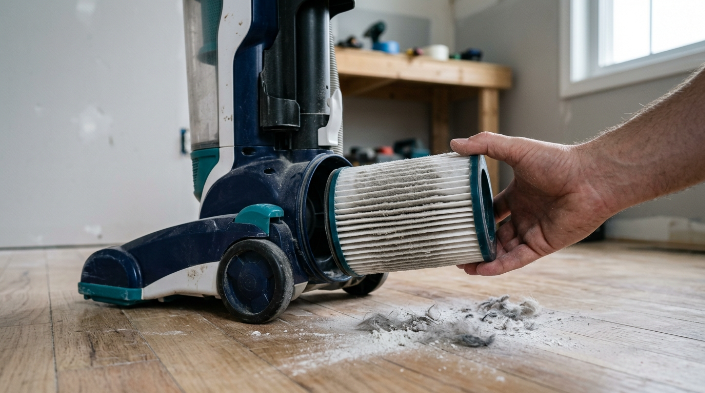
Fine dust is one of the fastest ways to load a vacuum filter. The smaller particles can spread across a large area of filter media and restrict its pores.
Dyson, for example, notes that filters on some models may need more frequent washing when the machine handles large amounts of fine dust. That doesn’t mean every vacuum filter is washable.
Common fine materials include:
- Drywall and joint-compound dust
- Sanding dust
- Fine soil
- Powdered household products
- Fireplace ash
- Very fine pet and textile debris
I’ve found that the mess can look small on the floor but become a thick coating once it spreads over filter pleats. That’s why the amount you vacuum isn’t always a good predictor of filter loading.
Why ordinary house dust matters too
Household dust isn’t one single substance. The U.S. Environmental Protection Agency’s indoor particulate guidance notes that indoor dust can contain soil, pollen, mold spores, pet dander, dust mites, skin flakes, hair, and particles from household activities.
That mixture explains why one home’s filter may load faster than another. Pets, carpeting, open windows, outdoor dust, and cleaning frequency all change the debris entering the machine.
Be careful with renovation dust
A regular household vacuum isn’t automatically suitable for every fine powder. Renovation debris may require a machine and collection system designed for that material.
Expert Alert: If you’re dealing with lead-contaminated dust, asbestos-containing material, silica dust, extensive mold contamination, or another hazardous renovation material, don’t rely on an ordinary household vacuum. Follow applicable safety guidance and use a qualified professional when needed.
Can a Full Bin or Hidden Clog Make the Filter Dirtier?
Yes. A filter can look like the main problem even when something else is restricting airflow first.
I check the whole dirt path before blaming the filter. It takes only a few minutes and often prevents unnecessary replacement.
Check these areas in order
- Dust bin or bag: Empty the bin or replace the bag as your manual directs.
- Floorhead: Look for packed hair, paper, lint, or debris around the intake.
- Brush roll: Remove wrapped hair and string while the machine is disconnected from power.
- Wand: Inspect narrow sections and bends for trapped objects.
- Hose: Check both ends and any curved sections where debris can lodge.
- Filter housing: Make sure the filter is installed correctly and the surrounding seals are clean.
A filter problem often appears as weak suction. Unfortunately, a full bag, hose clog, tangled brush roll, or air leak can create the same symptom.
Consumer Reports’ vacuum cleaner guidance also notes that vacuum filters need periodic cleaning or replacement.
Don’t test the machine without its required filter
It may seem tempting to remove the filter and run the vacuum briefly to see whether suction improves. Don’t do that unless the manufacturer specifically instructs you to.
Required filters help keep debris where the machine’s designers intended it to go.
Which Vacuum Filter Types Need Different Care?
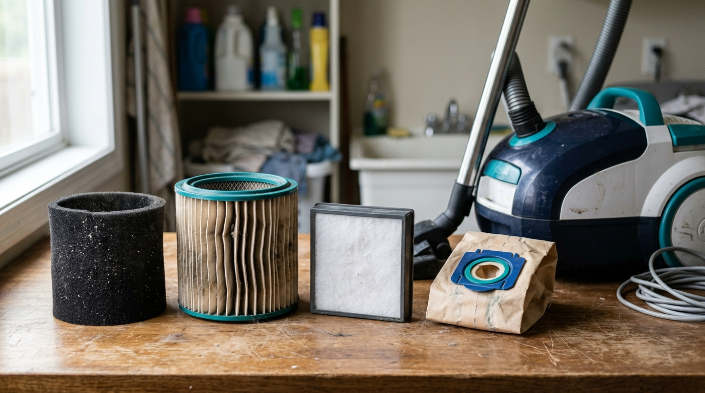
Vacuum filters don’t all use the same material or cleaning method. A washable foam pre-filter and a non-washable pleated filter can require completely different care.
That’s why the owner’s manual matters more than generic cleaning advice.
| Filter or Collection Type | Main Role | Washable? | Common Clogging Issue |
|---|---|---|---|
| Foam pre-filter | Captures debris before later filtration stages | Often, but model dependent | Hair, lint, and fine gray dust can mat the surface |
| Pleated cartridge | Provides a large filtering surface in a compact space | Depends on the exact filter | Fine powder can fill pleats rapidly |
| HEPA filter | High-efficiency fine-particle filtration | Never assume; check the manual | Fine particles gradually load the media |
| Vacuum bag | Collects debris and may provide a filtration stage | Usually replaced, not washed | Restricted airflow as the bag becomes loaded |
HEPA stands for high-efficiency particulate air. The EPA defines a HEPA filter as capable of capturing at least 99.97% of particles measuring 0.3 microns under the specified test definition.
That number describes HEPA filter performance, not how often your particular vacuum filter should be washed or replaced.
Wash only filters designed for washing
Some vacuum filters can be rinsed. Others can be damaged by water.
For washable Dyson vacuum filters, the manufacturer’s filter-care instructions say to let the filter dry for at least 24 hours and confirm it’s completely dry before reinstalling it.
Don’t turn that into a universal 24-hour rule for every brand. Follow the instructions for your exact model.
How Do I Stop My Vacuum Filter From Clogging So Fast?
The best fix is to reduce unnecessary debris loading while keeping the vacuum’s entire airflow path clear. Replacing filters repeatedly won’t solve the underlying cause.
Use this maintenance routine
- Empty the bin before it is packed. Follow the fill line or manufacturer guidance rather than squeezing in one more room.
- Replace bags on schedule. Don’t keep using an obviously loaded bag after suction begins falling.
- Remove large debris by hand. Pick up socks, paper scraps, coins, toy pieces, and other objects before vacuuming.
- Clean the brush roll. Hair and thread can reduce floorhead performance and contribute to airflow problems.
- Inspect the hose. Check it whenever suction changes suddenly.
- Maintain the filter correctly. Wash, tap, brush, or replace it only as the manufacturer permits.
- Match the vacuum to the mess. Don’t use a standard household machine for material it wasn’t designed to collect.
If pets or carpeting produce a lot of debris, checking the pre-filter more often may be reasonable. The correct interval still depends on your machine.
Reduce the dust your vacuum has to handle
Vacuuming is only one part of home hygiene. Damp dusting can remove settled material without sending as much loose dust back into the room.
For households dealing with dust-mite allergies, the Asthma and Allergy Foundation of America recommends measures that include regular cleaning and HEPA-filter vacuuming while noting that vacuuming alone doesn’t remove every dust mite.
As of 2026, that broader approach still makes sense. A clean vacuum filter helps, but source control and regular household cleaning matter too.
When Should I Replace the Filter or Have the Vacuum Checked?
Replace the filter when the manufacturer calls for replacement, when approved cleaning no longer restores it, or when you can see physical damage. Don’t keep washing a disposable filter to avoid buying a new one.
Replace the filter if you notice:
- Tears or holes in the filter material
- Crushed or badly distorted pleats
- Damaged seals or edges
- Heavy buildup that approved cleaning doesn’t remove
- A replacement reminder from the machine or manual
- A filter that no longer seats correctly
Weak suction after filter maintenance doesn’t prove the motor is bad. Recheck the bin, hose, wand, floorhead, brush roll, and seals first.
Know when to stop troubleshooting
Switch the vacuum off if it develops a burning smell, electrical smell, smoke, sparking, damaged wiring, or repeated overheating. Continuing to run it may turn a simple maintenance issue into a safety problem.
Expert Alert: Electrical repairs, internal motor repairs, melted wiring, repeated breaker trips, or persistent overheating should be handled by a qualified appliance technician rather than DIY troubleshooting.
For people sensitive to household allergens, remember that filtration is only part of the equation. A filter must also fit correctly, and the machine should keep collected dust contained rather than leaking it back into the room.
Frequently Asked Questions
Why does my vacuum filter get dirty after only one use?
A filter can become visibly dusty after one use if you’re collecting fine powder, heavy pet debris, carpet fibers, or a large amount of settled dust. Some surface dirt is normal, but rapid suction loss suggests heavier filter loading or another airflow restriction.
Can pet hair make a vacuum filter clog faster?
Yes. Pet hair can combine with dander, lint, carpet fibers, and ordinary dust to form a dense layer on pre-filters and other surfaces. Regular brush-roll cleaning and early bin emptying can reduce the amount of packed debris inside the machine.
Why does my HEPA filter clog so fast?
A HEPA filter can load quickly when large amounts of fine material reach it. Check whether your vacuum also has a pre-filter or other collection stage that needs maintenance, and never wash the HEPA filter unless your manufacturer specifically says it is washable.
Can I wash my vacuum filter every week?
Only if your vacuum manufacturer allows washing that specific filter and that frequency makes sense for your use. Some filters are washable, while others must remain dry. Unnecessary washing can damage filter material that wasn’t designed for repeated rinsing.
Does a clogged filter reduce vacuum suction?
Yes. A heavily loaded filter can restrict airflow and contribute to weaker pickup. However, a full bin, blocked hose, floorhead obstruction, tangled brush roll, or air leak can produce similar symptoms, so check the complete airflow path.
Should I buy a new filter every time suction drops?
No. First empty the bin or inspect the bag, check for blockages, and examine the filter. Clean reusable filters only as directed. Replace the filter when it’s damaged, disposable, beyond its service interval, or no longer responds to approved maintenance.
Is a HEPA vacuum better for household dust?
HEPA filtration can help keep fine captured particles from being exhausted back into the room. The EPA also suggests considering a HEPA-filter vacuum for reducing household dust buildup, but good cleaning habits and proper machine maintenance still matter.
Bottom line: A vacuum filter that keeps clogging is usually telling you something about the debris load or airflow through the machine.
Start with the easy checks. Empty the bin, inspect the hose and floorhead, identify what you’re vacuuming, and care for the filter exactly as your manufacturer recommends.