
Why Is My Vacuum Cleaner Losing Suction?

Quick Answer
A vacuum cleaner usually loses suction because airflow is restricted or escaping somewhere in the machine. Start with the dust bin or bag, then inspect the filters, hose, wand, floorhead, brush roll, and seals; the EPA’s indoor dust guidance also stresses regular vacuuming and proper filtration for controlling household dust.
Most common causes of weak suction
- Full bin or bag: Too much collected debris can restrict normal airflow.
- Dirty filter: Dust-loaded filter media makes it harder for air to move through the vacuum.
- Blocked hose: Hair, paper, small objects, and packed dust can obstruct the airflow path.
- Tangled brush roll: Hair and thread can reduce pickup even when the motor still produces suction.
- Air leak: A loose connection, cracked hose, or poorly seated bin can let suction escape.
- Mechanical fault: If the airflow path is completely clear, the motor or another internal component may need professional diagnosis.
Best first check
- Turn the vacuum off and disconnect power before opening the bin, removing filters, or checking for blockages.
Weak vacuum suction is one of those home hygiene problems that can make a five-minute cleaning job feel endless. Crumbs stay on the rug, pet hair needs repeated passes, and dust seems to survive everything you do.
I use one simple rule when troubleshooting a vacuum cleaner: follow the airflow. If air cannot enter, travel through the machine, and exit normally, cleaning performance will drop.
In This Guide
Why Does a Vacuum Cleaner Lose Suction?
A vacuum loses suction when normal airflow becomes restricted or when air leaks into the system before reaching the cleaning head. A full dirt container, clogged filter, blocked airway, tangled floorhead, or damaged connection can all produce similar symptoms.
Vacuum suction loss is a noticeable drop in the machine’s ability to move air and lift debris from a surface compared with its normal performance.
1. The dust bin or vacuum bag is too full
Check the collection system first. It’s the fastest problem to rule out and requires almost no disassembly.
- Bagless vacuum: Empty the bin when debris reaches the manufacturer’s fill line.
- Bagged vacuum: Replace the bag according to the fullness indicator or instructions in your manual.
- Cyclonic vacuum: Look for compacted debris around the cyclone inlet as well as inside the main container.
Don’t judge a bag only by its outside shape. Fine dust can increase airflow resistance before a bag looks completely packed.
2. A filter is clogged with fine dust
A filter catches particles carried through the vacuum’s airflow. As debris builds on the filter media, airflow may become more restricted.
Inspect every filter your model uses. These may include a foam pre-filter, pre-motor filter, pleated filter, or exhaust filter.
- Remove loose surface dust using the method recommended by the manufacturer.
- Wash a filter only when its instructions specifically identify it as washable.
- Allow washable filters to dry completely before reinstalling them.
- Replace torn, warped, damaged, or non-washable filters as directed.
Never assume a pleated or HEPA filter can go under the tap. Water can damage filters that were designed for dry replacement.
3. Something is blocking the hose or wand
A sudden drop in suction often points toward a physical blockage. Socks, paper scraps, pet hair clumps, toy pieces, and packed lint can become lodged in narrow bends.
Disconnect power before taking the hose apart. Then inspect the hose, wand, inlet, connectors, and floorhead neck separately.
4. Hair is wrapped around the brush roll
A brush-roll problem can feel like suction loss even when airflow remains strong. The vacuum may still pull air while failing to lift hair and debris effectively from carpet.
- Remove hair and thread wrapped around the roller.
- Check narrow openings behind the brush roll for packed debris.
- Inspect the drive belt if your model uses one.
- Confirm the roller turns as the manufacturer intends.
5. Air is leaking through a hose or seal
Vacuum systems depend on reasonably sealed airflow paths. A cracked hose or poorly fitted component allows air to enter where it shouldn’t.
Check the hose along its full length. Also inspect bin seals, filter covers, wand connections, and attachment joints.
Section Takeaway: Most suction problems start somewhere along the airflow path. Check the collection container, filters, hose, floorhead, and seals before assuming the motor has failed.
How Do You Find Where the Suction Problem Is?
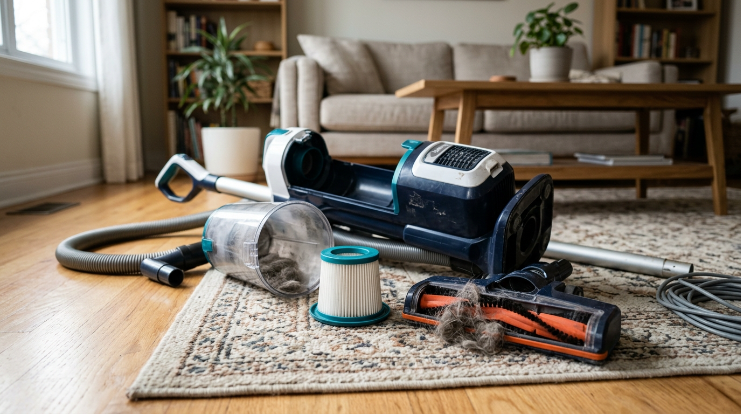
The easiest diagnostic method is to isolate one section of the vacuum at a time. You’re trying to discover where strong airflow changes into weak airflow.
- Disconnect the power. Unplug a corded vacuum or switch off the cordless machine before removing parts.
- Empty the collection system. Empty the bin or replace the bag according to your model’s directions.
- Inspect the filters. Check for heavy dust buildup, damage, incorrect seating, or a filter installed while still damp.
- Check the hose. Detach it when your model permits and inspect both ends for debris.
- Inspect the wand. Look through rigid tubes and attachment openings for trapped objects.
- Check the floorhead. Remove hair, string, and debris around the intake and brush roll.
- Inspect connections. Refit the bin, hose, filters, covers, and attachments securely.
- Test again. If suction remains poor everywhere, follow the manufacturer’s troubleshooting procedure.
My diagnostic rule is simple: if suction feels strong at the hose but weak at the floorhead, I stop blaming the motor. I concentrate on the wand, lower airway, floorhead neck, and brush roll instead.
Manufacturers use a similar isolation process when troubleshooting low suction. Testing the airflow at different points helps distinguish a local blockage from a problem closer to the motor.
Expert Alert: If the vacuum has weak suction directly at the machine’s intake after approved filters and accessible airways are cleared, stop disassembling it. Internal motor, fan, wiring, or control problems should be inspected by the manufacturer or a qualified appliance technician.
Is It the Filter, Hose, Brush Roll, or an Air Leak?
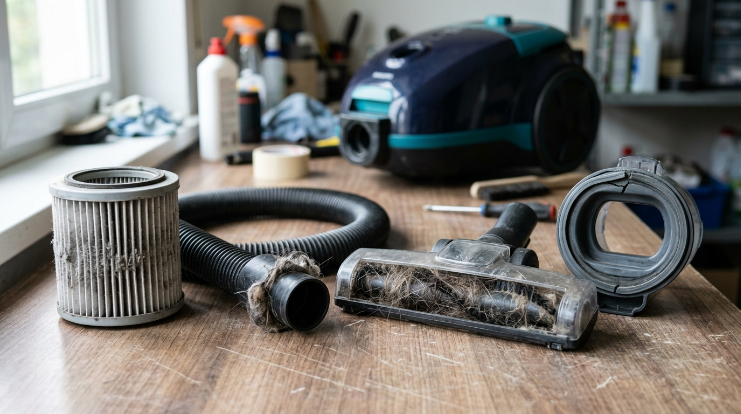
Several problems create almost identical symptoms. The pattern of the suction loss usually gives you the best clue.
| What you notice | Likely area | What to check | Best first action |
|---|---|---|---|
| Suction slowly gets weaker | Bin, bag, or filter | Fill level and filter condition | Empty, replace, or maintain as directed |
| Suction drops suddenly | Hose or airway | Hose, wand, bends, and inlet | Remove accessible blockage safely |
| Good hose suction but poor carpet pickup | Floorhead or brush roll | Hair, belt, roller, lower airway | Clear wrapped debris and inspect the head |
| Weak suction despite clear airways | Seal or hose leak | Cracks, loose joints, bin seating | Reseat parts and replace damaged components |
| Vacuum pulses or stops | Restricted airflow or model protection system | Filter and complete airway | Turn off, cool, and troubleshoot per manual |
Don’t run the machine without required filters as a suction test. Filters may protect internal components as well as control particles in the exhaust air.
Why Does My Vacuum Lose Suction After a Few Minutes?
A vacuum that works normally at first and then weakens may have an airflow restriction that becomes more noticeable as debris moves through the system. Some models may also pulse or shut down when a blockage or dirty filter interferes with normal operation.
Turn the machine off if it becomes unusually hot, develops a burning smell, or repeatedly stops. Allow it to cool before following the manufacturer’s troubleshooting steps.
Check for recurring restrictions
- Filter loads quickly: Fine debris may be coating the filter during use.
- Bin inlet plugs: Hair and fibers may collect around a narrow opening.
- Brush roll binds: Long hair or thread can continue winding around the roller.
- Hose clog moves: A loose obstruction can shift position as airflow changes.
- Incorrect assembly: A filter, bin, or cover may not be seated properly after cleaning.
A changed motor sound is another useful warning sign. Whistling, pulsing, or an unfamiliar high-pitched sound can justify shutting the machine down and checking the airflow path.
Expert Alert: Stop using a vacuum that repeatedly overheats, smells electrical, sparks, or trips a breaker after routine maintenance. Those symptoms need professional diagnosis rather than continued DIY testing.
Can a HEPA Filter Reduce Vacuum Suction?
A correctly specified HEPA filter should be used exactly as the vacuum manufacturer designed it. Suction problems are more likely when a required filter becomes heavily loaded, damaged, incorrectly fitted, or replaced with an unsuitable component.
HEPA means high-efficiency particulate air. The EPA’s HEPA explanation states that the filter category can theoretically capture at least 99.97% of particles measuring 0.3 microns under its defined test conditions.
That number describes filter performance under applicable testing. It doesn’t mean every vacuum fitted with something labeled HEPA has identical whole-machine filtration.
Why filtration matters in a home
Indoor dust can contain pollen, mold spores, pet dander, dust-mite material, fibers, and other particles. Vacuuming removes settled debris, although cleaning can also disturb dust temporarily.
- Keep required filters properly installed.
- Use the correct replacement filter for your model.
- Follow the manufacturer’s cleaning and replacement schedule.
- Never reinstall a washable filter until it is completely dry.
People managing asthma or allergies can also review resources from the Asthma and Allergy Foundation of America. For independent appliance information, Consumer Reports is another useful reference.
As of 2026, the safest maintenance advice hasn’t changed: match filter care to the exact machine. A washable foam filter and a non-washable pleated filter shouldn’t be treated the same way.
How Can You Prevent Vacuum Suction Loss?
Preventing suction loss is mostly about keeping the full airflow path clear. Small maintenance checks are easier than diagnosing a machine after performance collapses.
Before or after routine cleaning
- Check the bin or bag level.
- Look for hair around the brush roll.
- Remove visible debris from the floorhead.
- Check that the hose and wand are connected securely.
Inspect the filters regularly
There is no universal filter-cleaning schedule for every vacuum. Your owner’s manual should decide when each filter is cleaned or replaced.
More frequent inspection may make sense in homes with pets, heavy carpet use, or substantial fine dust. Inspection doesn’t mean automatically washing the filter.
Pick up unsuitable debris by hand
Standard household vacuums aren’t designed for every mess. Large objects and certain fine materials can create blockages or require specialized equipment.
- Coins and small toys
- Socks and fabric scraps
- Long pieces of string
- Large paper fragments
- Construction or renovation debris unless the vacuum is designed for it
- Liquids unless the machine is specifically rated for wet pickup
Good vacuum maintenance also supports a cleaner home environment because the machine can collect debris more effectively. The goal isn’t maximum suction at all costs; it’s the airflow and filtration performance the manufacturer intended.
Section Takeaway: Keep the bin, filters, hose, wand, floorhead, brush roll, and seals in your maintenance routine. A clear airflow path is the simplest way to protect normal suction.
Frequently Asked Questions
Why is my vacuum losing suction even after I empty it?
Check the filters, hose, wand, floorhead, and connections next. An empty bin won’t restore performance if a filter is heavily loaded, an object is stuck in the hose, or air is escaping through a damaged or loose connection.
Can a dirty vacuum filter cause weak suction?
Yes. A heavily loaded filter can restrict airflow through the vacuum and contribute to weaker pickup. Clean or replace the filter only according to the instructions for your exact model, since not every vacuum filter is washable.
How do I know if my vacuum hose is clogged?
A hose clog is more likely when suction disappears suddenly or feels weak at the hose end. Disconnect the vacuum from power, remove the hose if your model allows it, and inspect the airway for trapped debris without using sharp objects.
Why does my vacuum have suction through the hose but not the floorhead?
Strong hose suction with poor floor pickup usually shifts attention toward the lower airway, floorhead, brush roll, or belt. Remove wrapped hair and inspect the floorhead neck for debris before assuming the vacuum motor is failing.
Can I wash my vacuum’s HEPA filter?
Only wash it if the manufacturer specifically identifies that exact filter as washable. HEPA describes a filtration category, not a cleaning method, so one HEPA filter may tolerate rinsing while another needs dry maintenance or replacement.
Why does my vacuum keep stopping after a few minutes?
A blockage or dirty filter can contribute to restricted airflow, and some models may shut down or pulse under certain fault conditions. Turn the vacuum off, let it cool, inspect accessible airways and filters, and follow the manufacturer’s troubleshooting instructions.
When should I take my vacuum to a repair technician?
Seek professional help when suction remains weak after normal maintenance or when the vacuum overheats repeatedly, smells electrical, sparks, trips a breaker, or has no meaningful airflow at the main machine intake. Avoid opening motor or electrical assemblies yourself.
A vacuum that suddenly feels weak usually isn’t asking for a complicated repair first. Start with the airflow path, work through each component in order, and let the symptoms tell you where to look next.
Once suction returns, add those quick checks to your normal cleaning routine. A few minutes of maintenance can prevent the same frustrating problem from interrupting your next vacuuming session.