
Why Is My Vacuum Hose Clogged? Causes, Fixes, and Prevention

Quick Answer
Your vacuum hose is usually clogged because hair, lint, paper, pet fur, or a small object caught inside a bend and started collecting more debris. A full bin or bag, dirty filter, blocked floorhead, or tangled brush roll can create similar weak-suction symptoms, so check the whole airflow path before assuming the hose is the only problem. Consumer Reports’ vacuum guidance also notes that filters need periodic cleaning or replacement.
Common reasons a vacuum hose gets clogged
- Hair and fibers: Pet hair, long hair, thread, and lint can twist together into a dense plug.
- Large debris: Paper scraps, coins, toy parts, wrappers, and similar objects can lodge across a narrow bend.
- Fine powder: Large amounts of very fine dust can cake onto existing debris and narrow the airway.
- Full dirt container: An overfilled bin or bag can restrict airflow and make a partial hose clog worse.
- Dirty filters: A loaded filter can reduce airflow enough to mimic a blocked hose.
How to confirm it
- Isolate the hose: Unplug the vacuum, detach the hose if your model allows it, and inspect both ends with a flashlight before trying to remove anything.
When my vacuum suddenly loses suction, I treat it as an airflow problem first. That approach is faster than assuming the motor has failed.
A blocked vacuum hose is especially common on uprights and canister vacuums. This guide explains why it happens, how to confirm the blockage, how to clear it safely, and what stops the problem from coming back.
In This Guide
What Causes a Vacuum Hose to Clog?
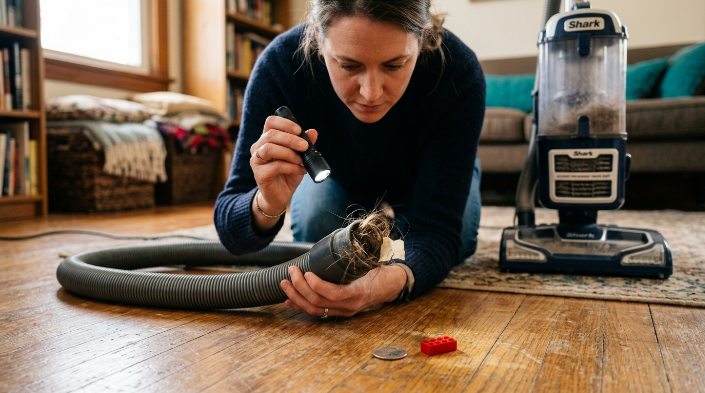
A vacuum hose clogs when something restricts the path that carries dirty air from the cleaning head toward the dirt container. The first obstruction is often small, but it catches more debris until airflow falls noticeably.
Definition: A vacuum hose clog is a physical blockage inside the vacuum’s airflow path that reduces or stops normal suction through the hose.
Hair, pet fur, and lint form plugs
Hair is one of the easiest materials to turn into a stubborn clog. Long strands wrap around lint and dust instead of moving cleanly through the hose.
Pet fur can cause the same problem. A few strands catch on an interior ridge, and the growing bundle starts trapping everything that follows.
- Human hair: Long strands can twist into compact balls.
- Pet fur: Soft fur mixes easily with dust and lint.
- Thread: Loose fibers can catch on hose ridges and connectors.
- Carpet fibers: Repeated pickup can contribute to a fibrous blockage.
Large objects create a starting point
A surprising number of hose clogs begin with one object that should never have entered the vacuum. The object gets stuck sideways, then ordinary dirt collects behind it.
- Small toy pieces
- Coins
- Paper scraps
- Food wrappers
- Hair clips
- Pieces of cardboard
- Socks or small pieces of fabric
The narrow connector near the floorhead is a common place to check. Curves and changes in diameter give larger debris somewhere to lodge.
Fine debris can make an existing clog worse
Ordinary household dust usually travels through a working vacuum without forming a solid plug. Trouble starts when fine material lands on hair, damp residue, or another obstruction already inside the airway.
I avoid picking up renovation dust, fireplace ash, and large amounts of powder with a normal household vacuum unless the manufacturer specifically allows it. Those materials can also overload filters and other internal parts.
The U.S. Environmental Protection Agency’s particulate matter guidance explains that airborne particles include materials such as dust and dirt in many different sizes. Your vacuum’s job is to collect household debris without allowing the airflow path to become restricted.
A full bin or dirty filter can amplify the problem
The hose does not work alone. Air must pass through several parts of the machine before it exits.
If the bin is packed or the filter is heavily loaded, airflow drops throughout the vacuum. A small hose restriction that was barely noticeable can then feel like a complete blockage.
Section Takeaway: Most vacuum hose clogs begin when hair, fibers, or a larger object catches inside the airway and starts collecting more debris.
How Can You Tell If the Vacuum Hose Is Clogged?
A sudden drop in suction is a strong clue, but it does not prove the hose is blocked. The easiest diagnosis comes from separating the hose from the rest of the vacuum.
Always unplug a corded vacuum before removing parts. Switch off a cordless model and follow its manual before opening any airway or powered attachment.
Look for the typical signs
- Weak suction at the hose: Pickup is poor even though the motor sounds normal.
- Sudden performance loss: Suction changed quickly rather than slowly over months.
- Changed motor sound: Restricted airflow may make the vacuum sound different.
- Debris falling back out: Dirt enters the wand but does not travel through the hose.
- Visible obstruction: A flashlight reveals hair, paper, or another object inside.
- Unusual heat: Some machines may become warmer when airflow is badly restricted.
Test the hose separately
Detach the hose from both ends if your model is designed for removal. Hold it as straight as possible and shine a flashlight through one end.
If you cannot see through a normally open hose, inspect from the opposite side. Flexible ridged hoses can hide a blockage around a curve.
I also check the hose cuffs first. Debris often packs directly behind a connector, where it is easier to remove than a clog in the middle.
Do not overlook a cracked hose
A hose with an air leak can feel clogged because suction at the cleaning end becomes weak. Look for splits, loose cuffs, punctures, or damaged seals while the hose is detached.
A leak and a blockage require different fixes. Clearing a perfectly open hose will not restore suction if air is entering through a crack.
How Do You Safely Clear a Clogged Vacuum Hose?
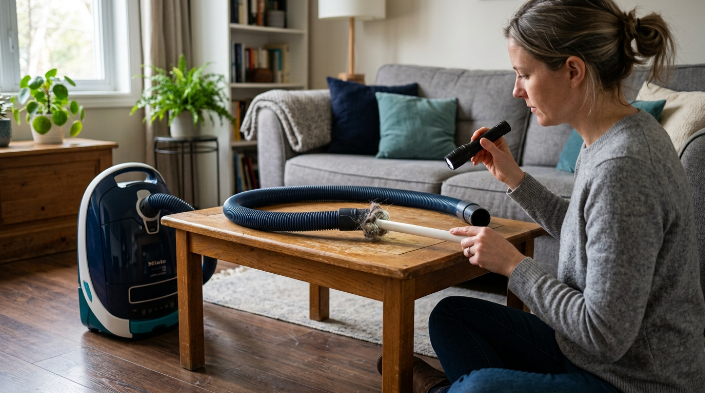
Clear a hose by working gently from the nearest accessible opening. Sharp tools and excessive force can turn a simple blockage into a punctured hose.
- Disconnect power. Unplug the vacuum or switch off the cordless machine according to its manual.
- Remove the hose. Detach it only where the manufacturer designed it to disconnect.
- Check both openings. Pull out visible hair, paper, or debris that is within easy reach.
- Use a flashlight. Look through the hose from each side to estimate where the blockage sits.
- Loosen the clog gently. Use a long, smooth, blunt object only if it can move through the hose without puncturing or stretching it.
- Remove the debris. Work toward the closest opening rather than forcing the obstruction deeper.
- Inspect again. Confirm that the airway is clear before reconnecting the hose.
- Test the vacuum. Reassemble it correctly and check whether normal suction has returned.
What should you not use?
A screwdriver, knife, exposed wire, or sharp coat hanger can pierce flexible hose material. Even a small hole can create an air leak.
Do not force a rigid tool around a tight bend. If the obstruction will not move with light pressure, stop before damaging the hose.
Can you wash a vacuum hose?
Only wash a hose when the manufacturer’s instructions say that particular hose is washable. Some hoses contain electrical wiring, powered-tool connections, or materials that should not be soaked.
If an approved non-powered hose is washed, let it become completely dry before reinstalling it. Trapped moisture can create odors and may support unwanted microbial growth.
The CDC’s mold guidance emphasizes that mold growth is tied to moisture. That is another reason I never reconnect a damp hose simply because its outside surface feels dry.
Expert Alert: If the hose contains electrical contacts, internal wiring, a powered handle, melted areas, or a persistent burning smell, stop DIY cleaning and contact the manufacturer or a qualified appliance repair professional.
Section Takeaway: Disconnect the vacuum, locate the obstruction, and remove it with gentle pressure. Never trade a removable clog for a punctured or electrically damaged hose.
Is It a Hose Clog or Another Vacuum Problem?
Several vacuum faults create almost identical symptoms. I usually troubleshoot from the easiest airflow checks toward the more complicated ones.
| Problem | Typical Clue | Where to Check | Best First Action |
|---|---|---|---|
| Hose clog | Sudden weak suction or debris stuck in the tube | Hose cuffs, bends, and internal airway | Detach and inspect the hose |
| Full bin or bag | Performance falls as collected debris builds up | Dust bin, bag, and inlet | Empty or replace as directed |
| Dirty filter | Weak airflow with visibly loaded filter media | Pre-motor and exhaust filter locations | Clean or replace according to the manual |
| Brush-roll tangle | Poor carpet pickup or a roller that cannot move normally | Floorhead and brush roll | Remove wrapped hair and thread safely |
| Air leak | Low suction even though the airway looks clear | Hose, seals, bin seating, and connectors | Reseat parts and inspect for damage |
If suction returns after the hose is detached or cleared, the blockage was likely part of the problem. If suction remains poor, continue checking the bin, filters, floorhead, seals, and other accessible air passages.
Never run a vacuum without required filters simply to test whether airflow improves. Use the machine only in the configuration specified by its manufacturer.
How Do You Stop a Vacuum Hose From Clogging Again?
Repeated clogs usually mean the same type of debris keeps entering the vacuum or normal airflow is already restricted elsewhere. Prevention is much easier than clearing a tightly packed hose every few weeks.
Pick up large objects before vacuuming
Walk through the room first and remove anything that could bridge a narrow opening. This takes less time than dismantling the vacuum later.
- Coins and toy pieces
- Large paper scraps
- Socks and fabric pieces
- Hair clips
- Long pieces of string
- Food wrappers
Empty the bin or manage the bag on time
Do not pack a bagless bin beyond its marked fill level. For bagged machines, replace the bag according to the manufacturer’s instructions instead of waiting until airflow is severely restricted.
Good airflow matters throughout the vacuum. One restriction can make another restriction more noticeable.
Keep the brush roll free of hair
Hair wrapped around the brush roll can interfere with pickup before debris even reaches the hose. Check it regularly if your home has pets or people with long hair.
Consumer Reports’ vacuum testing also identifies tangled hair around roller brushes as a common vacuum-owner problem. Catching that buildup early makes the rest of the airflow path easier to maintain.
Maintain filters exactly as directed
Some filters are washable. Others must stay dry and be replaced when required.
Do not assume every filter labeled HEPA can be rinsed. Follow the instructions for the exact vacuum and filter.
For households concerned about allergens, the Asthma and Allergy Foundation of America includes vacuum cleaners among products evaluated through its Asthma & Allergy Friendly certification program.
Match the vacuum to the mess
A household dry vacuum is not automatically suitable for every type of debris. Liquids, construction material, ash, and unusually heavy debris may require equipment designed for that job.
As of 2026, this remains one of my simplest maintenance rules: if the mess looks outside the vacuum’s normal household job, check the manual before sucking it up.
Section Takeaway: Prevent repeat hose clogs by removing oversized debris first, maintaining the dirt container and filters, clearing wrapped hair, and using the vacuum only for materials it was designed to collect.
Frequently Asked Questions
Why does my vacuum hose keep getting clogged with hair?
Hair binds easily with lint, carpet fibers, and pet fur. Once a few strands catch on a hose ridge or connector, they can form a web that traps more debris and gradually creates a dense blockage.
Can a clogged vacuum hose cause weak suction?
Yes. A hose blockage restricts airflow between the cleaning head and dirt container, so suction at the floor or attachment can drop sharply. A dirty filter, full bin, brush-roll problem, or air leak can cause similar symptoms.
Can a clogged vacuum make the motor overheat?
Restricted airflow can contribute to extra heat in some vacuum designs, and certain models may shut down when they become too hot. If the housing becomes unusually hot or you notice a burning smell, switch the vacuum off and investigate before using it again.
Can I use a coat hanger to unclog my vacuum hose?
I would avoid an exposed metal coat hanger. Its narrow end can puncture flexible plastic or damage internal wiring, so a smooth, blunt tool is safer when the manufacturer permits manual clog removal.
Should I wash a clogged vacuum hose?
Only if the manufacturer says the specific hose can be washed. Never soak a powered hose or one containing electrical connections, and never reinstall a washable hose until its interior is completely dry.
Why is my vacuum still weak after I unclogged the hose?
Check the dust bin or bag, filters, floorhead, brush roll, seals, hose connections, and other accessible air passages. If those areas are clear but suction remains poor, the machine may need professional diagnosis.
When should I replace the vacuum hose instead of unclogging it?
Replacement may make more sense when the hose is split, badly crushed, punctured, permanently kinked, or damaged around its connectors. Use a replacement that the vacuum manufacturer specifies as compatible with your model.
The main takeaway: A clogged vacuum hose is usually an airflow problem, not an immediate sign that the whole vacuum has failed. Start with the hose, bin or bag, filters, brush roll, and seals, then stop and seek qualified repair help if you find electrical damage, persistent overheating, or a problem you cannot safely access.