
Why Is My Vacuum Cleaner Smoking? Causes, Fixes, and Safety Steps

Quick Answer
If your vacuum cleaner is smoking, turn it off and unplug it immediately. Common causes include a jammed brush roll, slipping or damaged belt, clogged airflow, overheating motor, or an electrical or battery fault; cordless owners should also check the CPSC vacuum recall list before using a smoking machine again.
What to check first
- Unplug it: Don’t keep running the vacuum to see whether the smoke disappears.
- Check the brush: Hair, string, or carpet fibers can stop the brush roll and create friction.
- Inspect the belt: A stretched, slipping, melted, or broken belt may produce a hot-rubber smell.
- Clear airflow: Empty the bin or bag and inspect hoses, filters, and air passages for blockages.
- Locate the smoke: Smoke from the plug, cord, battery, or motor housing needs more caution than debris around the floor head.
Before restarting
- Follow your model’s manual for cooling, filter cleaning, belt replacement, and restart instructions. Stop using the vacuum if smoke or an electrical smell returns.
A smoking vacuum cleaner gets my attention fast, and it should get yours too. I’ve dealt with enough clogged hoses, tangled brush rolls, and overheated vacuums to know that continuing to clean is the wrong experiment.
The good news is that several common causes are easy to identify without opening the motor. This guide walks through the signs, safe checks, repair limits, and prevention steps I use in 2026.
In This Guide
Why Is My Vacuum Cleaner Smoking?
Your vacuum is usually smoking because something is producing abnormal heat. That heat can come from friction, restricted airflow, an overheating motor, or an electrical failure.
A smoking vacuum cleaner is a vacuum producing visible smoke or a burning odor because a component has become hotter than it should during operation. Smoke is a warning symptom, not normal vacuum exhaust.
A jammed brush roll creates friction
Hair, thread, string, carpet fibers, and other debris can wrap tightly around a rotating brush. The brush may slow down or stop while the drive system keeps trying to turn it.
- Common clue: The smell seems strongest near the floor head.
- Another clue: The brush roll stops spinning or sounds strained.
- What happens: Friction builds around the brush, bearings, or belt.
One pattern I’ve learned is that smell location matters. A sharp hot-rubber odor near the cleaning head makes me inspect the brush and belt before blaming the motor.
The drive belt may be slipping or damaged
Many upright vacuums use a rubber belt to turn the brush roll. If that belt stretches, jams, rubs, or partially melts, it can produce a strong burning-rubber smell and sometimes visible smoke.
A belt should never be replaced with a “close enough” size. Use the part specified for your exact model.
Restricted airflow can overheat the vacuum
Vacuum motors depend on airflow for normal operation and cooling. A full bag, packed dust cup, clogged hose, blocked airway, or dirty filter can make the machine run hotter.
- Empty an overfilled dust bin or replace a full bag.
- Check the hose and wand for compacted debris.
- Inspect pre-motor and exhaust filters as your manual directs.
- Look for blocked cooling or exhaust vents.
Some vacuums have thermal protection that shuts the motor down when temperatures rise too far. A vacuum that repeatedly stops after warming up may therefore be telling you about an airflow problem before smoke appears.
The motor or electrical system may be failing
Smoke from inside the motor housing is more serious. Worn electrical parts, damaged insulation, overheating components, a damaged cord, or an internal short can produce an acrid electrical odor.
Expert Alert: Don’t open the motor housing, rewire the cord, bypass a thermal cutoff, or repair a lithium-ion battery yourself. Have electrical faults inspected by a qualified appliance technician.
What Should I Do Immediately If My Vacuum Starts Smoking?
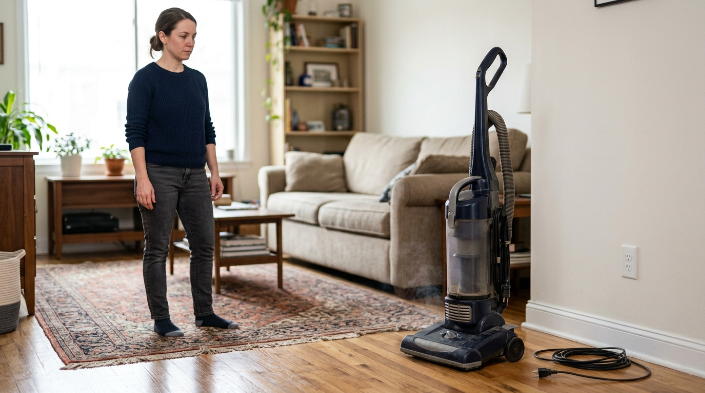
Stop using it at once. Continuing to run a smoking vacuum can turn a small belt or blockage problem into damaged plastic, a failed motor, or an electrical hazard.
- Switch the vacuum off. Don’t wait for a cleaning cycle to finish.
- Disconnect power. Unplug a corded model if it’s safe to reach the plug.
- Move away from obvious smoke. Keep children and pets clear of the area.
- Let the machine cool. Follow the cooling period stated in your model’s instructions.
- Inspect accessible parts. Check the bin, bag, hose, filters, brush roll, and belt only after the machine is cool.
- Stop if you find electrical damage. A scorched plug, melted cord, swollen battery, sparking, or smoke from the motor housing calls for professional help.
Don’t assume ten or twenty minutes is enough cooling time. Manufacturer guidance varies significantly between vacuum designs.
| Example guidance | Cooling instruction | Common issue checked |
|---|---|---|
| Shark upright support | About 60 minutes on covered overheating scenarios | Clogs in the hose, wand, dust cup, nozzle, or related airflow path |
| Dyson troubleshooting | At least 2 hours on certain thermal-cutout guidance | Blocked airflow or filters needing cleaning |
These are examples, not a universal rule. Your own vacuum’s manual should decide when and whether you restart it.
What Does the Smoke or Burning Smell Tell Me?
The smell can narrow down the problem before you remove a single screw. I use it as a clue, not a final diagnosis.
| What you notice | Likely area to inspect | Safe first check |
|---|---|---|
| Burning rubber smell near floor head | Belt or brush roll | Remove wrapped debris and inspect the belt for damage |
| Hot dusty smell with weak suction | Filter, hose, bag, or dust cup | Clear airflow and service filters according to the manual |
| Acrid electrical smell | Motor, wiring, plug, or electronics | Keep the vacuum unplugged and arrange professional inspection |
| Smoke or unusual heat around battery | Cordless battery pack | Stop charging or using it and check manufacturer safety information |
What if there is a burning smell but no smoke?
A burning smell still deserves attention. A belt may be slipping, debris may be rubbing against the brush roll, or the motor may be getting hotter than normal.
Turn the vacuum off before the smell becomes smoke. Early inspection can prevent a simple maintenance issue from becoming a larger repair.
What if the smoke came from a cordless battery?
Treat battery smoke, swelling, unusual heat, hissing, or a strong chemical smell as a serious warning. Don’t continue charging the vacuum or experiment with the battery pack.
As of 2026, the U.S. Consumer Product Safety Commission continues to publish vacuum recalls involving lithium-ion battery overheating and fire hazards. Check the manufacturer and current recall information before reuse.
Can I Fix a Smoking Vacuum Myself?
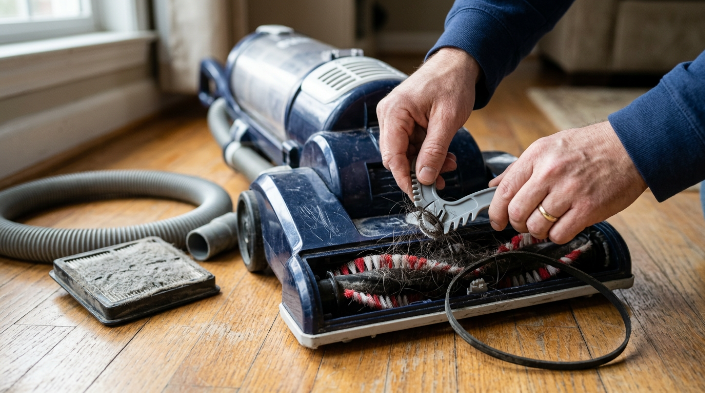
You can safely handle some maintenance problems if the vacuum is unplugged, cool, and your manual permits access. The safest DIY fixes stay outside the motor and electrical system.
Clear the brush roll
Turn the brush by hand after removing visible hair or string. It should rotate without severe resistance, although exact movement varies by design.
- Cut wrapped hair carefully without damaging bristles.
- Remove string from the brush ends and bearing areas.
- Check that nothing is wedged between the brush and housing.
Inspect the belt
Replace a belt that looks melted, cracked, badly stretched, frayed, or broken. Follow your model-specific instructions because belt access and tension differ between vacuums.
Don’t lubricate a rubber vacuum belt unless the manufacturer specifically instructs you to do so. Lubricants can make slipping worse or damage materials.
Restore the airflow path
Empty the dust container and inspect removable hoses or wands for clogs. Clean or replace filters only by the manufacturer’s recommended method.
Never reinstall a washable filter while it is still damp unless the manual explicitly allows it. Moisture and powered electrical components are a bad combination.
Know where DIY work should stop
If smoke came from the motor, switch, circuit board, plug, cord, charger, or battery, leave the vacuum disconnected. Internal electrical troubleshooting is not normal household maintenance.
Expert Alert: Burned wiring, damaged motor windings, battery faults, and melted electrical connectors should be inspected by a qualified technician. Don’t bypass fuses, thermal protection, switches, or battery-management electronics.
How Can I Stop My Vacuum From Smoking Again?
Most preventable overheating starts with restricted airflow or excessive friction. A simple maintenance routine reduces both.
- Empty the bin early: Don’t pack debris beyond the vacuum’s fill line.
- Change bags on time: A packed bag can reduce airflow before it looks completely full.
- Service filters correctly: Follow the cleaning and replacement intervals in your manual.
- Untangle the brush roll: Long hair and string can build up surprisingly fast.
- Check hoses: Small objects can create partial clogs that slowly reduce suction.
- Use the correct floor setting: Excessive brush resistance on the wrong surface can strain moving parts.
- Watch the cord and plug: Stop using the vacuum if insulation, prongs, or connectors become damaged.
Filtration matters for home hygiene too. The EPA recommends considering a vacuum with a HEPA filter to help reduce the amount of vacuumed dust that escapes back into indoor air.
HEPA means high-efficiency particulate air. For allergy-focused cleaning, the Asthma and Allergy Foundation of America also recommends regular vacuuming with HEPA filtration as one part of dust-mite control.
The National Institute of Environmental Health Sciences similarly includes HEPA-filtered or double-layer microfilter vacuuming among household dust-mite reduction strategies. Good filtration won’t fix a smoking motor, but clean airflow and proper filter maintenance help a vacuum operate as designed.
Should I Repair or Replace a Smoking Vacuum?
Repair makes sense when the problem is limited to a serviceable belt, brush roll, clog, hose, or replaceable filter. Replacement becomes more attractive when heat has damaged the motor, wiring, battery, or plastic housing.
Repair may make sense when:
- The problem began with an obvious brush-roll jam.
- The belt is the only visibly damaged component.
- A removable hose contains a clear blockage.
- The machine works normally after manufacturer-approved maintenance.
- Replacement parts are available for your exact model.
Stop using or consider replacing it when:
- Smoke returns after the basic maintenance checks.
- The cord, plug, charger, or battery shows heat damage.
- The motor housing has melted or scorched areas.
- You hear sparking, popping, or unusual electrical sounds.
- A technician finds that repair costs approach the value of a replacement vacuum.
Before replacing a cordless model after a battery incident, check the manufacturer’s support page and current recalls. In some cases, an affected component may have an official repair or replacement remedy.
I also avoid running a questionable vacuum “one last time” to confirm the fault. Smoke already confirmed that something needs attention.
Frequently Asked Questions
Is it safe to use a vacuum after it smoked once?
Not until you identify the likely cause and complete the appropriate inspection or repair. If smoke came from the motor, battery, cord, plug, or electronics, keep the vacuum out of service until a qualified technician or the manufacturer says it is safe.
Why does my vacuum smell like burning rubber?
A hot-rubber smell often points toward the brush-roll drive area. Hair can jam the brush, while a worn or slipping belt can rub and heat up, so unplug the vacuum and inspect those accessible parts first.
Can a clogged filter make a vacuum smoke?
A heavily clogged filter can restrict airflow and contribute to overheating on designs that rely on moving air through the machine. Clean or replace the filter exactly as your manual specifies, and make sure any washable filter is fully ready for reinstallation.
Why does my vacuum overheat and shut off?
Many vacuums include thermal protection that shuts the machine down when it gets too hot. Clogged filters, blocked hoses, packed dust containers, or restricted airways are common things to check before restarting according to the manufacturer’s instructions.
How long should I let an overheated vacuum cool?
There is no universal cooling time. For example, some Shark guidance uses about 60 minutes, while certain Dyson troubleshooting instructions specify at least two hours, so follow the manual or support instructions for your exact model.
Why is smoke coming from the bottom of my vacuum?
Smoke near the floor head can come from a jammed brush roll, debris rubbing inside the nozzle, or a damaged drive belt. Unplug the machine before removing hair, string, or other debris and inspect the belt only as your manual allows.
Can I repair a smoking vacuum motor myself?
Motor and electrical repairs go beyond routine vacuum maintenance. If the smoke originates inside the motor housing or you find burned wires, melted connectors, electrical arcing, or battery damage, stop using the machine and contact a qualified repair professional.
What Is the Safest Takeaway?
A smoking vacuum is telling you to stop, not to finish the room. Unplug it, let it cool, then check the brush roll, belt, dust container, filters, and airflow path before considering another use.
For smoke from the motor, battery, power cord, charger, or electrical components, skip DIY electrical repairs. A professional inspection or replacement is safer than gambling on a vacuum that has already overheated.