
Why Is My Vacuum Cleaner Making a Loud Noise?

Quick Answer
A vacuum cleaner usually starts making a loud noise because airflow is blocked, the brush roll is jammed, a filter is dirty, a part is loose, or a belt or motor component is wearing out. Start with simple airflow and brush-roll checks, and use a reliable vacuum cleaner guide when comparing normal features and vacuum types. Stop using the machine if you hear grinding or notice smoke, sparks, severe overheating, or a burning electrical smell.
Common noises and what they can mean
- Whistling: Check for a partial clog, leaking hose connection, damaged seal, or poorly seated filter.
- Rattling: Look for hard debris, a loose attachment, or something trapped near the brush roll.
- Grinding: Stop the vacuum and inspect the floorhead, brush mechanism, and accessible moving parts.
- High-pitched squeal: A belt, roller bearing, or other moving component may be struggling.
- Pulsing or surging: Restricted airflow, a clogged filter, or a blocked airway should be checked first.
- Sudden roaring: Check whether the bin, hose, filter cover, or another air-path connection has come loose.
Before you inspect anything
- Switch the vacuum off, unplug a corded model, or disconnect its removable battery when the manufacturer permits it.
If you’re wondering, “Why is my vacuum cleaner making a loud noise?” the change in sound is often more useful than the loudness itself. Upright, canister, stick, and robot vacuums all produce normal operating noise, but a new rattle, whistle, squeal, or grind deserves attention.
My rule is simple: if the sound changed suddenly, I check the easy airflow and moving-part problems before blaming the motor. This 2026 guide walks through that process without unnecessary disassembly.
In This Guide
- Why is my vacuum cleaner suddenly so loud?
- What do different vacuum noises mean?
- How do I troubleshoot a loud vacuum safely?
- Can the brush roll or belt make a vacuum loud?
- Can a filter, clog, or air leak cause loud noise?
- When does a loud vacuum mean motor damage?
- Frequently asked questions about loud vacuum noises
Why Is My Vacuum Cleaner Suddenly So Loud?
A vacuum that suddenly becomes louder usually has a change in airflow, vibration, or a moving component. A blockage, dirty filter, tangled brush roll, loose attachment, damaged seal, or worn mechanical part can all change its normal sound.
Definition: Vacuum noise is the combined sound created by the motor, moving air, brush roll, wheels, floorhead, and vibration through the vacuum body.
The key word is change. A vacuum that has always sounded loud may simply have a noisy design, while a machine that changes overnight deserves troubleshooting.
Restricted airflow is a common starting point
A vacuum depends on an open route from the floorhead to the exhaust. Anything blocking that path can affect suction and alter the motor or airflow sound.
- Dust bin: Empty it if debris has reached the manufacturer’s fill line.
- Vacuum bag: Replace it if it’s full or airflow is restricted.
- Hose: Look for socks, paper scraps, pet-hair clumps, or compacted dust.
- Wand: Inspect narrow bends and connection points.
- Floorhead: Look behind and around the brush roll for trapped debris.
- Filters: Clean or replace them exactly as your manual directs.
Don’t automatically wash a dirty filter. Some filters are washable, while others require replacement.
Loose parts can sound worse than they are
A loose bin, hose, wheel, cover, tool, or floorhead connection can vibrate rapidly. That vibration may sound like an internal mechanical problem.
With the vacuum switched off, reseat removable components and check for obvious movement. Never force a latch or cover that doesn’t fit correctly.
Section Takeaway: A sudden sound change usually deserves an airflow, attachment, and brush-area inspection before you assume the motor has failed.
What Do Different Vacuum Noises Mean?

Different sounds point toward different areas of the vacuum. The table below is a practical diagnostic guide rather than a substitute for your model’s service manual.
| Noise | Likely area to check | First action | Urgency |
|---|---|---|---|
| Whistling | Hose, seal, filter, narrow airway | Check for leaks and partial clogs | Inspect soon |
| Rattling | Floorhead, bin, hose, loose attachment | Remove trapped debris and reseat parts | Inspect soon |
| Grinding | Brush roll, bearing, motor, drive mechanism | Turn the vacuum off | High |
| Squealing | Belt, roller ends, moving components | Inspect accessible moving parts | Moderate to high |
| Pulsing | Filter, hose, wand, intake | Clear the airflow path | Inspect soon |
| Sudden roar | Loose hose, bin, filter cover, seal | Check connections | Inspect immediately |
Consumer Reports includes noise among the characteristics assessed during vacuum testing. That matters because normal sound varies between vacuum designs and categories.
Focus on what changed on your machine. A new harsh sound is more useful diagnostically than comparing your vacuum with someone else’s model.
How Do I Troubleshoot a Loud Vacuum Safely?
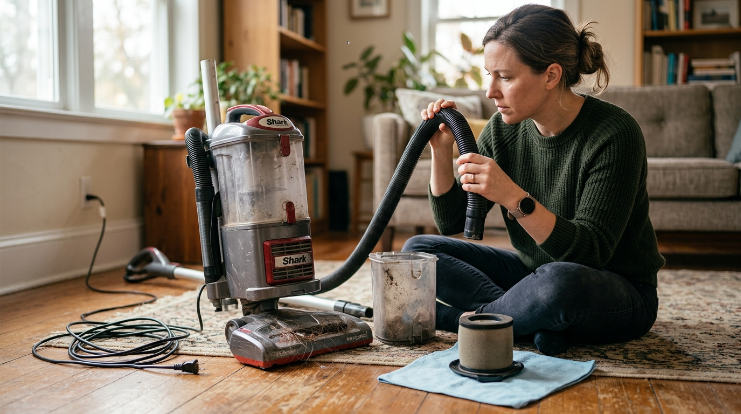
Start with components you can inspect without opening the motor housing. Work from the dirt-entry point toward the exhaust so you don’t miss a blockage.
- Disconnect power. Unplug a corded vacuum or follow the manufacturer’s shutdown instructions for a cordless model.
- Empty the bin or check the bag. Packed debris can restrict normal airflow.
- Inspect the floorhead. Remove visible hard debris, hair, string, and fibers.
- Check the brush roll. Make sure it isn’t jammed by wrapped material.
- Inspect the wand and hose. Look through removable sections for obstructions.
- Check each filter. Clean or replace it only according to the manufacturer’s directions.
- Reseat removable parts. Secure the bin, filter cover, hose, tools, and floorhead.
- Test briefly. If the dangerous sound remains, switch the machine off again.
Never push sharp metal tools blindly through a flexible hose. They can puncture the hose or damage internal wiring on designs with powered connections.
Household dust can contain pollen, mold spores, pet dander, dust-mite material, hair, and particles from everyday activities. The EPA’s indoor particulate matter guidance explains why controlling settled household dust matters.
If you’re sensitive to dust, avoid shaking dirty filters or bins indoors. Empty and maintain the vacuum in the manner recommended by its manufacturer.
Can the Brush Roll or Belt Make a Vacuum Loud?
Yes. The brush roll and its drive system contain fast-moving components, so problems there can create clicking, rattling, squealing, scraping, or grinding sounds.
Hair and thread can restrict the brush roll
Long hair, pet fur, carpet fiber, and thread often wrap around the roller. Material can also collect near the roller’s ends where it’s harder to see.
- Check the center: Look underneath dense rows of bristles.
- Check both ends: Hair often packs around end caps.
- Inspect the intake: Hard debris may be trapped behind the roller.
- Rotate carefully: Don’t force a jammed roller.
Consumer Reports’ vacuum testing information identifies tangled hair around roller brushes as a common problem reported with vacuums. Regular inspection is especially useful in homes with long hair or shedding pets.
A belt can squeal or slap
Some upright and canister floorheads use a belt to drive the brush roll. A stretched, damaged, misaligned, or slipping belt can produce a new squeal or repetitive noise.
Don’t guess at belt size or installation. Use the replacement part and procedure specified for your exact vacuum model.
Hard objects can create alarming rattles
Small stones, coins, toy pieces, screws, or other hard debris can reach the floorhead. A lightweight object bouncing inside an airway can sound surprisingly serious.
Stop the vacuum and remove the object before continuing. Leaving it inside can damage plastic surfaces or moving components.
Can a Filter, Clog, or Air Leak Cause Loud Noise?
Yes. Airflow problems commonly create whistling, pulsing, roaring, or strained sounds even when the vacuum motor still runs.
Dirty filters change airflow
A filter collects particles as air passes through the vacuum. Heavy buildup can restrict that air path and may change both suction and sound.
Some vacuums use a pre-filter plus a finer exhaust filter. Check every filter listed in your manual rather than assuming the visible one is the only filter.
HEPA means high-efficiency particulate air. The EPA explains that a qualifying HEPA filter is designed to capture at least 99.97% of particles measuring 0.3 microns under the applicable test conditions.
That HEPA definition doesn’t mean every vacuum labeled around filtration performs identically. Sealing, filter installation, airflow design, maintenance, and the manufacturer’s specifications still matter.
A partial clog may whistle instead of stopping suction
A blocked hose doesn’t always shut the vacuum down. Air can still pass through a narrow opening and create a high-pitched whistle.
- Hose bends: Soft debris can become tightly wedged.
- Wand joints: Narrow transitions catch larger pieces.
- Floorhead neck: Hair and paper can compress into dense plugs.
- Bin inlet: Fluff can collect where debris enters the container.
An air leak can make a roaring sound
A loose hose or poorly seated bin can suddenly admit air where it shouldn’t. Cracked tubing, damaged seals, and open filter covers can create similar symptoms.
Inspect visible seals and connection points without dismantling sealed assemblies. Replace damaged user-serviceable parts with the correct components for your model.
Section Takeaway: Whistling, pulsing, and sudden roaring often justify checking the complete airflow path before assuming an internal motor fault.
When Does a Loud Vacuum Mean Motor Damage?
A loud noise doesn’t automatically mean the motor is failing. However, grinding, harsh mechanical scraping, electrical buzzing, severe overheating, smoke, or a burning electrical odor deserve immediate attention.
Expert Alert: Stop using the vacuum if you suspect an electrical, battery, or internal motor problem. Internal appliance repair should be handled by a qualified technician unless the manufacturer specifically identifies the repair as user-serviceable.
Signs that should stop your troubleshooting
- Smoke: Disconnect the appliance from power when it is safe to do so.
- Sparks: Don’t continue testing the vacuum.
- Burning electrical smell: Stop operation and arrange inspection.
- Battery swelling: Stop using and charging the cordless vacuum.
- Persistent grinding: Don’t keep running the machine to “see if it clears.”
- Damaged power cord: Don’t use the vacuum until it is properly repaired.
Should you repair or replace it?
Repair makes more sense when the fault involves an available, reasonably priced service part and the rest of the vacuum works well. Replacement becomes more practical when major internal parts fail or repair costs approach the value of another suitable machine.
Age alone shouldn’t make the decision. Consider the vacuum’s overall condition, part availability, battery health, cleaning performance, and repair estimate together.
If the problem turns out to be a clog, dirty filter, tangled roller, loose hose, or replaceable belt, you may not need a new vacuum at all. That’s why the basic checks come first.
Frequently Asked Questions About Loud Vacuum Noises
Why is my vacuum louder than usual but still has suction?
Your vacuum may still have suction with a partial clog, dirty filter, air leak, loose attachment, or brush-roll obstruction. Inspect the accessible airflow path and floorhead before assuming the motor is damaged.
Why does my vacuum sound like a jet engine?
A sudden roaring or jet-like sound often means airflow has changed sharply. Check the hose connection, dustbin, filter cover, seals, and other removable air-path components for something loose or incorrectly seated.
Why is my vacuum making a high-pitched whistling noise?
Whistling often comes from air squeezing through a restricted opening or leak. Check the hose, wand, filters, seals, bin, and floorhead airway for partial blockages or poorly fitted connections.
Why does my vacuum make a grinding noise?
Turn the vacuum off rather than continuing to clean. Grinding can come from trapped hard debris, a jammed brush roll, damaged roller components, a drive problem, or internal mechanical wear that needs professional inspection.
Can a clogged filter make my vacuum sound louder?
Yes, a heavily loaded filter can restrict airflow and change the sound of some vacuums. Clean only filters identified as washable, and replace other filters according to your model’s instructions.
Why does my cordless vacuum keep pulsing?
Pulsing can happen when airflow is restricted by a clog or loaded filter, although behavior varies by model. Check the bin, filter, floorhead, wand, and accessible air passages before assuming the battery or motor is defective.
Should I replace a vacuum that suddenly becomes noisy?
Not automatically. Many sudden noise problems come from clogs, filters, brush-roll buildup, loose components, or replaceable parts, so troubleshoot those areas before deciding the vacuum has reached the end of its life.
Final takeaway: If your vacuum cleaner is making a loud noise, start with the simple things: disconnect the power, check airflow, clean the brush area, inspect filters, and secure loose components. Stop immediately when the sound comes with grinding, smoke, sparks, severe heat, battery damage, or an electrical burning smell.
A healthy cleaning appliance should sound consistent from one normal cleaning session to the next. When that familiar sound changes, treating it as an early warning can prevent a small maintenance problem from becoming a larger repair.