
Why Did My Vacuum Brush Stop Spinning? Causes and Fixes

Quick Answer
Your vacuum brush usually stops spinning because hair has jammed the brush roll, the drive belt has slipped or broken, the brush setting is off, or the powered floorhead has an electrical problem. Disconnect the vacuum from power first, then check the roller for tangles and confirm that it turns freely by hand. If your model uses a belt, this vacuum belt replacement guide shows why a failed belt can stop the brush while suction remains.
Check these common causes first
- Tangled brush roll: Hair, thread, pet fur, or carpet fibers can lock the roller in place.
- Broken drive belt: A snapped or badly stretched belt cannot transfer power to the brush.
- Wrong floor setting: Some vacuums intentionally switch the brush off for hard floors.
- Jammed end bearings: Hair can hide behind the roller’s end caps and stop free rotation.
- Powered-head fault: Cordless and canister floorheads may have a separate motor, wiring, or connector problem.
- Safety shutdown: Some models stop the brush when excessive resistance or heat is detected.
Before replacing parts
- Unplug the vacuum or remove its battery when your manufacturer’s instructions allow it, then clear visible debris and test the roller by hand.
Few vacuum problems are more annoying than hearing the motor run while the floor brush sits completely still. The good news is that a stopped brush roll often comes down to a blockage, belt, setting, or cleaner-head issue you can identify without replacing the whole vacuum.
I start with the brush itself before blaming the main motor. That simple order prevents a lot of unnecessary disassembly and replacement parts.
In This Guide
What Does a Vacuum Brush Roll Do?
A vacuum brush roll is the rotating cylinder inside many floorheads that agitates carpet and helps move debris toward the suction opening. You may also hear it called a roller brush, beater bar, agitator, or power brush.
Suction and brush rotation perform different jobs. That explains why a vacuum can still sound powerful while performing poorly on carpet after its brush stops.
- Suction pulls loosened dirt into the airflow path.
- Brush rotation agitates fibers and helps lift embedded hair, grit, and lint.
- Floorhead design guides loosened debris toward the intake.
Traditional uprights often use a rubber belt between the drive shaft and brush roll. Other designs use geared belts, direct-drive systems, or a separate electric motor inside the powered head.
As of 2026, there is no single drive system shared by every upright, stick, robot, or canister vacuum. Always check your model’s manual before opening a belt cover or powered cleaner head.
Some machines also have a brush-roll on/off control. Consumer Reports notes that this feature lets users stop brush rotation on bare floors and activate it for carpet in compatible models through its vacuum cleaner buying guide.
Why Did My Vacuum Brush Stop Spinning?
The most common causes are mechanical resistance, a failed drive component, or a setting that prevents the brush from receiving power. Start with visible debris because it is both common and easy to check.
1. Hair or string has jammed the brush roll
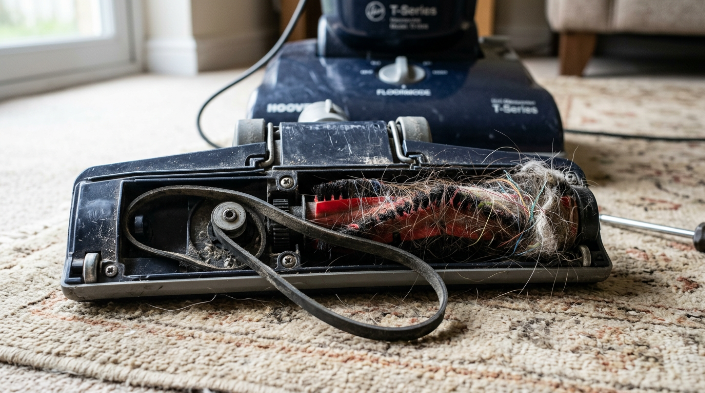
Long hair, pet fur, yarn, thread, and carpet fibers wrap around a spinning roller. Enough buildup can slow the brush or stop it completely.
Pay special attention to the ends. I often find the middle of a roller looking clean while a tight ring of hair is packed behind an end cap.
- Cut wrapped fibers carefully with small scissors or a seam ripper.
- Pull debris away from the bristles and roller grooves.
- Inspect both ends for hidden hair.
- Confirm the brush turns normally before reassembly.
2. The vacuum belt has broken or stretched
A belt-driven vacuum depends on the belt to transfer motion to the brush. When it snaps, the vacuum motor may continue running even though the roller stays still.
A stretched belt can cause a different symptom. The brush may spin in the air but slow dramatically once it touches carpet.
Look for cracks, fraying, shiny glazed areas, obvious slack, or a belt that has slipped off its track. Use only the belt specified for your exact model.
3. The brush-roll switch or floor mode is wrong
Before removing screws, check the controls. Some vacuums deliberately disable brush rotation in hard-floor mode.
- Check for a carpet or rug mode.
- Look for a separate brush-roll button.
- Confirm the handle is in the operating position if your model uses an interlock.
- Check whether the floorhead is fully connected to the wand or body.
4. The brush-roll bearings or end caps are binding
A roller can look clean yet remain difficult to turn. Hair, grit, or worn components around the ends may create enough friction to stop it.
With the vacuum disconnected from power, try turning the roller by hand. Do not force it if it feels seized.
5. A powered floorhead has lost electrical power
Many cordless sticks and powered canister heads use a separate brush motor. Their main suction motor can run normally even when the cleaner-head motor has stopped.
Inspect user-accessible connectors for dirt, poor seating, or obvious damage. Do not open sealed electrical modules unless the manufacturer describes them as serviceable.
6. The vacuum has triggered a protection feature
Some powered heads detect excessive resistance, overheating, or a jam and stop the brush to protect components. Clearing the obstruction may restore operation after the machine is reset according to its manual.
Do not repeatedly restart a brush that keeps shutting down. Repeated stopping usually means the original restriction still needs attention.
Section Takeaway: A stopped vacuum brush does not automatically mean a failed vacuum motor. Check tangles, belt condition, floor settings, roller movement, and cleaner-head connections first.
How Do I Troubleshoot a Vacuum Brush That Will Not Spin?
Use a simple outside-to-inside troubleshooting order. It keeps your hands away from powered moving parts and reduces unnecessary disassembly.
- Disconnect power. Unplug a corded vacuum or remove a removable battery when the manufacturer permits it.
- Check the controls. Select the correct carpet mode and turn the brush-roll function on.
- Inspect visible debris. Look for hair, thread, rug fringe, small socks, and other objects around the roller.
- Clean both roller ends. Hidden hair near an end cap can create more resistance than debris across the middle.
- Turn the brush by hand. It should not feel completely seized or abruptly jammed.
- Inspect the belt if accessible. Check for breakage, slipping, stretching, glazing, or incorrect routing.
- Reconnect removable parts. Make sure the floorhead, wand, battery, and electrical contacts are seated as designed.
- Reassemble before testing. Replace every cover or baseplate before reconnecting power.
Never work around the brush while the vacuum is energized. The U.S. Consumer Product Safety Commission provides broader electrical safety guidance for household products and wiring hazards.
Expert Alert: Stop DIY troubleshooting if you find melted wiring, scorched connectors, sparks, smoke, battery swelling, exposed conductors, or a strong electrical-burning smell. Have electrical or motor repairs handled by a qualified appliance technician.
How Can I Tell Whether the Belt, Brush, or Motor Is Bad?
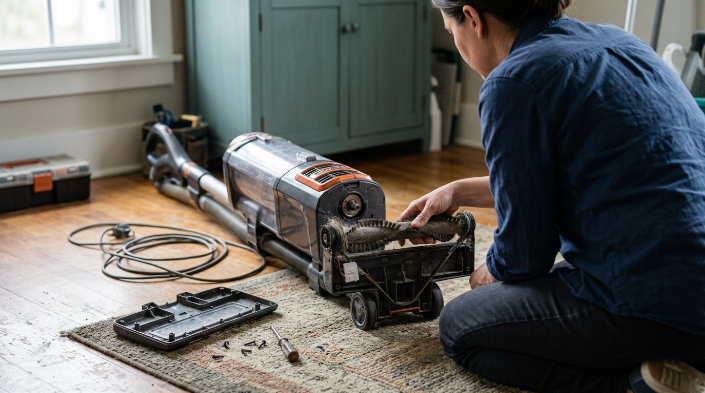
The symptom pattern usually narrows the problem quickly. Use this table before ordering a replacement brush roll, belt, or powered head.
| What You Notice | More Likely Cause | Next Safe Check |
|---|---|---|
| Brush will not turn by hand | Tangle, seized end cap, or damaged roller | Clean both ends and inspect for binding |
| Brush turns by hand but never under power | Broken belt, drive failure, switch, or powered-head fault | Inspect accessible belt and connections |
| Brush spins off the floor but stops on carpet | Slipping belt or excessive brush resistance | Check belt condition and roller ends |
| Suction remains strong but carpet pickup drops | Brush-drive problem | Confirm that the brush actually rotates |
| Burnt-rubber smell near floorhead | Slipping belt or jammed roller | Switch off immediately and inspect before reuse |
| Brush works intermittently when wand moves | Connector, wiring, or powered-head issue | Inspect user-accessible connections |
A broken belt is usually straightforward when you can see the damage. A roller that remains stiff after cleaning points more toward the brush assembly or its bearings.
Electrical symptoms deserve more caution. If a separate powered floorhead motor receives no power despite correct assembly and clean contacts, model-specific service may be necessary.
Repair is usually sensible when the problem is a removable tangle, replaceable belt, or user-serviceable brush roll. A replacement cleaner head or professional repair makes more sense when sealed motors, wiring, circuit boards, or damaged connectors are involved.
Section Takeaway: Test the mechanical parts before blaming electronics. A freely turning roller plus a healthy belt shifts attention toward switches, connectors, or the powered-head drive system.
Why Does My Vacuum Brush Stop Only on Carpet or During Use?
A brush that works at first but stops under load gives you an important clue. The drive system may have enough power to spin freely but not enough to overcome carpet resistance.
Why does the brush stop when it touches carpet?
A stretched or slipping belt is one possibility on belt-driven models. A heavily tangled roller can create the same symptom because carpet adds even more resistance.
- Check for hair around both roller ends.
- Inspect the belt for wear or looseness.
- Use the correct carpet-height setting if your vacuum provides one.
- Keep rug fringe and loose fabric away from the roller.
Why does the brush stop after several minutes?
Repeated stopping after some use may indicate a jam-protection or heat-protection feature. Let the vacuum cool and follow the reset procedure in your specific owner’s manual.
Also check the bin, bag, filters, hose, and floorhead for restrictions. Even when airflow is not the direct cause of brush failure, routine vacuum maintenance reduces unnecessary strain throughout the appliance.
Why does the brush keep getting tangled?
Long human hair and pet fur can wrap around almost any conventional roller. Anti-tangle designs reduce maintenance, but no brush system should be assumed maintenance-free.
Inspect the roller regularly before buildup becomes dense. Consumer Reports also recommends periodically clearing tangled hair and fibers from motorized brushes as part of routine vacuum care.
Efficient vacuuming also matters for household dust control. The EPA’s guidance on indoor particulate matter and dust recommends regular cleaning and vacuuming as part of reducing indoor dust buildup.
Section Takeaway: A brush that fails only under load often points toward excessive resistance or a slipping drive system. A brush that repeatedly stops after warming up may need model-specific protection-system troubleshooting.
Vacuum Brush Troubleshooting FAQ
Can a vacuum still have suction if the brush is not spinning?
Yes. Suction and brush rotation can come from different parts of the vacuum’s drive system. A broken belt or failed powered head may stop the brush while the main suction motor continues operating normally.
Can hair make a vacuum brush completely stop?
Yes. Hair, thread, pet fur, and carpet fibers can wrap tightly around the brush and its end caps. Heavy buildup creates friction and may eventually prevent the roller from turning.
Should a vacuum brush roll spin freely by hand?
It should usually rotate without feeling completely seized, although the amount of resistance varies by design. Belt-driven and geared systems may naturally feel different, so compare the movement with your manufacturer’s instructions.
How do I know if my vacuum belt is broken?
Common clues include a stationary brush, poor carpet pickup, visible belt damage, or a belt that has fallen off its drive path. Some worn belts remain intact but become stretched enough to slip under load.
Why does my vacuum brush stop spinning on thick carpet?
Thick carpet increases resistance against the roller. Check for tangles, a slipping belt, an incorrect height setting, or a floorhead that is not designed for that carpet type before forcing the vacuum forward.
Can I use my vacuum if the brush roll is not spinning?
You may still have suction, but carpet cleaning performance can suffer. Do not continue using the machine if the stopped brush is accompanied by a burning smell, grinding, overheating, smoke, sparks, or repeated shutdowns.
When should I call a vacuum repair technician?
Get professional help when troubleshooting reaches sealed motors, internal wiring, circuit boards, scorched connectors, or damaged batteries. Professional service is also sensible when a correctly installed replacement belt repeatedly fails or the brush motor receives no power.
Closing Takeaway: When your vacuum brush stops spinning, start with the simplest checks: power off the machine, clear tangles, inspect both roller ends, confirm the correct floor setting, and examine the belt if your model has one.
If the brush still will not run after those checks, the problem may be inside the powered head or drive system. Stop before opening electrical assemblies and use your manufacturer’s service instructions or a qualified repair technician.