
What Is the Most Important Vacuum Maintenance Task?

Quick Answer
The most important vacuum maintenance task is keeping the vacuum’s airflow path clear. Start by emptying the dustbin or replacing the bag before it becomes packed, then maintain filters and remove blockages as needed; the EPA’s HEPA filter guidance also reinforces why correct filter care matters.
What to prioritize
- Empty dirt early: Don’t let a bag or bin become tightly packed with debris.
- Maintain filters: Clean or replace each filter exactly as your vacuum’s manual directs.
- Clear blockages: Inspect the hose, wand, intake, and floorhead whenever suction suddenly drops.
- Remove tangled hair: Keep hair and thread from restricting the brush roll.
- Watch for heat: Stop using a vacuum that becomes unusually hot or smells electrically burnt.
Best rule to remember
- Protect airflow first, then follow the manufacturer’s maintenance schedule for your exact machine.
If you only remember one thing about vacuum cleaner maintenance, make it airflow. A vacuum depends on moving air through the floorhead, hose, dirt container, filters, and exhaust without unnecessary restriction.
I’ve found that many frustrating vacuum problems start in those simple areas. This guide explains which maintenance task matters most, what to check first, and when routine cleaning becomes a repair issue.
In This Guide
- What Is the Most Important Vacuum Maintenance Task?
- Why Is Airflow So Important to a Vacuum Cleaner?
- Which Vacuum Parts Should You Maintain First?
- How Often Should You Perform Vacuum Maintenance?
- Does the Most Important Task Change by Vacuum Type?
- What Signs Mean Your Vacuum Needs Maintenance Now?
- Vacuum Maintenance FAQ
What Is the Most Important Vacuum Maintenance Task?
The most important vacuum maintenance task is preventing restricted airflow. For most owners, that starts with emptying the dustbin or replacing the bag before collected debris becomes tightly packed.
A vacuum cleaner is an appliance that creates moving air to lift debris and transport it into a collection system. Any restriction along that route can interfere with normal pickup.
Definition: Vacuum airflow maintenance means keeping the dirt container, filters, hose, wand, intake, floorhead, and exhaust path clear enough for air to move through the machine as designed.
Why isn’t filter cleaning the single answer?
Filters are extremely important, but not every suction problem starts at the filter. A completely clear filter cannot compensate for a sock stuck inside the hose or an overfilled dustbin.
Filter care also varies by model. Some filters are washable, while others can be damaged by water and must be replaced.
- Bagless vacuum: Empty the bin before dirt becomes heavily compacted or passes its fill limit.
- Bagged vacuum: Replace the bag according to its fullness indicator or manufacturer guidance.
- Washable filter: Clean it only using the approved method and let it dry completely.
- Disposable filter: Replace it rather than attempting to wash it.
- Hose or wand: Inspect for blockages when suction changes suddenly.
That’s why I think of airflow as the main maintenance priority rather than one removable component. It gives you a simple troubleshooting order that works across many vacuum designs.
Section Takeaway: Protect the entire airflow path first. Emptying the dirt container is usually the fastest and most frequent step, but filters and clogs matter too.
Why Is Airflow So Important to a Vacuum Cleaner?
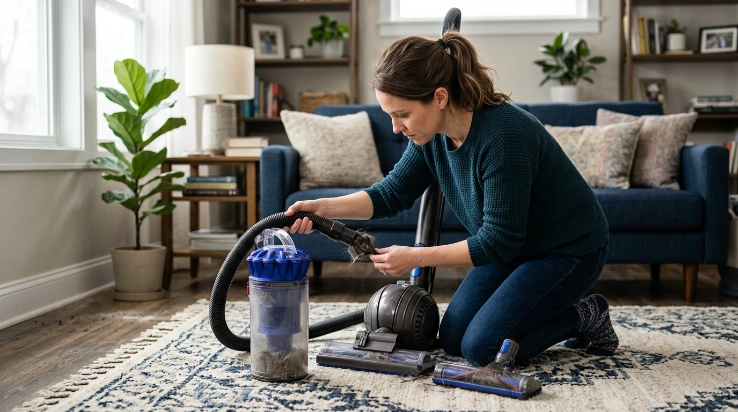
A vacuum cannot move debris efficiently without a reasonably clear path for air. Restrictions can appear gradually, so the decline may be easy to overlook.
You might notice weaker pickup, a different motor sound, or debris remaining on carpet after a normal pass. Those signs don’t automatically mean the motor has failed.
Several parts can restrict the same airflow
- Overfilled bin: Collected debris can crowd the dirt container and interfere with normal air movement.
- Full bag: A heavily loaded bag can create more resistance as air moves through the collection system.
- Dirty filter: Fine dust can accumulate within filter media and contribute to reduced airflow.
- Blocked hose: Hair, paper, small objects, and compacted dust can create partial or complete clogs.
- Blocked floorhead: Debris sometimes collects around narrow bends between the brush area and wand.
Consumer Reports’ current reliability reporting shows that hair tangles and clogs remain common owner-reported vacuum problems. That makes basic inspection more useful than assuming every performance change needs professional repair.
Airflow also connects maintenance with household dust control
The vacuum’s filtration system helps determine what happens to fine particles after they’re picked up. Correct filter installation and maintenance therefore deserve attention alongside suction performance.
The EPA notes that indoor dust may include pollen, mold spores, pet dander, dust-mite material, and other particles. Its indoor particulate matter guidance also explains that vacuuming can temporarily stir settled dust into the air.
I don’t treat a vacuum as an air purifier. I do want its filters, seals, and dirt container installed correctly so collected dust stays where the machine was designed to hold it.
Section Takeaway: Airflow is the connection between suction, filtration, and debris collection. When airflow changes, check simple restrictions before assuming the vacuum needs a major repair.
Which Vacuum Parts Should You Maintain First?
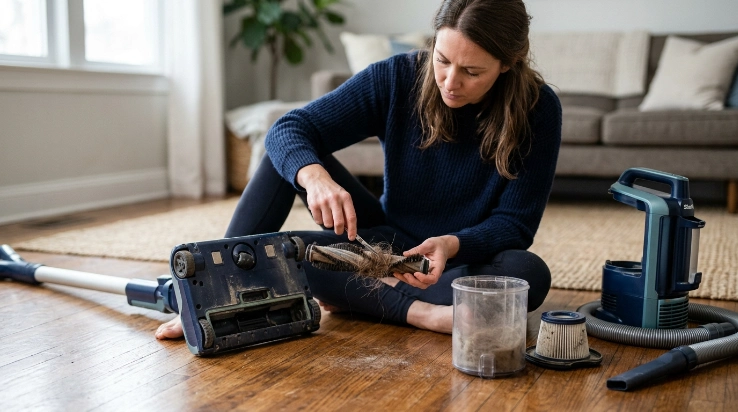
Start with the parts that collect dirt or directly affect airflow. Then move to the rotating brush, seals, wheels, battery, cord, and accessories.
The table below is the practical order I use for household vacuum checks. Your owner’s manual should override any general maintenance interval.
| Maintenance Area | Why It Matters | Practical Check Point | Priority |
|---|---|---|---|
| Dustbin or bag | Collected dirt can restrict the normal airflow path | Check during or after regular cleaning | Highest |
| Filters | Loaded filters may restrict airflow or affect exhaust filtration | Inspect regularly; service on the manufacturer’s schedule | High |
| Hose and wand | Hidden clogs can cause sudden suction loss | Check monthly or when suction changes | High |
| Brush roll | Hair can restrict rotation and reduce carpet pickup | Check weekly in pet or long-hair homes | High |
| Attachments and wheels | Debris can reduce usability or block smaller openings | Inspect during deeper cleaning | Medium |
What about HEPA filters?
HEPA stands for high-efficiency particulate air. The EPA defines a HEPA filter as a pleated mechanical filter capable, under the applicable test conditions, of theoretically removing at least 99.97% of airborne particles measuring 0.3 microns.
That specification does not tell you whether your vacuum’s HEPA filter can be washed. Always use the cleaning or replacement method listed for the exact filter.
Don’t forget the brush roll
Hair around a brush roll can become surprisingly dense. I usually find the worst buildup near the roller ends, where it isn’t as visible from above.
Disconnect the vacuum from power before working around rotating parts. Remove hair carefully without cutting belts, wiring, bristles, or soft roller material.
Section Takeaway: Check dirt collection and airflow components first, then the brush roll. Never assume a filter is washable because another filter in the same machine can be rinsed.
How Often Should You Perform Vacuum Maintenance?
There is no universal schedule that fits every vacuum cleaner. As of 2026, manufacturers still use different filter materials, dirt systems, brush designs, sensors, and batteries.
A home with three shedding pets may also load a vacuum much faster than a low-traffic apartment. Use the following schedule as an inspection baseline, not a replacement for your manual.
- During or after use: Check the bin or bag and look for obvious debris around the floorhead.
- Weekly: Inspect the brush roll if your home has pets, long hair, or heavy carpet use.
- About monthly: Check the hose, wand, filters, attachments, seals, and accessible airflow passages.
- Whenever suction drops: Check for an overfilled container, dirty filter, or blockage immediately.
- Manufacturer interval: Replace filters, bags, belts, brushes, and other wear parts as specified for your model.
Frequent vacuuming also matters in homes dealing with dust and allergens. The CDC recommends regular vacuuming with a HEPA-equipped vacuum as one step for reducing exposure to dust-mite triggers in homes where asthma is a concern.
If allergies are an issue, the Asthma and Allergy Foundation of America’s dust mite guidance also notes that vacuuming can stir dust temporarily. Sensitive household members may want to avoid the room during cleaning.
More maintenance isn’t always better
Over-cleaning the wrong component can cause problems too. Washing a non-washable filter is a good example.
Don’t disassemble parts simply because they look accessible. Routine maintenance should stay within the procedures the manufacturer expects owners to perform.
Section Takeaway: Inspect high-debris areas frequently, but use your model’s manual for actual cleaning and replacement intervals. Usage conditions matter more than a generic calendar.
Does the Most Important Task Change by Vacuum Type?
The main principle stays the same: protect airflow and remove collected debris. What changes is where dirt, hair, and restrictions tend to accumulate.
Upright and canister vacuums
Check the bag or bin, filters, hose, and brush roll. Uprights with powered floorheads may collect substantial hair around the roller and its end caps.
Cordless stick vacuums
Small dustbins can fill quickly, so I check them more often than a large canister. Filters, narrow air passages, brush rolls, and battery condition also deserve regular attention.
Robot vacuums
Robot vacuums add side brushes, small wheels, sensors, and compact dustbins to the routine. Hair around rollers and wheels can interfere with movement as well as cleaning.
Bagged vacuums
Don’t focus on the bag alone. Filters, brush rolls, hose connections, and the bag collar still need inspection.
Wet/dry vacuums
These machines require special attention after liquid pickup. Empty the tank and dry approved washable components before storage, following the manufacturer’s wet-pickup setup.
Expert Alert: If liquid has entered electrical areas, the motor housing needs to be opened, or a cord or battery appears damaged, stop using the vacuum and contact a qualified appliance technician.
Section Takeaway: Different vacuum designs move dirt differently, but they all depend on a clear collection and airflow system. Follow the maintenance procedure designed for your exact type.
What Signs Mean Your Vacuum Needs Maintenance Now?
Reduced suction is the classic warning, but you shouldn’t wait for the vacuum to stop picking up dirt completely. Changes in sound, heat, odor, and brush movement can appear sooner.
- Weak suction: Check the bin or bag, filters, hose, wand, intake, and floorhead.
- Debris left behind: Inspect the brush roll, floor setting, intake opening, and airflow path.
- Brush stopped: Disconnect power and check for wrapped hair, thread, or a belt problem.
- Whistling noise: Look for a partial clog, loose hose connection, or air leak.
- Unusual heat: Stop cleaning and inspect accessible airflow components.
- Dust near exhaust: Check filter installation, filter condition, seals, and dirt-container fit.
- Short cordless runtime: Review charging, battery condition, and manufacturer troubleshooting guidance.
When does maintenance become repair?
Routine maintenance should not require you to work on live electrical components or dismantle a sealed motor assembly. Visible electrical damage is also not a normal cleaning job.
Expert Alert: Stop using a vacuum that produces smoke, sparks, repeated electrical trips, severe overheating, battery swelling, or a persistent burning smell. Have the machine checked by a qualified technician.
I also stop troubleshooting when normal cleaning doesn’t restore performance. Repeatedly running a machine with an unresolved problem rarely tells you anything useful.
Section Takeaway: Treat sudden suction loss, excessive heat, burning odors, and abnormal sounds as warnings. Start with accessible maintenance, but leave electrical or internal motor work to a professional.
Vacuum Maintenance FAQ
Should I empty my vacuum after every use?
You don’t necessarily need to empty every vacuum after every use, but you should check the dirt level regularly. Small bagless vacuums may fill quickly, while larger bagged machines can go longer. Never keep cleaning once debris exceeds the manufacturer’s fill guidance.
Is cleaning the filter the most important vacuum maintenance task?
Filter maintenance is one of the most important tasks, but protecting the entire airflow path is a better overall rule. An overfilled bin, clogged hose, blocked floorhead, or dirty filter can each interfere with airflow and reduce cleaning performance.
How often should I clean my vacuum filter?
Follow the schedule in your vacuum’s manual because filter designs vary. Inspect filters regularly, but wash only those specifically identified as washable. Disposable and non-washable filters should be replaced or maintained according to their manufacturer instructions.
Can a full vacuum bag reduce suction?
A heavily loaded bag can create more resistance to airflow and may contribute to weaker pickup. Check the bag regularly and replace it according to the vacuum’s fullness indicator or manufacturer guidance rather than waiting until it is packed solid.
Why does my vacuum lose suction even after I empty it?
Check the filter, hose, wand, intake, floorhead, and connections next. A clog or heavily loaded filter can restrict airflow even when the dustbin is completely empty. If those areas are clear and suction stays weak, professional diagnosis may be appropriate.
Should I wash a HEPA vacuum filter?
Only if the manufacturer specifically says that exact HEPA filter is washable. HEPA describes a filtration performance standard, not a universal cleaning method. Some HEPA filters can be rinsed, while others must remain dry and be replaced when required.
Does regular vacuum maintenance help with household allergens?
Regular vacuuming and proper filtration can be part of a broader dust and allergen-control routine. However, no vacuum eliminates every household allergen. Cleaning frequency, dust control, humidity management, bedding care, and other measures may also matter depending on the household.
The bottom line: If you want one vacuum maintenance rule to remember, keep the airflow path clear. Empty collected dirt before it becomes packed, maintain filters correctly, clear clogs, and keep the brush roll free of heavy tangles.
A few minutes of routine inspection can also tell you when a problem is no longer routine. Follow your vacuum’s manual, and stop using the machine when electrical damage, severe overheating, or other unsafe symptoms appear.
