
How to Vacuum Without Scratching Hardwood Floors

Quick Answer
To vacuum hardwood without scratching it, remove loose grit first, turn off any stiff spinning brush roll, and use a soft hard-floor head. Keep the wheels and floor head clean so trapped sand cannot drag across the finish. A vacuum with good filtration can also help contain fine household dust, as explained in the EPA’s guidance on indoor particulate matter.
Quick scratch-safe steps
- Check the floor: Pick up stones, sand, screws, and other hard debris before vacuuming.
- Inspect the wheels: Remove grit or hair wrapped around the rollers.
- Stop stiff brushes: Switch off the carpet brush roll when your vacuum allows it.
- Use soft contact: Choose a hardwood, parquet, or soft-roller floor head.
- Move gently: Make slow passes instead of pushing the vacuum aggressively.
- Test first: Try the setup on a small, less-visible section before cleaning the whole room.
Vacuuming hardwood floors should improve home hygiene without leaving marks behind. I learned that scratches often come from what gets trapped under the vacuum, not suction itself.
A tiny piece of grit caught in a wheel can travel across an entire room. This guide shows how I prevent that problem and clean wood floors more carefully.
In This Guide
Why Can a Vacuum Scratch Hardwood Floors?
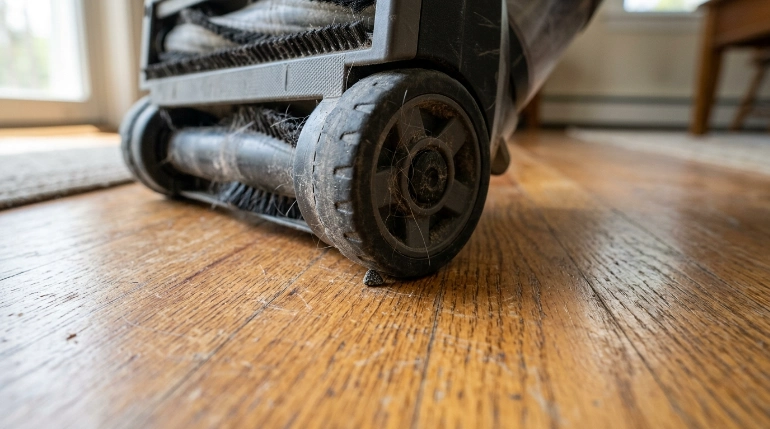
A vacuum usually scratches hardwood when a hard object becomes trapped between the machine and the floor. Sand, tiny stones, dried mud, and damaged vacuum parts are common troublemakers.
Hardwood finishes can tolerate normal cleaning. They are less forgiving when sharp debris gets dragged across them under pressure.
Grit caught under the floor head
This is the first place I check. A grain of coarse sand beneath the vacuum head can behave much like an abrasive particle.
- Sand and outdoor grit can collect near entry doors.
- Small stones may become lodged beside a wheel.
- Dried food can become surprisingly hard.
- Metal fragments such as screws or staples should be picked up by hand.
I once noticed a faint line appearing behind a vacuum wheel. When I turned the machine over, a hard piece of grit was stuck beside the roller.
Cleaning the wheel solved the dragging problem. Since then, I check the underside before cleaning a large hardwood area.
Stiff or damaged brush rolls
A carpet brush roll is built to agitate fibers. That aggressive action is often unnecessary on smooth hardwood.
If your vacuum lets you stop the brush roll, I prefer turning it off. A soft hard-floor roller is another good option when the manufacturer approves it for wood.
Damaged wheels and floor heads
Plastic wheels should roll freely. A seized wheel can slide instead, especially when hair is wrapped around its axle.
- Check for chipped plastic.
- Remove wound hair and thread.
- Look for exposed screws or metal.
- Feel for sharp edges underneath.
My check: I run a clean microfiber cloth across the underside. If it catches on something sharp, I fix that problem before the vacuum touches the floor.
How Should You Prepare Before Vacuuming Hardwood?
Spend one minute checking the room and vacuum before starting. That minute can prevent a scratch that remains visible for years.
Pick up dangerous debris first
I don’t expect the vacuum to swallow every object on the floor. Hard or oversized pieces get removed by hand first.
- Coins
- Stones
- Screws and nails
- Broken plastic
- Large food pieces
- Craft materials and beads
Pay extra attention around exterior doors. Shoes can carry in grit that becomes abrasive under a vacuum wheel.
Check the vacuum underneath
Turn the vacuum off and unplug a corded model before inspecting moving parts. For a cordless machine, follow its instructions for safely disabling the unit.
Then inspect everything that contacts the hardwood.
- Floor-head wheels
- Main brush or roller
- Front and rear edges
- Felt or fabric strips
- Small caster wheels
If the head has soft pads, make sure they are still attached. Replace damaged floor-contact parts rather than continuing to use them.
Expert Alert: If the vacuum has damaged wiring, exposed electrical parts, overheating, or a burning smell, stop using it and have it serviced by a qualified repair professional.
Know your floor finish
Not every wood floor has the same surface. Factory-finished hardwood, site-finished flooring, waxed wood, and older worn floors can react differently to cleaning.
When I’m unsure, I check the flooring maker’s care instructions. That guidance should take priority over general cleaning advice.
How Do You Vacuum Hardwood Without Scratching It?
The safest technique combines a clean floor head with controlled movement. You don’t need to press the vacuum hard against the boards.
Step 1: Remove large or sharp pieces
Walk through the room before turning on the vacuum. Pick up anything that looks hard enough to mark the finish.
Step 2: Choose hard-floor mode
Select the bare-floor or hardwood setting if your machine has one. This may stop the brush roll or change how the cleaner head operates.
Don’t assume every automatic setting is perfect for every wood finish. Test it first if you haven’t used that vacuum on the floor before.
Step 3: Start in a hidden area
I test a small area near a wall or under furniture. Two or three passes are enough to check how the floor and vacuum interact.
Look across the boards from a low angle afterward. Side lighting makes fresh marks easier to notice.
Step 4: Use slow, straight passes
Guide the vacuum rather than forcing it. Slow passes give the suction time to collect dust without aggressive scrubbing.
- Move forward slowly.
- Pull the head back gently.
- Overlap the next pass slightly.
- Avoid sharp turns on one wheel.
- Lift the head when crossing raised thresholds if needed.
Step 5: Check the head if you hear scraping
A new scraping or clicking sound deserves attention. Stop immediately rather than finishing the room first.
Turn the machine over safely and inspect it again. A newly collected stone may be trapped underneath.
Useful habit: I also check the vacuum after cleaning an entryway. That’s where my machine is most likely to collect coarse outdoor debris.
Which Vacuum Settings and Attachments Are Safest?
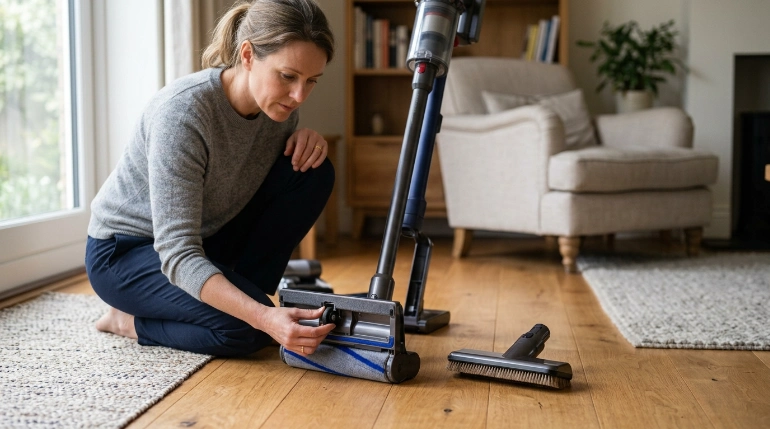
A soft floor head and clean rolling surfaces matter more than maximum suction. Your goal is to lift debris without aggressively rubbing the finish.
| Vacuum feature | Safer hardwood setup | Potential problem | My check |
|---|---|---|---|
| Brush roll | Off or wood-safe soft roller | Stiff bristles or trapped grit | Inspect before each major clean |
| Floor head | Parquet or hard-floor head | Sharp or damaged underside | Run a cloth across contact points |
| Wheels | Clean and freely rotating | Embedded grit or seized roller | Spin each wheel by hand |
| Suction | Enough to lift loose debris | Head becomes difficult to move | Reduce power if needed |
Soft roller vs. traditional brush roll
Soft rollers are designed to contact hard surfaces more gently than many stiff carpet brushes. They still need inspection because grit can become stuck in the roller material.
A traditional brush roll can work if the manufacturer approves it for hardwood. I prefer a shutoff option because it gives me more control.
Canister, stick, upright, or robot?
Any of these vacuum types can work on hardwood when the floor-contact parts are suitable. The design alone does not guarantee scratch-free cleaning.
- Canister vacuums: Often pair well with dedicated parquet heads.
- Stick vacuums: Convenient when they include a soft hard-floor roller.
- Upright vacuums: Look for brush-roll shutoff or a hard-floor mode.
- Robot vacuums: Keep wheels and underside brushes clean because they operate unattended.
Does HEPA filtration matter for hardwood?
HEPA filtration doesn’t stop scratches, but it can matter for home hygiene. The EPA explains HEPA filtration as a mechanical filtration method for capturing very small airborne particles.
The EPA also suggests considering HEPA-filtered vacuums when reducing indoor dust buildup. People managing allergies may also find AAFA’s indoor allergen guidance useful.
Good filtration is still only part of the system. Seals, maintenance, and correct filter installation also affect how well a vacuum contains collected dust.
What Should You Do After Vacuuming?
Check the floor briefly once you’ve finished. Early inspection can reveal a vacuum problem before you repeat it in another room.
Look for new lines or dull marks
View the hardwood from different angles. Window light often makes fine surface marks easier to see.
If you notice a new line, stop using the vacuum until you find the cause. Check the wheels, roller, floor head, and collected debris.
Clean the vacuum head
Don’t store the vacuum with grit stuck underneath. Removing it now means the next cleaning starts with a clean floor head.
- Wipe the wheels.
- Remove hair from axles.
- Clear the roller.
- Empty the dust container when needed.
- Check filters according to the manual.
For general household dust control, the EPA’s indoor-environment guidance also recommends cleaning approaches such as vacuuming and damp dusting.
What if the hardwood is already scratched?
First determine whether you’re seeing a surface mark or damage through the finish. Some light transfer marks may clean away, while deeper scratches need proper floor repair.
Avoid experimenting with abrasive pads, harsh cleaners, or random polishing compounds. They can change the sheen and make one small problem more noticeable.
Expert Alert: Deep gouges, widespread finish damage, loose boards, or major refinishing work are better handled by a qualified hardwood-floor professional.
Frequently Asked Questions
Can vacuum suction scratch hardwood floors?
Suction itself is rarely the main scratch risk. Problems are more likely when hard debris, damaged wheels, stiff brushes, or sharp floor-head parts physically drag across the finish.
Should I turn the brush roll off on hardwood?
I usually turn off a stiff carpet brush roll when the vacuum provides that option. A manufacturer-approved soft roller may remain on because it is designed for hard-floor cleaning.
Is sweeping safer than vacuuming hardwood?
Not automatically. A dirty broom can also drag grit across the floor, while a properly configured vacuum can remove loose particles with little rubbing.
Can a robot vacuum scratch wood floors?
It can if grit becomes trapped in its wheels, brushes, or underside. Check those areas regularly, especially after the robot cleans entrances or rooms where sand gets tracked inside.
How often should I vacuum hardwood floors?
There is no single schedule for every home. High-traffic homes, pet households, and entry areas may need more frequent cleaning because debris accumulates faster.
Do I need a special hardwood vacuum?
Not always. A regular vacuum can work if it has clean wheels, a wood-safe head, and a brush roll that is suitable for hard flooring or can be switched off.
Should I vacuum or mop hardwood first?
Vacuum or dry-clean loose debris first. Removing grit before damp cleaning reduces the chance that the mop will push abrasive particles across the finish.
Final Takeaway
Learning how to vacuum without scratching hardwood floors is mostly about controlling what touches the wood. Clean wheels, a suitable floor head, and debris-free brushes make the biggest practical difference.
As of 2026, my routine is simple: inspect first, use the hard-floor setup, vacuum gently, and stop when anything sounds wrong. That approach keeps cleaning effective without treating hardwood like carpet.
Before your next full-room clean, turn your vacuum over and inspect the underside. That 30-second check may be the easiest way to protect your floor.