
How to Vacuum Around Pets: A Safe, Practical Cleaning Guide

Quick Answer
To vacuum around pets, move your pet to a comfortable spot first, pick up toys and bowls, then vacuum slowly from the room edges toward high-traffic areas. For homes concerned about pet allergens, the Asthma and Allergy Foundation of America recommends regular vacuuming of carpets and fabric furniture.
Quick steps for vacuuming around pets
- Move your pet: Give your dog or cat a quiet place away from the vacuum.
- Clear the floor: Pick up toys, bowls, cords, blankets, and anything your vacuum could catch.
- Use the right tool: Choose the floor head for flooring and an upholstery tool for furniture.
- Vacuum slowly: Give the machine time to lift hair, crumbs, dust, and tracked-in dirt.
- Clean edges: Use a crevice tool around baseboards, pet beds, furniture legs, and feeding areas.
- Empty it safely: Empty the bin outdoors when practical, or replace a bag without shaking it.
One rule I always follow
- Never chase a frightened pet with the vacuum or try to vacuum the animal directly.
Vacuuming changes when a dog or cat shares the house. Hair collects along walls, crumbs gather near bowls, and soft furniture can hold far more debris than it shows.
I learned that simply running a vacuum through the middle of a room was not enough. A calmer pet, the right attachment, and a repeatable cleaning pattern made the job much easier.
In This Guide
What Should You Do Before Vacuuming Around Pets?
Move your pet away from the immediate cleaning zone before turning on the vacuum. Then remove small pet items that can block the floor head or become damaged.
A pet-safe vacuuming routine is a cleaning method that removes household debris while keeping the machine, cord, attachments, and noise away from an animal that feels threatened by them.
Give your pet somewhere else to settle
I get better results when I deal with the pet before I deal with the floor. Trying to vacuum around a dog circling the machine wastes time and creates stress.
A bedroom, crate, gated area, patio, or another familiar space can work. Choose whatever is already normal and comfortable for your pet.
- Close the door if the pet tries to chase the vacuum.
- Use a gate when the animal prefers to see you from a distance.
- Leave familiar bedding in the quiet area when that helps the pet settle.
- Keep escape routes clear so a nervous animal never feels trapped by the machine.
Pick up pet items before you start
Pet toys create more vacuum problems than I once expected. Small rope pieces, fabric strips, chewed plastic, and thin cords can disappear under a floor head fast.
I do one quick walk through the room first.
- Pick up toys and chews.
- Move food and water bowls.
- Lift lightweight pet blankets.
- Remove loose training pads.
- Check for damaged toys or small pieces.
- Move charging cables and other cords.
Look for wet messes first
Do not run a normal dry vacuum over urine, vomit, spilled water, or another wet pet mess. Clean the wet material using a method appropriate for the surface.
Also check the vacuum manual before collecting anything damp. A standard household dry vacuum is not the same appliance as a wet/dry vacuum.
If disinfecting pet supplies is necessary, follow the product label carefully. The CDC also advises keeping pets away from wet disinfectants until treated items or surfaces are safe for use.
Section Takeaway: Prepare the pet and the room before switching on the vacuum. A one-minute floor check prevents many avoidable problems.
How Do You Vacuum Pet Hair Effectively?
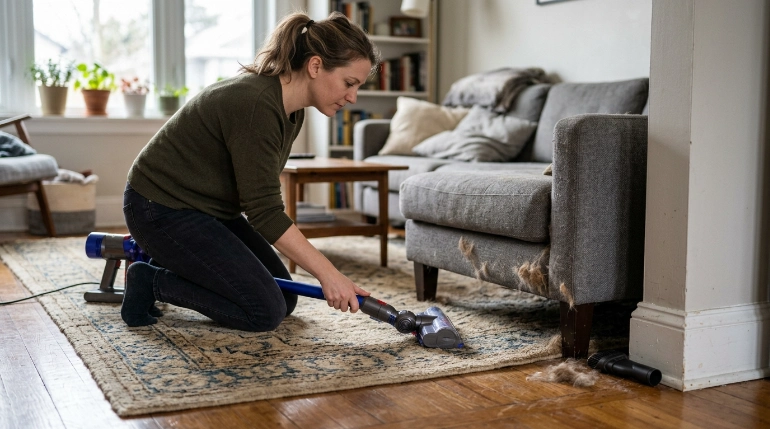
For pet hair, vacuum slowly and work in overlapping passes rather than rushing across the room once. Focus extra attention on edges, carpet traffic lanes, furniture, and your pet’s favorite resting places.
Start with loose hair on hard floors
Hair on hard flooring often drifts toward walls and furniture instead of staying in the center. I usually begin around the perimeter for that reason.
A soft floor head or hard-floor setting is useful when the manufacturer recommends it. The goal is to pick up hair rather than scatter it forward.
- Vacuum along baseboards and wall edges.
- Clean under the front edge of furniture.
- Move into the open floor area.
- Finish around the pet’s feeding and sleeping areas.
If the floor head keeps pushing light hair away, reduce your speed. Changing the head or suction setting may also help if your vacuum provides those controls.
Use overlapping passes on carpet
Carpet can hold hair below the visible surface. One fast pass may make the carpet look better without collecting everything caught between the fibers.
I prefer a simple cross-pattern in heavy-shedding areas.
- Vacuum the area slowly in one direction.
- Turn about 90 degrees.
- Vacuum the same area again.
This is especially useful near sofas, beds, doorways, and other places where pets spend time. You do not need to repeat the pattern across every inch of carpet during every cleaning.
Do not forget furniture
A clean floor can still leave a room covered in pet hair if the sofa is ignored. Upholstery, cushions, fabric chairs, and pet beds often need their own pass.
- Remove loose cushions when practical.
- Vacuum the seat and back surfaces.
- Use a crevice tool along cushion gaps.
- Clean underneath removable cushions.
- Vacuum the floor below the furniture afterward.
I save the floor beneath the sofa for last. Hair and crumbs often fall while I clean the upholstery.
Clean the places where hair hides
The visible fur is only part of the job. Fine hair also gathers around table legs, under radiators, behind doors, and beside pet beds.
A crevice tool makes these spots much faster to handle.
- Baseboard edges
- Furniture legs
- Stair corners
- Under low furniture
- Around feeding stations
- Beside litter boxes
- Along pet-bed edges
The EPA recommends frequent cleaning to limit the buildup of indoor dust and allergens. Its guidance includes regular vacuuming of carpets and furniture.
Section Takeaway: Slow passes, clean edges, and regular upholstery cleaning matter more than repeatedly vacuuming the center of the floor.
Which Vacuum Tools Work Best Around Pets?
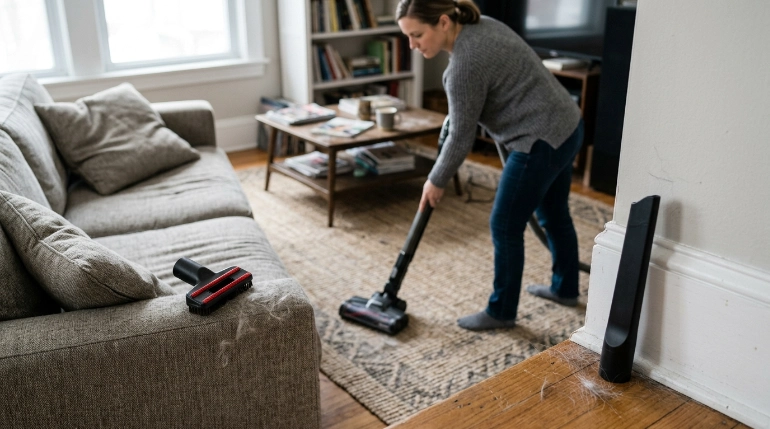
The best attachment depends on where the pet hair is sitting. A floor head, upholstery tool, and crevice tool can cover most pet-related vacuuming jobs.
Floor head or brush roll
A powered brush roll can help lift embedded debris from suitable carpets. Always follow the vacuum and flooring manufacturer’s instructions.
Some hard floors need a gentler setup. If your vacuum offers a hard-floor mode or soft roller, use it where appropriate.
Upholstery or mini motorized tool
An upholstery attachment works well on sofas, fabric chairs, stairs, and some pet beds. Powered mini tools can also help with hair that clings tightly to fabric.
Test delicate fabrics in an inconspicuous area first. Strong suction or a rotating brush may not suit every textile.
Crevice tool
This is the attachment I use most around pet zones. It reaches narrow gaps where a normal floor head leaves a visible line of fur.
Use it around walls, cushion gaps, furniture frames, stairs, and room edges.
Vacuum types compared for pet homes
| Vacuum type | Best pet-cleaning role | Main advantage | Watch for |
|---|---|---|---|
| Upright | Carpeted rooms | Wide floor path and powered cleaning heads are common | Weight on stairs and tight spaces |
| Canister | Stairs, edges, furniture, mixed floors | Flexible hose and attachment reach | Canister must follow you around the room |
| Cordless stick | Frequent hair pickup and small messes | Fast to grab for daily cleaning | Battery runtime and small dustbins |
| Robot | Routine floor maintenance | Can collect loose hair between deeper cleans | Pet accidents, cords, toys, stairs, and frightened animals |
For me, the most useful vacuum is the one that reaches the actual mess. Strong specifications mean little if I avoid using the machine because it is awkward.
How Often Should You Vacuum With Pets?
Start with at least weekly cleaning of carpets and fabric furniture, then increase the frequency where hair builds faster. AAFA recommends vacuuming once or twice weekly as part of indoor allergen control.
There is no universal schedule for every pet home. Shedding level, floor type, pet access, household size, and allergy sensitivity all change the answer.
A practical starting schedule
The schedule below is a housekeeping starting point, not a medical standard. I increase or reduce it based on how quickly hair and debris return.
| Area | Practical starting frequency | Useful tool |
|---|---|---|
| High-traffic hard floors | 2–4 times per week in shedding homes | Hard-floor head or stick vacuum |
| Carpet | 1–2 times per week | Suitable powered floor head |
| Pet-used sofa or chair | 1–2 times per week | Upholstery or mini tool |
| Pet-bed area | 1–2 times per week, or as debris appears | Upholstery and crevice tools |
| Baseboards and room edges | Weekly | Crevice tool |
| Low-traffic hidden areas | Every 1–2 weeks | Hose or low-profile head |
A heavy-shedding dog may force you to clean visible areas more often. A short-haired indoor cat in a mostly hard-floor home may need a different routine.
Use visible buildup as feedback
I do not wait for a specific day when tumbleweeds of fur are already forming. Visible buildup tells me my current schedule is too light for that area.
- Hair appears along walls one day after cleaning.
- Fur transfers to clothing from the sofa.
- Pet bedding leaves debris on the surrounding floor.
- Hair collects around table and chair legs.
- The vacuum bin fills unusually fast in one room.
Small maintenance cleans can prevent a much longer weekend session. A cordless or robot vacuum can be useful for that role if your pet tolerates it.
How Can You Vacuum Without Frightening Your Pet?
Give the animal distance and control instead of forcing it to stay beside the machine. Vacuum noise, movement, airflow, and the approaching floor head can all be unsettling.
Do not chase your pet with the vacuum
I avoid pushing the cleaner toward a dog or cat that keeps backing away. Even when it looks playful to us, the animal may be trying to escape.
Pause and move the pet to a different area instead.
Introduce the machine gradually
If a pet is new to vacuum noise, start with the machine switched off and sitting at a distance. Let the pet choose whether to approach.
Later, you can run the vacuum farther away while the animal stays in a familiar safe area. Keep these introductions short and avoid forcing contact.
- Never block the pet into a corner.
- Keep the vacuum cord away from chewing pets.
- Do not leave small attachments where pets can mouth them.
- Stop if the animal becomes highly distressed.
- Keep pets away while emptying a dusty bin.
Be extra careful with robot vacuums
A robot vacuum can help collect loose hair, but the floor must be checked before every run. Toys, strings, charging cords, food, and pet accidents can cause problems.
I would never schedule a robot to run unattended in a room where a pet sometimes has indoor accidents. Checking the floor first is safer for the machine and the home.
If a pet shows persistent fear or aggressive behavior around a vacuum, stop pushing the interaction. A veterinarian or qualified animal-behavior professional can help with severe reactions.
Section Takeaway: Your cleaning schedule should adapt to the pet, not force the pet to adapt instantly to the vacuum.
What Should Allergy-Sensitive Homes Do Differently?
Allergy-sensitive homes should focus on both surface cleaning and careful dust control. Pet allergens can remain in household dust and on carpets, upholstery, bedding, and other surfaces.
Pet allergy is not simply an allergy to visible fur. Proteins associated with animal dander, saliva, and other biological material can contribute to allergic reactions in sensitive people.
Consider effective vacuum filtration
A high-efficiency filter can help limit the fine material that passes through a vacuum’s exhaust. Filtration works best when the machine also directs collected air through the intended filter path.
Consumer Reports recommends considering HEPA filtration when choosing a vacuum for allergy-sensitive users.
HEPA stands for high-efficiency particulate air. Do not assume that every phrase such as “HEPA-style” or “HEPA-type” represents the same filtration standard.
Remember that vacuuming can stir particles temporarily
Cleaning removes settled material, but the activity can also re-suspend fine particles for a while. The EPA notes this issue in guidance about vacuuming and sensitive individuals.
If vacuuming noticeably aggravates someone’s asthma or allergies, that person may be better away from the immediate cleaning area. Discuss ongoing symptoms with an appropriate healthcare professional.
Combine vacuuming with other source-control habits
A vacuum cannot remove every airborne or surface allergen by itself. I treat it as one part of a wider cleaning routine.
- Dust hard surfaces with a damp cloth instead of scattering dry dust.
- Clean carpets and upholstered furniture regularly.
- Wash washable pet bedding according to its care label.
- Keep especially sensitive sleeping areas pet-free when medically appropriate.
- Maintain vacuum filters according to the manufacturer.
- Empty dust containers carefully.
The EPA recommends frequent cleaning to reduce indoor dust and allergen buildup. Its guidance specifically includes vacuuming carpets and furniture.
Do air purifiers replace vacuuming?
No. Air cleaners target airborne particles, while vacuums remove material that has settled on floors, carpets, furniture, and other reachable surfaces.
The CDC includes HEPA air cleaners among several measures for people with asthma triggered by furry pets. That guidance does not make surface cleaning unnecessary.
As of 2026, I still see these two tools as complementary rather than interchangeable. Vacuum the surfaces, then use appropriate air filtration when your household needs it.
Section Takeaway: Allergy control works best as a layered routine. Regular vacuuming matters, but filtration, dust control, pet access, and individual sensitivity matter too.
Frequently Asked Questions
Should I vacuum while my dog or cat is in the room?
You can if the pet is calm and has plenty of space to move away. If the animal hides, chases the vacuum, barks constantly, or appears frightened, place it in another familiar area before cleaning.
Can I vacuum my dog or cat directly?
Do not use a normal floor or upholstery attachment directly on an animal. If you want a vacuum-assisted grooming tool, use only equipment designed for that purpose and follow the manufacturer and pet-care guidance.
Should I vacuum pet hair every day?
Daily vacuuming is not necessary in every home. It can be useful in heavy-shedding homes or high-traffic areas, while a thorough one-to-two-times-weekly routine may be enough elsewhere.
Is a HEPA vacuum necessary for pet hair?
Not specifically for picking up visible hair. HEPA filtration becomes more relevant when controlling fine particles and allergens is a priority, especially for allergy-sensitive household members.
Is a bagged or bagless vacuum better around pets?
Both can collect pet hair effectively. A bagged system can reduce direct contact with collected debris during disposal, while bagless machines avoid replacement bags but require careful bin emptying.
Why does pet hair stay on my carpet after vacuuming?
Hair may be embedded in carpet fibers, wrapped around the brush roll, or beyond the reach of a poorly adjusted floor head. Slow down, check the brush roll, and make overlapping passes from different directions.
Can I use a robot vacuum around pets?
Yes, when the pet tolerates it and the floor is checked first. Remove cords, toys, food, and other obstacles, and never let a robot encounter an unnoticed pet accident.
The easiest way to vacuum around pets is to make the routine predictable. Move your pet somewhere comfortable, clear the floor, clean slowly, and concentrate on the places where hair actually collects.
Once I stopped treating every room the same, pet cleanup became much easier. A few targeted passes during the week now save me from fighting a house full of fur later.