How to Vacuum a Large House Without Wasting Time

Quick Answer
The easiest way to vacuum a large house is to divide it into zones and finish one zone before moving to the next. Clear clutter first, start at the farthest or highest point, clean edges before open floors, and avoid unnecessary backtracking. If controlling household dust matters, the EPA suggests considering a HEPA-filtered vacuum to help keep some collected dust from escaping back into the air.
Quick steps for vacuuming a large house
- Divide the house: Group rooms into manageable floors or cleaning zones.
- Clear the route: Pick up toys, cords, shoes, and other floor clutter before starting.
- Start far away: Begin upstairs or in the room farthest from your finishing point.
- Clean edges first: Use a crevice tool along baseboards, corners, and furniture edges.
- Vacuum open floors: Use slow, overlapping passes instead of racing across the room.
- Finish each zone: Empty the bin or check the bag before moving to another large area.
A large house can make vacuuming feel like an all-day project. I find the biggest problem is usually poor routing, not the amount of floor alone.
This guide shows the system I use to make the job easier. It covers vacuum choice, room order, flooring, stairs, furniture, dust control, and a realistic weekly routine.
In This Guide
- What is the best way to vacuum a large house?
- Which vacuum type works best for a large house?
- What order should you vacuum a large house?
- How should you vacuum different surfaces?
- How often should you vacuum a large house?
- How can you reduce dust and allergens while vacuuming?
- Frequently asked questions
What Is the Best Way to Vacuum a Large House?
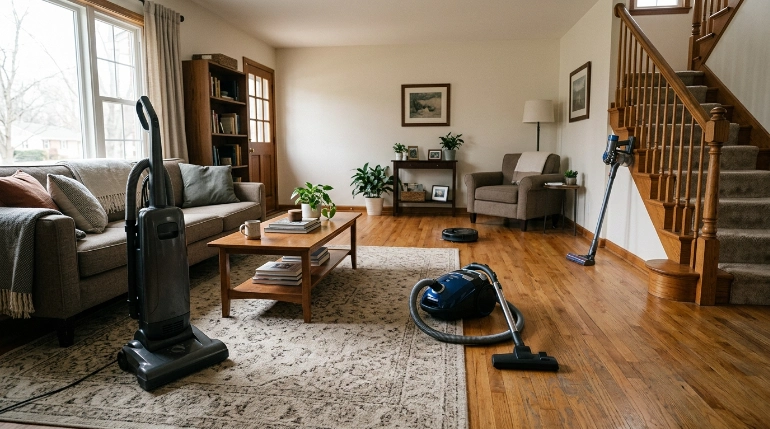
The best strategy is to treat a large house as several smaller cleaning zones. This keeps you from carrying equipment back and forth or repeatedly crossing areas you already cleaned.
For this guide, a large-house vacuuming system means a planned route that divides floors, rooms, stairs, and furniture into separate zones. It is a cleaning method, not a fixed square-foot measurement.
Make a simple zone map before you start
I like to decide where I will start and finish before plugging anything in. That small decision prevents a surprising amount of wasted walking.
A two-story home might use these zones:
- Zone 1: Upstairs bedrooms and hallway
- Zone 2: Upstairs bathrooms and closets
- Zone 3: Staircase and landing
- Zone 4: Living room and family room
- Zone 5: Kitchen, dining room, and entry
- Zone 6: Basement, office, or other lower-level spaces
You do not need to clean every zone on the same day. In a large home, splitting the work often makes the routine easier to maintain.
Prepare the rooms before bringing out the vacuum
Stopping every minute to move shoes or untangle a cord wastes energy. I prefer doing one fast pickup round before vacuuming begins.
Remove or move these items first:
- Loose clothing and towels
- Children’s toys
- Charging cables and extension cords
- Pet bowls and pet toys
- Small rugs that need shaking outside
- Light chairs that block large floor areas
- Paper, coins, and objects that could enter the vacuum
If you plan to dust shelves or furniture, do that before the final floor pass. Settled dust can fall onto a floor you just cleaned.
Use a finish-line rule for every room
One mistake I try to avoid is leaving several rooms half finished. I complete the edges, floor, and obvious furniture areas in one room before crossing it off.
A simple room finish line includes:
- Clear loose objects.
- Vacuum corners and edges.
- Clean under accessible furniture.
- Vacuum the main floor area.
- Check the doorway before leaving.
Then I move forward. I do not return unless I missed something important.
Section Takeaway: Divide a large house into zones, prepare the rooms first, and completely finish one area before moving on. A good route saves more effort than rushing the vacuum itself.
Which Vacuum Type Works Best for a Large House?
There is no single best vacuum style for every large house. Floor type, stairs, pets, storage space, and how long you clean at once all matter.
I would choose the machine around the hardest part of the house. A home with several carpeted rooms has different needs from one with mostly hardwood and two staircases.
| Vacuum Type | Power Source | Large Carpet Areas | Stairs | Best Large-House Use | Main Tradeoff |
|---|---|---|---|---|---|
| Upright | Usually corded | Strong fit | Less convenient | Large carpeted floors | Bulkier to carry |
| Canister | Usually corded | Good with suitable floor head | Good | Mixed flooring and furniture | Canister follows behind you |
| Cordless stick | Rechargeable battery | Model dependent | Very convenient | Fast daily zones and stairs | Runtime and bin size vary |
| Robot | Rechargeable battery | Routine surface cleaning | Cannot clean stairs | Maintenance between deeper cleans | Still needs manual backup |
If most of your home has carpet, a full-size upright can reduce interruptions from small dust bins or battery changes. A canister can be easier around furniture, hard floors, and stairs.
A cordless stick is useful when carrying a full-size machine between floors becomes the part you hate most. For a large home, battery runtime and bin capacity deserve close attention.
A robot vacuum can maintain open rooms between manual sessions. It does not replace edge cleaning, stairs, upholstery, or detailed work.
The Consumer Reports vacuum buying guide is also useful when comparing vacuum styles, filtration, flooring needs, and other features.
What Order Should You Vacuum a Large House?
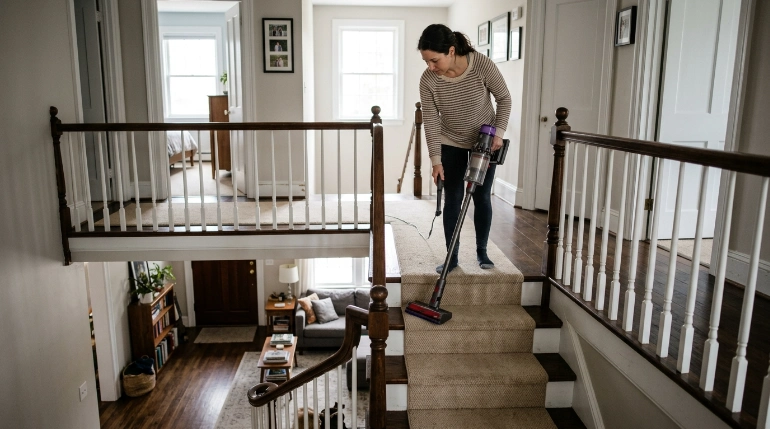
Start at the highest or farthest part of the house and work toward your final exit point. This creates a one-way route and reduces walking over freshly cleaned floors.
In a multi-story house, I normally treat each level as its own project. I also finish the stairs while moving from one floor to another.
Step 1: Start with upstairs bedrooms
Bedrooms are often easy places to build momentum. Clear the floor, vacuum the perimeter, clean under reachable furniture, and finish the open area.
Pay extra attention to these dust-catching spots:
- Under the bed
- Around nightstands
- Closet edges
- Behind the door
- Around dresser legs
Step 2: Finish the upstairs hallway
Do the hallway after the rooms feeding into it. That way, you are not repeatedly walking across a finished hallway with the vacuum.
Use the crevice tool where the floor meets the baseboard if visible debris collects there.
Step 3: Clean the stairs on your way down
Stairs are easier when treated as the transition between zones. Start at the top and work downward one step at a time.
If your main vacuum feels awkward on stairs, use a hose, compact machine, or removable handheld unit. Keep the machine stable so it cannot fall toward you.
Step 4: Move through the main living spaces
After the upper floor, clean the living room, family room, office, and other large common areas. These rooms often need more furniture-edge work.
My usual sequence is:
- Vacuum upholstered furniture if needed.
- Clean the room perimeter.
- Reach under accessible furniture.
- Vacuum rugs or carpet.
- Finish exposed hard flooring.
Step 5: Leave busy entry areas until late
Entryways and kitchen-adjacent floors get walked on while you clean other rooms. Leaving them until later reduces the chance of cleaning them twice.
Finish near the place where you plan to store or empty the vacuum. That gives the whole job a natural endpoint.
Section Takeaway: Work from upstairs or farthest rooms toward your exit. Finish bedrooms before hallways, stairs during floor transitions, and busy entry areas near the end.
How Should You Vacuum Different Surfaces in a Large House?
A large house often contains several floor types. Using the same floor head and technique everywhere can make the job slower or less effective.
Carpet
Do not race across carpet. A controlled pass gives the floor head time to pick up loose debris and material trapped between carpet fibers.
For carpeted rooms:
- Check that the floor head is suitable for carpet.
- Adjust height settings if your vacuum provides them.
- Use overlapping passes through open areas.
- Make an extra pass through visibly dirty traffic lanes.
- Use the crevice tool around walls when needed.
I usually save detailed edge work for deeper cleaning days. It does not need to turn every routine vacuuming session into a major project.
Hard floors
Use a hard-floor setting or suitable floor head when your vacuum provides one. A spinning brush that cannot be switched off may scatter some loose debris on certain floors.
Start around the perimeter, then work through the center in straight sections. Watch underneath cabinets and furniture where dust collects out of normal sight.
Area rugs
Check whether the rug can safely handle a powered brush roll. Lightweight rugs may lift or shift under strong suction.
For a loose rug, reduce suction if your machine allows it or use an appropriate attachment. Clean the exposed floor around and beneath movable rugs when practical.
Stairs
Vacuum the tread first, then clean the edge where the tread meets the riser. A crevice attachment is useful along stair corners.
Keep cords behind you and avoid balancing a heavy vacuum on a narrow step. A fall is not worth saving a few minutes.
Sofas and upholstered chairs
Furniture can hold crumbs, pet hair, and loose dust even when the floor looks clean. I remove cushions when the design allows and vacuum the seams before the broad surfaces.
Useful furniture attachments include:
- Upholstery tool
- Crevice tool
- Soft dusting brush
- Pet-hair attachment when appropriate
Check the furniture maker’s care instructions before using aggressive powered attachments on delicate fabric.
Section Takeaway: Match the tool and technique to the surface. Carpet benefits from controlled overlapping passes, while stairs, edges, rugs, and upholstery often need smaller attachments.
How Often Should You Vacuum a Large House?
You do not have to deep-vacuum every room every day. A zone schedule is usually easier to maintain in a large home.
High-traffic areas may need attention more often than guest rooms or spaces that stay closed. Pets, children, outdoor dirt, carpeting, and allergy concerns can also change the schedule.
The Asthma and Allergy Foundation of America recommends vacuuming once or twice a week as part of indoor-allergen control. Homes without those concerns can still adjust frequency according to visible soil and household activity.
A simple large-house weekly schedule
- Monday: Main living room and entry areas
- Tuesday: Upstairs bedrooms and hallway
- Wednesday: No full vacuuming; spot-clean visible debris
- Thursday: Kitchen-adjacent areas and dining room
- Friday: Stairs, office, and frequently used rooms
- Weekend: Upholstery, under furniture, or another deeper-cleaning task as needed
This is only a framework. A quiet household may need less, while a home with shedding pets may need more frequent floor cleaning.
I find it more useful to separate maintenance vacuuming from deep vacuuming. The first keeps visible debris under control, while the second covers edges, upholstery, and hard-to-reach spaces.
How Can You Reduce Dust and Allergens While Vacuuming?
Vacuuming removes settled material, but the machine can also disturb fine dust while you work. Good filtration and sensible cleaning habits matter when someone in the home is sensitive to airborne particles.
A HEPA filter is a high-efficiency particulate air filter. In a vacuum, the complete filtration and sealing design matters because collected air still has to pass through the machine before returning to the room.
Use a dust-control routine
- Dust surfaces with a damp cloth before the final floor pass.
- Check that the vacuum filter is installed correctly.
- Replace or clean filters according to the manufacturer’s instructions.
- Do not let the dust bin become excessively packed.
- Empty the vacuum carefully, preferably away from sensitive household members.
- Clean heavily used carpet and upholstery on a regular schedule.
If someone has asthma or significant allergies, avoid making health promises based on vacuuming alone. EPA and AAFA guidance treats cleaning as one part of reducing exposure to indoor particles and allergens.
Do not vacuum every type of household mess
A household vacuum is not the right tool for every material. Stop before vacuuming anything that could damage the machine or create a safety problem.
Examples include:
- Hot fireplace ash or hidden embers
- Large amounts of liquid with a dry-only vacuum
- Sharp construction debris
- Unknown powders or chemicals
- Large quantities of fine renovation dust without suitable filtration
What if you find mold while cleaning?
Do not assume normal vacuuming fixes a mold problem. The CDC explains that indoor mold grows where moisture is present, so the moisture source needs attention too.
Expert Alert: If you find widespread mold, repeated moisture damage, or mold linked to a plumbing or building problem, consider qualified remediation or repair help instead of treating the area as a normal vacuuming job.
Section Takeaway: Good filtration, maintained filters, careful emptying, and regular cleaning can help control household dust. Treat unusual debris, moisture problems, and significant mold as separate issues rather than ordinary vacuuming.
Frequently Asked Questions About Vacuuming a Large House
How long should it take to vacuum a large house?
There is no reliable universal time because layouts, floor types, furniture, pets, stairs, and cleaning depth vary widely. A maintenance pass can be much faster than a session that includes edges, upholstery, stairs, and cleaning under furniture.
Should I vacuum the whole house in one day?
No. You can divide a large house into floors or zones and clean them on different days. This is often easier than postponing vacuuming until you have enough time and energy to clean every room at once.
Should I dust or vacuum first?
Dust higher surfaces before the final floor vacuuming. Some loosened dust can settle onto lower surfaces and floors, so finishing with the floor helps collect material disturbed during the earlier cleaning steps.
Is a cordless vacuum good enough for a large house?
It can be, depending on battery runtime, floor type, bin capacity, and cleaning expectations. Cordless models are especially convenient for stairs and quick zones, while long whole-house sessions may require charging breaks, a second battery, or another vacuum.
Should I vacuum slowly or quickly?
Use controlled passes rather than pushing the vacuum as fast as possible. Slow, overlapping movement is especially helpful on carpet and visibly dirty areas because the cleaning head spends more time over each section.
Can a robot vacuum handle a large house?
A robot can help maintain accessible floors between manual cleaning sessions. It cannot clean stairs, upholstery, many corners, or every space beneath furniture, so most large homes still benefit from a conventional vacuum for deeper work.
What is the easiest way to vacuum a two-story house?
Start on the upper floor, finish its rooms and hallway, clean the staircase while moving downstairs, then complete the lower level. This one-direction route reduces equipment carrying and prevents unnecessary trips between floors.
Final takeaway: Vacuuming a large house becomes easier when you stop treating it as one giant room. Divide it into zones, prepare the route, match your vacuum to your surfaces, and finish one area before moving forward.
Start with one floor this week and test the system. Once you find a route that works, repeat it until the process becomes automatic.
“`