How to Vacuum a Boat: A Complete Step-by-Step Guide

Quick Answer
To vacuum a boat, remove loose gear first, work from the highest surfaces down, and use a crevice tool around seats, lockers, and rails. A cordless handheld or compact canister works for dry debris, while a wet/dry vacuum is safer for liquid pickup; this vacuum cleaner buying guide can help you compare basic vacuum types.
Quick boat vacuuming steps
- 1. Clear the boat: Remove bags, life jackets, coolers, mats, and other loose items.
- 2. Shake out debris: Take removable mats and cushions outside before vacuuming them.
- 3. Start high: Vacuum seat seams, ledges, consoles, and storage areas before the deck.
- 4. Use attachments: Switch between a brush, crevice tool, and upholstery nozzle as needed.
- 5. Finish the floor: Vacuum carpet, vinyl, or nonskid decking in overlapping passes.
- 6. Check moisture: Never collect standing water with a dry-only vacuum.
One rule makes the job easier
- Treat the boat as three zones: seats and surfaces, storage spaces, then floors and deck areas.
Vacuuming a boat looks simple until sand gets buried in carpet, crumbs disappear beneath cushions, and pet hair sticks to marine upholstery. A normal household cleaning routine does not always reach those places.
I like to divide the job into small zones instead of chasing dirt around the entire boat. This guide shows you how to vacuum a boat efficiently without damaging upholstery, flooring, storage compartments, or your vacuum.
In This Guide
- What should you do before vacuuming a boat?
- What type of vacuum works best on a boat?
- How do you vacuum boat floors, carpet, and vinyl?
- How do you vacuum boat seats, cushions, and storage compartments?
- How do you remove sand, pet hair, moisture, and mildew?
- How often should you vacuum a boat?
- Frequently asked questions
What Should You Do Before Vacuuming a Boat?
Before you turn on the vacuum, remove anything that can block your path or hide debris. A few minutes of preparation usually makes the actual vacuuming much faster.
Start while the boat is stable and well ventilated. If possible, clean it at the dock, on the trailer, or another safe location where you can move around comfortably.
Clear loose equipment first
Take removable items off the surfaces you plan to clean. You will expose the dirt underneath instead of vacuuming around it.
- Coolers and tackle boxes
- Life jackets and flotation gear
- Dock lines
- Bags and clothing
- Portable electronics
- Trash containers
- Removable floor mats
- Loose seat cushions
Check under every item as you move it. Damp towels, food wrappers, and leaves can trap moisture against flooring or upholstery.
Remove large debris by hand
Do not ask the vacuum to swallow bottle caps, fishing line, hooks, screws, or large pieces of vegetation. These objects can jam a hose or damage a brush head.
Fishing line deserves extra attention. It can wrap tightly around a rotating brush in much the same way that long hair does.
Check whether the surface is wet
A dry vacuum is designed for dry dirt and debris. A wet/dry vacuum is built to collect dry material and liquids when configured according to its instructions.
Do not assume a vacuum can handle water because its floor head looks durable. Check the manufacturer instructions before collecting any damp or wet material.
- Dry crumbs and dust: A normal handheld or canister vacuum can work.
- Damp carpet: Let it dry when practical before using a dry-only vacuum.
- Standing water: Use equipment specifically rated for wet pickup.
- Unknown liquid: Identify and handle the spill safely before vacuuming.
Also avoid running ordinary electrical equipment where cords, outlets, or connections may contact water. Marine electrical safety should take priority over finishing the cleaning job.
What Type of Vacuum Works Best on a Boat?
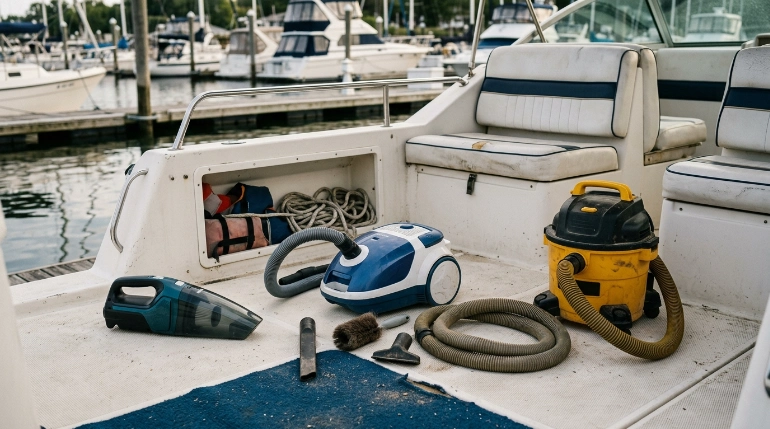
The best boat vacuum depends on the debris, available power, storage space, and whether you need liquid pickup. Most owners need portability more than a large upright vacuum.
As of 2026, cordless handhelds, compact canisters, and wet/dry vacuums remain the most practical categories for this job. Each solves a different cleaning problem.
| Vacuum type | Power source | Liquid pickup | Best boat use | Main limitation |
|---|---|---|---|---|
| Cordless handheld | Rechargeable battery | Usually no unless specifically rated | Seats, consoles, crumbs, quick cleanups | Smaller bin and limited runtime |
| Compact canister | Usually AC power | No unless specifically rated | Carpet, cabins, upholstery, detailed cleaning | Requires cord management |
| Wet/dry vacuum | Corded or battery, depending on model | Yes when configured correctly | Heavy debris, wet carpet, liquid pickup | Bulkier to store |
| 12-volt automotive-style vacuum | 12-volt outlet | Usually no unless rated | Light dirt when shore power is unavailable | Performance varies widely |
Look for useful attachments
Attachments often matter more on a boat than a large floor head. Boats have narrow channels, seat seams, cupholders, lockers, and corners that a standard head cannot reach.
- Crevice tool: Reaches seat gaps, rails, locker edges, and console seams.
- Soft brush: Loosens dust from dashboards and textured surfaces.
- Upholstery tool: Covers cushions faster without concentrating suction in one spot.
- Flexible hose: Reaches beneath seats and inside compartments.
When is HEPA filtration useful?
HEPA means high-efficiency particulate air. The EPA explains HEPA filtration as a mechanical filtration method designed to capture very small airborne particles.
A well-filtered vacuum may be worth considering if fine dust and allergens are frequent problems. Filtration alone, however, does not fix a moisture or mold source.
Section Takeaway: Choose the smallest vacuum that can handle your actual debris. Add wet pickup only when you genuinely need it.
How Do You Vacuum Boat Floors, Carpet, and Vinyl?
Vacuum boat flooring after the higher surfaces are finished. Any sand or crumbs knocked loose from seats will then be collected during the final floor pass.
The correct technique changes with the flooring material. Carpet holds debris differently from smooth vinyl or textured nonskid surfaces.
How to vacuum marine carpet
Marine carpet can hide sand deep between its fibers. One fast pass often removes only what you can see.
- Pick up large debris by hand.
- Use a crevice tool along walls, seat bases, and hatch edges.
- Vacuum the open carpet slowly in overlapping passes.
- Change direction and make a second pass over sandy areas.
- Check corners again before replacing mats or gear.
If your vacuum has an aggressive rotating brush, test it on a hidden area first. Some delicate or aging carpet can fuzz when brushed too hard.
How to vacuum vinyl flooring
Smooth vinyl usually needs less agitation. A soft floor nozzle or brush attachment can collect grit without dragging it across the surface.
- Start around seat pedestals and edges.
- Pull debris from grooves with the crevice tool.
- Use long passes across open flooring.
- Vacuum loose grit before wet cleaning or wiping.
Removing grit first matters because sand can act like an abrasive when rubbed under a cloth or shoe.
How to clean textured nonskid decking
Nonskid patterns trap particles inside small recesses. A brush attachment can loosen that debris while suction lifts it away.
Work slowly instead of pressing hard. The goal is to disturb trapped dirt, not scrape the surface.
How Do You Vacuum Boat Seats, Cushions, and Storage Compartments?
Boat upholstery collects crumbs, sunscreen residue, sand, hair, and dust around seams. The narrow spaces around cushions are often dirtier than the visible seating surface.
Start with low suction when cleaning delicate upholstery. Increase it only when the material stays stable and the vacuum is not pulling at seams.
Vacuum the seams first
Use the crevice tool around piping, stitching, hinges, and gaps between cushions. Hold the nozzle slightly above fragile stitching rather than scraping it directly across the thread.
Then switch to an upholstery tool for the larger seat surface. Work from top to bottom so loosened debris falls into areas you have not cleaned yet.
Lift removable cushions
The space beneath a cushion can hold surprising amounts of dirt. It can also reveal moisture that would otherwise stay hidden.
- Vacuum the underside of the cushion.
- Clean the support surface underneath it.
- Inspect drainage channels.
- Check corners for damp leaves or organic debris.
- Let damp areas dry before reinstalling the cushion.
Empty storage compartments completely
Do not vacuum a locker while it is still packed. Removing everything makes it easier to find dirt, leaks, damp fabric, insects, or damaged gear.
Use a crevice tool around hinges and corners. A soft brush works better on dusty walls and shelves.
Keep small screws, hooks, terminals, and electrical parts away from the nozzle. Vacuuming hardware can damage the machine and leave you searching for missing boat parts.
How Do You Remove Sand, Pet Hair, Moisture, and Mildew?
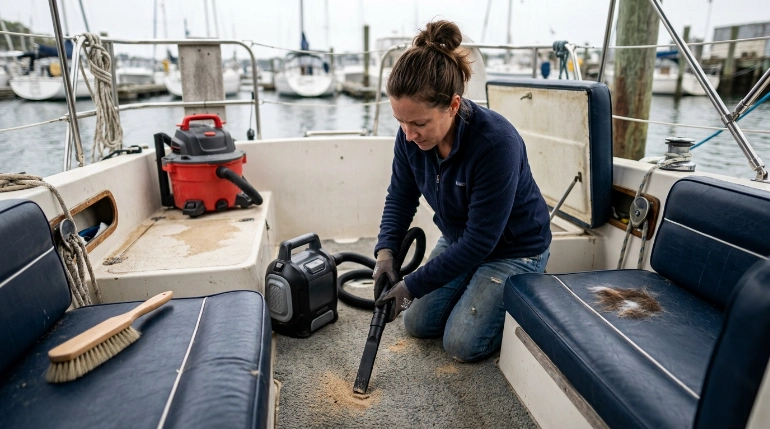
Sand and pet hair need more than ordinary straight-line vacuuming. Moisture and mold require a different approach because suction alone does not solve the underlying problem.
Sand
Let loose sand dry before vacuuming when possible. Dry grains separate from carpet and seams more easily than sand mixed with water.
- Shake removable mats outside.
- Loosen buried sand with a soft brush.
- Vacuum slowly in one direction.
- Repeat from the opposite direction.
- Finish edges with a crevice tool.
Empty a small vacuum bin before it becomes packed with sand. Dense debris can fill a compact container faster than ordinary household dust.
Pet hair
Pet hair often clings to fabric through friction. A rubber-edged upholstery tool or vacuum attachment designed for hair can help gather it into manageable clumps.
Work in short strokes rather than sweeping the nozzle randomly. Check the brush roll and inlet often for wrapped hair.
Moisture
Use a dry-only vacuum only on dry material. If you need to remove pooled water, use a wet/dry vacuum that the manufacturer specifically allows for liquid pickup.
After removing water, address why the area became wet. A leaking hatch, clogged drain, wet cover, or trapped condensation can create the same problem again.
What if you find mildew or mold?
Mold is a fungal growth that develops where enough moisture is present. Vacuuming visible growth is not a complete mold-control method because the moisture source still needs attention.
The EPA’s mold guidance emphasizes moisture control as the key to preventing mold growth. The CDC’s mold cleanup guidance also recommends appropriate personal protection when cleaning mold-contaminated materials.
Do not aggressively dry-vacuum a visibly moldy cushion just to make the surface look clean. Disturbing contaminated material can spread particles through the immediate area.
Expert Alert: If mold is widespread, keeps returning, has penetrated absorbent materials, or follows major water intrusion, use a qualified marine cleaning or remediation professional instead of relying on DIY vacuuming.
Section Takeaway: Vacuuming removes loose debris, but moisture control is what helps prevent recurring mold and musty conditions.
How Often Should You Vacuum a Boat?
There is no single schedule for every boat. Usage, passengers, pets, weather, storage conditions, and the type of water around you all change how quickly dirt builds up.
A better method is to match the cleaning frequency to how the boat is used.
| Situation | Practical vacuuming routine |
|---|---|
| Light recreational use | Quick debris check after outings and a deeper vacuum when visible dirt builds up |
| Frequent beach or sandbar trips | Remove sand after each trip before it works deeply into carpet and seams |
| Pets aboard | Vacuum hair and tracked debris after heavy shedding or messy trips |
| Food regularly served aboard | Remove crumbs soon after use, especially around seats and storage spaces |
| End-of-season storage | Deep vacuum before storage and confirm surfaces are dry |
Maintain the vacuum after boat cleaning
Boat debris can be rough on a vacuum. Sand, hair, leaves, and damp dirt build up around filters and inlets quickly.
- Empty the bin or bag.
- Remove hair from the brush roll.
- Check the hose for trapped debris.
- Inspect the filter.
- Clean or replace filters only as the manufacturer directs.
- Dry wet/dry vacuum components before storage.
- Recharge cordless batteries according to the product instructions.
Do not automatically wash a vacuum filter under a faucet. Some filters are washable, while others require replacement or dry cleaning.
My simple three-zone routine
My preferred way to organize the job is to think in three zones: upper surfaces, hidden storage, and floors. That order keeps me from cleaning the same area twice.
- Seats, consoles, ledges, and cupholders
- Lockers, cushion cavities, and under-seat spaces
- Carpet, vinyl, nonskid flooring, and final edge work
Finish by walking through the boat once with the crevice tool. Small edges are where the last line of sand usually hides.
Frequently Asked Questions About Vacuuming a Boat
Can you use a regular vacuum cleaner on a boat?
Yes, a normal dry vacuum can clean dry boat carpet, seats, and flooring if you have a safe power source. Do not use a dry-only vacuum for standing water, wet debris, or any task its manufacturer does not approve.
Can you vacuum water out of a boat?
Only use a vacuum specifically designed for wet pickup. A wet/dry vacuum can handle liquids when correctly configured, but it should not replace the boat’s drainage, bilge, or leak-repair systems.
What is the best attachment for cleaning boat seats?
An upholstery tool works well across broad seat surfaces, while a crevice tool reaches piping and seams. A soft brush is useful for textured surfaces where crumbs or dry dust need gentle agitation.
How do you get sand out of boat carpet?
Let the sand dry when possible, shake removable mats outside, and loosen trapped grains with a soft brush. Vacuum slowly in overlapping passes, then repeat from another direction to reach particles buried between carpet fibers.
Should you vacuum before washing a boat interior?
Usually, yes. Removing dry sand, dust, hair, and crumbs before wiping or washing helps prevent loose grit from spreading across wet surfaces and makes the later cleaning steps easier.
Is a HEPA vacuum necessary for a boat?
No. A HEPA-equipped vacuum can be useful when fine dust or allergen containment matters, but many ordinary boat cleanups do not require one. Good suction, suitable attachments, safe wet-versus-dry use, and regular filter maintenance matter too.
Can vacuuming remove mold from boat upholstery?
Vacuuming alone does not solve a mold problem. You need to correct the moisture source and properly clean or replace affected material; the National Institute of Environmental Health Sciences’ mold information explains how damp conditions support mold growth.
A clean boat starts with dry surfaces and regular debris removal. Clear the cabin, vacuum from high areas to low ones, choose the correct attachments, and never collect liquids with equipment meant only for dry debris.
Make a short vacuuming pass part of your post-trip routine. It is much easier to remove fresh sand, crumbs, and hair than to tackle a season’s worth of compacted dirt later.