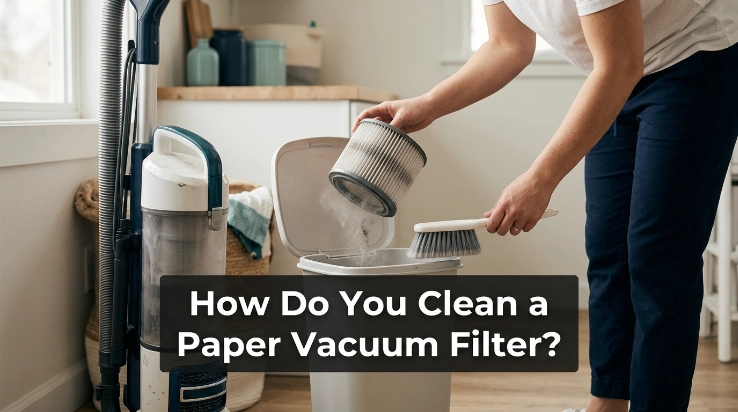
How Do You Clean a Foam Vacuum Filter? Safe Step-by-Step Guide

Quick Answer
To clean a foam vacuum filter, first confirm that your specific filter is washable. Remove it from the powered-off vacuum, shake or tap away loose dust, rinse it gently with water using the method your manufacturer recommends, and let it air-dry completely before reinstalling it. A BISSELL foam-filter cleaning guide provides one manufacturer example of this process.
Quick Cleaning Steps
- Check washability: Never assume every foam-looking filter can safely go under water.
- Disconnect power: Unplug the vacuum or remove its battery when your model allows it.
- Remove loose dust: Gently tap or shake the filter before adding water.
- Rinse gently: Use clean water and avoid damaging the foam with aggressive scrubbing.
- Use soap cautiously: Add mild detergent only when your manufacturer permits it.
- Dry completely: Do not reinstall the filter while moisture remains inside the foam.
Safest Rule
- If the manual does not identify the filter as washable, keep it dry and follow the manufacturer’s replacement or dry-cleaning instructions instead.
Foam vacuum filters catch dust before it reaches other parts of the machine, so they can become dirty surprisingly fast. Cleaning them correctly can help maintain normal airflow without damaging the filter.
My rule is simple: I check the filter instructions before reaching for water. Foam material often looks washable, but the vacuum’s exact filter design matters more than appearance.
In This Guide
Can You Wash a Foam Vacuum Filter?
You can wash many foam vacuum filters, but only when the manufacturer identifies that specific filter as washable. Some vacuums combine washable foam with another filter that must remain dry.
A foam vacuum filter is a porous filter made from flexible foam material that traps dust and debris as air moves through the vacuum. It is commonly used as a pre-motor filter or as part of a multi-stage filtration system.
Why filter type matters
A vacuum may contain several filters that need completely different care. Removing them together does not mean you should clean them together.
- Foam filter: Frequently washable, depending on the model.
- Felt or fabric filter: May be washable, dry-clean only, or replaceable.
- Pleated filter: Cleaning instructions vary considerably.
- HEPA filter: May be washable or non-washable depending on its construction.
- Post-motor filter: Some models require replacement instead of washing.
For example, some BISSELL models use a washable foam filter beside a pleated filter that must not be washed. That is why identifying each filter before cleaning is important.
A HEPA designation also does not tell you whether a filter can be washed. The U.S. Environmental Protection Agency’s HEPA vacuum guidance describes HEPA in terms of filtration performance and vacuum design, not washability.
How Do You Clean a Foam Vacuum Filter Step by Step?
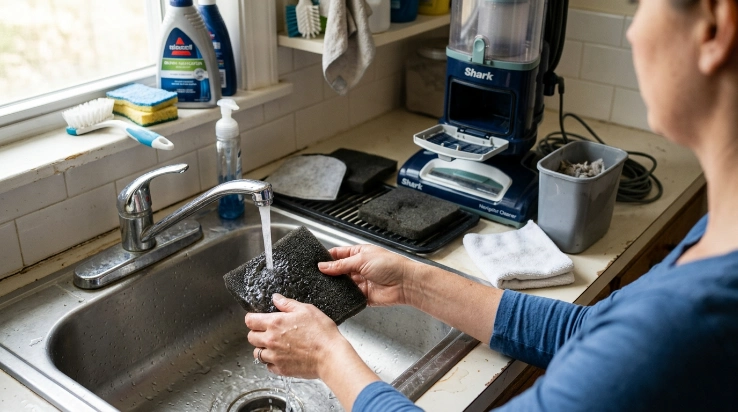
The safest cleaning method is gentle and simple. You want to remove embedded dust without stretching, tearing, or deforming the foam.
1. Turn off and disconnect the vacuum
Unplug a corded machine before opening its filter compartment. For a cordless vacuum, switch it off and remove the battery when your manufacturer allows battery removal.
2. Find the foam filter
Check the owner’s manual if you are unsure where it sits. Foam filters are often found near the dirt bin, under a filter cover, or before the motor.
Pay attention to how the filter fits before removing it. A quick photo can help if the filter stack contains several layers.
3. Remove loose dirt first
Take the filter outside or hold it over a trash container. Tap it gently to loosen surface dust, hair, and crumbs.
Do not beat the filter against a hard edge. Rough handling can damage thin foam or alter its shape.
4. Rinse the filter if washing is approved
Hold the washable foam under clean running water. Let water move through the filter while gently working dirt out with your fingers.
- Use the water temperature specified by the manufacturer.
- Avoid a concentrated high-pressure spray.
- Do not scrub the foam with a stiff brush.
- Keep water away from the vacuum’s motor and electrical parts.
5. Continue until heavy dirt is gone
Rinse from different directions if the manufacturer allows it. Foam can hold fine dust deeper inside its pores than you can see from the surface.
Do not chase a perfectly white appearance if the foam has permanent staining. Cleanliness and unrestricted pores matter more than cosmetic color.
6. Remove excess water gently
Shake off loose water and handle the foam carefully. Avoid aggressive twisting unless the manufacturer specifically tells you to squeeze or manipulate that filter.
7. Air-dry the filter completely
Set the filter in a well-ventilated place and give it enough time to dry throughout. The center can stay damp after the surface already feels dry.
Never reinstall a damp filter simply because you need to vacuum immediately. Use a fully dry spare filter when your model supports one.
Section Takeaway: Check washability first, use gentle cleaning, and treat complete drying as part of the cleaning process rather than an optional final step.
Should You Use Soap or Just Water?
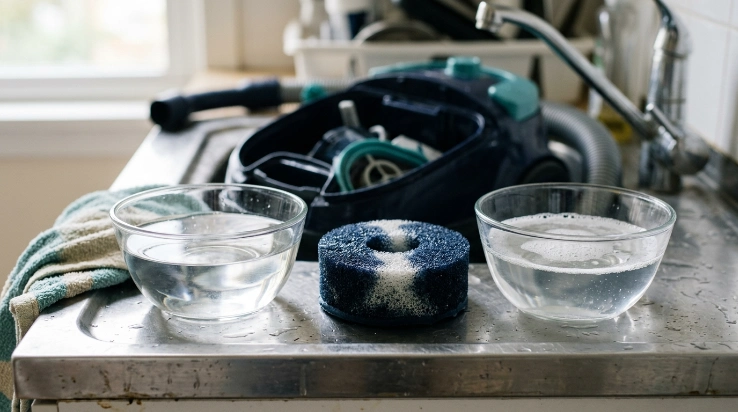
There is no universal soap rule for every foam vacuum filter. Some manufacturers permit mild detergent, while others specifically instruct owners to use water only.
This is one reason I avoid applying a single cleaning recipe to every vacuum. Manufacturer instructions should settle the question.
| Filter Situation | Typical Approach | Key Precaution |
|---|---|---|
| Washable foam filter | Rinse with water as directed | Dry completely before reuse |
| Manufacturer allows mild detergent | Use a small amount and rinse thoroughly | Do not leave soap residue in the foam |
| Water-only instructions | Use plain water | Do not add detergent or cleaners |
| Non-washable filter | Use approved dry maintenance or replace it | Do not rinse it |
BISSELL’s instructions for certain washable foam filters allow water and, on some models, mild detergent. Other filter designs have different rules.
Dyson, for comparison, tells owners of supported washable vacuum filters to use water without detergent. Its vacuum filter-care instructions also stress complete drying before the filter goes back into the machine.
How Long Should a Foam Vacuum Filter Dry?
A foam vacuum filter should dry until no moisture remains anywhere inside it. There is no single drying time that applies to every foam filter, climate, or vacuum model.
Some manufacturer instructions specify about 24 hours, while certain models call for 24 to 48 hours. Follow your exact manual whenever it states a minimum.
How to help the filter dry safely
- Increase airflow: Leave it in a dry, ventilated room.
- Expose more surface: Position the filter so air can reach multiple sides.
- Check the center: Thick foam may retain moisture internally.
- Allow extra time: Humid weather can slow evaporation.
Avoid ovens, microwaves, tumble dryers, open flames, or intense direct heat unless your manufacturer explicitly approves a drying method. High heat may deform filter material.
Before reinstalling it, touch several areas and check for cool, damp spots. If you are unsure, give the filter more drying time.
What Mistakes Can Damage a Foam Vacuum Filter?
The most common problems come from treating every filter like a washable sponge. Vacuum filters are functional components, so rough cleaning can shorten their useful life.
- Washing without checking: Foam appearance alone does not prove the filter is washable.
- Using harsh chemicals: Bleach, solvents, disinfectants, and strong cleaners may damage filter material.
- Scrubbing aggressively: Hard brushes can tear or thin the foam.
- Using excessive pressure: Strong water pressure can stress delicate filter structures.
- Twisting forcefully: Wringing may stretch or deform some filters.
- Reinstalling while damp: Moisture should not be introduced into a vacuum designed for dry filtration.
- Washing neighboring filters: A washable foam layer may sit beside a non-washable filter.
What if water gets into the vacuum?
Stop and disconnect power if cleaning water reaches the motor housing, electrical connections, charging contacts, or battery compartment. Do not switch the vacuum on just to see whether it still works.
Expert Alert: If liquid reaches electrical or motor components, follow the manufacturer’s service guidance or contact a qualified appliance repair professional rather than dismantling or energizing the machine.
Keeping filtration working properly also matters for household dust control. The EPA’s indoor particulate matter guidance recommends regular cleaning and notes that HEPA-filter vacuums can help keep some collected dust from escaping back into indoor air.
How Often Should You Clean a Foam Vacuum Filter?
Clean the filter according to your vacuum manufacturer’s maintenance schedule rather than using one universal interval. How quickly it becomes dirty depends on the machine, home, debris load, and cleaning habits.
As of 2026, manufacturer guidance still varies substantially between models. Some brands advise frequent checks, while others provide model-specific washing or replacement intervals.
Signs you should inspect the filter
- Visible dust has built up across the foam.
- Suction seems weaker than normal.
- The vacuum’s filter indicator asks for maintenance.
- Fine dust is being vacuumed frequently.
- The filter has not been checked for a long time.
Do not assume cleaning will rescue a damaged filter. Torn, crumbling, permanently deformed, or poorly fitting foam may need replacement.
Regular vacuuming itself can help reduce household dust and allergens, but the vacuum should contain collected material effectively. The Asthma and Allergy Foundation of America’s indoor allergen guidance recommends regular vacuuming and emphasizes filtration that limits particles returning to the air.
That matters especially in homes where dust mites, pollen, pet dander, or other allergens are a concern. A clean filter is only one part of a broader cleaning routine.
Frequently Asked Questions
Can I wash every foam vacuum filter?
No. Many foam vacuum filters are washable, but the material alone does not guarantee it. Check the owner’s manual, filter label, or manufacturer’s support instructions before rinsing it. If washing is not clearly approved, use the recommended dry-cleaning or replacement method.
Can I wash a foam vacuum filter with dish soap?
Use detergent only if your vacuum manufacturer allows it. Some BISSELL foam filters can be washed with mild detergent, while other manufacturers specify plain water. Avoid assuming dish soap is safe because residue or added ingredients may not suit every filter.
Can I put a wet foam filter back in my vacuum?
No, not in a dry vacuum unless the manufacturer specifically says otherwise. Let a washed filter air-dry completely before reinstalling it. Moisture can remain inside thick foam even after the exterior feels dry, so allow extra time when needed.
Can I dry a foam vacuum filter with a hair dryer?
It is safer to air-dry the filter unless the manufacturer approves another method. Concentrated heat may damage or deform some filter materials. Place the filter where air can circulate around it and wait until the entire filter is completely dry.
Why does my foam vacuum filter still look dirty after washing?
Foam can develop staining that remains after loose and embedded dirt has been removed. Do not use harsher chemicals simply to restore its original color. Replace the filter when it is damaged, permanently blocked, deteriorating, or due for replacement under your manufacturer’s instructions.
Can a dirty vacuum filter reduce suction?
Yes. A dirty filter can restrict airflow on many vacuum designs, which may contribute to weaker cleaning performance. Check the dirt bin, hose, floor head, and other filters too, because clogs and overfilled collection systems can cause similar symptoms.
Is a foam filter the same as a HEPA filter?
No. Foam describes filter material or construction, while HEPA refers to a filtration-performance standard. A vacuum may use a foam pre-filter together with a separate HEPA filter. Never assume the HEPA component is washable just because the nearby foam filter can be rinsed.
Cleaning a foam vacuum filter is straightforward once you know the filter is washable: remove loose dust, rinse it gently, follow the manufacturer’s soap instructions, and allow complete air drying.
Check the filter whenever you notice heavy buildup or reduced airflow. A few minutes of correct maintenance is safer than aggressive washing that damages a filter designed to protect your vacuum.
“`