How Often Should You Replace Robot Vacuum Filters?

Quick Answer
A practical replacement range for many robot vacuum filters is about every 2–6 months, but there is no universal schedule. Your exact model’s instructions should come first because, for example, iRobot’s j Series maintenance guidance calls for filter replacement every two months.
Replace the filter sooner when:
- Airflow stays weak: Suction remains poor after you empty the bin and clear obvious debris.
- Dirt stays embedded: Approved cleaning no longer removes the heavy dust trapped in the filter.
- Material is damaged: Pleats, foam, frames, or sealing edges are torn, bent, or deformed.
- You have pets: Hair and fine household debris can make filter maintenance necessary more often.
- The interval is reached: Replace a disposable filter when your manufacturer says it is due.
Best rule to remember
- Check the filter regularly, maintain it exactly as directed, and use its condition plus the manufacturer schedule to decide when replacement is due.
Robot vacuum filters are easy to forget because they sit hidden inside a small dustbin. Yet they handle fine dust every time the robot cleans your floors.
I’ve found that a calendar alone isn’t enough for filter care. In this guide, I’ll show you how often to replace robot vacuum filters, what shortens their life, and how to tell when cleaning is no longer enough.
In This Guide
- How Often Should You Replace Robot Vacuum Filters?
- What Makes a Robot Vacuum Filter Wear Out Faster?
- How Can You Tell a Robot Vacuum Filter Needs Replacing?
- Should You Clean or Replace a Robot Vacuum Filter?
- How Can You Make Robot Vacuum Filters Last Longer?
- Frequently Asked Questions
- Final Takeaway
How Often Should You Replace Robot Vacuum Filters?
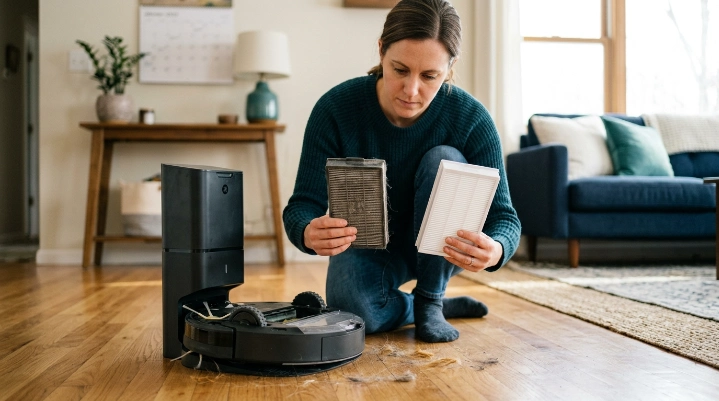
Most owners should think in terms of a model-specific schedule rather than one fixed number. Based on current manufacturer examples in 2026, replacement intervals commonly fall somewhere between about two and six months.
That range is only a starting point. Usage, filter design, pets, dust levels, and the manufacturer’s instructions can move your replacement date earlier.
Definition: A robot vacuum filter is a removable filtration component positioned in the machine’s airflow path. It helps capture particles carried into the dustbin before outgoing air leaves the vacuum.
Why replacement schedules vary
Robot vacuums don’t all use the same filter design. Some filters must remain dry, while other models use washable filters that can be rinsed and reused for a limited period.
Manufacturers also update their products. A replacement schedule that applies to an older robot may not apply to the latest version from the same company.
- Filter material: Pleated, foam, mesh, and multilayer designs can require different care.
- Robot design: Airflow paths and dustbin capacities vary between machines.
- Cleaning frequency: A robot running daily processes more debris than one used twice weekly.
- Household conditions: Pets, carpet, tracked-in soil, and renovation dust can increase filter loading.
- Maintenance habits: Regular approved cleaning may prevent premature clogging.
Real manufacturer replacement examples
The table below shows why I don’t recommend one universal number. Even products from the same brand can follow different schedules.
| Robot or Filter | Typical Care Guidance | Replacement Guidance |
|---|---|---|
| iRobot Roomba j Series | Clean weekly; twice weekly in homes with pets | Every 2 months |
| iRobot Roomba 100/1000 Series | Clean weekly; twice weekly in homes with pets | Every 3–6 months |
| eufy RoboVac general guidance | Clean weekly; twice weekly with pets | Every 6 months or after 50 cleaning rounds |
| eufy C10/C20 washable filter | Maintenance about every 2 weeks | Every 3–6 months depending on use |
For another example of brand-specific guidance, eufy’s RoboVac maintenance schedule ties filter care and replacement to both time and usage.
I treat these schedules as limits rather than permission to ignore the filter until the final day. A quick visual check often catches excessive buildup sooner.
Section Takeaway: Robot vacuum filter replacement commonly falls within a two-to-six-month window, but your exact model’s instructions should control the schedule. Check condition as well as the calendar.
What Makes a Robot Vacuum Filter Wear Out Faster?
A filter may need replacement sooner when the robot processes more dust than expected. Heavy use can load a small filter quickly even when the robot itself still looks clean.
Several household conditions make that more likely.
- Pets: Hair, dander, litter dust, and tracked debris can increase the material entering the vacuum.
- Daily cleaning: More cleaning cycles mean more air and debris pass through the filter.
- Carpeted rooms: Carpet can hold fine dirt that becomes available each time the robot passes.
- Open windows: Outdoor dust and pollen can enter and settle on floors.
- Renovation activity: Fine construction dust can overwhelm household cleaning equipment quickly.
- Full dustbins: Allowing debris to remain packed around the filter area may interfere with normal airflow.
Do pets mean you should replace the filter twice as often?
Not automatically. However, several manufacturers recommend cleaning filters more frequently in homes with pets.
That makes regular inspection especially useful. If the filter becomes heavily loaded well before the scheduled replacement date, don’t wait simply because the calendar says you have another month.
Does a HEPA filter last longer?
No general rule says a HEPA filter lasts longer than every other filter. HEPA describes filtration performance, not a universal service life.
The U.S. Environmental Protection Agency’s HEPA guidance explains that HEPA refers to a defined type of high-efficiency particulate filtration. It doesn’t tell you whether your robot’s particular filter is washable or how often it should be replaced.
This distinction matters. A pleated filter may look like a HEPA filter without carrying a verified HEPA classification.
How Can You Tell a Robot Vacuum Filter Needs Replacing?
Replace a filter when it reaches the manufacturer’s interval or when its physical condition shows that normal maintenance is no longer enough. Damage is a stronger warning sign than ordinary surface dust.
I check the filter whenever I empty or thoroughly clean the robot. That takes seconds and makes changes easier to notice.
Warning signs worth checking
- Torn filter media: Holes or tears mean the filter can no longer remain intact as designed.
- Bent pleats: Crushed or permanently distorted material may justify replacement.
- Damaged frame: A cracked frame can prevent the filter from seating correctly.
- Worn sealing edge: Damaged seals may prevent the filter from fitting as intended.
- Deep embedded dirt: Approved cleaning no longer removes substantial buildup.
- Persistent weak pickup: Performance stays poor after the bin, brushes, airflow path, and filter have been checked.
Is low suction always caused by the filter?
No. Weak debris pickup can also come from a full bin, tangled brush, blocked intake, worn brush, or another airflow problem.
Use a simple troubleshooting order before blaming the filter.
- Empty the dustbin.
- Check the main and side brushes.
- Inspect accessible airflow openings for debris.
- Maintain the filter according to the manual.
- Replace the filter if it is damaged or due.
- Run a short test cycle.
Expert Alert: If the robot smells like burning, repeatedly overheats, shows electrical damage, or has a motor fault that remains after normal maintenance, stop using it and contact a qualified appliance repair professional or the manufacturer.
Should You Clean or Replace a Robot Vacuum Filter?
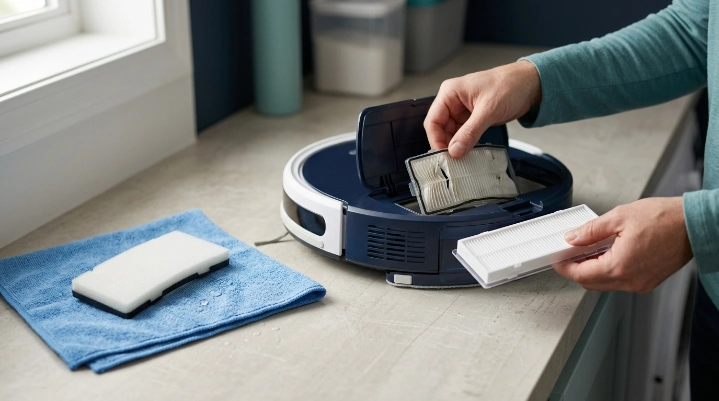
Clean the filter when its manufacturer says cleaning is allowed and the filter remains serviceable. Replace it when it reaches its stated interval, becomes damaged, or no longer responds to approved maintenance.
The important word is approved. Never assume a filter can be rinsed simply because another robot’s filter can.
Washable vs. non-washable filters
| Filter Situation | What to Do | Main Caution |
|---|---|---|
| Manufacturer labels it washable | Wash only using the stated method | Dry completely before reinstalling |
| Manufacturer says not to wash | Use the approved dry-cleaning method | Keep water away from the filter |
| Instructions are unknown | Check the manual or official support page | Don’t experiment with rinsing |
| Filter is torn or deformed | Replace it | Cleaning cannot repair damaged material |
Why filtration matters in a dusty home
A properly maintained filter is part of the vacuum’s particle-control system. It shouldn’t be treated as an optional accessory.
The CDC’s asthma-control guidance recommends regular vacuuming with HEPA-filter-equipped vacuums as one measure for managing household dust-mite exposure for people with asthma.
The Asthma and Allergy Foundation of America’s indoor-air guidance also emphasizes regular cleaning and maintaining filtration equipment as directed.
That doesn’t mean changing a robot vacuum filter will cure allergies or guarantee healthier air. It means sensible filter care supports the cleaning system’s intended function.
Section Takeaway: Clean only when the manufacturer allows it, and never use water on a filter whose instructions don’t specifically permit washing. Replacement is the right choice for damaged or end-of-life filters.
How Can You Make Robot Vacuum Filters Last Longer?
Good routine maintenance can reduce unnecessary filter loading. The goal isn’t to keep a disposable filter forever, but to prevent avoidable clogging before its normal replacement point.
A simple maintenance routine
- Empty the dustbin regularly. Don’t let debris remain packed around the filter compartment.
- Check the filter frequently. Look for buildup, tears, bent material, and damaged sealing edges.
- Clean it correctly. Follow only the method specified for your model.
- Keep brushes clear. Remove hair and thread that can interfere with normal debris pickup.
- Inspect airflow openings. Remove accessible debris without dismantling protected components.
- Dry washable filters completely. Never reinstall one while moisture remains.
- Keep a spare available. A correct replacement prevents you from running the robot without its required filter.
Keep track of replacement dates
I like writing the installation month on the replacement package or recording it in my phone. That removes the guesswork when the filter still looks reasonably clean months later.
If your app tracks cleaning hours or cycles, use that information too. Some manufacturers base maintenance guidance partly on actual use rather than calendar time alone.
Frequently Asked Questions
Can you wash a robot vacuum filter?
Only wash a robot vacuum filter when the manufacturer specifically says that filter is washable or rinseable. Some robot filters tolerate water, while others must remain dry, so filter appearance alone isn’t a reliable guide.
What happens if you never replace a robot vacuum filter?
An overdue filter can become heavily loaded with debris and restrict normal airflow. Continued use may reduce cleaning performance, while damaged filtration material should be replaced rather than repeatedly cleaned.
Should pet owners replace robot vacuum filters more often?
Possibly. Pet hair, dander, litter dust, and extra cleaning cycles can increase filter loading, and some manufacturers recommend more frequent filter cleaning in homes with pets. Inspect the filter often and follow your model’s replacement schedule.
Can I run my robot vacuum while a washable filter is drying?
Don’t operate the robot without a filter if the manufacturer requires one. Allow a washed filter to dry completely, or install a compatible dry spare before using the robot again.
Is a HEPA robot vacuum filter automatically washable?
No. HEPA describes filtration performance and doesn’t mean a filter can safely contact water. Washability depends on the materials and instructions for the specific filter supplied or approved by the robot manufacturer.
Do aftermarket robot vacuum filters last as long as original filters?
There is no reliable universal answer because third-party filter quality and fit vary. Check exact model compatibility, dimensions, sealing surfaces, material claims, and warranty requirements before replacing an original filter with another brand.
Final Takeaway
So, how often should you replace robot vacuum filters? For many current models, a practical range is roughly every two to six months, but the correct interval is the one specified for your exact robot and filter.
Check the filter regularly and replace it sooner when it is damaged or maintenance no longer restores it. That simple habit can keep your robot’s filtration and airflow system working as intended.
Make filter inspection part of your regular robot vacuum routine. A few seconds of checking today can prevent you from guessing months later.