How Often Should Pet Owners Clean Vacuum Filters?

Quick Answer
Pet owners should inspect vacuum filters about once a week and use monthly cleaning as a practical starting point for washable filters. During heavy shedding, you may need to clean them every two to four weeks, but your vacuum’s manual always comes first; for example, Dyson’s vacuum filter-care guidance recommends at least monthly washing for supported cordless filters.
A practical pet-home routine
- Check weekly: Look for hair, gray dust, dander, or packed debris on accessible filters.
- Clean monthly: Use this as a starting point only when the filter is specifically washable.
- Heavy shedding: Inspect more often and clean sooner if the filter is visibly loading up.
- Watch airflow: Reduced pickup after emptying the bin can signal a dirty filter or another blockage.
- Follow the manual: Never wash a filter unless its manufacturer approves washing.
Most important rule
- A clean-looking filter can still need maintenance, while a dirty-looking disposable filter may need replacement rather than washing.
Living with a dog or cat changes how I approach vacuum maintenance. Fur is obvious, but the finer dust mixed with pet dander is what makes regular filter checks worth remembering.
This guide explains how often to clean vacuum filters in a pet home, when to clean sooner, and when cleaning is the wrong choice.
In This Guide
- How often should pet owners clean vacuum filters?
- Why do pet homes need more frequent filter checks?
- What vacuum-filter schedule works best with pets?
- How can you tell when a filter needs cleaning sooner?
- How should pet owners clean a washable vacuum filter?
- Can pet owners wash HEPA vacuum filters?
- Frequently asked questions
How Often Should Pet Owners Clean Vacuum Filters?
For most pet homes, I recommend inspecting accessible vacuum filters weekly and treating monthly cleaning as a starting point for washable filters. Heavy shedding, frequent vacuuming, or visible filter buildup can justify earlier cleaning.
That is a maintenance routine, not a universal manufacturer interval. Your exact vacuum manual should override any general schedule.
Definition: Vacuum-filter cleaning means removing accumulated debris using the maintenance method approved for that specific filter, such as tapping, rinsing, or brushing. It does not automatically mean washing the filter with water.
As of 2026, filter-care instructions still vary widely between vacuum models. Even filters from the same brand may have different cleaning and replacement requirements.
Is once a month enough for a pet home?
Monthly cleaning can be enough when you have a lightly shedding pet and the vacuum receives moderate use. I still prefer checking the filter weekly because an inspection takes only a moment.
Some manufacturer guidance supports a monthly baseline. Dyson, for example, tells owners of supported cordless models to wash their filters at least once each month and notes that heavier dust conditions may require more frequent care.
When should you clean more often?
Increase your inspection frequency when your home generates more debris than usual. The filter condition matters more than simply reaching a date on the calendar.
- Seasonal shedding: Dogs and cats may release much more loose fur during certain periods.
- Multiple pets: More animals usually mean more hair, tracked dirt, and household cleaning.
- Daily vacuuming: A machine used every day processes far more debris than one used weekly.
- Carpeted rooms: Carpet and upholstery can hold pet hair, dander, dust, and other particles between cleaning sessions.
- Fine litter or dust: Small particles can load filtration surfaces differently from larger hair.
I treat the calendar as a reminder to inspect the machine, not permission to ignore a visibly dirty filter.
Why Do Pet Homes Need More Frequent Filter Checks?
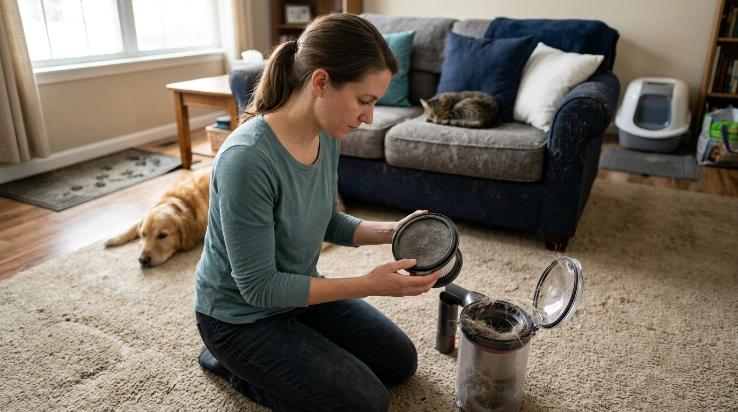
Pets add several kinds of material to household dust. Hair is easy to see, while dander and other fine particles can be much less obvious.
The EPA’s indoor particulate matter guidance identifies pet dander among the biological particles that may be found in indoor dust. It also recommends regular vacuuming as part of reducing household dust buildup.
Pet hair and pet allergens are not the same thing
Pet hair is not itself the main pet allergen. Fur can collect and transport dander, saliva proteins, pollen, dust, and other material through the home.
The National Institute of Environmental Health Sciences notes that pet allergens can remain airborne and collect on carpets and furniture.
- Hair: Often collects around brush rolls, cyclone screens, bins, and filter housings.
- Dander: Tiny skin-derived particles can mix with ordinary household dust.
- Tracked debris: Outdoor pets may bring pollen, soil, and fine particles indoors.
- Litter dust: Cat households may introduce additional fine dust near litter areas.
This is why I don’t judge filter condition only by how much fur I can see. A filter may look gray and loaded even when very little hair is attached to it.
Does frequent pet vacuuming matter?
Yes, because more vacuuming means more air and debris pass through the machine. A household cleaning daily after two shedding dogs will usually put more demand on its vacuum than a low-use home.
The Asthma and Allergy Foundation of America recommends vacuuming once or twice weekly as one measure for controlling indoor allergens. Pet households may clean even more often simply to manage visible hair.
Section Takeaway: Pet ownership does not create one mandatory filter-cleaning interval. It does make frequent inspection especially useful because hair, dander, dust, and increased vacuum use can add to the machine’s debris load.
What Vacuum-Filter Schedule Works Best With Pets?
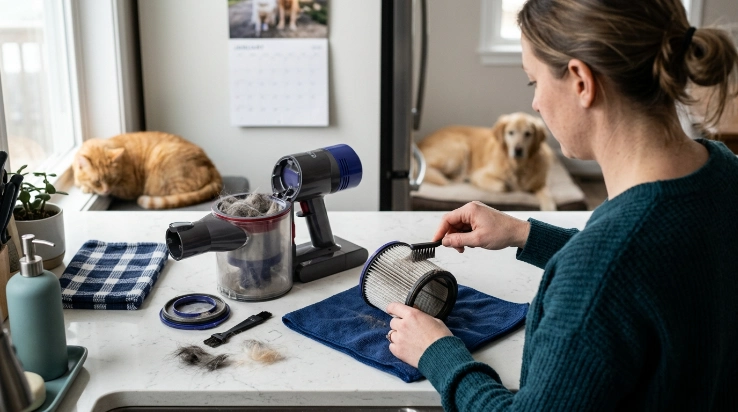
A simple schedule works better than waiting for obvious suction problems. I use the table below as a practical starting point, then adjust it to the vacuum manual and what I see on the filter.
| Pet-home situation | Inspection starting point | Washable-filter starting point | Adjustment |
|---|---|---|---|
| One lightly shedding pet | Weekly | About monthly | Clean sooner if buildup appears |
| Heavy seasonal shedding | Weekly or after fur-heavy cleaning | Often every 2-4 weeks if approved | Let filter condition guide you |
| Multiple pets | Weekly | Monthly or sooner as needed | Watch airflow and visible loading |
| Daily vacuum use | Weekly | Follow manual; inspect before interval | Higher use may justify earlier care |
| Non-washable filter | Check as manual directs | Do not wash | Replace or dry-clean only as specified |
These intervals are deliberately conservative. They are not a substitute for the service schedule printed in your manual.
One habit has helped me most: I check the filter whenever I notice that the bin is filling faster than usual. That often happens during a shedding spell, so the filter check fits naturally into the same maintenance session.
How Can You Tell When a Filter Needs Cleaning Sooner?
Don’t wait for a monthly reminder when your vacuum is already showing signs of restricted airflow or heavy filter loading. Check the whole airflow path before blaming the filter alone.
What warning signs should pet owners watch for?
- Visible buildup: The filter has a noticeable layer of gray dust, fine debris, or hair.
- Reduced pickup: Suction feels weaker after you have emptied the bin or changed the bag.
- Filter alert: Your vacuum displays a maintenance warning or filter indicator.
- Unusual pulsing: Some vacuums change motor behavior when airflow becomes restricted.
- Dusty exhaust: Check installation, seals, filter condition, and the correct filter setup.
- Persistent odor: Inspect the bin, brush roll, hose, filters, and any trapped pet debris.
A clogged hose or hair-packed brush roll can mimic a filter problem. I therefore check the bin, intake, brush roll, hose, and filter together whenever performance suddenly drops.
Should you replace instead of clean?
Replace a disposable filter according to its manufacturer schedule rather than trying to wash it. A washable filter may also need replacement if the media, frame, or sealing surface becomes damaged.
Tears, permanent deformation, crumbling foam, or a damaged seal are good reasons to stop reusing the filter. Cleaning cannot repair physical damage.
How Should Pet Owners Clean a Washable Vacuum Filter?
Clean only filters that the manufacturer identifies as washable. Water can damage filters designed for dry maintenance or replacement.
- Disconnect power. Unplug the vacuum or switch off the cordless machine before opening the filter compartment.
- Remove the filter carefully. Follow the manual so you do not damage clips, seals, or filter housings.
- Remove loose debris. Gently tap away hair and surface dust using the method approved for your filter.
- Rinse only if approved. Follow the manufacturer’s instructions for water temperature and washing technique.
- Avoid unapproved cleaners. Do not add soap or detergent unless the manufacturer specifically allows it.
- Air-dry completely. Do not reinstall a damp filter.
- Reinstall correctly. Make sure the filter sits in its proper orientation and seals as designed.
Dyson’s current guidance for supported cordless filters specifies at least 24 hours of drying with good airflow. That time should not be treated as a universal requirement for every brand.
Should you clean the filter indoors?
If tapping the filter releases a noticeable dust cloud, I prefer doing that part outdoors when practical. Vacuuming and other cleaning activity can temporarily stir settled particles back into the air.
People who have asthma or allergies may want to avoid the immediate area during dusty cleaning tasks. EPA and allergy-organization guidance also recognizes that vacuuming can disturb settled dust.
Expert Alert: If your vacuum shows electrical damage, overheating, burning smells, battery swelling, or liquid near electrical components, stop using it and contact a qualified appliance technician or the manufacturer.
Can Pet Owners Wash HEPA Vacuum Filters?
Only wash a HEPA vacuum filter when its manufacturer specifically says that exact filter is washable. The term HEPA describes filtration performance, not whether the filter can safely go under water.
The EPA’s HEPA filter explanation defines HEPA as a high-efficiency particulate air filtration standard. Washability is a separate product-design decision.
How do washable and non-washable filters differ?
- Washable foam: Often reusable, but washing instructions still vary by model.
- Washable pleated filter: Rinse only when explicitly approved.
- Washable HEPA filter: Follow the exact cleaning and drying instructions supplied with the vacuum.
- Non-washable HEPA filter: Keep it away from water and replace or maintain it as directed.
- Disposable filter: Replace it rather than attempting to extend its life by washing.
I never decide washability by looking at the filter. Two pleated filters can look nearly identical while having completely different care requirements.
Frequently Asked Questions
Should pet owners clean vacuum filters every week?
Usually, a weekly inspection is more useful than automatically washing the filter weekly. Check for visible buildup and restricted airflow, then clean a washable filter according to its manual and actual condition.
How often should I clean my vacuum filter if I have two dogs?
Start by inspecting it weekly. If both dogs shed heavily and you vacuum frequently, a washable filter may need cleaning every two to four weeks, but never exceed or ignore your manufacturer’s maintenance instructions.
Does cat litter make vacuum filters dirty faster?
Fine litter dust can add to the small particles entering a vacuum, particularly when you clean around a litter box often. Check the filter more frequently and use only vacuum attachments and filtration methods approved for your machine.
Should I wash a filter when it looks gray?
Not automatically. A gray filter may need cleaning, but first confirm whether it is washable. Non-washable filters should be maintained or replaced according to the manufacturer’s directions rather than rinsed.
Can I use my vacuum while its filter is drying?
Do not operate a household vacuum without a required filter unless the manufacturer explicitly permits that configuration. If your washable filter is drying, wait until it is completely dry and correctly reinstalled.
How often should pet owners replace vacuum filters?
There is no universal replacement interval. Some filters are reusable, while others have model-specific replacement schedules, so use the manual and replace sooner when you find tears, damaged seals, deformation, or other deterioration.
Is a HEPA vacuum better for a home with pet allergens?
HEPA filtration can help limit the escape of fine collected particles when it is part of a properly designed vacuum. Filtration is still only one part of allergen control, alongside regular cleaning and reducing exposure to allergen sources.
Final Takeaway: For pet owners, a good routine is simple: inspect filters weekly, use about monthly cleaning as a starting point for washable filters, and check more often during heavy shedding. Always let your vacuum’s official manual decide whether a filter can be washed and how often it should be serviced.
If your vacuum starts collecting less effectively, check the entire airflow path rather than waiting for the next scheduled maintenance day. A few minutes of routine care can make pet cleanup much easier to manage.