
How Do You Clean a Vacuum After Drywall Dust?

Quick Answer
To clean a vacuum after drywall dust, disconnect the power, empty the bag or bin carefully, remove the filters, and clean each filter only as its manufacturer allows. Then clean the dust container, hose, attachments, seals, and brush roll before letting washable parts dry completely. For renovation dust, an EPA-described HEPA vacuum provides better fine-particle containment than simply adding a HEPA filter to an unsuitable vacuum.
Quick Cleaning Steps
- Disconnect power: Unplug the vacuum or remove its battery before opening it.
- Empty the dust: Remove the bag or empty the bin gently, preferably where loose powder will not spread indoors.
- Inspect filters: Clean washable filters as directed and replace disposable or damaged filters when required.
- Clean the airflow path: Check the hose, wand, inlet, attachments, and brush area for packed drywall powder.
- Wipe the housing: Use a slightly damp cloth on safe exterior surfaces without getting moisture into the motor.
- Dry and test: Reassemble only when every washable part is completely dry, then check the exhaust and suction.
Stop Using the Vacuum If
- Dust blows from the exhaust: The filter, seal, bag, or airflow system may not be containing the fine powder.
- Suction stays weak: A filter, hose, inlet, or internal airflow path may still be clogged.
- The motor sounds strained: Stop rather than continuing to run the machine with restricted airflow.
Drywall dust can make a vacuum look clean on the outside while leaving fine powder throughout its filtration and airflow system. I’ve found that the filter and seals deserve more attention than the dust bin itself.
This guide covers how I clean a vacuum after drywall sanding or renovation dust, what I keep dry, and when I stop cleaning and replace a filter instead.
In This Guide
Why Is Drywall Dust Hard on a Vacuum?
Drywall dust is a fine powder created when drywall, joint compound, or similar finishing materials are cut or sanded. Fine particles can load a vacuum filter much faster than ordinary crumbs, hair, or household debris.
The powder also reaches places that larger dirt often misses. It can settle inside pleated filters, hose bends, seals, attachment joints, and the dust-bin cyclone area.
The National Institute for Occupational Safety and Health has documented substantial dust generation during drywall sanding. NIOSH also found large reductions in measured exposure when vacuum-assisted sanding controls captured dust near its source.
- Fine filters load quickly: A layer of powder can restrict airflow even when the bin is not full.
- Loose dust travels easily: Aggressive emptying or brushing can send settled powder back into the room.
- Seals matter: Fine dust can escape through gaps when bags, filters, lids, or gaskets are fitted incorrectly.
- Motor protection matters: Pre-motor filters help prevent collected debris from reaching sensitive internal components.
HEPA vacuum vs. ordinary vacuum for renovation dust
HEPA means high-efficiency particulate air. EPA defines a HEPA filter as one capable of capturing at least 99.97% of particles at 0.3 microns under the applicable definition.
| Vacuum Setup | Fine-Dust Control | Key Detail | After Drywall Dust |
|---|---|---|---|
| Purpose-designed HEPA vacuum | Designed for high-efficiency filtration when properly operated | EPA’s HEPA definition uses 99.97% efficiency at 0.3 microns | Service filters, bag or bin, hose, and seals as directed |
| Shop or wet/dry vacuum with basic filter | Varies by filter and machine design | Adding a HEPA-labelled filter alone does not prove the machine is sealed as a HEPA vacuum | Inspect filter loading and clean the tank and airflow path |
| Regular household vacuum | Model-dependent | Manufacturer instructions decide whether fine construction dust is appropriate | Inspect carefully for clogged filters and dusty exhaust |
Section Takeaway: Drywall dust is harder on a vacuum because fine powder can load filters and enter small airflow passages quickly. Filtration, sealing, and correct maintenance matter more than the vacuum’s appearance.
How Do You Clean a Vacuum After Drywall Dust Step by Step?
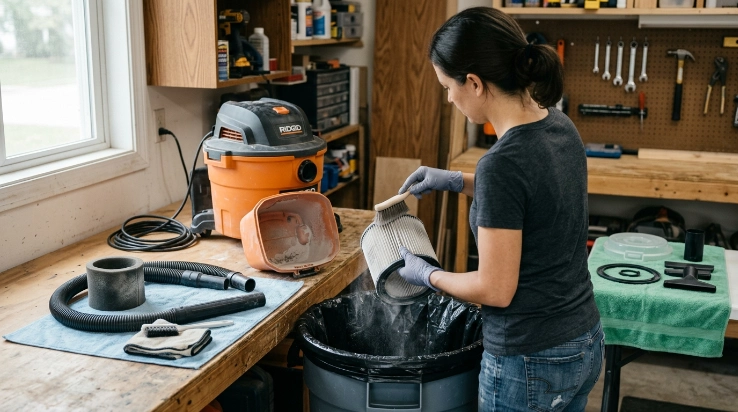
Start by stopping the dust from spreading again. Don’t immediately shake the filter, blast the machine with compressed air, or dump a powder-filled bin beside clean furniture.
As of 2026, my routine is still simple: work from the dirtiest removable parts toward the cleaner housing. I keep water away from anything electrical unless the manufacturer’s instructions specifically allow washing.
1. Disconnect the vacuum completely
Unplug a corded vacuum before opening it. For a cordless machine, switch it off and remove the battery when the design allows.
This prevents accidental startup while your fingers are near the brush roll, inlet, or filter compartment.
2. Move to a controlled cleaning area
If practical, service the dusty vacuum in a garage, utility area, or another location where a small amount of loose powder is easier to contain. Avoid working beside an HVAC return or a running fan.
The EPA’s indoor particulate matter guidance notes that cleaning and vacuuming can stir settled dust back into indoor air. Gentle handling helps limit that problem.
3. Remove the bag or empty the dust bin
For a bagged vacuum, remove the bag according to the manual and avoid squeezing it. Replace disposable bags rather than trying to empty and reuse them.
For a bagless vacuum, lower the bin into or close to the trash container before opening it. This reduces the distance loose powder can fall.
4. Remove and inspect every accessible filter
Some vacuums contain more than one filter. Look for pre-motor foam, felt, cartridge, pleated, and post-motor or HEPA filters.
- Check for a heavy white or gray coating.
- Look for tears, distorted pleats, or damaged seals.
- Confirm whether each filter is washable.
- Replace filters that the manual says are disposable.
- Never assume a HEPA filter can be rinsed.
5. Clear the main airflow path
Disconnect the hose and wand when your model permits it. Look through each section for packed powder, drywall fragments, or another blockage.
Use a soft brush or another manufacturer-approved method for dry debris. Don’t push a hard object through a flexible hose if it could puncture the wall.
6. Clean the dust container and removable parts
Wipe fine residue from the bin or tank before washing anything. If the manual permits washing, use the recommended method and keep electrical connections dry.
Let washed components air-dry completely. Moisture trapped behind a filter or inside a powered housing is a problem you don’t want to create.
7. Wipe seals and mating surfaces
Fine drywall dust often collects around lid edges, filter seats, O-rings, and bin seals. A clean seal helps the vacuum maintain its intended airflow path.
Use a clean cloth to remove the powder gently. Inspect seals for cracks or obvious deformation while you’re there.
8. Reassemble and perform a short test
Install every filter in its correct position before switching the vacuum on. Make sure the bin, tank, bag compartment, hose, and covers lock fully into place.
Run the machine briefly and watch for dusty exhaust, weak suction, unusual heat, or a changed motor sound. Stop if something seems wrong.
Section Takeaway: Clean a drywall-dust vacuum in stages—power off, empty, inspect filters, clear the airflow path, clean approved washable parts, dry completely, and test cautiously.
How Should You Clean the Vacuum Filter?
The safest filter-cleaning rule is easy: follow the instructions for that exact filter. A filter’s shape, color, or HEPA label does not tell you whether water is safe.
Washable filters
If the manufacturer identifies the filter as washable, remove loose surface dust before rinsing it by the approved method. Don’t add detergent unless the instructions permit it.
- Remove loose powder: Handle the filter gently so you don’t damage foam or pleats.
- Rinse only if approved: Follow the specified water direction and temperature.
- Avoid aggressive scrubbing: Don’t crush pleats or tear foam.
- Air-dry completely: Reinstall only after no moisture remains.
Non-washable or disposable filters
Keep a non-washable filter away from the sink. Follow the manual’s dry-cleaning or replacement instructions instead.
Drywall powder can become deeply embedded in pleated media. If cleaning no longer restores the condition required by the manufacturer, replacement is usually the more sensible option.
What about a HEPA filter?
A HEPA filter can be washable or non-washable depending on its construction. HEPA describes filtration performance, not a universal cleaning method.
Don’t blast a HEPA filter with high-pressure compressed air unless its manufacturer specifically approves that process. The force can damage delicate filter media or spread captured powder.
Section Takeaway: Never wash a vacuum filter just because it looks washable. The model-specific manual decides whether you rinse, dry-clean, or replace it.
How Do You Clean the Hose, Bin, and Attachments?
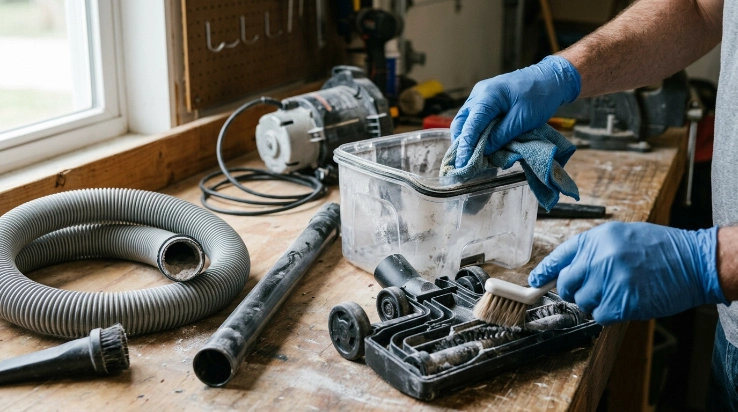
Once the filters are handled, move through the rest of the dust path. Drywall powder tends to collect anywhere airflow slows or changes direction.
Dust bin or wet/dry tank
Remove loose powder first. If the tank or bin is manufacturer-approved for washing, clean it separately from the motor assembly.
Pay attention to corners and cyclone passages that you can safely access. Never pour water into a powered vacuum body to rinse hidden dust away.
Vacuum hose and wand
Disconnect both ends and inspect them under good light. A white coating is normal after heavy drywall cleanup, but a solid plug needs to be removed.
Some non-electrical hoses can be washed, while others shouldn’t be. Follow the manual and let any washable hose drain and dry fully before reconnecting it.
Floor heads and brush rolls
Drywall dust can cake around brush-roll ends, wheels, suction channels, and height-adjustment mechanisms. Remove hair and larger debris before wiping the remaining powder.
Motorized floor heads need more caution. Don’t immerse them or flood electrical contacts.
Exterior housing and exhaust area
Use a dry or slightly damp microfiber cloth for safe exterior surfaces. Keep liquid away from switches, vents, charging contacts, motor openings, and electrical connectors.
The EPA also recommends HEPA vacuuming and wet cleaning as part of controlling renovation dust in appropriate work areas. Its safe renovation and repair guidance emphasizes thorough dust removal rather than simply moving dust from one surface to another.
Expert Alert: If drywall dust has entered the motor, electrical compartment, battery housing, or wiring, stop disassembling the vacuum unless the manufacturer provides a user-service procedure. A qualified appliance technician is the safer choice for internal electrical work.
Section Takeaway: Clean every removable part that drywall dust traveled through, but separate washable components from electrical ones. Never use water as a shortcut for cleaning the powered housing.
How Do You Know the Vacuum Is Safe to Use Again?
A clean-looking vacuum isn’t enough. Check airflow, filtration, and reassembly before returning it to normal household cleaning.
- Filters are installed: Every required pre-motor and exhaust filter is back in its correct position.
- Washable parts are dry: No filter, tank, hose, or bin is still damp.
- Seals are clean: Lids, bags, gaskets, and filter seats close properly.
- Suction feels normal: Airflow should not remain unusually weak after maintenance.
- Exhaust looks clean: Stop if you see a visible plume of drywall powder.
- Motor sounds normal: Grinding, straining, surging, or a new high-pitched sound deserves investigation.
Do a short test before vacuuming the whole house
Run the vacuum briefly in an easy-to-clean area. Check the hose connections, bin, filter cover, and exhaust while it operates.
I prefer this short test because it catches a badly seated filter before I carry residual drywall dust into bedrooms or upholstery.
Clean the room after servicing the vacuum
Any powder released while emptying or servicing should be cleaned as well. Use controlled vacuuming with suitable filtration followed by damp wiping on compatible hard surfaces.
Avoid dry sweeping fine renovation dust around the room. The goal is to capture settled dust without repeatedly throwing it back into the air.
Can Drywall Dust Damage a Vacuum?
Yes, heavy drywall dust can contribute to vacuum problems, especially when the machine is not designed for fine construction debris. The most immediate issue is usually restricted airflow from a heavily loaded filter.
What happens next depends on the vacuum design. That’s why the manufacturer’s limits matter more than a blanket rule about all household vacuums.
Warning signs after drywall cleanup
- Persistent weak suction: Check filters, hose bends, inlets, and the bag or bin.
- Visible dusty exhaust: Stop and inspect filtration, seals, and filter installation.
- Repeated overheating: Restricted airflow or another fault may require service.
- Unusual motor noise: Don’t keep running the machine hoping the sound will disappear.
- Damaged filter media: Replace the filter according to the manufacturer’s instructions.
How can you avoid the problem next time?
Capture drywall dust close to where it is generated whenever possible. NIOSH research on vacuum-assisted drywall sanding systems found measured dust-exposure reductions of 80% to 97% compared with conventional nonventilated sanding in the tested systems.
Containment also makes final cleaning easier. Fewer particles reach furniture, HVAC openings, floors, and the vacuum’s filters.
- Use a vacuum designed for the intended renovation dust.
- Use the correct filter and collection bag when required.
- Check the filter before suction noticeably drops.
- Empty collected powder carefully.
- Keep doors and nearby HVAC openings managed during dusty work.
- Finish compatible hard surfaces with damp cleaning.
Expert Alert: Renovation dust can involve more than drywall. If work disturbs suspected lead-based paint, asbestos-containing material, or another hazardous building material, don’t treat it as ordinary household dust cleanup. Follow the applicable professional and regulatory guidance.
Section Takeaway: Drywall dust doesn’t automatically destroy a vacuum, but large amounts can overwhelm unsuitable filtration and restrict airflow. Use the right machine, maintain it early, and stop if dust escapes or the motor behaves abnormally.
Frequently Asked Questions
Can you wash drywall dust out of a vacuum?
You can wash only vacuum parts that the manufacturer identifies as washable. A removable plastic tank may tolerate washing while a motor housing, electrical floor head, or non-washable filter must stay dry.
Should I wash a vacuum filter after drywall dust?
Wash the filter only if the manufacturer specifically says it is washable. If it’s disposable or non-washable, follow the approved dry-cleaning or replacement method instead.
Can drywall dust ruin a HEPA filter?
Heavy drywall dust can load a HEPA filter and restrict airflow. Whether the filter can be cleaned or must be replaced depends on the vacuum and filter manufacturer’s maintenance instructions.
Why is my vacuum blowing drywall dust back out?
Stop the vacuum if you see a dust plume. Possible causes include an overloaded or damaged filter, an incorrectly installed filter, a leaking bag, a poorly seated bin, or another gap in the intended airflow path.
Can I use compressed air to clean drywall dust from my vacuum?
Avoid blasting filters or the vacuum’s interior with compressed air unless the manufacturer specifically approves it. High-pressure air can spread fine powder and may damage some filter media.
How long should vacuum parts dry after washing?
Let every washable component dry completely before reassembly. Drying time varies with the material, design, temperature, humidity, and manufacturer instructions, so don’t rely on one universal number.
Should I use my regular home vacuum for drywall dust again?
Use it for drywall dust only if the manufacturer allows that type of debris and the filtration system is suitable. For substantial renovation cleanup, a purpose-designed HEPA vacuum or appropriately configured dust extractor is the better approach.
Final Takeaway: After vacuuming drywall dust, don’t stop at emptying the bin. Clean the filters, dust container, hose, attachments, seals, and accessible airflow path using the maintenance method approved for each part.
If the vacuum still blows dust, overheats, sounds strained, or has powder inside electrical components after cleaning, stop using it and have the machine inspected before returning it to normal household service.
“`
