
How Do You Clean a Vacuum After Ash?

Quick Answer
To clean a vacuum after ash, switch it off, disconnect the power, and move it to a well-ventilated cleanup area. Empty the ash carefully, service the filter according to its manual, clean only washable parts, and let everything dry completely before reassembly. If you collected wildfire or burned-structure ash, follow EPA ash-cleanup guidance because that material can require extra exposure precautions.
Quick cleaning steps
- Disconnect power: Unplug the vacuum or remove its battery before opening it.
- Move carefully: Take the vacuum to an appropriate outdoor or ventilated cleanup area when possible.
- Empty the ash: Open the collection chamber slowly so fine particles do not billow into the air.
- Check the filter: Wash it only when the manufacturer specifically says that exact filter is washable.
- Clean approved parts: Wipe or wash the bin, tank, hose, and tools only as your manual allows.
- Dry completely: Never reinstall a damp filter or wet component near the vacuum motor.
Ash leaves a vacuum dirtier than ordinary household dust because its particles can be extremely fine. I treat an ash-contaminated vacuum as a filtration and airflow problem, not just an empty-the-bin job.
The right cleaning method also depends on what you vacuumed. Cold fireplace ash in an approved ash vacuum is very different from wildfire ash collected accidentally with a household vacuum.
In This Guide
- What Should You Do Immediately After Vacuuming Ash?
- How Do You Clean a Vacuum After Ash Step by Step?
- Which Vacuum Parts Can You Wash After Ash?
- What If You Used a Regular Vacuum for Ash by Mistake?
- How Do You Know if Ash Reached the Vacuum Motor?
- Frequently Asked Questions
- What Is the Safest Takeaway?
What Should You Do Immediately After Vacuuming Ash?
Stop using the vacuum once the ash cleanup is finished. Do not continue vacuuming normal floors with an ash-loaded filter or collection chamber.
Ash can quickly load filtration media and restrict airflow. Fine particles can also escape if a filter, seal, bag, or collection system is not designed for the material.
Definition: Ash contamination in a vacuum means fine combustion residue has entered the collection chamber, filter, hose, attachments, or other parts of the machine’s airflow path.
Make sure the ash was completely cold
If the material came from a fireplace, wood stove, pellet appliance, or grill, hidden heat is the first concern. Do not open or empty equipment around combustible materials if you suspect an ember was collected.
- No visible glow: There should be no glowing coals or embers.
- No smoke: Stop if collected material is smoking or smoldering.
- No noticeable heat: Treat suspiciously warm equipment cautiously.
- Use the correct container: Follow fireplace and local disposal guidance for cooled ash.
Know what kind of ash you collected
Ordinary clean-wood fireplace ash and post-fire structural ash should not be treated as the same material. Burned buildings can leave ash containing residues from paints, plastics, treated materials, chemicals, and other products.
The CDC’s wildfire cleanup guidance advises avoiding actions that put ash back into the air. It also notes that common shop and household vacuums may not adequately contain small ash particles.
Expert Alert: If the vacuum contains wildfire ash, burned-building debris, asbestos-suspect material, lead dust, or unknown fire residue, don’t perform an aggressive DIY deep clean. Follow local cleanup guidance or use a qualified remediation professional.
Section Takeaway: Identify the ash before you dismantle the vacuum. Cold fireplace ash is mainly a fine-dust maintenance problem, while structural fire ash can involve additional hazards.
How Do You Clean a Vacuum After Ash Step by Step?
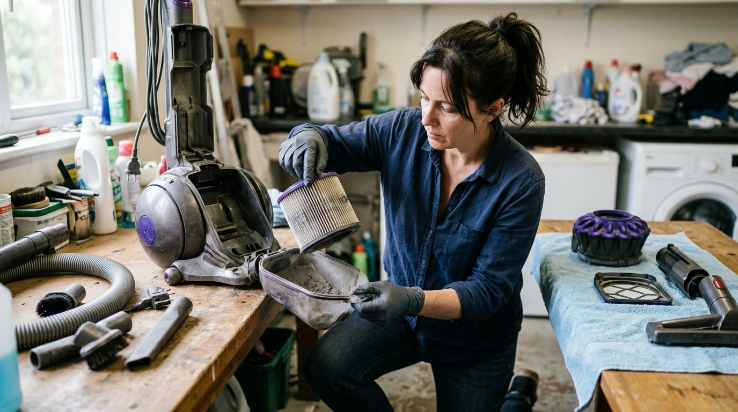
Start with the collection system and work toward the motor. This keeps you from pushing loose ash deeper into the machine while cleaning it.
1. Turn off and disconnect the vacuum
Unplug a corded machine before opening any cover, tank, or filter compartment. For cordless models, remove the battery when the manufacturer’s instructions allow it.
Never clean powered components with the vacuum connected to electricity.
2. Move to a suitable cleanup location
Fine ash can form a visible cloud when a bin or filter is disturbed. I prefer opening a dirty collection chamber away from carpets, bedding, furniture, and HVAC return vents.
Avoid windy conditions that could blow the ash back toward you or nearby property.
3. Empty the collection chamber slowly
Open the tank, bag compartment, or dust bin gently. Do not shake it aggressively just to make the ash fall faster.
- Ash vacuum: Follow its specific canister-emptying procedure.
- Bagged vacuum: Remove the contaminated bag carefully and replace it when required.
- Bagless vacuum: Empty the bin without banging it against the trash container.
- Wet/dry vacuum: Follow the filter and tank instructions for the exact model.
4. Remove the filter without creating a dust cloud
Fine ash often accumulates heavily on filter media. Lift the filter out slowly rather than slapping, shaking, or blowing it clean.
Never use compressed air indoors to blast ash from a filter. That simply turns trapped material back into airborne dust.
5. Clean or replace the filter correctly
Check the filter label or owner’s manual before using water. A pleated filter, foam filter, pre-motor filter, and HEPA filter can all have different maintenance rules.
The Consumer Reports filter-maintenance guidance also recommends checking the owner’s manual because vacuum filters differ in how often they need cleaning or replacement.
- Washable filter: Rinse only by the approved method.
- Non-washable filter: Keep it dry and replace or service it as directed.
- Damaged filter: Replace filters with tears, broken seals, deformation, or other visible damage.
- Heavily ash-loaded filter: Replacement may be more practical when approved cleaning cannot restore it.
6. Clean the bin, tank, hose, and attachments
Wipe accessible surfaces first to remove loose ash. Wash only components that the manufacturer says can safely contact water.
For an approved washable tank or plastic bin, use the cleaning method in the manual. Avoid getting water into powered brush heads, electrical connectors, motors, charging contacts, or electronic controls.
7. Dry everything fully
Air-dry every washed component before reassembly. A filter that feels damp inside its pleats is not ready to go back into the vacuum.
Some vacuum manufacturers specify drying periods around 24 hours for certain washable filters. Follow the time listed for your exact model rather than using one universal drying rule.
Section Takeaway: Work from the dirty collection area toward the filtration system, and never improvise with water. The owner’s manual decides which parts can be washed.
Which Vacuum Parts Can You Wash After Ash?
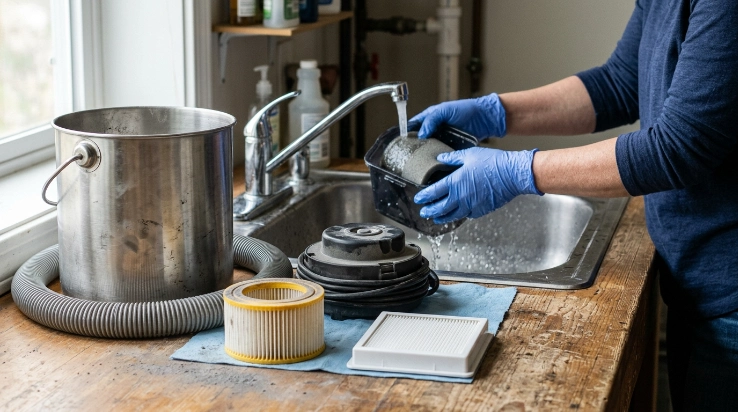
Washability depends on the component, not simply on whether the vacuum is called an ash vacuum, shop vacuum, or household vacuum. Even machines with washable tanks may use filters that must remain dry.
| Vacuum Part | Typical Ash Cleanup | Wash With Water? | Key Rule |
|---|---|---|---|
| Metal ash-vacuum canister | Empty and wipe out residue | Only if manufacturer permits | Keep motor head and electrical areas dry |
| Plastic dust bin | Empty and wipe thoroughly | Often model-dependent | Dry completely before reinstalling |
| Washable foam filter | Remove ash gently, then rinse as directed | Yes, when labeled washable | Never reinstall damp |
| Pleated cartridge filter | Service or replace according to manual | Only if explicitly approved | Do not assume pleated media is washable |
| HEPA filter | Clean or replace by model instructions | Varies by design | HEPA does not mean washable |
| Motor housing | External wiping only for normal user care | No | Internal contamination may need professional service |
What does HEPA mean here?
HEPA stands for high-efficiency particulate air. The EPA’s HEPA definition describes a pleated mechanical filter capable, under the defined standard, of theoretically capturing at least 99.97% of particles measuring 0.3 microns.
That performance definition does not tell you whether a particular vacuum filter can be washed. The manufacturer still decides the approved cleaning method.
This distinction matters after ash pickup. A filter can look physically intact while still being overloaded with fine residue.
What If You Used a Regular Vacuum for Ash by Mistake?
If you accidentally used a regular vacuum for ash, stop using it and inspect it before cleaning anything else. Do not assume emptying the bin makes the machine ready for normal household use.
First, determine whether the ash was cold
If there is any chance hot material entered the vacuum, move away from combustible surroundings only if you can do so safely. Smoke, heat, melting plastic, or a burning odor requires immediate caution.
Do not open a smoking vacuum indoors to investigate it.
Then inspect the filtration system
A regular upright, canister, stick, or robot vacuum may not be designed for fireplace ash. Fine material can load the pre-motor filter, exhaust filter, bag, seals, and cyclone passages.
- Replace disposable bags: Do not try to shake fine ash out for reuse.
- Inspect pre-motor filters: Replace or clean only as directed.
- Inspect exhaust filters: Look for heavy gray loading or damaged seals.
- Check the bin seals: Fine ash around sealing surfaces can create leakage.
- Check the hose: Ash residue may remain in bends and corrugations.
Do not assume adding a HEPA filter fixes the problem
A HEPA filter works best as part of a vacuum designed so collected air passes through the intended filtration path. Simply installing a high-efficiency filter does not automatically make an ordinary machine suitable for ash.
As of 2026, my practical rule is simple: use equipment for the debris it was designed to collect. Specialized fine dust deserves specialized handling.
Expert Alert: If a normal household vacuum now produces smoke, electrical smells, repeated overheating, sparks, or abnormal motor noise after ash pickup, stop using it. Have a qualified appliance technician inspect the machine.
How Do You Know if Ash Reached the Vacuum Motor?
You usually cannot confirm internal motor contamination without opening areas that manufacturers do not consider user-serviceable. However, several warning signs suggest you should stop routine DIY cleaning.
- Dusty exhaust: A visible gray plume from the exhaust can indicate filtration or sealing problems.
- Burning smell: Stop the vacuum if you notice a new electrical or hot-dust odor.
- Changed motor pitch: A strained, unusually high, or rough sound deserves investigation.
- Rapid overheating: Restricted airflow or internal contamination may be involved.
- Repeated shutdowns: Thermal protection can activate when a vacuum gets too hot.
- Ash past the pre-motor filter: Visible residue downstream of the intended filter barrier is a warning sign.
Should you open the motor housing?
For most homeowners, no. Opening a motor housing can expose wiring, capacitors, electronics, bearings, and components that are not designed for routine cleaning.
Instead, clean only the user-serviceable areas listed in the manual. If ash has passed those barriers, professional service is the safer next step.
Can you blow the motor clean with compressed air?
I would not use compressed air as a shortcut. It can drive fine ash farther into bearings, electrical components, cooling passages, or the surrounding air.
A vacuum that needs internal motor cleaning has moved beyond ordinary bin-and-filter maintenance.
Section Takeaway: Visible ash beyond the normal filtration path, unusual heat, odors, or motor sounds are reasons to stop. Internal electrical or motor cleaning is a repair job, not routine vacuum maintenance.
Frequently Asked Questions
Can I wash my vacuum filter after vacuuming ash?
Only if the manufacturer specifically says that exact filter is washable. HEPA, pleated, foam, felt, and cartridge filters have different care requirements, so never rinse one based on appearance alone.
Can I use a regular household vacuum for fireplace ash?
A regular household vacuum is generally a poor choice for fireplace ash. Fine ash can overwhelm ordinary filtration, while hidden embers create another risk, so use equipment specifically approved for cold ash collection.
How do I get ash smell out of a vacuum?
Start by emptying the collection chamber and servicing contaminated filters. Wipe or wash approved bins, hoses, and attachments, then let everything dry completely; if odor remains after proper maintenance, inspect the filter and airflow path for trapped residue.
Should I replace a vacuum filter after ash?
Replace it when the filter is disposable, damaged, permanently loaded, or cannot be restored using its approved maintenance method. If the manual provides a cleaning procedure, follow that before deciding whether replacement is necessary.
Can I rinse an ash-vacuum hose?
Only when the ash-vacuum manufacturer says the hose can be washed. Some hoses or attachments may contain conductive materials, liners, connections, or other components that need a specific cleaning method.
What should I do if wildfire ash entered my vacuum?
Avoid opening and shaking the vacuum indoors. Wildfire and structural ash can contain hazardous residues, so follow EPA, CDC, and local cleanup guidance and consider professional help when contamination is significant or the material is unknown.
Can I use the vacuum immediately after washing the filter?
No. A washable filter should be completely dry before reinstallation, and you should follow any minimum drying time specified by the manufacturer.
What Is the Safest Takeaway?
Cleaning a vacuum after ash starts with controlling the dust rather than spreading it. Disconnect power, empty the machine carefully, maintain its filtration system, and wash only components approved for water cleaning.
If you used a dedicated ash vacuum for completely cold fireplace ash, normal manufacturer-approved maintenance may be all you need. A household vacuum accidentally exposed to fine ash deserves a closer filter and airflow inspection.
Do not ignore ash beyond the pre-motor filter, dusty exhaust, abnormal heat, burning smells, or unusual motor sounds. Those signs can mean the problem has moved beyond routine homeowner maintenance.
Final takeaway: Clean the collection system first, protect the filtration path, and keep water out of the motor. When ash reaches electrical or non-serviceable components, stop DIY cleaning and get the vacuum inspected.
