Can You Store a Vacuum in the Garage?

Quick Answer
Yes, you can store a vacuum in the garage if the space stays dry, reasonably temperature-stable, and protected from leaks, pests, dust, and physical damage. I would avoid garage storage when condensation or high humidity is common, especially for cordless vacuums with lithium-ion batteries. The EPA’s indoor air guidance also emphasizes moisture control as an important part of keeping indoor spaces dry.
A garage is suitable when:
- It stays dry: There are no roof leaks, wet floors, regular condensation, or damp storage corners.
- Temperatures stay reasonable: The vacuum is not exposed to severe summer heat or freezing conditions beyond its manufacturer’s limits.
- The vacuum is clean: The bin is emptied and washable parts are completely dry before storage.
- It is protected: Tools, boxes, vehicles, and stored items cannot fall onto or crush the machine.
- The battery is protected: Cordless-vacuum storage and charging temperatures remain within the manufacturer’s instructions.
My simple rule
- If the garage sometimes feels damp, develops condensation, or becomes extremely hot, I choose an indoor closet instead.
A garage can seem like the perfect place for a bulky vacuum. It keeps the machine out of your living space and close to the dirt that enters through the garage door.
I still treat garage vacuum storage as conditional. The question is not just whether the vacuum physically fits there, but whether the environment protects the motor, filters, hose, electrical parts, and battery.
In This Guide
- Is It Safe to Store a Vacuum in the Garage?
- What Garage Conditions Can Damage a Vacuum?
- How Do You Know If Your Garage Is Suitable?
- How Should You Prepare a Vacuum for Garage Storage?
- Can You Store a Cordless Vacuum and Battery in the Garage?
- Garage vs. Closet vs. Basement: Which Is Better?
- Frequently Asked Questions
Is It Safe to Store a Vacuum in the Garage?
Yes, garage storage can be safe for a vacuum when the garage remains clean, dry, protected, and within the appliance manufacturer’s permitted storage conditions. A conditioned attached garage may be much safer than an uninsulated detached garage.
Garage vacuum storage means keeping a household vacuum in a garage between uses while protecting it from moisture, temperature extremes, dirt, pests, and accidental damage.
A dry garage is the starting point
Moisture is the first thing I check. I would not store a household vacuum beside a leaking wall, damp concrete corner, frequently wet garage door, or area where condensation forms.
Electrical appliances and lingering dampness are a poor combination. Moisture can also create conditions that support mold growth on nearby porous materials.
- Good sign: The floor and walls stay dry after rain.
- Good sign: You do not see regular condensation on stored items.
- Warning sign: Cardboard boxes feel soft or damp.
- Warning sign: The garage smells persistently musty.
- Warning sign: Water enters beneath the garage door.
The CDC explains that excess moisture is a major factor in indoor mold growth. That makes persistent garage dampness worth fixing even if you decide to move the vacuum elsewhere.
The vacuum type matters too
A basic corded shop vacuum is often more at home in a garage than a premium cordless stick vacuum. That does not mean every shop vacuum can tolerate any temperature or moisture level.
Household uprights, canisters, robot vacuums, and cordless sticks usually contain more parts that I would rather protect from harsh storage conditions.
- Upright vacuum: Protect the brush roll, cord, hose, and filters.
- Canister vacuum: Avoid crushing or sharply bending the flexible hose.
- Cordless stick vacuum: Pay special attention to battery storage and charging limits.
- Robot vacuum: An indoor charging location is usually the more practical choice.
- Wet/dry vacuum: Empty collected liquid and dry the tank before storage.
Section Takeaway: A garage can work, but dryness and manufacturer storage limits matter more than convenience.
What Garage Conditions Can Damage a Vacuum?
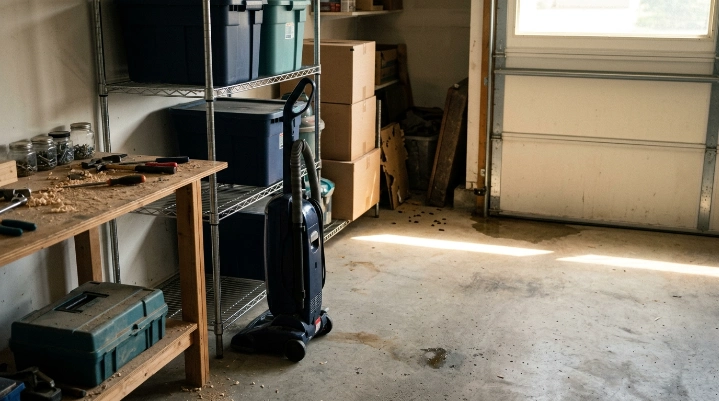
The biggest concerns are moisture, extreme temperatures, dust, pests, chemicals, and physical damage. I check these conditions before deciding whether a garage deserves to become the vacuum’s permanent home.
Humidity and condensation
High humidity does not automatically destroy a vacuum. Persistent dampness, condensation, and water exposure are much more concerning.
EPA household guidance recommends keeping relative humidity around 30% to 50% where practical. That range is also useful when I evaluate whether a storage area feels excessively damp.
- Use an inexpensive digital humidity meter if dampness is uncertain.
- Check the garage during the wettest part of the year.
- Look behind shelving for hidden condensation or staining.
- Fix leaks instead of relying only on a storage cover.
The Asthma and Allergy Foundation of America is also a useful resource for understanding common household allergens such as mold and dust mites.
Summer heat
Closed garages can become much hotter than nearby indoor rooms. Heat becomes especially important when a vacuum contains a rechargeable battery.
I never assume one universal safe temperature. Battery chemistry, charging systems, and manufacturer limits differ between models.
Cold and freezing conditions
An unheated garage can become extremely cold in winter. Cold temperatures can temporarily affect cordless battery performance and may fall outside a manufacturer’s charging range.
Another concern is condensation after moving a cold appliance into warmer, humid air. Give the vacuum time to acclimate before powering or charging it if condensation is possible.
Dust, sawdust, and workshop debris
A garage used for woodworking or DIY projects may coat stored appliances with fine dust. A loose breathable cover can help keep settled debris off a clean vacuum.
Do not tightly seal a damp vacuum inside plastic. Any washable component should be completely dry first.
Pests and physical damage
Garages also contain hazards you rarely find in a cleaning closet. Rodents, insects, stacked boxes, garden tools, bicycles, and moving vehicles can all damage an exposed vacuum.
- Keep cords off areas where pests are active.
- Do not place heavy boxes above the vacuum.
- Protect hoses from being pinched by shelving.
- Keep the machine away from vehicle paths.
- Store attachments together so they do not get stepped on.
Section Takeaway: Moisture is the first risk to rule out, but heat, cold, dust, pests, and impact damage also affect whether garage storage makes sense.
How Do You Know If Your Garage Is Suitable?
I use a simple five-point check. If a garage fails several of these checks, an indoor closet or utility room is usually the easier choice.
| Check | Good Storage Condition | Warning Sign |
|---|---|---|
| Moisture | Dry walls and floor | Leaks, condensation, musty odor |
| Temperature | Within manufacturer limits | Severe seasonal heat or freezing |
| Dust | Normal household-level dust | Heavy workshop or renovation dust |
| Protection | Dedicated shelf or floor space | Falling tools, traffic, unstable boxes |
| Pests | No signs of activity | Droppings, gnaw marks, nesting |
Check the garage during bad weather
A garage may look perfect during a mild, dry week. I would rather judge it after heavy rain, during peak summer heat, and during the coldest part of winter.
Seasonal checks reveal problems that a one-time inspection misses.
- Look for water beneath doors after rain.
- Check walls and shelving for condensation.
- Watch for rust forming on nearby metal tools.
- Notice whether cardboard becomes damp.
- Compare conditions with your vacuum manual.
Expert Alert: Persistent water intrusion, widespread mold, damaged wiring, or serious structural dampness should be assessed by an appropriate qualified professional instead of treated as a simple vacuum-storage problem.
How Should You Prepare a Vacuum for Garage Storage?
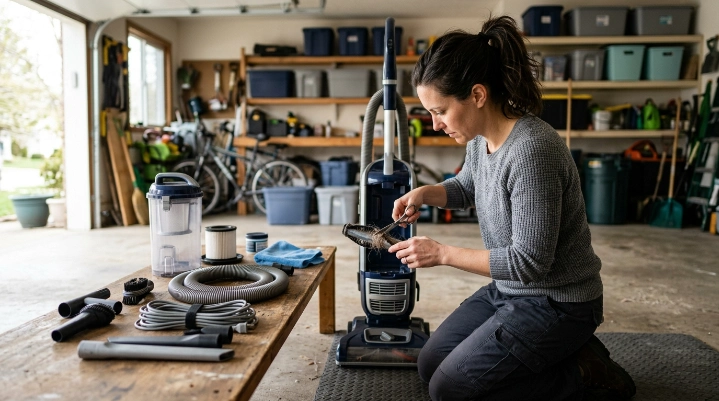
Store the vacuum clean, empty, dry, and protected. This matters even if the garage itself has excellent conditions.
1. Empty the vacuum
Empty a bagless dustbin before extended storage. For a bagged model, follow the manufacturer’s guidance and replace an overloaded or dirty bag when needed.
A wet/dry vacuum needs extra attention. Remove collected liquid and residue before putting it away.
2. Clean the brush roll
Hair, thread, and fibers can stay wrapped around a brush for months. I prefer removing them before storage instead of discovering the mess later.
3. Check the filters
Only wash a filter when the manufacturer identifies it as washable. Never assume a filter can be rinsed because it looks similar to another model’s filter.
Let every washed component dry completely before reinstalling it.
4. Protect the hose and cord
- Coil the power cord loosely around its intended hooks.
- Avoid sharp bends in flexible hoses.
- Do not place storage bins on top of the hose.
- Keep attachments in a basket, cabinet, or designated holder.
5. Choose a protected position
A dedicated cabinet or shelving area works better than leaving the vacuum in an open traffic lane. Upright vacuums should stand securely and not lean where they can fall.
Keep the vacuum away from gasoline, paint thinner, pesticides, and other garage chemicals. A cleaning appliance should not become part of a chemical-storage pile.
The National Institutes of Health provides broader health research resources if you are researching household environmental exposures.
Section Takeaway: A clean, dry vacuum stored in a protected position is much less likely to develop storage-related problems than one pushed into the garage immediately after use.
Can You Store a Cordless Vacuum and Battery in the Garage?
You can only do so when the garage stays within the battery and charger conditions specified by the manufacturer. For cordless vacuums, this is the part of garage storage I take most seriously.
Lithium-ion batteries are sensitive to environmental conditions. Excess heat is one reason I prefer an indoor charging location when a garage becomes extremely hot.
Read the battery instructions separately
The vacuum manual may contain one set of operating limits and another set for charging or storage. Check the battery and charger documentation too.
- Storage temperature: Stay within the manufacturer’s stated range.
- Charging temperature: Do not charge outside the approved range.
- Direct sunlight: Keep the battery away from sun-heated shelves and windows.
- Moisture: Never charge where water or condensation can reach the charger.
- Long-term storage: Follow the brand’s recommended charge level and maintenance instructions.
Consider storing the battery indoors
Some people have room for the vacuum body in the garage but not ideal battery conditions. In that situation, storing a removable battery indoors may solve part of the problem.
Do this only when the manufacturer permits removing and storing the battery separately. Keep terminals protected from metal objects and accidental contact.
If your garage regularly experiences harsh seasonal temperatures, moving the complete cordless vacuum indoors is often simpler.
Garage vs. Closet vs. Basement: Which Is Better?
An indoor utility closet is usually my first choice because temperature and humidity tend to be more stable. Garages and basements can work, but their suitability depends heavily on the building.
| Storage Area | Typical Suitability | Main Concern | Best For |
|---|---|---|---|
| Indoor closet | Usually best | Crowding | Most household vacuums |
| Utility room | Usually good | Leaks near plumbing | Upright, stick, canister |
| Garage | Conditional | Temperature and humidity | Dry, protected garages |
| Basement | Conditional | Humidity and flooding | Dry, conditioned basements |
| Outdoor shed | Often poor | Weather and temperature swings | Only when manufacturer limits are met |
When I would choose the garage
- The garage remains dry year-round.
- Temperatures stay inside the vacuum’s storage limits.
- The appliance has a dedicated protected space.
- There is no active pest problem.
- The vacuum is convenient to access without moving heavy objects.
When I would move it indoors
- Condensation appears regularly.
- The garage has roof or wall leaks.
- Summer heat becomes extreme.
- Winter conditions exceed battery or appliance limits.
- The vacuum must sit beside chemicals or workshop debris.
- The cordless charger would be exposed to moisture or harsh temperatures.
As of 2026, I still see no reason to force a vacuum into a garage just to save a small amount of closet space. Storage should protect the appliance first.
Section Takeaway: An indoor closet is usually the lowest-risk option, while garage and basement storage depend on the actual moisture and temperature conditions in your home.
Frequently Asked Questions
Can I leave my vacuum in an unheated garage?
You can only leave it there if temperatures remain within the storage limits listed by the vacuum manufacturer. An unheated garage may become too cold in winter or too hot during summer, especially for cordless batteries.
Will humidity damage a vacuum cleaner?
Persistent dampness and condensation can create problems for stored electrical appliances and nearby materials. Keep the vacuum dry, avoid leak-prone locations, and consider monitoring garage humidity if the space often feels damp.
Can I store a Dyson, Shark, or other cordless vacuum in the garage?
Possibly, but check the instructions for your exact model and battery. Cordless vacuums have manufacturer-specific storage and charging limits, so a garage that works for one model may not be appropriate for another.
Can I charge my cordless vacuum in the garage?
Only charge it when the charger and battery are dry and the garage temperature falls within the manufacturer’s charging range. If your garage becomes extremely hot, cold, or damp, an indoor charging area is safer.
Should I cover a vacuum stored in the garage?
A loose, clean cover can help protect the vacuum from settled garage dust. Make sure the machine and every washable part are completely dry first, and avoid trapping moisture inside a tightly sealed plastic covering.
Can I store a wet/dry vacuum in the garage?
Yes, a wet/dry vacuum is commonly suited to garage use, but it still needs proper storage. Empty collected liquids, clean approved components, dry the tank and accessories, and follow the manufacturer’s environmental limits.
What is the best place to store a vacuum cleaner?
For most household vacuums, a clean and dry indoor closet or utility area is the simplest choice. A garage can also work when it stays dry, protected, and within the manufacturer’s temperature requirements.
Final takeaway: You can store a vacuum in the garage, but I would not treat every garage as safe storage. Check moisture, seasonal temperature, battery requirements, dust, pests, and physical protection before deciding.
If the garage fails those checks, move the vacuum indoors. A little inconvenience is easier to deal with than exposing an appliance to months of dampness, extreme heat, or accidental damage.