
11 Best Kärcher Vacuum Cleaners in 2026

Kärcher builds machines for specific jobs, not one do-it-all vacuum for every mess. A shop vac that swallows wet plaster dust and standing water works nothing like a cordless roller mop meant for daily kitchen spills, and a commercial carpet extractor operates on a different principle entirely from a canister vacuum with a water filter. Picking the wrong type means fighting your equipment instead of the mess.
The lineup spans wet/dry shop vacuums for garages and vehicles, compact canister vacuums for everyday floors, powered hard-floor washers that mop and vacuum in one pass, and heavy-duty commercial units built for daily professional use. Suction power, tank capacity, filter type, and hose reach all shift depending on which category a model falls into.
The right pick depends entirely on the mess you’re solving: wet/dry vacuums handle garages and spills, canister vacuums suit everyday floors, and commercial gear is built for daily professional wear. Matching the machine to the job saves money and frustration, since an oversized shop vac is overkill for a studio apartment and a compact canister vacuum won’t touch a flooded basement.
Best for car and garage cleanup: KÄRCHER Shop Vacuum WD 3
Best for small apartments: KÄRCHER WD 2 Plus Wet and Dry Vacuum
Best for DIY workshops: KÄRCHER Shop Wet Dry Vacuum WD 4
Best for bagless everyday cleaning: Kärcher VC 3 Cyclone Compact Vacuum
Best for daily hard-floor mopping: Kärcher FC 7 Cordless Hard Floor Cleaner
Best for larger renovation messes: KÄRCHER WD 5 Wet/Dry Shop Vacuum
Best for construction and job sites: KÄRCHER NT 30/1 Tact L
Best for commercial carpet maintenance: KÄRCHER Versamatic 14″ Upright
Best for allergy-conscious households: Kärcher DS 6 Water Filter Vacuum
Best for upholstery and stain removal: Kärcher Puzzi 8/1 C Carpet Extractor
Best for industrial-scale cleanup: Kärcher NT 65/2 Tact² Commercial Vacuum
KÄRCHER Shop Vacuum WD 3

This is the shop vac to buy if car detailing, garage floors, and the occasional wet spill are your main targets.
Pros
- Blower function doubles as a leaf and debris clearer
- 26-foot combined reach from cord and hose
- Compact enough to store in a car trunk or closet
Cons
- 4.5-gallon tank is modest for bigger renovation jobs
- Single speed setting limits fine control
The WD 3 hits a sweet spot for anyone who wants shop vac power without shop vac bulk. Its top-mounted cartridge filter stays in place for both wet and dry pickup, which saves the annoying mid-job filter swap. The included crevice and floor nozzles make it a genuine car-detailing tool, not just a garage afterthought. At 10.8 pounds, it’s light enough to carry up stairs one-handed. The blower mode earns its keep clearing garage corners and porch debris without a second tool.
KÄRCHER WD 2 Plus Wet and Dry Vacuum

Buy this one if floor space and storage room are tight but you still need wet/dry capability on demand.
Pros
- Compact 12-liter tank fits in small closets
- One-piece cartridge filter needs no swapping between wet and dry
- Includes floor and crevice nozzles plus two suction tubes
Cons
- Shorter 1.8-meter hose limits reach
- Higher-pitched motor noise than the mid-size models
The WD 2 Plus is built for renters, apartment dwellers, and anyone whose garage is really just a closet. Its suction rating of 180 AW handles fine dust and coarse debris without complaint. Reviewers consistently note it outperforms bagged household vacuums on hard floors and car interiors. The tradeoff is reach: the shorter hose and cord mean more repositioning during larger jobs. For quick spills and routine upkeep, it does the job without demanding garage-level storage space.
KÄRCHER Shop Wet Dry Vacuum WD 4
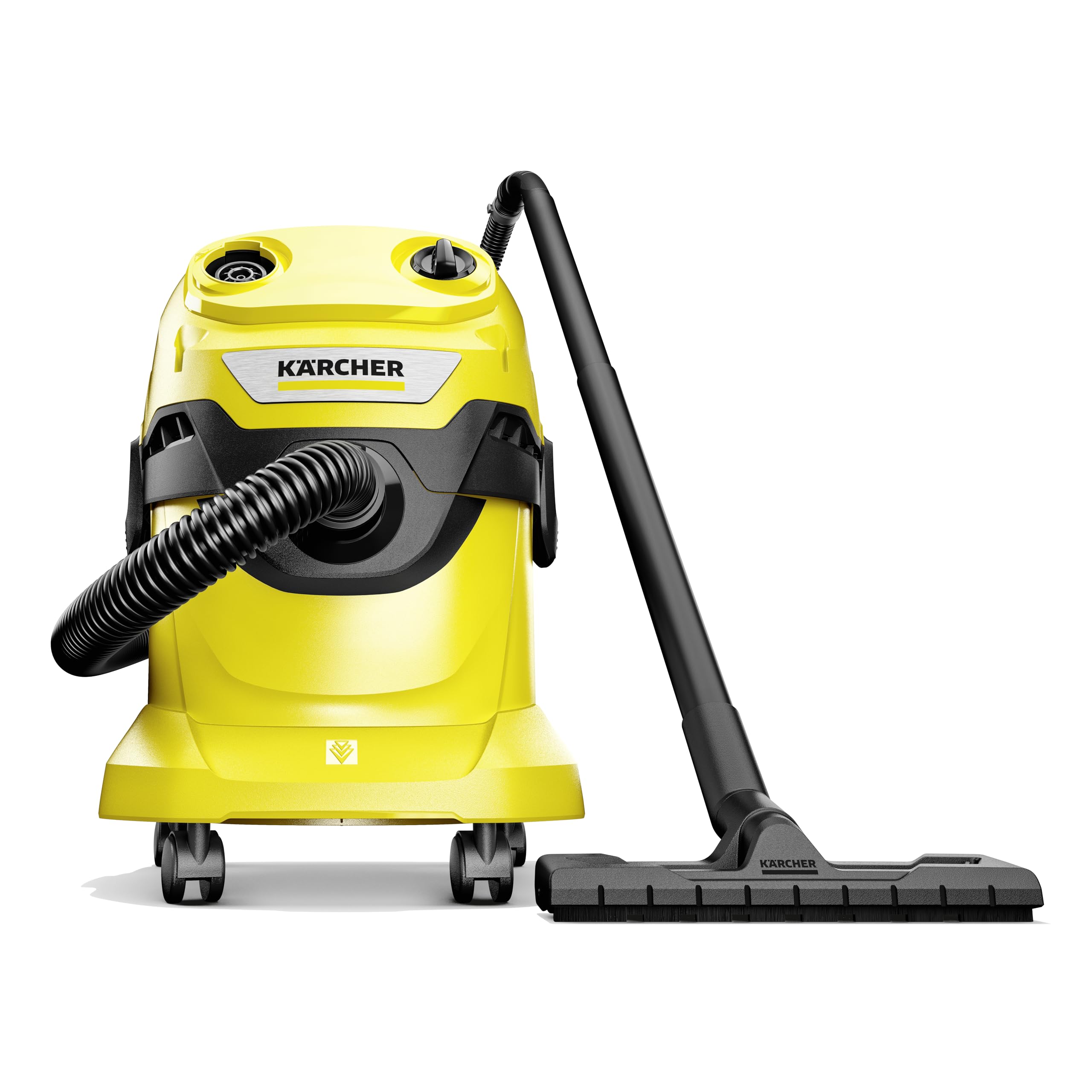
Choose the WD 4 for a genuine step up in tank size and reach over entry-level shop vacs, ideal for regular DIY projects.
Pros
- 5.3-gallon tank handles bigger jobs between empties
- 33-foot combined reach from hose and power cord
- Three power levels for finer control over suction
Cons
- Slightly heavier footprint than the WD 3
- Limited long-term review history since its 2025 release
The WD 4 is the shop vac for someone who renovates rooms, not just cleans out a car trunk. Its flat pleated filter switches between wet and dry debris without removal, and the fleece filter bag option keeps dust containment tidy for drywall work. Early reviewers praise the vacuum bag feature specifically for keeping dust and insect debris from recirculating into the garage air. Three power levels give more control than the single-speed WD 3, useful when moving between delicate upholstery and heavy rubble.
Kärcher VC 3 Cyclone Compact Vacuum

Pick the VC 3 if you’re done buying filter bags and want a lightweight bagless vacuum for apartments or small homes.
Pros
- Bagless cyclone design eliminates recurring bag purchases
- Transparent bin shows exactly when it needs emptying
- EPA hygiene filter traps pollen and fine allergens
Cons
- Small 0.23-gallon capacity means frequent emptying
- Can run warm during extended sessions
The VC 3 trades tank size for convenience. Multi-cyclone technology separates dirt without a bag, and the clear collection bin removes the guesswork of judging suction loss. Households with pets may find the tiny bin fills faster than expected, a common complaint among reviewers with cats or dogs shedding heavily. For apartment dwellers without pets, it’s a low-maintenance daily vacuum that skips the ongoing bag expense entirely. The EPA filter is a genuine plus for allergy sufferers.
Kärcher FC 7 Cordless Hard Floor Cleaner

This is a floor washer, not a suction vacuum, and it earns its spot for households wanting to skip the vacuum-then-mop routine entirely.
Pros
- Four rollers vacuum and mop hard floors simultaneously
- Dual-tank system keeps clean and dirty water separate
- Reaches under furniture with a low-profile head
Cons
- Roller maintenance and cleaning add time after each use
- Some units have reported water tank or spray failures
The FC 7 works differently from every other machine on this list: it’s built exclusively for hard flooring like laminate, tile, and hardwood, not carpet. Four microfiber rollers pick up crumbs and spills in one pass, and floors dry within a couple of minutes thanks to minimal water use. Reviews are mixed on long-term durability, with some praising a full year of reliable service and others reporting tank leaks or spray failures. Budget for replacement roller sets, since heavy pet hair use wears through them fairly fast.
KÄRCHER WD 5 Wet/Dry Shop Vacuum

Go with the WD 5 when the WD 3 or WD 4’s tank size feels too small for the mess at hand.
Pros
- 25-liter tank covers extended cleanup sessions
- Flat filter design restores suction quickly after clogging
- Multiple storage points for cord, hose, and nozzles
Cons
- This listing is voltage-specific to European markets in some cases
- Bulkier than the WD 3 and WD 4 for storage
The WD 5 is aimed at garages, terraces, and post-renovation cleanups where a smaller shop vac would need emptying every few minutes. Its innovative filter cleaning function knocks debris loose from the flat filter without manual scraping, restoring suction fast. One important note from buyers: confirm voltage compatibility before ordering, since some units are wired for 220-240V European standards rather than US 120V outlets. For those with confirmed 120V compatibility, it’s a genuine workhorse for bigger cleanup jobs.
KÄRCHER NT 30/1 Tact L

Professional contractors and serious DIYers sanding drywall regularly will get the most from this vacuum’s automatic filter cleaning system.
Pros
- Tact automatic filter cleaning maintains suction through heavy fine dust
- 30-liter tank with metal casters for job site durability
- Removable filter housing keeps dust exposure to a minimum
Cons
- Heavier and bulkier than household shop vacs
- Overkill for occasional home use
The NT 30/1 Tact L is built for construction sites and workshops generating constant fine dust, like drywall sanding or concrete cutting. Its automatic Tact filter cleaning system knocks dust off the PES flat fold filter continuously, so suction doesn’t fade over long sessions the way it does in basic shop vacs. Reviewers who use it for drywall work report minimal suction loss even after covering significant square footage. This is specialized equipment for people generating serious dust volume, not a general household vacuum.
KÄRCHER Versamatic 14″ Upright

This dual-motor upright is designed for buildings needing daily carpet maintenance, not residential living rooms.
Pros
- Two motors provide dedicated brush and suction power
- HEPA filtration meets indoor air quality standards
- Detachable hose adds flexibility for detail work
Cons
- 40-foot cord and upright bulk are unwieldy for home closets
- Priced and built for commercial daily use, not occasional cleaning
The Versamatic HEPA is standard equipment in offices, hotels, and retail spaces needing daily carpet upkeep across large areas. Its electronic clutch protects the motor and belt from jams, extending service life under constant use. The HEPA filtration meets Carpet and Rug Institute standards, a detail that matters for commercial buildings managing indoor air quality. Home users with normal carpet square footage will find this vacuum’s size and cord length excessive for anything short of a very large house.
Kärcher DS 6 Water Filter Vacuum
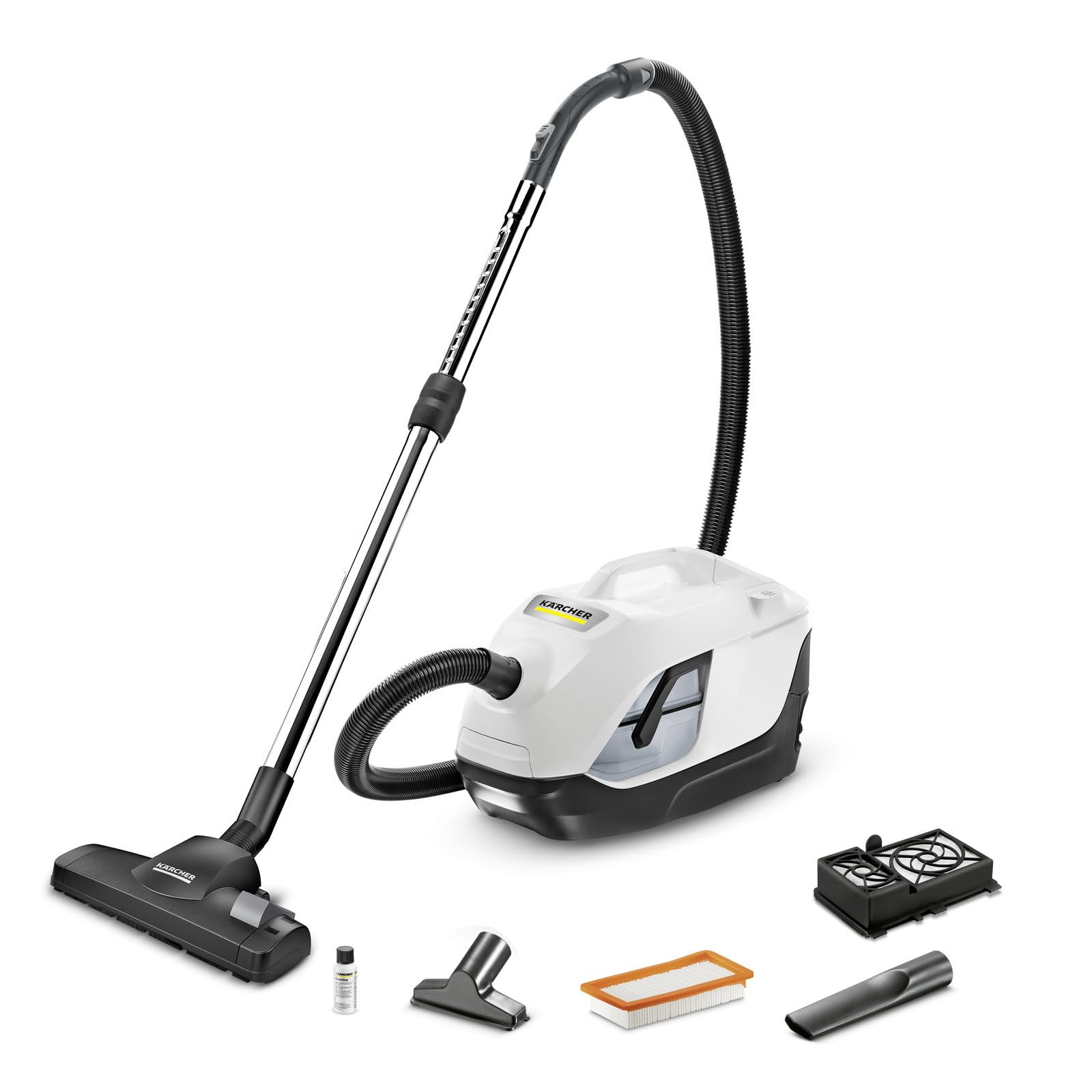
Consider the DS 6 if allergy symptoms or dust sensitivity are a bigger concern than raw suction power.
Pros
- Water filtration traps fine dust before it recirculates into room air
- No filter bags or cartridges to replace
- Exhaust air is filtered to a high purity standard
Cons
- Voltage compatibility varies by region; confirm before buying
- Heavier than standard canister vacuums due to the water tank
The DS 6 works on a genuinely different principle from every dry vacuum on this list. Instead of trapping dust in a bag or cartridge filter, it routes incoming air through swirling water that binds dirt and dust particles before they escape through the exhaust. Buyers with allergies or asthma consistently praise the mess-free disposal and noticeably fresher air after vacuuming. Confirm the voltage rating on the specific listing before purchase, since some units are wired for markets outside the US.
Kärcher Puzzi 8/1 C Carpet Extractor

This is a carpet and upholstery extractor, not a vacuum, and it’s the right tool when stains need lifting rather than just surface dirt.
Pros
- Sprays cleaning solution deep into fibers, then extracts it
- Fast drying thanks to strong back-suction performance
- Compact at 23 pounds with onboard accessory storage
Cons
- Requires kneeling for upholstery and low-furniture work
- Separate cleaning solution purchase needed for best results
The Puzzi 8/1 C is a spray-extraction machine built for genuine stain removal, not routine vacuuming. It injects cleaning solution into carpet or upholstery fibers, then pulls both dirt and moisture back out in the same pass. Reviewers doing car detailing and upholstery cleaning report dramatic results on stained fabric, with drying times as short as a few hours. The extra-short upholstery nozzle handles tight furniture gaps well, though working close to the floor requires some kneeling.
Kärcher NT 65/2 Tact² Commercial Vacuum

This is the largest, most industrial machine in the lineup, built for construction sites and facilities generating constant fine dust and debris.
Pros
- 17.2-gallon tank handles extended jobs without emptying
- Dual motors sustain suction power through heavy use
- Automatic filter cleaning reduces manual filter maintenance
Cons
- At over 72 pounds, it demands real storage space
- Far more machine than any residential job requires
The NT 65/2 Tact² is commercial equipment through and through, the kind found on construction sites, in food processing facilities, or on industrial floors. Its automatic Tact² filter cleaning system uses air blasts to knock dust off the flat pleated filter continuously, extending time between manual filter changes. Bayonet and clip connections make attaching accessories fast, a detail that matters when crews are swapping tools throughout a shift. For homeowners, this is significant overkill; it belongs in commercial and industrial settings where its size and dual-motor power actually get used.
Buying Guide
Match the Vacuum Type to the Job
Kärcher’s lineup splits into distinct categories, and picking the wrong one leads to frustration. Shop vacuums (wet/dry canister models) handle spills, garage debris, and renovation dust. Household canister and upright vacuums suit everyday carpet and hard-floor maintenance. Powered floor washers combine mopping and vacuuming for hard surfaces only. Carpet extractors deep-clean fabric and remove stains rather than just lifting surface dirt.
Tank Capacity and Reach
Larger tanks mean fewer stops to empty, but also more bulk to store and maneuver. A 4 to 5-gallon tank suits most home garages and car detailing. Larger 25-gallon-plus tanks fit renovation projects or commercial jobs where dumping mid-task wastes time.
Reach matters just as much as capacity. Add the hose length and cord length together to estimate how far a vacuum reaches from a single outlet without dragging the whole unit around.
| Capacity Range | Best Fit |
|---|---|
| Under 1 gallon | Daily household dry vacuuming |
| 4-6 gallons | Garage, car detailing, small DIY jobs |
| 12-25 gallons | Renovation debris, workshops |
| 17+ gallons | Commercial and industrial cleanup |
Filtration Type
Filter type determines what a vacuum can safely pick up and how much maintenance it demands.
- Cartridge filters handle both wet and dry debris without swapping, ideal for shop vacs used across varied messes.
- HEPA filters trap fine particles and allergens, useful for households with allergy sufferers or pet dander concerns.
- Water filters trap dust in water rather than a bag, producing cleaner exhaust air but adding weight.
- Bagless cyclone filters skip ongoing bag costs but usually mean smaller collection bins.
Wet Pickup Ability
Not every vacuum handles liquid. Confirm a machine is explicitly rated for wet pickup before using it on spills, since standard household vacuums can be damaged or become electrically unsafe with liquid intake. Wet/dry shop vacs are engineered specifically for this dual duty, with sealed motors and float shutoffs that stop suction once the tank fills with liquid.
Noise and Maneuverability
Commercial and shop vacuums run louder than household canister models, often in the high 70s to low 80s decibel range. Swivel casters and lightweight bodies under 15 pounds make a real difference for anyone moving a vacuum between rooms or up stairs regularly.
Editor’s Choice
The KÄRCHER Shop Vacuum WD 3 stands out as the strongest all-around pick for most buyers. It balances a genuinely useful 4.5-gallon tank with 26 feet of combined reach, a blower function, and dedicated car-detailing attachments, all in a body light enough to carry with one hand.
For households wanting to skip shop vac bulk entirely, the KÄRCHER WD 2 Plus delivers wet/dry versatility in a footprint that fits a coat closet. Anyone tackling renovation-level messes regularly should look at the KÄRCHER WD 4 or WD 5 instead, since their larger tanks reduce how often you’re stopping to empty.
Specialized jobs call for specialized machines. Stain removal on carpet or upholstery belongs to the Puzzi 8/1 C, daily hard-floor mopping suits the FC 7, and commercial facilities generating constant dust should look toward the NT 30/1 Tact L or NT 65/2 Tact².
Conclusion
Choosing among Kärcher’s lineup comes down to matching machine type to task rather than chasing the highest suction number on a spec sheet. A shop vac like the WD 3 or WD 4 covers garages, car interiors, and typical DIY messes without demanding a dedicated storage room. Households focused on daily floor upkeep are better served by a compact canister vacuum or the FC 7 hard-floor washer, while carpet stains and upholstery need the spray-extraction approach of the Puzzi 8/1 C.
Commercial and industrial buyers should size up to the NT 30/1 Tact L, NT 65/2 Tact², or Versamatic upright, all of which are built for daily heavy use well beyond typical household demands. Check tank capacity, hose and cord reach, and filter type against your specific cleaning tasks before buying, and confirm voltage compatibility on any listing that mentions European specifications.
FAQS
Can Kärcher shop vacuums pick up standing water? Yes, models like the WD 3, WD 4, and WD 5 are built for wet pickup with sealed motors designed for liquid intake. Always check the specific model’s wet-pickup rating before vacuuming standing water.
What’s the difference between the FC 7 and a standard shop vac? The FC 7 is a powered floor washer that mops and vacuums hard floors simultaneously using rotating microfiber rollers. Shop vacs rely purely on suction and work across a wider range of surfaces, including carpet and outdoor debris.
Do Kärcher wet/dry vacuums work on carpet? Most wet/dry shop vacuums handle carpet fine for surface debris and spills, but they don’t deep-clean fibers or remove embedded stains. For that, a carpet extractor like the Puzzi 8/1 C is the right tool.
Are commercial Kärcher vacuums worth buying for home use? Rarely. Commercial units like the NT 65/2 Tact² or Versamatic upright are built for daily heavy use in facilities and cost more in size and weight than most homes need. A residential shop vac or canister vacuum covers typical household demands more efficiently.
How often do cartridge filters need replacing? Filter lifespan depends on usage frequency and debris type, but most Kärcher cartridge filters last months under regular home use. Rinse or tap out debris periodically to maintain suction between full replacements.