
Best Dehumidifier for Grow Tent (2026): 6 Picks for Healthy Plants

Quick answer
The AC Infinity Hydrone 7 is the best dehumidifier for most grow tents. It’s built for tents with 4 to 6 plants, has ten drying levels with built-in humidity and VPD control, and can duct dry air into the tent or run a closed loop. For a ducted compressor unit that sits outside the tent, the Spider Farmer 32 Pint is a well-equipped choice with app control. For a small tent with 2 or 3 plants, the AC Infinity Hydrone 5 is the compact option.
HomeHygia is reader-supported. When you buy through links on this page, we may earn a small commission from Amazon at no extra cost to you.
Plants release almost all the water you give them back into the air through their leaves. In an open room that moisture spreads out, but in a sealed grow tent it builds up fast, especially after lights-off when the temperature drops. High humidity in late veg and flowering raises the risk of powdery mildew, bud rot and other fungal problems, and it makes it harder to hit the vapor pressure deficit (VPD) your plants grow best at.
An ordinary room dehumidifier can help, but grow tents have their own needs. Most tents are small and already warm under lights, so a dehumidifier that dumps heat inside the tent can push temperatures too high. Many growers prefer units that sit outside the tent and duct dry air in, or that can run in a closed loop. Precise control also matters, because you want to hold a target humidity or VPD, not just run flat out.
We compared six dehumidifiers that suit grow tents and small grow rooms on tent size, ducting options, humidity and VPD control, heat management and drainage. Our picks are based on maker specifications and design rather than our own testing, so capacity and coverage figures are maker claims. We focus on legal home growing of vegetables, herbs and houseplants as well as any other plants you’re permitted to grow where you live.
Our picks at a glance
| Product | Model | Best for | Tent size / control | Buy |
|---|---|---|---|---|
 | AC Infinity HYDRONE 7 Smart Plant Dehumidifier | Best dehumidifier for a grow tent overall | 4 to 6 plants / VPD control | Check price |
 | Spider Farmer 32 Pint Plant Dehumidifier | Best ducted compressor dehumidifier for a tent | 3×3 to 4×4 tents / app | Check price |
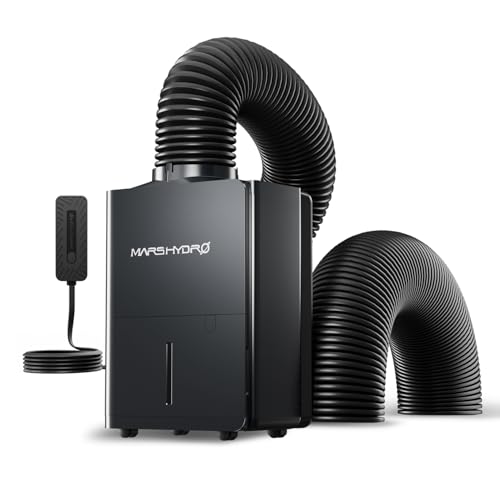 | MARS HYDRO 38 Pint Plant Dehumidifier | Best capacity for a 4×4 tent | 38 pints / ducted | Check price |
 | AC Infinity HYDRONE 5 Precision Plant Dehumidifier | Best for small grow tents | 2 to 3 plants / compact | Check price |
 | hOmeLabs 50 Pint Dehumidifier with Wi-Fi | Best for a grow room or several tents | 50 pints at 80°F / Wi-Fi | Check price |
 | Midea Cube 20 Pint Dehumidifier | Best compact room unit for a small grow space | 20 pints / large bucket | Check price |
The best dehumidifiers for grow tents, reviewed
1. Best dehumidifier for a grow tent overall
AC Infinity HYDRONE 7 Smart Plant Dehumidifier
| Designed for | Grow tents with 4 to 6 plants (maker) |
| Control | 10 drying levels, built-in humidity and VPD control |
| Motor | PWM-controlled rotary motor (maker) |
| Climate range | Rated for hot and very cold environments (maker) |
| Ducting | Exhaust port into the tent, optional intake for closed loop |
| Size | About 24.4 × 14 × 11.5 in. |
| Model | AC-DHT7 |
AC Infinity is one of the best-known names in grow tent gear, and the Hydrone 7 is designed specifically for plants rather than adapted from a home unit. AC Infinity sizes it for tents with 4 to 6 plants, which covers most 4×4 and 5×5 setups.
The standout is control. Instead of simply turning on and off, it has ten distinct drying levels driven by a PWM-controlled motor, and AC Infinity says its built-in humidity and VPD controls adjust output in exact percentages to hold your target climate. That kind of fine control helps avoid the big humidity swings that stress plants.
It has an exhaust port so you can duct dry air into the tent, plus an optional intake port for a closed-loop setup that pulls air from the tent and returns it drier. AC Infinity says it works in both hot and very cold environments and can reach low humidity levels, useful for late flowering or drying. It’s a tall unit, so plan floor space next to the tent.
What works
- Designed for grow tents
- Fine-grained humidity and VPD control
- Ducting and closed-loop options
- Works across a wide temperature range
What to watch
- Tall footprint
- Capacity in pints not stated on the listing
- Premium-priced for its size class
2. Best ducted compressor dehumidifier for a tent
Spider Farmer 32 Pint Plant Dehumidifier
| Capacity | Up to 32 pints per day at 95°F, 90% RH (maker) |
| Tent size | 3×3, 2×4 and 4×4 ft (maker) |
| Ducting | Air duct so the unit can sit outside the tent |
| Humidity range | 30% to 80%, with remote sensor probe |
| Drainage | Tank with full alarm, or drain hose |
| Extras | 24-hour timer, three modes, app control, wheels |
Spider Farmer’s 32-pint dehumidifier is a compressor unit adapted for grow tents. The key feature is an air duct, which lets you keep the dehumidifier outside the tent and blow dry air in. That keeps the compressor’s heat out of the grow space, a common problem with standard dehumidifiers placed inside small tents.
It comes with a temperature and humidity sensor probe that you place in the tent, so the unit reads conditions at your plants rather than at its own intake. You can set humidity from 30% to 80%, and it stops when it reaches your target. There’s also a 24-hour timer, three modes and app control.
Spider Farmer rates it at up to 32 pints a day under hot, humid conditions and sizes it for 3×3, 2×4 and 4×4 tents. It drains to a tank with a full alarm or through a hose, and rolls on wheels.
What works
- Ducts dry air in from outside the tent
- Remote sensor probe
- App control and timer
- Hose drain option
What to watch
- Compressor heat still goes into the room
- Capacity figure is at extreme conditions
- Bulkier than purpose-built tent units
3. Best capacity for a 4×4 tent
MARS HYDRO 38 Pint Plant Dehumidifier
| Capacity | Up to 38 pints (18 L) per day (maker) |
| Tent size | 3×3, 2×4 and 4×4 ft (maker) |
| Ducting | Air duct so the unit can sit outside the tent |
| Humidity range | 30% to 90%, auto mode |
| Tank | 2.1 L with auto stop |
| Maintenance | Washable dust filter, drain hose included |
MARS HYDRO, another popular grow light brand, offers a ducted compressor dehumidifier with a bit more capacity than the Spider Farmer. MARS HYDRO rates it at up to 38 pints a day and, like the Spider Farmer, includes an air duct so the unit can sit outside the tent without adding heat to it.
Its digital display shows temperature and humidity, and auto mode switches the compressor on and off to hold a target between 30% and 90%. The 2.1-liter tank stops the unit when full, or you can use the included drain hose.
The washable dust filter is a practical touch for grow spaces, where soil dust and plant debris can clog coils. It’s a solid alternative if you want more drying power in a 4×4 tent.
What works
- Higher capacity
- Ducts in from outside
- Drain hose included
- Washable filter
What to watch
- No app listed
- Compressor adds heat to the room
- Max capacity figure
4. Best for small grow tents
AC Infinity HYDRONE 5 Precision Plant Dehumidifier
| Designed for | Smaller grow tents with 2 to 3 plants (maker) |
| Control | 10 drying levels |
| Ducting | Dual duct ports, exhaust and optional intake |
| Climate range | Rated for hot and very cold environments (maker) |
| Smart | Works with AC Infinity outlet and smart controllers for app control |
| Size | About 15.7 × 10.2 × 9.5 in. |
The Hydrone 5 is the smaller sibling of the Hydrone 7, sized for 2×2, 2×4 and 3×3 tents with 2 or 3 plants. At under 16 inches tall, it fits beside even a small tent.
It shares the same ten-level drying control and dual duct ports, so you can duct dry air into the tent or run a closed loop. AC Infinity says it works in both hot and very cold conditions.
Unlike the Hydrone 7, its app and VPD automations come through AC Infinity’s separate outlet and smart controllers, so if you already use their controller system, it slots right in. If not, factor in a controller for the smart features.
What works
- Compact for small tents
- Fine drying control
- Dual duct ports
- Integrates with AC Infinity controllers
What to watch
- Smart features need a separate controller
- For small tents only
- Capacity not stated in pints
5. Best for a grow room or several tents
hOmeLabs 50 Pint Dehumidifier with Wi-Fi
| Capacity | 50 pints per day at 80°F, 60% RH; up to 120 at 95°F, 90% RH (maker) |
| Coverage | Up to 7,000 sq ft (maker) |
| Smart | Wi-Fi app |
| Airflow | 188 CFM normal, 218 CFM turbo (maker) |
| Drainage | Tank with auto shut-off, hose outlet (hose not included) |
If you grow in a dedicated room or run several tents in the same space, a full-size room dehumidifier can control the whole room’s air, which then feeds the tents’ intakes. hOmeLabs gives a realistic capacity figure of 50 pints a day at 80°F and 60% humidity, close to typical grow room conditions.
Wi-Fi lets you check and adjust humidity remotely, and turbo mode raises airflow when humidity spikes after lights-off. It drains to a tank that shuts it off when full, or through a hose outlet if you supply a hose.
It’s not ducted, so it’s best placed in the room rather than inside a tent, where its heat and size would be a problem.
What works
- Realistic capacity figure
- Wi-Fi control
- Handles a whole grow room
- Turbo airflow
What to watch
- Not for inside a tent
- Hose not included
- Adds heat to the room
6. Best compact room unit for a small grow space
Midea Cube 20 Pint Dehumidifier
| Capacity | 20 pints per day (maker) |
| Humidity range | 35% to 85% |
| Tank | Large removable bucket (maker says up to 3× standard) |
| Drainage | Bucket or continuous drain hose (included) |
| Smart | SmartHome app, Alexa and Google |
| Efficiency | ENERGY STAR |
For a closet grow, a small grow room or a corner with one tent, Midea’s Cube is a compact, efficient room dehumidifier with smart control. Its extending design gives it a much larger bucket than most 20-pint units, which means fewer interruptions, and a hose is included for continuous draining.
You can set humidity from 35% to 85% and manage it through the app or a voice assistant. It’s ENERGY STAR certified, which helps for a unit that may run around the clock.
Like the hOmeLabs, it’s a room unit rather than a ducted tent unit, so place it outside the tent near the tent’s intake.
What works
- Large bucket and hose included
- ENERGY STAR
- App and voice control
- Compact footprint
What to watch
- Not ducted
- Lower capacity
- Room unit, not a tent unit
How to choose a dehumidifier for a grow tent
1. Size it to your tent and plant count
Purpose-built tent dehumidifiers list the tent size or number of plants they handle. A 2×2 or 3×3 tent with a few plants needs much less capacity than a 5×5 in late flower. More plants and bigger plants mean more moisture, so size up if you’re near the top of a range.
2. Keep the heat out of the tent
Every dehumidifier gives off heat. Inside a small tent under lights, that heat can push temperatures too high. Choose a ducted model that sits outside the tent and blows dry air in, or place a room dehumidifier near the tent’s intake rather than inside it.
3. Look for precise control
Plants prefer steady conditions. A sensor probe at canopy level, fine fan control or VPD-based automation helps hold your target and avoid big swings, especially at lights-off when humidity jumps.
4. Plan drainage
A tent dehumidifier can collect a lot of water in a day. Use a drain hose to a bucket, sink or floor drain wherever possible, and keep cords and outlets off the floor near standing water.
5. Combine with airflow
A dehumidifier works best with good air movement. Use an exhaust fan and clip fans so humid air doesn’t sit in the canopy. If you’re also controlling humidity for houseplants elsewhere, our best humidifiers for plants guide covers the other side of the equation. The EPA’s mold and moisture guide explains why lingering dampness causes problems.
FAQ
Do I need a dehumidifier for my grow tent?
If your tent humidity regularly rises above your target, especially in late growth or at lights-off, a dehumidifier helps prevent mildew and mold and keeps plants in their ideal range.
Should the dehumidifier go inside or outside the grow tent?
Outside is usually better, because it keeps the unit’s heat out of the tent. Ducted models blow dry air in from outside.
What humidity should a grow tent be?
It depends on the plant and stage. Many plants do well around 50% to 70% in early growth and lower, around 40% to 50%, later on. Follow the guidance for what you grow.
What is VPD control on a dehumidifier?
VPD, or vapor pressure deficit, combines temperature and humidity into one measure of how plants transpire. VPD control adjusts drying to hold that balance rather than humidity alone.
Can I use a regular dehumidifier for a grow tent?
Yes, if you place it in the room outside the tent near the intake. Inside a small tent, a regular unit can add too much heat.
Bottom line
For most grow tents, the AC Infinity Hydrone 7 is our top pick for its tent-specific design and precise humidity and VPD control. Choose the Spider Farmer or MARS HYDRO for a ducted compressor unit, the Hydrone 5 for a small tent, or a room unit like the hOmeLabs for a full grow room. For other spaces, see our best dehumidifiers for bedrooms and best basement dehumidifiers.