Best Vacuum for Drywall Dust (2026): 6 HEPA Dust Extractors That Won’t Choke

Quick answer
The DEWALT DWV010 is the best vacuum for drywall dust for most people: an 8 gallon HEPA dust extractor with 150 CFM and a filter that cleans itself every 30 seconds, so it keeps pulling while you sand. For bigger jobs, the Bosch VAC140AH holds 14 gallons and pulses its filter every 15 seconds. Skip the household vacuum. Drywall dust clogs it fast and can wreck the motor.
HomeHygia is reader-supported. When you buy through links on this page, we may earn a small commission from Amazon at no extra cost to you.
Drywall dust is one of the worst things you can put through a vacuum. Sanding joint compound produces a powder that is far finer than ordinary house dust. It packs into a standard filter within minutes, the suction drops, and the fine stuff that gets past the filter coats the motor. Plenty of people have killed a good household vacuum cleaning up after a single room of drywall.
The tool made for this job is a dust extractor: a shop vac with a sealed HEPA filter, a fleece bag to catch most of the dust before it reaches the filter, and an automatic filter-cleaning system that knocks the cake off the filter every few seconds. Most also have a power-tool outlet so the vac turns on when your sander does. Connected to a drywall sander, it catches dust at the source instead of letting it settle on every surface in the house.
We picked six extractors from DEWALT, Bosch, Makita, Fein and Festool and compared them on airflow (CFM), water lift, filter type, filter cleaning, tank size, hose length and noise. All the figures are from the makers’ listings. We haven’t run them ourselves, so treat the numbers as published specs.
Our picks at a glance
| Product | Model | Best for | Airflow / filter | Buy |
|---|---|---|---|---|
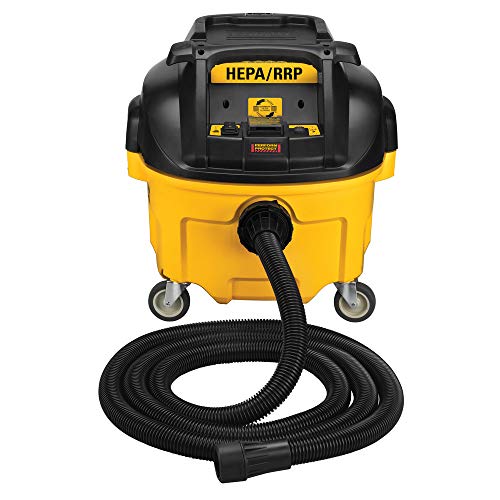 | DEWALT DWV010 8 Gallon HEPA Dust Extractor | Best overall | 150 CFM, HEPA | Check price |
 | Bosch VAC140AH 14 Gallon Dust Extractor | Best for big remodels | 150 CFM, HEPA 99.97% | Check price |
 | Bosch VAC090AH 9 Gallon Dust Extractor | Best mid-size extractor | 150 CFM, HEPA 99.97% | Check price |
 | Makita VC4210L 11 Gallon Wet/Dry HEPA Dust Extractor | Best two-stage filtration | 148 CFM, 2-stage HEPA | Check price |
 | Fein Turbo I HEPA Pro Set 5.8 Gallon Dust Extractor | Best quiet extractor for indoor work | 151 CFM, HEPA (class L) | Check price |
 | Festool CT 15 HEPA Dust Extractor (578441) | Best compact premium extractor | Adjustable turbine, HEPA | Check price |
The best vacuums for drywall dust, reviewed
1. Best overall
DEWALT DWV010 8 Gallon HEPA Dust Extractor
| Airflow / filter | 150 CFM, HEPA |
| Filter cleaning | Auto pulse every 30 sec |
| Tank | 8 gal |
| Hose | 15 ft x 1.25 in anti-static |
| Motor | 15 amp |
| Model | DWV010 |
The DWV010 is a long-time favorite on job sites, and for drywall it gets the important things right. The headline feature is automatic filter cleaning: the filter pulses every 30 seconds, which knocks the dust cake off so the vac keeps pulling without you stopping to tap the filter out. With drywall dust, that is the difference between steady suction and a vac that’s choking after ten minutes.
A 15 amp motor delivers 150 CFM of airflow, among the highest here. Power Tool Actuation turns the vac on and off with your sander, so you’re not walking back to it. The 15 ft anti-static hose (1.25 inch) stops the static shocks you get when fine dust races through a plastic hose, and the universal connector fits most sanders.
DEWALT notes that it meets the EPA Lead RRP rule for HEPA vacuums when used with DWV9330 filters, which matters if you’re working on an older home where paint might contain lead. Heavy-duty wheels and casters make it easy to roll from room to room.
What works
- Auto filter cleaning every 30 seconds
- 150 CFM airflow
- Power tool on/off
- 15 ft anti-static hose
What to watch
- 8 gallons fills fast on big jobs
- RRP compliance needs DWV9330 filters
- 1-year limited warranty listed
2. Best for big remodels
Bosch VAC140AH 14 Gallon Dust Extractor
| Airflow / filter | 150 CFM, HEPA 99.97% |
| Water lift | 97 in |
| Filter cleaning | Auto every 15 sec |
| Tank | 14 gal + fleece bag |
| Control | Power Broker dial |
| Model | VAC140AH |
For a full basement finish or a whole-house remodel, the VAC140AH’s 14 gallon tank means far fewer stops to empty it. Bosch’s filter cleaning is more frequent than DEWALT’s too: it pulses every 15 seconds to keep suction high.
Bosch lists 150 CFM and a sustainable 97 inches of static water lift. The HEPA filter captures 99.97% of particles at 0.3 microns, and the fleece filter bag in the box catches most of the dust first, which protects the filter and makes emptying much cleaner. The Power Broker dial lets you match suction to the job, which helps when a strong pull would stick a sanding pad to the wall.
It’s part of Bosch’s PRO+GUARD system, aimed at helping users move toward OSHA Silica Table 1 dust compliance. For drywall at home, the practical benefit is simple: a big tank, a self-cleaning HEPA filter and power tool activation.
What works
- 14 gallon tank
- Filter cleans every 15 seconds
- HEPA filter plus fleece bag
- Power Broker suction dial
What to watch
- Big and heavy to carry upstairs
- More vac than one room needs
- Takes floor space in storage
3. Best mid-size extractor
Bosch VAC090AH 9 Gallon Dust Extractor
| Airflow / filter | 150 CFM, HEPA 99.97% |
| Water lift | 97 in |
| Filter cleaning | Auto every 15 sec |
| Tank | 9 gal + fleece bag |
| Use | Wet/dry |
| Model | VAC090AH |
The VAC090AH is the same Bosch system in a 9 gallon size, which is a sweet spot for most home drywall jobs. You get the 15-second auto filter cleaning, the HEPA filter rated at 99.97% at 0.3 microns, the fleece bag, the Power Broker dial and power tool activation.
The numbers match its bigger sibling: up to 150 CFM and 97 inches of sustainable static water lift. Bosch also lists wet/dry collection, so it can deal with a wet sponge-sanding cleanup or a spill.
It’s lighter and smaller than the 14 gallon model, which makes it easier to carry between floors. If you’re doing a room or two at a time, this is the better-sized Bosch.
What works
- 15-second auto filter cleaning
- 150 CFM, 97 in water lift
- HEPA filter and fleece bag
- Easier to move than the 14 gallon
What to watch
- Still a large machine
- 1-year limited warranty listed
- Fleece bags are a running cost
4. Best two-stage filtration
Makita VC4210L 11 Gallon Wet/Dry HEPA Dust Extractor
| Airflow / filter | 148 CFM, 2-stage HEPA |
| Water lift | 92 in |
| Filter cleaning | Automatic |
| Tank | 11 gal |
| Motor | 12 amp |
| Model | VC4210L |
Makita’s VC4210L uses two stages of filtration. A main flat filter catches 99.95% of particles 2 microns and larger, and the HEPA filter behind it captures 99.97% at 0.3 microns. That’s a good layout for drywall, because the first filter does most of the work and the HEPA filter stays cleaner for longer.
A 12 amp motor generates 148 CFM and 92 inches of water lift. The automatic filter cleaning system extends filter life, and the on-board tool-activated outlet starts and stops the vac with your sander. A 10 second “off” delay keeps it running briefly after you stop, which clears the dust still in the hose.
The 11 gallon tank sits between the DEWALT and the big Bosch. It handles wet pickup too.
What works
- Two-stage filtration with HEPA
- 148 CFM, 92 in water lift
- 10-second delay clears the hose
- 11 gallon tank
What to watch
- Warranty listed as “None” on this listing
- Large footprint
- Check hose length in the box
5. Best quiet extractor for indoor work
Fein Turbo I HEPA Pro Set 5.8 Gallon Dust Extractor
| Airflow / filter | 151 CFM, HEPA (class L) |
| Water lift | 98 in |
| Noise | 66 dB |
| Tank | 5.8 gal |
| Hose / cord | 13 ft / 19 ft |
| Model | Turbo I |
Dust extractors are loud, and when you’re sanding in a finished house with family at home, that matters. Fein rates the Turbo I at just 66 dB, the quietest figure in this group, and pitches it for noise-sensitive indoor jobs.
It doesn’t give much away on power for its size. Fein lists 151 CFM and 98 inches of water lift in a compact 5.8 gallon wet/dry unit. The HEPA filter and filter bag are approved for dust class L, and the autostart outlet has soft-start to prevent power spikes when the sander kicks on.
You get a 19 ft cord, a 13 ft anti-static hose, swivel wheels and on-board storage, plus a brush and nozzles. The trade-off is the small tank and no automatic filter cleaning listed, so empty the bag and tap the filter more often on big jobs.
What works
- Very quiet at 66 dB
- 151 CFM, 98 in water lift
- HEPA filter, dust class L
- 19 ft cord, 13 ft anti-static hose
What to watch
- Small 5.8 gallon tank
- No auto filter cleaning listed
- Premium brand pricing
6. Best compact premium extractor
Festool CT 15 HEPA Dust Extractor (578441)
| Airflow / filter | Adjustable turbine, HEPA |
| Filter cleaning | AutoClean |
| Tank | 3.96 gal (15L) |
| Start | Automatic tool start |
| Warranty | 3-year comprehensive |
| Model | CT 15 (578441) |
Festool’s CT 15 is a small, well-built extractor for people who do finish work and move between rooms a lot. It has a HEPA filter, an adjustable high-performance turbine, automatic tool start, and Festool’s AutoClean system. The 3.96 gallon (15L) container is small, but the compact chassis with steel axles makes it easy to carry up stairs.
The crevice and upholstery nozzles store inside the unit, and the flat top works as a small shelf for sandpaper and tools. Touch controls make it simple to use.
The standout is Festool’s 3-year comprehensive warranty, which covers wear and tear. If you already own Festool sanders, it plugs straight into that system. For a big remodel, though, the tank is small and you’ll be emptying it often.
What works
- HEPA filter and AutoClean
- Compact, light, steel-axle chassis
- Tools store on board
- 3-year warranty incl. wear and tear
What to watch
- Small 3.96 gallon container
- Costly bags and filters
- No CFM figure on this listing
How to choose a vacuum for drywall dust
Drywall dust is extreme, so the usual rules for vacuums don’t apply. Here’s what matters.
1. A true HEPA filter
Sanded joint compound is extremely fine. A standard shop vac filter lets much of it straight through and blows it back into the room. Look for a HEPA filter rated at 99.97% at 0.3 microns. The EPA explains what that rating means. All six picks list HEPA filtration.
2. Automatic filter cleaning
Even a HEPA filter cakes over quickly with drywall dust. Auto filter cleaning pulses air back through the filter every 15–30 seconds to knock the dust off. Without it, you’ll have to stop and clean the filter over and over. The DEWALT, both Bosch models, the Makita and the Festool have it.
3. A fleece or filter bag
A fleece bag inside the tank catches most of the dust before it gets to the filter. It keeps suction steady, makes the filter last longer and lets you empty the vac without a cloud of dust. Use one for every drywall job.
4. Airflow and power tool activation
For connecting to a sander, look for about 130–150 CFM. Power tool activation turns the vac on and off with the sander, which keeps the job simple. An anti-static hose stops the shocks fine dust can cause.
5. Tank size and weight
Drywall dust is light but bulky. An 8–9 gallon tank is right for most rooms, 14 gallons for big remodels, and a 4–6 gallon unit if you mostly do small patches and need to carry it around.
How to control drywall dust while you work
- Connect the vac to the sander. Catching dust at the source is far better than cleaning it up later.
- Seal the room. Close doors, tape plastic over openings and cover HVAC returns so dust doesn’t travel through the house.
- Wear a respirator. Even with an extractor, wear a well-fitted dust mask or respirator while sanding.
- Vacuum before you sweep. Sweeping throws fine dust into the air. Vacuum the floor first, then damp-mop. Our guide on how to vacuum drywall dust covers the steps.
- Clean the vac after the job. Empty the bag outside and clean or replace the filter. See how to clean a vacuum after drywall dust.
FAQ
Can I use a regular vacuum for drywall dust?
It’s not a good idea. Drywall dust clogs household vacuum filters within minutes, cuts suction and can damage the motor. Use a dust extractor or shop vac with a HEPA filter and a filter bag.
Is a shop vac good enough for drywall dust?
A basic shop vac can work for a small cleanup if you add a fine-dust or HEPA filter and a filter bag. For sanding a whole room, a dust extractor with automatic filter cleaning works much better.
What is automatic filter cleaning on a dust extractor?
It’s a system that pulses air back through the filter every few seconds to knock off the dust that builds up on it. This keeps suction steady during long sanding jobs without stopping to clean the filter.
Do I need a HEPA vacuum for drywall?
Yes, if you want the fine dust to stay out of the air. A HEPA filter captures 99.97% of particles at 0.3 microns. In older homes with possible lead paint, a HEPA vacuum is also required for certain renovation work under EPA rules.
How do I connect a dust extractor to a drywall sander?
Most extractors come with a universal hose connector that fits common sander ports. Plug the sander into the vac’s tool outlet so the vac starts and stops with the sander.
Bottom line
The DEWALT DWV010 is the best vacuum for drywall dust for most jobs: HEPA filtration, 150 CFM and a filter that cleans itself every 30 seconds. Step up to the Bosch VAC140AH for whole-house remodels, choose the Fein Turbo I if noise matters indoors, or the Festool CT 15 if you want a compact premium extractor with a long warranty.