
Why Is My Vacuum Brush Not Spinning? Causes and Fixes

Quick Answer
If your vacuum brush is not spinning, the usual causes are tangled hair, a disabled brush-roll setting, a broken or loose belt, jammed bearings, or a problem inside a motorized floor head. Disconnect the vacuum from power first, then check the roller from the simplest cause to the most mechanical one. You can also review vacuum cleaner basics from Consumer Reports when identifying how your machine’s floor head is designed.
Check These First
- Power off: Unplug a corded vacuum or remove the battery when your cordless model allows it.
- Hair and string: Remove anything tightly wrapped around the roller or its end caps.
- Brush setting: Make sure the brush-roll switch or carpet mode is turned on.
- Drive belt: Look for a belt that has snapped, stretched, slipped, or become damaged.
- Free rotation: With power disconnected, check whether the roller turns without severe binding.
- Motorized head: If there is no belt, inspect connections and follow the manufacturer’s troubleshooting instructions.
Stop Using It If
- You smell burning, see smoke, hear grinding, or find damaged wiring or electrical contacts.
Few vacuum problems are more annoying than hearing the motor run while the brush underneath sits completely still. You may still feel suction, yet carpet pickup suddenly becomes disappointing.
When I troubleshoot this problem, I start with the brush head instead of assuming the main motor has failed. Most checks are simple, and this guide walks through them in the safest order.
In This Guide
- Why does a vacuum brush stop spinning?
- How do you fix a vacuum brush that won’t spin?
- Could a switch or floor setting be the problem?
- Is the problem a belt or a motorized brush head?
- Why does the brush stop spinning during use?
- When should you repair or replace the brush roll?
- Frequently asked questions
Why Does a Vacuum Brush Stop Spinning?
A vacuum brush usually stops because something prevents the roller from turning or the drive system no longer transfers power to it. Tangled debris, incorrect settings, worn belts, seized roller ends, and motorized-head faults are the main areas to check.
Definition: A vacuum brush roll, also called a roller brush or agitator, is the rotating cylinder inside the floor head. Its bristles or fins help loosen debris so airflow can carry that dirt into the vacuum.
Hair or thread is locking the roller
Long hair, pet fur, thread, carpet fibers, and string can wind tightly around a brush roll. The buildup often becomes thickest near the roller’s ends.
Those end areas matter because many brush rolls rotate on bearings, bushings, or end caps. Packed debris there can make a roller much harder to turn.
- Long hair: Often winds across the full width of the roller.
- Pet fur: Can form dense mats around bristles and end caps.
- Thread and string: May cinch tightly as the roller turns.
- Carpet fibers: Can collect around the roller after repeated cleaning.
The belt is no longer driving the brush
Many traditional upright and canister floor heads use a belt between the motor drive and brush roll. If that belt breaks or slips, the motor can run while the brush remains still.
A stretched belt may cause intermittent or weak rotation instead of a complete stop. Visible cracking, fraying, glazing, or looseness can also point toward belt trouble.
The brush is intentionally switched off
Some vacuums let you disable the rotating brush for bare floors. Others only activate it in a carpet setting.
This can look exactly like a mechanical failure. Always check your controls before taking the floor head apart.
The roller itself is binding
A clean-looking brush can still have trouble at its ends. Hidden hair, damaged end caps, distorted parts, or worn bearings may stop free rotation.
With the vacuum disconnected from power, gently test the roller as your owner’s manual allows. Severe resistance after visible debris is removed deserves closer inspection.
Section Takeaway: A non-spinning brush does not automatically mean the vacuum motor has failed. Start with tangles, controls, roller movement, and the drive system.
How Do You Fix a Vacuum Brush That Won’t Spin?
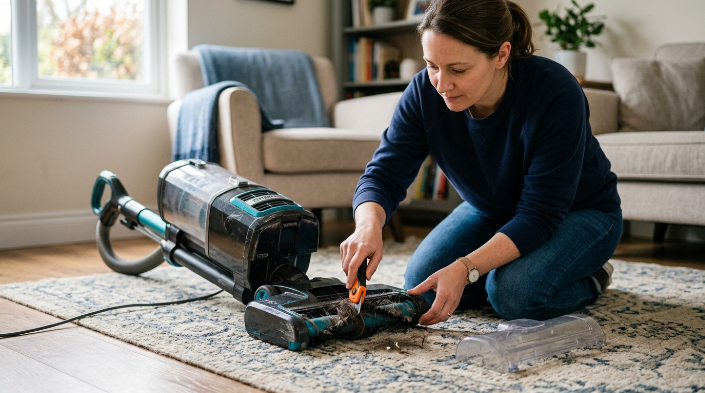
Fix it by moving from the safest external checks toward the internal mechanical ones. This avoids unnecessary disassembly and helps you identify the actual fault faster.
1. Disconnect all power
Unplug a corded machine before touching the brush roll. On a cordless vacuum, remove the battery if the manufacturer designed it to be removable.
Never rely only on the trigger or power button. Your hands will be close to a moving component.
2. Turn the floor head over and inspect it
Look across the entire roller rather than checking only the middle. Pay close attention to both ends and the narrow space between the roller and housing.
- Look for wrapped hair and string.
- Check for small objects wedged beside the roller.
- Inspect the intake opening behind the brush.
- Look for cracked, warped, or loose parts.
3. Remove wrapped debris carefully
Use the cleaning tool supplied with your vacuum when possible. Small scissors or a seam ripper can also help cut hair, but keep sharp edges away from the belt and bristles.
Cut the tangled material in several places, then pull it away gently. Don’t yank against a stuck roller.
4. Check whether the roller can move
With power disconnected, rotate the brush by hand only if your model’s design allows it. Some resistance can be normal, especially on belt-driven machines.
A roller that will not move at all may still have debris packed beneath an end cap. It can also indicate a damaged bearing or drive component.
5. Inspect the belt when accessible
If your vacuum uses a serviceable belt, open the approved cover according to the owner’s manual. Do not remove unrelated housings just to reach it.
- Broken belt: The brush usually receives no mechanical drive.
- Slipped belt: The belt may be intact but off its normal track.
- Stretched belt: The brush may turn weakly or inconsistently.
- Damaged belt: Cracks, fraying, melted areas, or severe wear suggest replacement.
6. Reassemble and test
Make sure covers, guards, rollers, and batteries are correctly installed before restoring power. Test the vacuum briefly on the correct floor setting.
If the roller works normally again, the fault was probably maintenance-related. If it still refuses to turn, continue with the drive-system checks below.
Section Takeaway: Clear debris before buying parts. A tightly wrapped roller can imitate a belt or motor failure and is one of the fastest problems to rule out.
Could a Switch or Floor Setting Be the Problem?
Yes. Some vacuum brushes remain stationary by design until you choose a carpet mode, release the handle, or activate a separate brush-roll control.
Check this before opening the machine. It takes seconds and can prevent a completely unnecessary repair.
Look for a brush-roll on/off control
Full-size vacuums sometimes include a dedicated switch for the rotating brush. Consumer vacuums may label it as brush roll, carpet, floor, or similar wording.
Brush-roll controls are useful on bare floors because a spinning brush can scatter some loose debris. The correct setting depends on your machine and floor surface.
Check handle position
Some upright designs stop the brush when the handle is fully upright. Reclining the vacuum into its normal cleaning position can activate the floor head.
If the brush spins only after the handle moves, that behavior may be normal. Check the owner’s manual before treating it as a fault.
Check floor-height adjustment
A manually adjustable floor head can behave poorly if set too low for thick carpet. The brush may face excessive resistance from the carpet pile.
Raise the setting and test again if your vacuum has this control. Never force a struggling floor head through dense carpet.
| Symptom | Likely Area | First Check | Next Action |
|---|---|---|---|
| Brush never starts | Setting or drive system | Brush switch and carpet mode | Inspect roller and belt |
| Brush turns slowly | Tangles or belt | Wrapped hair and free movement | Clear debris; inspect belt |
| Stops on thick carpet | Floor setting or overload | Height and carpet setting | Adjust per manual |
| Suction works, brush does not | Brush-drive system | Roller, belt, or powered head | Service the affected component |
| Burning smell or grinding | Mechanical or electrical fault | Stop immediately | Inspect professionally if needed |
Is the Problem a Belt or a Motorized Brush Head?

That depends on how your vacuum drives the roller. Traditional floor heads commonly use a mechanical belt, while many cordless and powered heads use an electric motor inside the nozzle.
The troubleshooting path changes once you know which design you have. Don’t assume every non-spinning brush needs a replacement belt.
Belt-driven brush roll
A belt connects the drive mechanism to the roller. When it fails, suction may remain normal because the main airflow system can still operate.
Inspect only covers the manufacturer identifies as user-serviceable. Use the exact replacement belt specified for your vacuum model.
Motorized floor head
A motorized head receives electrical power through contacts, wiring, or a connection running through the wand. These heads may not have a conventional user-replaceable belt.
First reseat every removable connection with the vacuum switched off. Check the battery charge and inspect visible contacts for debris or obvious damage.
- Reconnect the floor head firmly.
- Reconnect the wand and main body.
- Remove debris around the brush roll.
- Check for warning lights or error indicators.
- Consult the model’s manual for reset instructions.
Expert Alert: If troubleshooting requires opening a motor housing, testing live wiring, repairing circuit boards, or bypassing a safety switch, stop and use a qualified appliance repair technician.
Why this matters for cleaning performance
A rotating brush is especially useful for agitating carpet fibers and lifting embedded debris toward the suction path. If the brush stops, the vacuum may still collect loose surface dust while leaving more material behind in carpet.
The U.S. Environmental Protection Agency’s indoor particulate guidance recommends routine cleaning and notes that HEPA-filter vacuums can help keep some captured dust from escaping back into indoor air.
Section Takeaway: Identify the drive design before buying parts. A belt-driven upright and an electrically powered cordless floor head can show the same symptom for completely different reasons.
Why Does the Brush Stop Spinning During Use?
A brush that starts normally and then stops often points to increasing resistance, an overload-protection response, a loose drive component, or a problem that appears as the floor head warms up. The exact protection system varies by model.
Dense hair is building resistance
A partially tangled roller may still start when clean and cool. As more debris wraps around it, the drive system has to work harder.
Turn the vacuum off and inspect the roller instead of repeatedly restarting it. Continued use can make the original problem worse.
Thick carpet is overloading the head
Some floor heads struggle when the brush is pressed too deeply into dense carpet. A low height setting can add even more resistance.
If your model has carpet-height adjustment or power levels, use the manufacturer’s recommended setting. Never assume maximum suction is best for every carpet.
A protection system may be activating
Many modern vacuums use protective electronics or mechanical systems that can stop a brush when it jams. The reset procedure can differ widely between brands.
- Switch the vacuum off.
- Disconnect it from power.
- Remove the obstruction.
- Allow the machine to cool if the manual instructs you to do so.
- Follow the manufacturer’s reset procedure.
Check airflow problems too
A brush-roll fault and weak airflow can happen at the same time. Inspect the dust bin or bag, filters, floor-head intake, hose, and wand if pickup has also dropped.
For homes where allergens are a concern, the Asthma and Allergy Foundation of America recommends regular vacuuming with HEPA filtration as one part of dust-mite exposure control.
The CDC’s asthma guidance also lists regular HEPA-filter vacuuming among measures that can help reduce exposure to common asthma triggers such as dust mites.
That doesn’t mean repairing a brush roll will cure allergies or asthma. It simply helps the vacuum perform the floor-cleaning job it was designed to do.
Section Takeaway: A brush that stops after several seconds or minutes deserves more than repeated resets. Find the resistance, blockage, setting, or drive problem causing the shutdown.
When Should You Repair or Replace the Brush Roll?
Clean the brush first when the roller and bristles remain physically sound. Replace or professionally repair components when cleaning no longer restores smooth, reliable operation.
Cleaning is usually enough when
- The problem started after vacuuming long hair or pet fur.
- The roller becomes free after debris removal.
- The bristles remain firmly attached.
- The end caps show no obvious damage.
- The brush resumes normal operation after reassembly.
Consider replacement when
- The roller is cracked or visibly warped.
- End components remain seized after accessible debris is cleared.
- Bristles or cleaning fins are heavily damaged.
- The roller wobbles or makes persistent mechanical noise.
- The correct new belt cannot drive the roller normally.
Use your exact model number when ordering a brush roll, belt, floor head, or other replacement part. Parts that look similar are not necessarily interchangeable.
Know when to stop DIY troubleshooting
Stop using the vacuum if you notice smoke, sparks, a persistent electrical smell, melted wiring, damaged electrical contacts, or severe grinding. Disconnect power immediately.
Expert Alert: Internal motor, wiring, circuit-board, switch, and live-electrical repairs should be handled by a qualified technician unless the manufacturer explicitly provides a safe user-service procedure.
As of 2026, my preferred troubleshooting order remains simple: settings first, debris second, free roller movement third, drive system fourth. That sequence solves the easy possibilities before you spend money on parts.
Frequently Asked Questions
Can a vacuum still have suction if the brush is not spinning?
Yes. The suction motor and brush-drive system are separate on many vacuum designs. A broken belt, jammed roller, disabled brush setting, or faulty motorized floor head can stop the brush while airflow remains available.
How do I know if my vacuum belt is broken?
Disconnect the vacuum from power and inspect the belt only through the manufacturer-approved access area. A belt may need replacement if it is snapped, disconnected, badly stretched, cracked, frayed, melted, or unable to drive the roller correctly.
Why won’t my vacuum brush spin after I cleaned the hair out?
Debris may still be packed around an end cap or bearing. If the roller turns freely, check the brush control, belt, floor-head connections, and any model-specific reset procedure next.
Why does my vacuum brush spin by hand but not when powered?
If the roller moves freely by hand but receives no powered rotation, the problem is more likely in the drive system. Depending on the model, that could mean a belt, electrical connection, powered-head motor, switch, sensor, or control component.
Can thick carpet stop a vacuum brush from spinning?
Yes, some floor heads can encounter too much resistance on dense carpet, especially when the height setting is too low. Use the carpet-height, suction, or floor-mode settings recommended by your vacuum and carpet manufacturers.
Should I lubricate a vacuum brush-roll bearing?
Don’t add oil or lubricant unless your manufacturer’s maintenance instructions specifically tell you to do so. Some brush-roll bearings and bushings are sealed or designed to operate dry, and adding the wrong lubricant can attract dirt or damage components.
Is a burning smell from a stopped brush dangerous?
Treat any burning smell seriously. Turn the vacuum off, disconnect power, and inspect accessible areas for a jammed roller or damaged belt; if the smell appears electrical, persists after maintenance, or comes with smoke or melting, use professional repair service.
The main takeaway: When your vacuum brush stops spinning, don’t start by replacing the entire machine. Disconnect power, clear the roller, check the controls, inspect the drive system, and stop if the problem moves beyond safe user maintenance.
A few careful checks can often reveal whether you’re dealing with ordinary hair buildup or a part that genuinely needs repair. Once the brush spins freely again, keep it inspected so the same buildup doesn’t quietly return.
“`
