Is It Worth Repairing an Old Vacuum?

Quick Answer
Yes, an old vacuum is often worth repairing when the problem is a clog, belt, filter, hose, brush roll, or another replaceable wear part. Replacement makes more sense when the machine has repeated failures, unavailable parts, serious motor or electrical problems, or a repair quote approaching the cost of a comparable new vacuum from a current vacuum buying guide.
Repair usually makes sense when:
- Failure is minor: The problem involves a clog, belt, filter, hose, switch, or brush roll.
- Parts are available: Replacement components still exist for your exact model.
- Cleaning is good: The vacuum performed well before the current problem appeared.
- Cost stays reasonable: The repair costs substantially less than replacing the machine with an equivalent model.
- Condition is solid: The housing, cord, seals, cleaner head, and major components remain usable.
Replacement becomes more attractive when:
- The machine needs repeated repairs, has major electrical damage, or no longer fits your household cleaning needs.
I don’t automatically throw away a vacuum because it’s old. Age matters, but the failed part, repair price, overall condition, and original quality tell me much more.
A ten-minute airflow check can sometimes save a machine that looks finished. This guide shows how I decide whether an aging upright, canister, cordless, robot, or central vacuum deserves another repair.
In This Guide
How Do You Know if an Old Vacuum Is Worth Repairing?
An old vacuum is worth repairing when one affordable repair can restore dependable cleaning performance. I look at the problem first and the machine’s age second.
Repairing an old vacuum means restoring a failed or worn component so the machine can keep operating safely and effectively instead of replacing the complete appliance.
A vacuum that suddenly loses suction may not have a failing motor. A packed filter, full bag, blocked hose, or clogged cleaner head can create similar symptoms.
Start with the problem, not the birthday
Before pricing a repair, I disconnect the vacuum from power and check the parts that commonly restrict airflow. These checks require little or no disassembly.
- Bin or bag: Empty an overloaded bin or replace a full bag.
- Filter: Inspect it for heavy dirt, damage, or incorrect installation.
- Hose and wand: Look for compacted hair, paper, lint, or other blockages.
- Brush roll: Remove wrapped hair and thread that prevent free rotation.
- Cleaner head: Inspect the intake for objects restricting airflow.
I’ve seen a vacuum feel nearly useless because one dense clog was hiding inside a curved hose section. Once airflow returned, the machine didn’t need a major repair at all.
Ask whether the rest of the machine is still healthy
One worn component does not make the entire vacuum worn out. Look at the condition of the housing, wheels, cord, hose, seals, attachments, and cleaner head.
A well-built vacuum with one failed belt deserves different treatment from a machine with cracked plastic, damaged wiring, weak suction, and several previous repairs.
- Good candidate: One known fault and otherwise normal operation.
- Borderline candidate: Several aging components or recurring problems.
- Poor candidate: Structural damage, unsafe electrical symptoms, or unavailable essential parts.
Section Takeaway: A vacuum’s condition and type of failure matter more than age alone. Diagnose simple airflow and wear-part problems before assuming the machine has reached the end of its life.
Which Vacuum Problems Are Usually Worth Fixing?
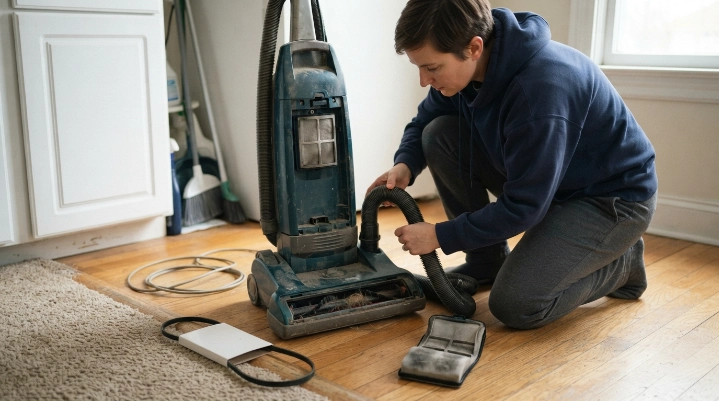
Clogs, filters, belts, brush rolls, hoses, and some switches are usually the strongest repair candidates. Motor, circuit-board, battery, and electrical failures require more careful cost comparison.
Clogged airflow
A clog is one of the best reasons to keep an older vacuum. Reduced airflow can cause weak suction, unusual noise, extra heat, and poor debris pickup.
Clear accessible hoses, wands, intakes, and cleaner heads without forcing sharp tools through flexible parts. Stop if the blockage requires opening an electrical or motor housing.
Worn or broken belt
A belt can fail while the motor still runs normally. Current 2026 repair guidance from Angi lists replacement vacuum belts at roughly $3 to $20 for the part.
A stalled brush, hot-rubber smell, or weak carpet agitation can point toward the belt. Check your exact model before ordering anything.
Dirty or damaged filter
A heavily loaded filter can restrict airflow and reduce cleaning performance. Replace damaged filters, and wash only filters that the manufacturer specifically identifies as washable.
For households managing asthma triggers, the CDC recommends regular vacuuming with a HEPA-equipped vacuum as one measure for reducing dust-mite exposure. HEPA means high-efficiency particulate air filtration.
Brush roll or hose failure
A replaceable hose, cleaner head, or brush roll can make repair worthwhile on a machine you otherwise like. Confirm that genuine or compatible parts fit your exact model number.
Wrapped hair can also imitate a failed brush assembly. Remove tangles before paying for a replacement part.
Motor, wiring, or electronics
A motor or electronic failure is not automatically a reason to discard a premium vacuum. It does make getting a proper estimate more important.
Expert Alert: Stop using the vacuum if you notice sparking, smoke, melted plastic, exposed wiring, a damaged power cord, or a sharp electrical burning smell. Have a qualified appliance repair technician inspect it rather than opening electrical components yourself.
How Much Should You Spend Repairing an Old Vacuum?

Compare the complete repair quote with the current price of a genuinely comparable replacement. A cheap repair on a good machine is easy to justify, while a major repair on a low-cost aging vacuum often is not.
As of 2026, there is no universal vacuum repair price. Labor rates, brands, parts, location, and machine design can change the final bill considerably.
| Repair situation | 2026 cost reference | How I would use the number |
|---|---|---|
| Replacement vacuum belt | About $3–$20 for the belt | Usually worth investigating before replacing the vacuum |
| Many common upright or canister repairs | Roughly $50–$150 in one 2026 repair-shop guide | Compare the actual written estimate with an equivalent new model |
| Central vacuum repair | About $129–$560 in 2026 Angi data | Treat separately because built-in systems have different labor and replacement costs |
The $50–$150 portable-vacuum range is a useful reference, not a quote for your machine. A local diagnosis can land above or below it.
Use the 50 percent rule carefully
A common repair-industry rule of thumb says to think hard about replacement when the repair approaches half the price of a comparable new vacuum. I treat that as a starting point, not an automatic cutoff.
For example, a $120 repair may make sense on a durable $500 vacuum with available parts. The same repair makes much less sense on an aging $140 vacuum with other worn components.
Compare like with like
Don’t compare your premium canister with the cheapest vacuum on a store shelf. Compare it with a new machine that offers similar floor capability, filtration, attachments, build quality, and convenience.
- Repair quote: Include parts, labor, diagnostic charges, and tax.
- Replacement price: Use the cost of an equivalent machine, not an unrelated budget model.
- Future risk: Consider whether other expensive components already show wear.
- Current satisfaction: Ask whether you still like using the vacuum.
- Warranty: Check coverage before paying for either repair or replacement.
Section Takeaway: Cost matters most when you compare the repair against the right replacement. A percentage rule helps, but condition, quality, parts support, and future reliability should make the final decision.
Does Vacuum Age, Type, and Parts Availability Matter?
Yes. Two vacuums of the same age can have completely different repair value because their construction, battery condition, replacement parts, and original price differ.
Upright and canister vacuums
Traditional uprights and canisters can be attractive repair candidates when hoses, belts, filters, brush rolls, switches, and other service parts remain available. A solid body and healthy motor strengthen the case.
These machines can also be easier to evaluate because a mechanical wear part may be clearly separate from the motor assembly.
Cordless stick vacuums
Battery condition becomes a major factor with an older cordless vacuum. A machine may clean well but deliver such short runtime that a battery replacement becomes part of the decision.
Check the manufacturer’s battery price and availability before assuming the entire vacuum needs replacing. Never open or rebuild a lithium-ion battery pack yourself.
Robot vacuums
Robot vacuums add sensors, wheels, batteries, charging contacts, electronic boards, and navigation components. A replaceable wheel or battery can be sensible, while several electronic failures can quickly change the math.
Software support matters too. An otherwise functional robot may become less useful if important app or mapping functions no longer meet your needs.
Filtration can affect the replacement decision
If dust and allergens are a priority, compare the old vacuum’s filtration and sealing with your current needs. The Asthma and Allergy Foundation of America notes that vacuuming helps control indoor allergens and recommends equipment designed to limit particles returning to the air.
That does not mean every old vacuum needs replacing. A well-sealed model with suitable filters and available replacement parts may still serve you well.
When Should You Replace an Old Vacuum Instead?
Replace an old vacuum when repair no longer offers reasonable safety, reliability, parts support, or value. Repeated failures are often more important than the calendar age printed on your receipt.
Strong signs that replacement deserves serious consideration
- Repeated breakdowns: You have repaired several unrelated components within a short period.
- Major structural damage: Cracked housings or broken connections prevent proper sealing or safe assembly.
- Parts unavailable: Critical manufacturer or compatible components can no longer be sourced reliably.
- Major repair cost: The quote approaches the cost of a comparable replacement.
- Electrical deterioration: The cord, motor, battery system, or electronics show unsafe failure symptoms.
- Poor performance remains: The vacuum still cleans badly after filters, clogs, brushes, and maintenance items are addressed.
- Your needs changed: New flooring, pets, accessibility needs, or filtration requirements make another design more suitable.
Check recalls before paying for repair
Before repairing an older model, search the U.S. Consumer Product Safety Commission vacuum recall database. A manufacturer recall may provide specific instructions or remedies that change what you should do next.
Do not continue using a recalled product unless the recall instructions say it is safe. Follow the manufacturer and CPSC remedy exactly.
Recycle rather than automatically throwing it away
If replacement wins, check local rules before putting the old vacuum in household trash. Cordless and robot models deserve extra attention because they may contain lithium-ion batteries.
The EPA electronics donation and recycling guidance recommends safe recycling and notes that lithium-ion batteries should not go into household garbage or ordinary recycling bins.
A working machine may also be reusable through donation or resale. Clean it first and disclose any known faults.
Frequently Asked Questions
Is a 10-year-old vacuum worth repairing?
It can be. A well-built 10-year-old vacuum with one replaceable failed component may be a better repair candidate than a much newer budget model with multiple problems.
Check parts availability, the repair quote, motor condition, and the price of a comparable replacement before deciding.
Is it worth replacing the motor in an old vacuum?
Motor replacement can make sense on a high-quality vacuum when the rest of the machine is in good condition and parts remain available. On a low-cost vacuum with other worn components, a major motor repair can approach replacement value too quickly.
Should I repair a vacuum that has lost suction?
Don’t assume a major repair is needed. First check the bin or bag, filter, cleaner head, wand, hose, and brush roll because airflow restrictions commonly cause weak suction.
If suction stays poor after those checks, a professional diagnosis may be worthwhile.
Is a broken vacuum belt worth repairing?
Usually, yes. A belt is generally a relatively inexpensive wear component, and 2026 cost guidance lists many replacement belts at only a few dollars to around $20 for the part.
Make sure another problem did not cause the belt to fail.
Should I repair an old cordless vacuum or buy a new one?
Check the battery first. If the vacuum still cleans well and a manufacturer-approved replacement battery is reasonably priced, replacement of the battery may extend its useful life.
Multiple electronic, motor, and battery problems make complete replacement more attractive.
Is it safe to keep using a vacuum with a burning smell?
No. Turn it off and disconnect it from power.
A hot-rubber smell can involve a jammed brush or belt, while an electrical or melting-plastic smell can indicate a more serious failure that needs professional inspection.
What is the easiest rule for repair versus replacement?
Get the actual repair cost, compare it with a similar new vacuum, and consider the condition of the remaining machine. Repair minor isolated faults; think carefully about major repairs that approach roughly half the replacement cost or come after repeated failures.
Final takeaway: An old vacuum is not automatically a bad vacuum. If one affordable repair restores a machine that still cleans well, has available parts, and remains safe to use, repairing it can be the smarter choice.
If the problems are multiplying, important parts have disappeared, or the repair bill is closing in on replacement cost, put that money toward a vacuum that better fits your home today.
“`