How Long Should a Vacuum Filter Dry?

Quick Answer
Most washable vacuum filters should air-dry for at least 24 hours, although some manufacturers recommend 24–48 hours. The filter must be completely dry before reinstalling it, so follow your model’s manual rather than relying only on the clock. For example, Dyson’s current filter-care guidance specifies at least 24 hours and a final moisture check before installation.
Before Reinstalling Your Filter
- Check the manual: Confirm that your specific filter is washable and note its stated drying time.
- Expect 24+ hours: Many washable vacuum filters require at least a full day of air-drying.
- Allow extra time: Thick foam filters or humid conditions may require closer to 48 hours.
- Check the center: The outside can feel dry while moisture remains inside thicker material.
- Use airflow: Leave the filter in an open, ventilated area rather than a closed cabinet.
- Wait if unsure: A few extra drying hours are safer than reinstalling a damp filter.
I’ve learned not to treat vacuum-filter drying as a simple countdown. A filter that looks dry after several hours can still hold moisture deep inside its foam or pleated material.
That matters for both vacuum maintenance and home hygiene. In this guide, I’ll show you how long to wait, how to test the filter, and what to do if you reinstall it too soon.
In This Guide
- How long should a vacuum filter dry before you put it back?
- How can you tell when a vacuum filter is completely dry?
- Why is using a damp vacuum filter a bad idea?
- What is the safest way to dry a washable vacuum filter?
- Do different vacuum brands give different drying times?
- What should you do if you reinstalled the filter too soon?
- Frequently Asked Questions
How long should a vacuum filter dry before you put it back?
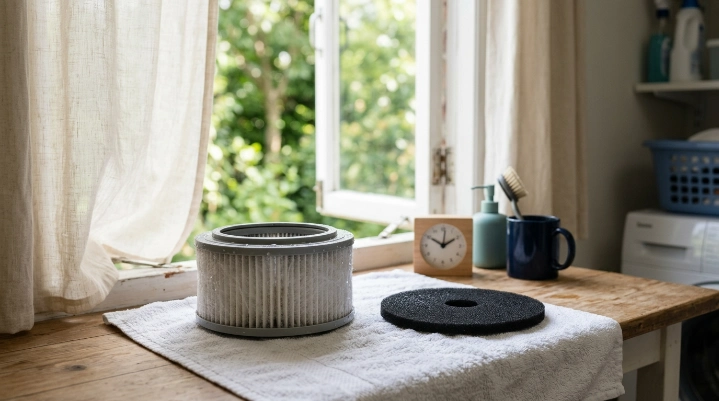
Allow at least 24 hours for many washable vacuum filters, but 24–48 hours is a safer working range when the manufacturer’s instructions allow it. Never reinstall the filter until every part feels completely dry.
The exact time changes with filter construction, room humidity, airflow, and the manufacturer’s instructions. That’s why one universal drying time doesn’t work for every vacuum.
Definition: Vacuum-filter drying is the period after a washable filter has been rinsed when moisture evaporates from the filter before it returns to the machine.
The important part is complete evaporation. The drying period isn’t finished simply because 24 hours have passed.
Is 24 hours always enough?
No. Twenty-four hours is a common minimum, not a guarantee that every filter will be dry.
Current manufacturer guidance shows that drying recommendations differ:
- Dyson: At least 24 hours for many washable cordless vacuum filters.
- Shark: Some support guidance specifies 24–48 hours.
- BISSELL: Several washable filter instructions specify 24–48 hours.
- Hoover: Some current maintenance guidance lists 24–36 hours.
Your specific owner’s manual should therefore take priority. Filters within the same brand can also have different maintenance requirements.
When should you wait closer to 48 hours?
Give the filter more time whenever it still feels cool, damp, heavy, or soft with retained moisture. Humid indoor air and limited airflow can also slow evaporation.
Thick foam deserves extra attention. I don’t trust the outside surface alone because the middle can hold moisture after the edges feel dry.
- Thick foam: Check the center carefully before reinstalling.
- Humid weather: Expect evaporation to take longer.
- Poor airflow: Move the filter to a more open location.
- Multiple filter layers: Separate them for drying when the manufacturer permits it.
When you’re choosing between using the vacuum today and giving its filter another night to dry, I recommend waiting.
How can you tell when a vacuum filter is completely dry?
A vacuum filter is ready when it has no detectable moisture on its surface or inside thicker sections. It should not feel damp, unusually cool, or heavier from retained water.
Time alone isn’t a reliable test. Check the actual filter before reinstalling it.
Use a simple touch test
Start with clean, dry hands. Feel several areas instead of touching only one exposed edge.
- Touch the outer surface. It should feel dry rather than clammy.
- Check thicker sections. Gently press foam areas where moisture can remain trapped.
- Check folds or pleats. Look around seams and recessed areas.
- Compare temperatures. A noticeably cool section can indicate continuing evaporation.
- Wait when uncertain. Give the filter several more hours and check again.
Do not squeeze delicate pleated material unless the manufacturer specifically tells you to. Some filter media can lose its shape when handled aggressively.
Look for hidden water
Inspect the filter under good light. Watch for droplets, darkened damp patches, or moisture around plastic frames.
Then turn the filter over. Water sometimes collects at the lowest edge while a filter sits drying.
A paper towel can help check a sturdy washable plastic edge or foam surface. If the towel picks up moisture, drying isn’t complete.
Section Takeaway: Don’t judge a filter by its dry-looking surface. Check thicker material, seams, edges, and recessed areas before putting it back into your vacuum.
Why is using a damp vacuum filter a bad idea?
A damp filter can restrict airflow, create odors, and expose parts of a dry vacuum to moisture they weren’t designed to handle. Manufacturers therefore consistently tell users to reinstall washable filters only after complete drying.
Moisture can also combine with the dirt remaining in a filter and create an unpleasant smell. That smell may then become noticeable whenever air moves through the machine.
A damp filter can affect airflow
Vacuum cleaners depend on controlled airflow. Air must pass through filters while the motor creates suction.
Water in porous filter material can interfere with that airflow. The machine may sound different or appear to lose suction.
- Reduced airflow: Wet material can become harder for air to pass through.
- Weak pickup: Reduced airflow can make cleaning performance seem worse.
- Extra strain: Continuing to operate an abnormal machine isn’t a good maintenance practice.
- Damp odor: Moist dust and filter material can develop an unpleasant smell.
What about mold?
Mold needs moisture to grow indoors, according to the Centers for Disease Control and Prevention. That doesn’t mean a filter automatically develops mold because it stayed damp for a few hours.
It does mean keeping washable vacuum parts persistently damp is unnecessary. Dry them thoroughly before storage or reassembly.
If controlling household particles is important to you, filter condition matters too. The U.S. Environmental Protection Agency’s HEPA guidance explains that HEPA filters are designed to capture very small airborne particles.
However, a HEPA label doesn’t automatically mean a vacuum filter is washable. Never rinse a disposable or non-washable HEPA filter unless its manufacturer explicitly permits it.
Section Takeaway: Complete drying protects airflow, reduces avoidable moisture inside the machine, and helps prevent musty filter odors. Treat “completely dry” as the requirement, not merely “dry for 24 hours.”
What is the safest way to dry a washable vacuum filter?
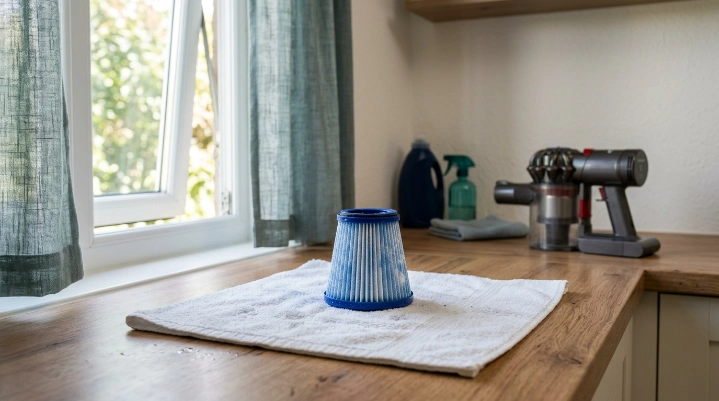
The safest general method is natural air-drying in a clean place with good ventilation. Remove excess water first, then leave plenty of space around the filter.
Always confirm that the filter is washable before starting. Some HEPA and pleated filters must be replaced rather than rinsed.
How to air-dry a vacuum filter
- Finish rinsing. Follow the manufacturer’s cleaning directions and remove remaining loose dirt.
- Remove excess water. Shake the filter gently if its instructions permit this.
- Choose an open location. Put it where room air can circulate freely.
- Position it correctly. Follow any manufacturer instruction about which side should face upward.
- Leave it undisturbed. Allow at least the stated minimum drying period.
- Inspect it again. Check the center, edges, seams, and frame for moisture.
- Reinstall only when dry. Wait longer if any section remains questionable.
Can you use a hair dryer?
I wouldn’t use direct high heat unless your vacuum manufacturer specifically allows it. Heat can deform foam, plastic frames, seals, or filter material.
The same caution applies to tumble dryers, ovens, microwaves, radiators, and open flames. Dyson, for example, specifically warns against several heated drying methods.
Can you put the filter outside in the sun?
Follow your manual before using direct sunlight. Strong heat and ultraviolet exposure aren’t necessary when ordinary moving air can dry the filter safely.
I prefer a clean indoor location near good airflow. It also keeps pollen, insects, and outdoor dust from landing on a freshly washed filter.
Should you use a fan?
Gentle room airflow can help evaporation when the filter sits nearby. Avoid forcing dirty air directly through delicate filter media.
For households concerned about dust allergens, the Asthma and Allergy Foundation of America also recommends HEPA-filter vacuums as one part of reducing exposure to dust-mite material.
Keeping the vacuum’s filters clean, correctly installed, and maintained helps the machine work as intended.
Section Takeaway: Air-dry washable filters naturally, provide good ventilation, and avoid aggressive heat. Reinstall the filter only after a physical moisture check confirms it’s dry.
Do different vacuum brands give different drying times?
Yes. Current manufacturer support pages show drying recommendations ranging from at least 24 hours to 24–48 hours, depending on the brand and filter.
As of 2026, these examples illustrate why checking your own vacuum instructions matters:
| Brand | Example Current Guidance | Key Requirement |
|---|---|---|
| Dyson | At least 24 hours | Filter must be completely dry |
| Shark | 24–48 hours on some cordless guidance | Air-dry before reinserting |
| BISSELL | 24–48 hours on several washable filters | Completely air-dry before reinstalling |
| Hoover | 24–36 hours in current FAQ guidance | Allow full drying after rinsing |
These figures are examples, not universal specifications for every product made by each company. Your model’s maintenance manual remains the deciding source.
Does filter type change drying time?
It can. Thickness, density, shape, and the amount of water retained all influence evaporation.
- Foam pre-filter: May retain water deep inside its thickness.
- Washable pleated filter: Moisture can remain between pleats and around the frame.
- Multi-layer filter: Internal layers may dry slower than exposed surfaces.
- Non-washable filter: Should not be rinsed simply because another filter in the same vacuum is washable.
Never identify washability based only on appearance. Two similar-looking vacuum filters can have different care instructions.
What should you do if you reinstalled the filter too soon?
If you realize the filter was still damp, stop using the vacuum and disconnect it from power. Remove the filter and let it finish drying according to the manufacturer’s instructions.
Don’t continue vacuuming simply to see whether airflow will dry it. The filter should dry outside the machine.
If you only ran the vacuum briefly
Turn it off and remove the damp filter. Inspect accessible filter compartments for visible moisture without opening sealed electrical components.
Let washable removable parts dry separately. Do not operate the vacuum again until required components are completely dry.
If the vacuum now smells musty
Remove the filter and inspect washable components for retained moisture or dirty residue. Wash them again only when their care instructions allow it.
Persistent dampness should be addressed rather than masked with fragrance. The goal is to remove the moisture source.
If the vacuum makes unusual noises or stops working
Switch it off immediately. Check only the user-serviceable items listed in the manual, such as the filter, bin, hose, and visible blockages.
Expert Alert: If moisture may have reached the motor or electrical components, or the vacuum smells burnt, sparks, trips power, or will not operate normally, stop using it and contact the manufacturer or a qualified appliance repair technician. Do not open or repair energized electrical components yourself.
For broader household dust control, the National Institutes of Health’s healthier-home guidance recommends regular vacuuming with HEPA filtration when possible.
A properly maintained filter supports that cleaning routine. A wet, damaged, incorrectly fitted, or clogged filter does not.
Frequently Asked Questions
Can a vacuum filter dry in less than 24 hours?
It may feel dry sooner, especially if it’s thin and airflow is good. However, if your manufacturer specifies at least 24 hours, follow that minimum even when the surface feels dry.
Can I leave a vacuum filter drying for 48 hours?
Yes, for washable filters that are meant to air-dry, giving them additional drying time is normally preferable to reinstalling them damp. Some Shark and BISSELL guidance specifically calls for 24–48 hours.
Can I put a slightly damp filter back in my vacuum?
No. Wait until the filter is completely dry. A slightly damp surface can indicate more moisture remains inside the filter material, and manufacturers commonly require complete drying before reinstallation.
How do I make my vacuum filter dry faster?
Remove excess water as directed and place the filter in a clean area with good airflow. Avoid ovens, tumble dryers, microwaves, open flames, and other high-heat methods unless your manufacturer explicitly approves them.
Can I wash every HEPA vacuum filter?
No. HEPA describes filtration performance, not whether a filter can be washed. Some HEPA filters are washable, while others must remain dry and be replaced when dirty.
Why does my vacuum filter still smell after drying?
Residual dirt, pet debris, moisture, or contamination elsewhere in the vacuum may cause the smell. Inspect the bin and other washable parts, and follow the manufacturer’s cleaning instructions before assuming the filter alone is responsible.
Should a vacuum filter feel cool after drying?
A cool area can sometimes indicate ongoing evaporation, especially when the surrounding filter feels warmer. If one section seems unusually cool or damp, give it more drying time before reinstalling it.
The safest rule is simple: don’t reinstall a washable vacuum filter because the timer says it’s ready. Reinstall it when you’ve met the manufacturer’s minimum drying time and confirmed that the entire filter is completely dry.
For many vacuums, that means at least 24 hours. In slower-drying conditions or with manufacturer guidance that allows for it, expect 24–48 hours before your vacuum is ready to use again.
“`