Can You Wash a HEPA Vacuum Filter?

Quick Answer
Yes, you can wash a HEPA vacuum filter only when the vacuum manufacturer specifically labels that filter as washable or reusable. A HEPA rating describes filtration performance, not whether water is safe for the filter, so check your manual before rinsing it and review the EPA explanation of HEPA filtration if you want to understand what the term means.
Before You Wash the Filter
- Check the manual: Look for the words “washable,” “rinseable,” or specific cleaning instructions.
- Identify the filter: Foam pre-filters and HEPA exhaust filters may need completely different care.
- Avoid guessing: A dirty white pleated filter is not automatically safe to rinse.
- Skip detergents: Do not add soap or cleaning chemicals unless the manufacturer explicitly permits them.
- Dry completely: Never reinstall a washable filter while any moisture remains.
Safest Rule
- If the manual does not clearly say the HEPA filter is washable, treat it as non-washable and follow the replacement instructions instead.
If your vacuum’s HEPA filter looks gray, dusty, or clogged, putting it under the faucet can seem like the obvious fix. I’ve found that the safer question is not how dirty the filter looks, but whether that exact filter was designed to get wet.
In this guide, I’ll show you how to identify a washable HEPA vacuum filter, clean one safely, avoid common mistakes, and decide when replacement makes more sense.
In This Guide
- Can You Wash a HEPA Vacuum Filter Safely?
- How Do You Know if a HEPA Vacuum Filter Is Washable?
- How Do You Wash a Washable HEPA Vacuum Filter?
- What Happens if You Wash a Non-Washable HEPA Filter?
- HEPA vs Foam vs Pre-Filters: Which Can Be Washed?
- How Often Should You Clean or Replace a Vacuum Filter?
- Frequently Asked Questions
Can You Wash a HEPA Vacuum Filter Safely?
You can safely wash some HEPA vacuum filters, but only filters specifically designed for water cleaning. Disposable or non-washable HEPA filters should stay dry unless their manufacturer says otherwise.
HEPA stands for high efficiency particulate air. It describes a type of high-efficiency particle filtration rather than a cleaning method.
Definition: A HEPA filter is a pleated mechanical air filter designed to capture extremely small airborne particles. The U.S. EPA defines HEPA filtration as theoretically removing at least 99.97% of particles measuring 0.3 microns.
That definition tells you how the filter performs. It does not tell you whether its fibers, frame, adhesive, seals, or supporting material can withstand rinsing.
This distinction matters because a filter can still look normal after an incorrect wash. Damage inside the pleated media may not be easy to see.
- Washable HEPA filter: Built by the manufacturer to tolerate an approved rinsing process.
- Non-washable HEPA filter: Intended for dry maintenance or replacement.
- Foam pre-filter: Often washable, but still model-dependent.
- Mesh or cyclone screen: May be washable or wipeable depending on the vacuum design.
Good filtration also depends on more than the filter media. Air must pass through the filter rather than leaking around gaps in the vacuum body.
The Asthma and Allergy Foundation of America discusses indoor air quality and controlling airborne triggers, which is one reason proper vacuum filtration and maintenance matter in homes managing dust and allergens.
As of 2026, my rule remains simple: HEPA does not automatically mean washable. The manufacturer’s instructions decide.
How Do You Know if a HEPA Vacuum Filter Is Washable?
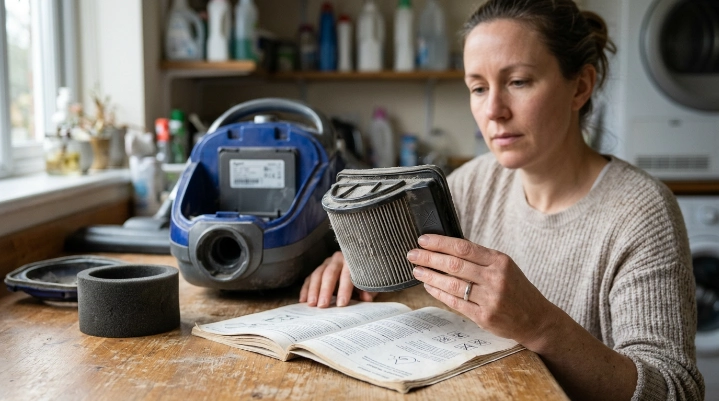
Check the vacuum manual, filter label, or official manufacturer instructions for an explicit washable designation. Do not rely on appearance alone.
My first check is always the wording around the filter compartment. A molded water symbol or the word “washable” is much stronger evidence than a product description saying only “HEPA.”
Look for these signs
- “Washable” or “rinseable” wording on the filter or filter housing.
- Water-cleaning instructions in the owner’s manual.
- A specified drying procedure before reinstallation.
- A reusable-filter description on the manufacturer’s support page.
- The exact filter part number matching the instructions you found.
Be careful when a vacuum contains several filters. A manufacturer may allow you to rinse one foam filter while requiring replacement of the pleated HEPA exhaust filter.
The two filters can sit only inches apart. Their care instructions can still be completely different.
What if the manual is missing?
Find your vacuum’s model number first. It is often printed on a rating label underneath the machine, behind the dust bin, or near the battery compartment.
Then search the manufacturer’s official support information using that exact model. Avoid assuming instructions for a similar-looking vacuum apply to yours.
How Do You Wash a Washable HEPA Vacuum Filter?

If your manual confirms the HEPA filter is washable, remove it with the vacuum unplugged, rinse it as directed, and let it dry completely before reinstalling it. Do not improvise with cleaners or heat.
The manufacturer’s directions always take priority. The steps below are a conservative general method for filters that are explicitly approved for rinsing.
- Switch off and unplug the vacuum. For a cordless model, remove the battery if the manual instructs you to do so.
- Remove the filter carefully. Hold it over a trash container so loose dust does not spread across the room.
- Remove loose debris as instructed. Do not beat, scrape, or aggressively brush delicate pleats.
- Rinse only if approved. Use the water temperature and direction specified by the manufacturer.
- Skip soap unless permitted. Detergent residue can remain in porous filter material.
- Let excess water drain naturally. Avoid wringing, twisting, or crushing pleated media.
- Air-dry the filter completely. Follow the manual’s drying time and do not reinstall it while damp.
Why complete drying matters
A damp filter restricts normal airflow differently from a dry one. Moisture also does not belong near a vacuum’s motor or electrical components.
Some manuals specify a minimum drying period, while others simply require complete air drying. Treat the manufacturer’s stated time as a minimum rather than rushing the process.
- Do not use a hair dryer unless the manufacturer explicitly allows it.
- Do not place the filter in an oven or microwave.
- Do not reinstall a filter that feels cool or damp inside the pleats.
- Do not run the vacuum without required filters just because the washed filter is drying.
I prefer planning filter cleaning when I do not need the vacuum again that day. That removes the temptation to put a slightly damp filter back into the machine.
What Happens if You Wash a Non-Washable HEPA Filter?
Washing a non-washable HEPA filter can damage its filter media, supporting structure, seals, or shape. That can interfere with airflow and particle capture even when the damage is not obvious.
A pleated filter depends on both its material and its physical structure. Water can affect components that were intended to stay dry.
Possible problems after an incorrect wash
- Distorted pleats: Bent or collapsed pleats can change airflow through the filter.
- Damaged media: Rubbing, rinsing pressure, or handling may weaken delicate filter material.
- Loose seals: Water can affect some adhesives, frames, or bonded edges.
- Persistent moisture: Dense pleats may remain damp inside after the outside feels dry.
- Poor fit: A warped frame may no longer seal correctly in the filter compartment.
Do not judge a washed filter only by its color. A bright-looking filter is not necessarily a properly functioning filter.
If you accidentally washed a filter labeled non-washable, the conservative choice is replacement. Use the exact filter specified for your vacuum model.
You should also inspect the filter compartment for moisture before installing the replacement. Keep the vacuum off until the compartment is fully dry.
HEPA vs Foam vs Pre-Filters: Which Can Be Washed?
Washability depends on the filter’s construction and the manufacturer’s design, not simply its location in the vacuum. Foam filters are often washable, while pleated HEPA filters vary widely.
| Filter Type | Typical Job | Can It Be Washed? | Key Rule |
|---|---|---|---|
| Washable HEPA | Captures fine particles in approved HEPA filtration systems | Yes, when explicitly labeled washable | Follow the exact rinse and drying instructions |
| Disposable HEPA | Fine-particle filtration | No, unless the manufacturer states otherwise | Replace according to the manual |
| Foam filter | Often catches larger debris before another filter or the motor | Often washable, but model-dependent | Confirm in the vacuum manual |
| Mesh or screen pre-filter | Separates hair and larger dust | Frequently cleanable, depending on design | Use only the approved cleaning method |
The HEPA benchmark itself is specific: EPA describes HEPA filtration as at least 99.97% efficient for 0.3-micron particles under the definition it cites. A vacuum’s real-world containment also depends on its housing, seals, airflow path, and overall design.
That distinction is worth remembering when shopping. A vacuum containing a HEPA filter is not automatically identical to a well-sealed system that directs exhaust through that filter.
Research indexed by the National Library of Medicine has compared conventional and filtered vacuum cleaners while measuring airborne house-dust-mite allergen. The results reinforce why the whole vacuum system matters, not just a label on one component.
The CDC’s filtration guidance also emphasizes proper filter fit and maintaining filters within their recommended service life. Although that guidance focuses on ventilation systems, the basic filtration principle is useful: air needs to pass through correctly fitted filter media.
How Often Should You Clean or Replace a Vacuum Filter?
There is no universal cleaning or replacement interval for every HEPA vacuum filter. Follow your manufacturer’s schedule and shorten inspections when the vacuum handles unusually heavy dust, pet hair, or fine debris.
Usage varies too much for one number to fit every home. A vacuum used twice a month in a small apartment does not load its filters like one used daily in a home with several shedding pets.
Check the filter when you notice these signs
- Reduced suction: First rule out a full bin, full bag, tangled brush roll, or blocked hose.
- Visible heavy loading: Dust is packed across the filter surface or deep into accessible pleats.
- Unusual odor: A persistent dusty or musty smell deserves inspection.
- Longer cleaning time: The vacuum needs repeated passes where one or two usually worked.
- Filter damage: Tears, cracks, warped frames, or damaged seals usually call for replacement.
- Service indicator: Some vacuums provide a filter warning based on their own system.
A dirty filter is not the only cause of weak airflow. Check the dust bin, bag, hose, wand, intake passages, and brush roll before assuming the HEPA filter is responsible.
Likewise, washable does not mean permanent. Repeated use, handling, and normal aging can eventually make replacement necessary.
For households dealing with allergies, dust, or pet dander, filter maintenance should be part of the entire cleaning routine. Keeping the vacuum sealed, unclogged, and correctly assembled matters just as much as keeping the filter clean.
Frequently Asked Questions
Can I rinse any HEPA vacuum filter with water?
No. Only rinse a HEPA vacuum filter when the manufacturer specifically says that exact filter is washable or rinseable. If the manual describes it as replaceable or gives no water-cleaning instructions, keep it dry and follow the recommended replacement procedure.
Can I wash a HEPA vacuum filter with soap?
Do not use soap unless your vacuum manufacturer specifically tells you to. Detergent can leave residue in porous filter media, while scrubbing can damage delicate pleats or supporting material.
How long should a washable HEPA filter dry?
Follow the drying period in your vacuum’s manual and wait until the filter is completely dry throughout. Do not rely only on the surface feeling dry, because moisture can remain deeper inside pleated material.
Can I put a damp HEPA filter back in my vacuum?
No. A washable filter should be completely dry before reinstallation. Moisture can interfere with airflow and should not be introduced near the vacuum’s motor, battery, wiring, or other electrical components.
Can I vacuum dust off a non-washable HEPA filter?
Only if the manufacturer lists vacuuming as an approved maintenance method. Some delicate filters are intended to be replaced rather than cleaned aggressively, so using another vacuum or brush without instructions can damage the filter media.
Does washing a HEPA filter make it work like new?
Not necessarily. Washing removes permitted dirt from filters designed for rinsing, but it does not reverse normal aging or physical damage. Replace a washable filter when the manufacturer recommends it or when its frame, seals, or filter media become damaged.
Are all foam vacuum filters washable?
No. Foam filters are commonly designed for washing, but that is not universal. Check the instructions for your exact vacuum model because foam pre-filters, motor filters, and combination filter assemblies can have different maintenance requirements.
The takeaway is simple: you can wash a HEPA vacuum filter only when the manufacturer says that specific filter is washable.
Check the label and manual before adding water, use only the approved cleaning method, and let the filter dry completely. When washability is uncertain, replacement is the safer choice.