
How to Vacuum Without Spreading Dust: A Cleaner, Safer Method

Quick Answer
To vacuum without spreading dust, start with a clean, well-maintained vacuum that controls exhaust air. Work slowly from higher surfaces toward the floor, avoid aggressive sweeping, and empty the vacuum carefully. The EPA’s indoor particulate matter guidance also recommends HEPA-filtered vacuuming to help reduce indoor dust buildup.
Quick steps
- 1. Check the vacuum: Start with a clean filter, empty bag or bin, secure hose, and correctly fitted attachments.
- 2. Clean high first: Vacuum shelves, furniture, baseboards, and other raised surfaces before doing the floor.
- 3. Move slowly: Use controlled, overlapping passes instead of pushing the floor head rapidly through dusty areas.
- 4. Watch the exhaust: Stop if you see dust blowing from the vacuum, connections, bag compartment, or exhaust area.
- 5. Empty carefully: Handle dusty bags and bins gently, preferably away from the main living area.
- 6. Finish damp: Wipe suitable hard surfaces with a damp microfiber cloth after loose dust has been captured.
One extra precaution
- If someone in the home has asthma or strong dust allergies, keep them away from the room while you vacuum.
Vacuuming should remove dust, but the wrong technique can send part of it back into the room. I pay almost as much attention to airflow, filtration, and cleaning order as I do to suction.
This guide explains how to vacuum without spreading dust through carpets, hard floors, furniture, and the surrounding air. It also covers HEPA filtration, vacuum maintenance, allergens, and the mistakes that create those frustrating dust clouds.
In This Guide
- Why Does Vacuuming Spread Dust Around the Room?
- What Vacuum Setup Helps Keep Dust From Escaping?
- How Do You Vacuum Without Spreading Dust Step by Step?
- How Should You Vacuum Different Surfaces?
- What Vacuuming Mistakes Spread More Dust?
- Can an Air Purifier Help While You Vacuum?
- Frequently Asked Questions
Why Does Vacuuming Spread Dust Around the Room?
Vacuuming can spread dust when floor movement disturbs settled particles or when collected dust escapes through the machine. Poor filtration, clogged filters, leaking seals, and careless emptying can all contribute.
Vacuuming without spreading dust means capturing settled debris while limiting how much of that material becomes airborne again.
Dust can become airborne before it reaches the vacuum
A floor head moves air as it travels. Your feet, brush roll, hose, and vacuum body also disturb particles lying nearby.
This matters most with fine household dust. Light particles can lift into the air before the nozzle captures them.
- Fast passes: Rapid movement can push or disturb loose dust.
- Dry sweeping: A broom may lift fine particles before vacuuming begins.
- Heavy foot traffic: Walking repeatedly through the area can disturb settled material.
- Dusting afterward: Cleaning shelves after the floor lets more dust fall onto the freshly vacuumed area.
The vacuum itself can be part of the problem
A vacuum draws dusty air into the machine and must release filtered air somewhere. The filtration system controls what happens before that exhaust returns to the room.
The EPA defines a HEPA filter as a high-efficiency particulate air filter capable of capturing at least 99.97% of particles measuring 0.3 microns under its defined test conditions.
That rating applies to the filter media. It does not automatically mean every vacuum containing a HEPA filter has perfectly sealed airflow.
I check the filter compartment, hose connection, bin, bag, and exhaust whenever I notice unusual dusty smells or visible particles. A good filter cannot help much if air is bypassing it through another opening.
Section Takeaway: Dust control starts before the nozzle touches the floor. Slow movement, good filtration, sealed airflow, and the right cleaning order all help reduce recirculation.
What Vacuum Setup Helps Keep Dust From Escaping?
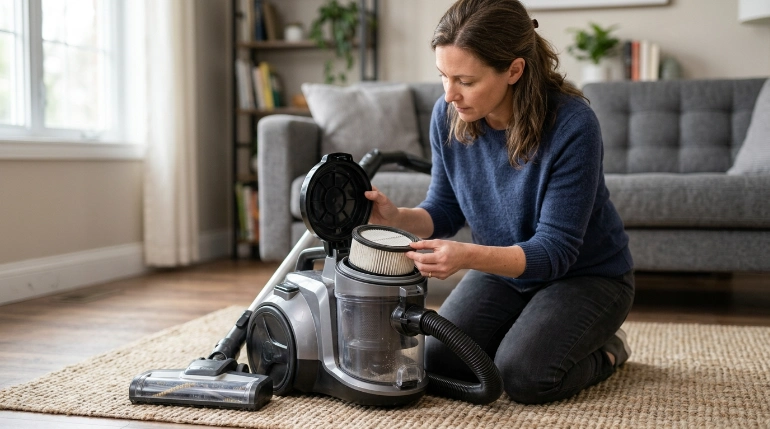
A well-sealed vacuum with appropriate filtration is the better choice when dust containment matters. HEPA filtration is especially useful when household allergens or fine particles are a concern.
I also look at how the vacuum stores debris. The cleanest filtration system can still create a dust cloud if the bin is dumped carelessly indoors.
| Cleaning Setup | Filtration / Containment | Best Use | Main Dust Concern |
|---|---|---|---|
| Sealed HEPA bagged vacuum | HEPA filter media is rated at 99.97% capture at 0.3 µm under the HEPA definition | Homes where dust containment is a priority | Performance still depends on seals, bag fit, and maintenance |
| Sealed HEPA bagless vacuum | Can provide strong filtration when the complete air path is properly sealed | Routine floors, rugs, furniture, and pet debris | Dust may escape while emptying the bin |
| Standard filtered vacuum | Performance varies by model; no HEPA-level performance should be assumed | Ordinary visible household debris | Fine particles may pass through or leak around the system |
| Dry broom before vacuuming | No filtration | Large debris when necessary | Fine settled dust can be stirred into the air |
Bagged or bagless?
Either design can work well when filtration and sealing are good. The practical difference appears when you dispose of the collected dirt.
A bag keeps much of the debris enclosed during removal. A bagless bin requires more care because pouring or shaking its contents can release fine dust.
Maintenance matters as much as the filter label
A loaded filter restricts airflow. Damaged seals, loose hoses, overfilled bags, and packed bins can also reduce normal vacuum performance.
Before a dusty cleaning session, I check these five areas:
- The collection bag or dustbin
- The main filter and any pre-filter
- The hose and attachment connections
- The brush roll and air passages
- The filter cover and visible seals
The CDC’s asthma-control guidance recommends regular vacuuming with a HEPA-equipped vacuum as one measure for reducing exposure to dust-mite triggers.
How Do You Vacuum Without Spreading Dust Step by Step?
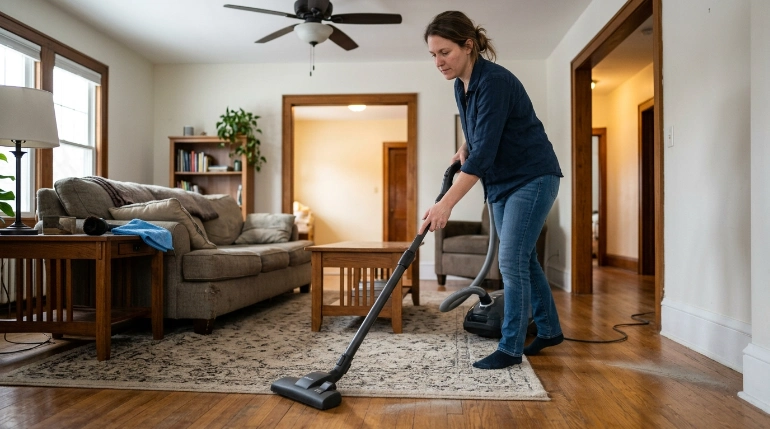
The simplest method is to work from high to low, use slow passes, and avoid disturbing more dust than your vacuum can immediately capture. Finish by handling the collected debris carefully.
Before you start vacuuming
- Remove large objects. Pick up toys, paper, cables, and anything that blocks smooth vacuum passes.
- Check the vacuum. Empty an overly full bin or replace a full bag, then inspect the filter according to the manufacturer’s instructions.
- Turn off strong fans. Avoid directing unnecessary airflow across dusty floors while you clean.
- Vacuum higher surfaces first. Use a suitable soft-brush or upholstery attachment on shelves, furniture, vents, and accessible ledges.
The high-to-low order saves work. Dust that falls from a shelf lands on a floor you have not cleaned yet.
While you vacuum the floor
- Begin at the far side. Work toward the doorway so you do not repeatedly walk across finished areas.
- Make slow passes. Give the nozzle time to pull loose material into the airflow.
- Overlap slightly. Cover a small part of the previous pass instead of leaving narrow dusty strips.
- Clean edges separately. Use a crevice tool along baseboards, corners, furniture legs, and other dust traps.
- Watch for escaping dust. Stop if the exhaust, hose, or body produces an obvious dust plume.
I resist the urge to race over a dusty floor twice. One controlled pass followed by a careful inspection is easier to manage.
After vacuuming
- Let disturbed particles settle. Check the room again instead of assuming one pass captured everything.
- Damp-wipe suitable surfaces. Use a lightly damp microfiber cloth on washable hard surfaces to collect remaining film.
- Handle the debris gently. Remove bags carefully or empty bagless bins away from the main living space when practical.
- Wash your hands. Do this after handling dusty bags, bins, filters, and attachments.
The Asthma and Allergy Foundation of America also recommends HEPA-filtered vacuuming for dust-mite control, while noting that vacuuming alone cannot remove every mite or allergen reservoir.
Section Takeaway: The most useful change is often technique, not stronger suction. Clean high to low, move slowly, overlap passes, and avoid creating a new dust cloud when you empty the machine.
How Should You Vacuum Different Surfaces?
The same dust-control principles work throughout the house, but the attachment and technique should match the surface. Carpet needs a different approach from hardwood or upholstery.
Hard floors
Use a hard-floor head or a manufacturer-approved setting that will not scratch the finish. Move slowly around baseboards because fine dust often collects along room edges.
After vacuuming, damp mop only if the flooring manufacturer allows it. Avoid excessive water on wood, laminate, and other moisture-sensitive surfaces.
Carpet and rugs
Carpet can hold particles below the visible surface. Make controlled passes and change direction when the carpet needs a more thorough clean.
Do not aggressively shake dusty rugs indoors first. That defeats the purpose by releasing settled debris into the surrounding air.
Upholstery
Use an upholstery tool on cushions, seams, chair backs, and fabric-covered furniture. A crevice attachment helps around cushion gaps.
Dust mites and their allergens can collect in upholstered furniture and bedding. AAFA notes that vacuuming helps but cannot remove everything living deep within these materials.
Baseboards, shelves, and corners
A soft dusting brush works well on many raised surfaces. Use a crevice tool for narrow edges where a full floor head cannot reach.
These areas matter because leftover dust can fall back onto the floor later. That often creates the impression that the floor became dusty again immediately.
What Vacuuming Mistakes Spread More Dust?
The most common problem is disturbing dust faster than you capture it. Poor vacuum maintenance can make the situation worse.
- Vacuuming too fast: Quick strokes can disturb loose particles before the nozzle collects them.
- Dry sweeping first: Sweeping fine dust can throw it back into the air.
- Using a clogged filter: Restricted airflow can reduce normal pickup performance.
- Ignoring leaks: Loose connections or damaged seals can allow dusty air to bypass the intended path.
- Overfilling the bin: Waiting too long to empty the vacuum can interfere with airflow on some machines.
- Dumping dust indoors: Shaking a bagless bin into a kitchen trash can may undo part of your cleaning.
- Dusting after the floor: Debris from furniture and ledges simply lands on your cleaned surface.
- Cleaning around sensitive people: Vacuuming can temporarily stir particles that bother people with asthma or allergies.
The EPA notes that people with asthma or allergies may benefit from leaving the area while vacuuming because the activity can stir dust. Keeping sensitive household members out of the immediate cleaning area is a simple precaution.
*Expert Alert: Ordinary household dust is different from potentially hazardous renovation material. If you suspect lead dust, asbestos-containing material, extensive mold contamination, or another hazardous substance, stop routine DIY cleaning and contact a qualified professional for appropriate assessment and cleanup.*
Can an Air Purifier Help While You Vacuum?
Yes, an appropriately sized air purifier can help capture some particles that remain airborne. It should support good vacuuming and source removal rather than replace them.
A vacuum handles material on carpets, floors, and furniture. An air purifier deals with particles suspended in the air passing through the purifier.
The EPA explains that portable air cleaners and HVAC filters can reduce indoor air pollution, but they cannot remove every pollutant.
Where CADR fits in
CADR means clean air delivery rate. It describes how quickly a portable air cleaner delivers filtered air for specific particle categories under its test system.
I would not choose an air purifier only because the box says HEPA. Room size and CADR also matter when comparing units for particle removal.
An air purifier can be especially useful as part of a broader dust-control routine:
- Vacuum settled debris with suitable filtration.
- Damp-wipe washable hard surfaces.
- Reduce unnecessary dust reservoirs.
- Maintain HVAC and portable-air-cleaner filters as directed.
- Control indoor humidity where dust mites are a concern.
For dust-mite management, AAFA recommends keeping indoor humidity between roughly 30% and 50% along with cleaning measures. Humidity control, bedding care, and vacuuming work together rather than as competing solutions.
Section Takeaway: An air purifier can capture some airborne particles, but it cannot vacuum your carpet or remove dust sitting on furniture. Source cleaning remains the first job.
Frequently Asked Questions
Why does my room look dustier after vacuuming?
You may have disturbed settled particles, used a vacuum with poor filtration, or left dust on higher surfaces. Check the filter, seals, exhaust, and bin, then clean from high to low using slower passes.
Is a HEPA vacuum better for dust?
A properly designed HEPA-equipped vacuum can improve fine-particle containment. However, a HEPA filter alone does not guarantee that the complete vacuum is sealed, so whole-machine design and maintenance still matter.
Should I dust or vacuum first?
Clean higher surfaces before the floor. Vacuum or wipe shelves, furniture, ledges, and baseboards first so loosened debris falls onto flooring that still needs cleaning.
Should I open the windows while vacuuming?
It depends on outdoor conditions. Ventilation can dilute some indoor pollutants, but open windows may also bring in pollen, smoke, or outdoor dust, so consider local outdoor air conditions before ventilating.
How do I empty a bagless vacuum without making dust?
Carry the bin carefully and empty it away from the main living area when practical. Lower it into the waste container before releasing the debris, avoid shaking it aggressively, and follow the manufacturer’s cleaning instructions.
Can vacuuming remove dust mites completely?
No. Vacuuming can remove some mite material and allergens from surfaces, but dust mites can remain deep in mattresses, upholstered furniture, pillows, and carpets. Bedding care and humidity control may also be needed.
How often should I vacuum for dust control?
The right schedule depends on occupants, pets, flooring, outdoor dust, and allergy concerns. Homes that collect visible dust quickly may need more frequent cleaning than low-traffic homes with mostly hard flooring.
Final takeaway: If your vacuum seems to spread dust, do not assume you need more suction. Start by checking filtration, airflow, seals, cleaning order, speed, and how you empty the machine.
For my own routine, I keep it simple: clean high surfaces first, vacuum slowly toward the exit, finish suitable hard surfaces with a damp cloth, and deal with the collected dust carefully. Those habits make routine home cleaning far more controlled.