
How to Vacuum With Allergies: A Safer Step-by-Step Routine

Quick Answer
To vacuum with allergies, use a well-filtered vacuum, work slowly, avoid stirring up extra dust, and clean the highest-allergen areas first. If vacuuming triggers your symptoms, the Asthma and Allergy Foundation of America advises wearing an N95 mask or having someone else vacuum when possible.
Quick allergy-friendly vacuuming steps
- Prepare first: Pick up clutter and damp-dust hard surfaces before starting the vacuum.
- Use good filtration: Choose a vacuum with a HEPA filter or the highest-efficiency filtration your machine supports.
- Protect yourself: Wear a well-fitting N95 if dust commonly triggers your symptoms.
- Vacuum slowly: Make controlled passes instead of racing across carpets and rugs.
- Target soft surfaces: Pay attention to carpets, rugs, upholstery, and other places where household dust collects.
- Leave afterward: If you’re sensitive to stirred-up dust, stay out of the cleaned room for at least 20 to 30 minutes.
One important rule
- Vacuuming helps remove settled allergens, but it isn’t a substitute for managing the source of an allergy or following medical advice.
I used to treat vacuuming as a simple race through the house. That approach changed once I noticed how much dust could hang in the air after an aggressive cleaning session.
Now I use a slower routine aimed at collecting dust without spreading more of it. This guide explains how to vacuum with allergies, what vacuum features matter, and which cleaning habits help keep household allergens under better control.
In This Guide
- Why can vacuuming make allergies feel worse?
- How should you prepare before vacuuming with allergies?
- How do you vacuum with allergies step by step?
- Which vacuum features matter most for allergies?
- Where and how often should you vacuum?
- What vacuuming mistakes should allergy sufferers avoid?
- Frequently asked questions
Why Can Vacuuming Make Allergies Feel Worse?
Vacuuming can temporarily disturb settled dust before the machine captures it. Fine particles may also escape from a poorly filtered or leaking vacuum.
That explains a problem I noticed in my own cleaning routine. The floor looked better, yet I sometimes felt like the room was dustier for a short time afterward.
Definition: Allergy-friendly vacuuming is a cleaning method designed to collect settled allergens while limiting how much dust becomes airborne during the process.
What is hiding in ordinary household dust?
Household dust isn’t one single substance. Its makeup changes from one home and room to another.
- Pollen: Outdoor pollen can enter through doors, windows, clothes, shoes, and pets.
- Pet allergens: Proteins from skin flakes, saliva, and other pet material can settle into furniture and flooring.
- Dust mite material: Dust mite allergens often collect in mattresses, bedding, carpets, and upholstered items.
- Mold spores: Spores can settle with ordinary dust when a moisture or mold problem exists.
- Fine debris: Soil, fibers, skin particles, and other small material can build up on indoor surfaces.
The U.S. Environmental Protection Agency notes that vacuuming can disturb particles while cleaning. It also recommends considering a vacuum with HEPA filtration to reduce dust buildup.
You can read the EPA’s guidance on indoor particulate matter and household dust for more detail.
Why does the vacuum itself matter?
A vacuum pulls dirty air through its cleaning path. That air eventually has to leave the machine again.
The filter and the way the machine contains airflow therefore matter. I pay attention to filtration instead of judging a vacuum only by how strongly it pulls at the carpet.
- Good filtration helps capture fine particles carried through the machine.
- Good seals help direct dirty air through the intended filter path.
- A full bin or bag may reduce normal airflow on some machines.
- A clogged filter can hurt performance and should be serviced according to the manual.
Section Takeaway: Vacuuming can help remove settled allergens, but the cleaning process can also disturb dust. Your technique and the vacuum’s filtration both matter.
How Should You Prepare Before Vacuuming With Allergies?
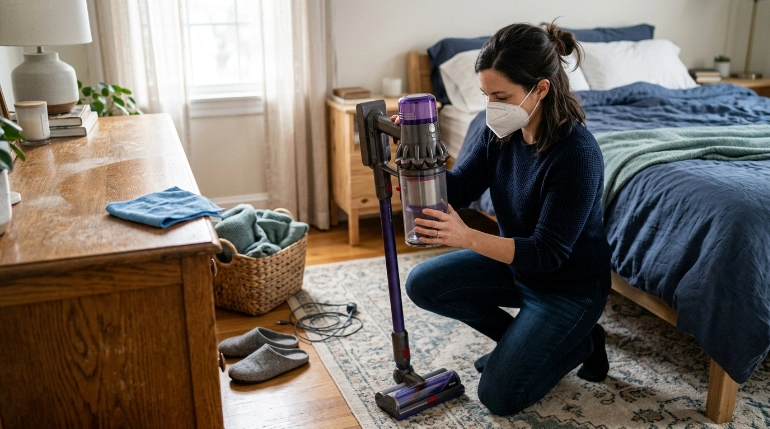
Prepare the room before you switch on the vacuum. This reduces unnecessary movement and keeps you from repeatedly disturbing dusty areas.
Should you dust before or after vacuuming?
I prefer to remove dust from higher hard surfaces first with a damp or dust-trapping cloth. Then I vacuum whatever falls toward the floor.
A dry feather duster can throw fine dust back into the room. A slightly damp microfiber cloth usually gives me more control.
- Pick up toys, clothes, cables, and other floor clutter.
- Damp-dust shelves, tables, and other hard surfaces.
- Give disturbed dust a little time to settle if needed.
- Check that the vacuum bin, bag, filter, hose, and floor head are ready.
- Put on a mask before cleaning if vacuuming tends to trigger your allergies.
Should you wear a mask while vacuuming?
If you’re sensitive to airborne dust, a well-fitting N95 can reduce what you inhale while cleaning. AAFA specifically recommends this when a person with dust mite allergy has to vacuum or dust.
If another household member without the allergy can vacuum, that can reduce your direct exposure. The EPA also advises people with asthma or allergies to avoid the area being vacuumed when practical.
Should you run an air purifier while vacuuming?
A portable air cleaner can reduce some airborne particles, but it doesn’t replace surface cleaning. The EPA explains that air cleaners and HVAC filters cannot remove every indoor pollutant.
If I use a purifier, I treat it as a supporting tool rather than my main cleaning method. See the EPA’s overview of air cleaners and air filters in the home.
How Do You Vacuum With Allergies Step by Step?
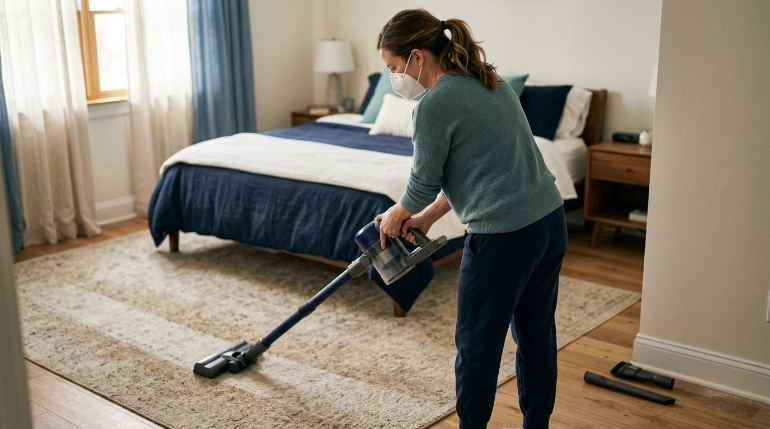
The best routine is controlled and repeatable. I get better results when I stop trying to finish the room as fast as possible.
1. Start with a clean, correctly installed filter
Check the vacuum manual before washing, cleaning, or replacing any filter. Some filters are washable, while others can be damaged by water.
HEPA stands for high-efficiency particulate air. The EPA defines a HEPA filter as a pleated mechanical filter designed to capture at least 99.97% of particles measuring 0.3 microns under its specified test conditions.
You can check the EPA’s HEPA filter explanation if you’re comparing filter terminology.
2. Begin at the cleanest practical area
I avoid dragging a dirty floor head through already cleaned spaces. In a bedroom, I might start around open flooring before moving to the dustier edges and under furniture.
Use a crevice tool along places where visible dust gathers:
- Baseboards
- Room corners
- Under furniture edges
- Around bed frames
- Along carpet-to-wall seams
3. Make slow, overlapping passes
A fast sweep can miss embedded debris. Move the floor head at a controlled pace and overlap the previous path.
On carpet, I normally make a pass in one direction and then cover stubborn areas from another angle. I don’t keep grinding the same spot once debris stops coming up.
4. Use the correct tool on upholstery
Sofas, upholstered chairs, and fabric headboards can hold dust and pet material. Use an upholstery attachment or manufacturer-approved powered tool.
Work over seams, folds, and areas where people or pets spend the most time. Check cushions individually when the furniture design allows it.
5. Handle the bin or bag carefully
Emptying a bagless bin can create another dust cloud. I prefer to empty mine outdoors when the vacuum manufacturer allows that routine.
With a bagged machine, remove and seal the bag as directed by the manufacturer. Don’t squeeze a dusty bag to make extra room.
6. Leave the room if cleaning has stirred up dust
AAFA notes that vacuuming and dusting can stir up dust. Its dust mite guidance recommends staying out of the room for at least 20 to 30 minutes after cleaning.
This is one of the simplest changes I made. I finish the bedroom, leave it alone, and work elsewhere instead of immediately spending time in the freshly disturbed space.
Section Takeaway: Slow passes, correct attachments, careful disposal, and time away from the freshly vacuumed room form a practical allergy-conscious routine.
Which Vacuum Features Matter Most for Allergies?
Start with filtration and containment rather than flashy accessories. A powerful motor doesn’t help much if fine dust escapes through weak filtration or gaps.
| Vacuum Feature | Why It Matters | What I Check | Allergy Consideration |
|---|---|---|---|
| HEPA filtration | Designed to capture fine particles from exhaust airflow | Clear HEPA specification and correct replacement filter | Useful when fine dust and allergens are a priority |
| Sealed airflow path | Helps direct dirty air through the intended filtration system | Manufacturer claims about whole-machine or sealed filtration | Helps avoid relying on the filter alone |
| Bagged collection | Debris stays inside a removable bag | Self-sealing or easy-to-close replacement bags | Can make disposal less dusty |
| Bagless collection | No replacement dust bag is needed | Simple bin release and washable parts where allowed | Emptying may expose you to collected dust |
| Upholstery tool | Reaches fabric surfaces where allergens can settle | Easy-to-clean nozzle sized for furniture | Useful for beds, sofas, chairs, and pet areas |
| Brush-roll control | Lets the cleaner adapt to different floors | On/off control or an appropriate hard-floor setting | May reduce debris scattering on suitable hard floors |
Is HEPA always necessary?
The EPA recommends considering HEPA filtration when controlling household dust. For someone specifically shopping around allergies, I put proper filtration high on the list.
I also check the complete vacuum design. A filter can’t capture air that bypasses it through another exhaust path.
Is a bagged vacuum better for allergies?
A good bagged vacuum has one practical advantage: you usually don’t have to pour loose collected dust from an open bin. That can make disposal easier for a sensitive user.
Bagless models can still have effective filtration. The tradeoff is that I need to be more careful while emptying and cleaning the dust container.
What about robot vacuums?
A robot vacuum can help prevent visible debris from building up between deeper cleaning sessions. I view it as maintenance rather than a complete allergy-control plan.
Check the robot’s filter, dust-bin design, floor compatibility, and maintenance needs. Don’t assume every small filter marketed with allergy language meets a true HEPA standard.
Where and How Often Should You Vacuum?
AAFA recommends vacuuming once or twice a week as part of indoor allergen control. Your home may need a different schedule based on pets, flooring, traffic, and your allergy triggers.
I focus frequency on the areas that collect dust fastest instead of vacuuming every room equally.
Which areas deserve the most attention?
- Bedroom floors: Dust mite exposure is an important concern around sleeping areas.
- Carpets and rugs: Fibers can hold settled dust below the visible surface.
- Upholstered furniture: Sofas and chairs collect dust, crumbs, skin material, and pet allergens.
- Pet areas: Beds and favorite resting spots can collect fur and dander quickly.
- Entry areas: Shoes and outdoor traffic can bring soil and pollen inside.
- Edges and corners: Air movement can push lightweight debris toward walls and furniture.
How should you vacuum carpet when you have allergies?
Use slow overlapping passes and avoid aggressive movements that visibly throw debris. Empty or replace the collection container before airflow becomes restricted.
The AAFA recommends vacuuming regularly as part of a broader plan to control indoor allergens. Vacuuming alone won’t eliminate every dust mite or allergen source.
How should you vacuum hard floors?
Use the hard-floor setting recommended for your vacuum and flooring type. A spinning brush that throws fine crumbs behind you isn’t helping.
I inspect the floor head before each session. A small stone trapped in a wheel or brush can also scratch some finished floors.
Should you vacuum mattresses?
A mattress can contain dust and dust mite allergens, but vacuuming isn’t a complete dust mite solution. Allergen-proof covers and appropriate bedding care may also be part of a broader control plan.
Research indexed by the National Library of Medicine has found that repeated vacuum cleaning can reduce some mattress or household dust mite allergen reservoirs, although vacuuming doesn’t eliminate living mites. See the PubMed-indexed vacuum cleaning study for one example.
Section Takeaway: Spend most of your effort where dust and allergens collect. Regular, targeted vacuuming is usually more useful than occasional frantic whole-house cleaning.
What Vacuuming Mistakes Should Allergy Sufferers Avoid?
Most problems I see come from technique or maintenance rather than lack of suction. Small changes can make the routine cleaner and easier.
Don’t empty a dusty bin beside your freshly cleaned floor
The vacuum may have collected the debris successfully. Opening the bin indoors can put part of that dust back into your surroundings.
If your manual allows it, empty the container into an outdoor trash receptacle. Keep your face away from the opening and avoid shaking the bin.
Don’t wash a filter unless the manufacturer says you can
Some vacuum filters are washable. Others lose performance or become damaged when soaked.
Always follow the filter’s care instructions. A washable filter should also be fully dry before reinstalling it.
Don’t ignore leaks, odd smells, or damaged seals
A torn hose, poorly seated filter, damaged gasket, or cracked dust container deserves attention. Continuing to vacuum may reduce normal cleaning performance.
Stop and inspect the machine according to its manual. Replace damaged parts with compatible components.
Don’t dry-scrub visible mold with a household vacuum
Ordinary allergy cleaning is different from mold remediation. A visible moisture or mold problem requires control of the moisture source, not just collection of loose surface dust.
Expert Alert: If you find extensive mold growth, recurring moisture damage, contaminated building materials, or a problem beyond a small surface area, contact a qualified mold or moisture-remediation professional instead of treating a household vacuum as the solution.
Don’t expect vacuuming to treat an allergy
Vacuuming is an exposure-control measure. It doesn’t diagnose an allergy, replace prescribed treatment, or guarantee that symptoms will improve.
If cleaning repeatedly causes wheezing, significant shortness of breath, or other concerning reactions, speak with a qualified healthcare professional about your symptoms and cleaning environment.
Frequently Asked Questions
Should I vacuum if I have dust allergies?
Yes, regular vacuuming can help remove settled household dust. Use good filtration and avoid unnecessary dust exposure while cleaning. If vacuuming triggers symptoms, consider having someone else do it or wear a well-fitting N95 and leave the room afterward.
What kind of vacuum is best for allergies?
Look for effective particulate filtration, a well-contained airflow path, and a dust-disposal system you can handle cleanly. A true HEPA filter is a useful feature. Bagged designs may also make disposal less dusty for some users.
How often should allergy sufferers vacuum?
AAFA recommends vacuuming once or twice a week for indoor allergen control. Homes with pets, heavy carpeting, high foot traffic, or fast dust buildup may need more frequent cleaning in specific areas.
Should I wear a mask while vacuuming?
If dust tends to trigger your allergies, a well-fitting N95 can reduce direct exposure during vacuuming. AAFA recommends an N95 when people with dust mite allergy must dust or vacuum themselves.
How long should I stay out of a room after vacuuming?
AAFA’s dust mite guidance says to stay out of the room for at least 20 to 30 minutes after dusting or vacuuming. This gives stirred-up dust time to settle or be removed from the air.
Does a HEPA vacuum remove all allergens?
No. HEPA filtration can help capture fine particles passing through the filter, but no vacuum removes every allergen source. Dust mites, pet allergens, pollen, moisture problems, bedding, and airborne particles may require other control measures too.
Is vacuuming or using an air purifier better for allergies?
They do different jobs. Vacuuming removes settled debris from floors and fabrics, while an air purifier filters particles suspended in room air. Neither method should be treated as a complete substitute for controlling the allergen source.
The simplest routine is also the one I can repeat: prepare the room, use good filtration, vacuum slowly, target dust-holding surfaces, dispose of debris carefully, and give the room time to settle afterward.
As of 2026, that’s the approach I would start with before buying extra cleaning gadgets. A careful routine with a properly maintained vacuum can do more for household dust control than rushing through the room with an unsuitable machine.